
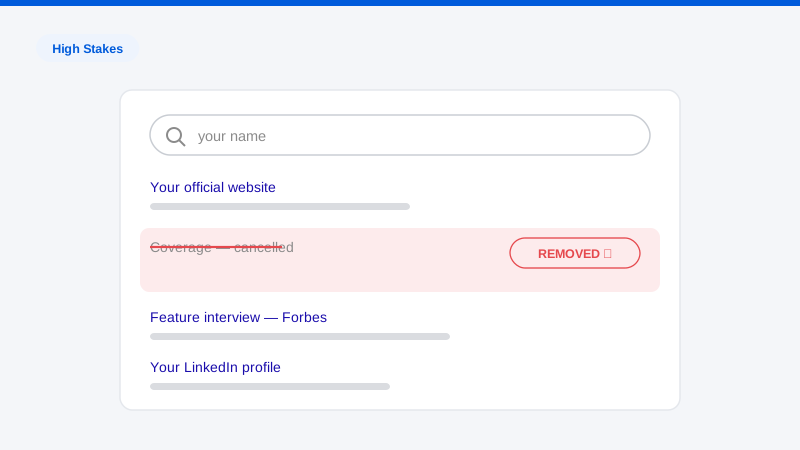
Reputation management after being cancelled is the systematic repair of a search footprint that has been overwritten, usually within days, by coverage and commentary from the peak of a public pile-on. Cancellation is not a legal event or even, strictly, a media event; it is an indexing event. In the space of a week, the accumulated record of a career is displaced by outrage-cycle content: viral posts, aggregation articles, reaction videos, screenshot threads, and commentary about the commentary. Then the crowd moves on, and the content stays exactly where the crowd left it, at the top of your name, indefinitely.
This is the defining cruelty of the mechanism: the intensity is temporary, the residue is permanent. Whatever the underlying incident was (a genuine lapse, a misunderstood remark, a decade-old resurfaced post, an accusation later complicated or withdrawn) the web’s record of it is written almost entirely during the seventy-two hours when accuracy mattered least and velocity mattered most. Corrections, context, apologies accepted, facts that emerged later: none of it was interesting enough to rank. The search page freezes at peak outrage.
For executives, founders, professionals, and public figures, this frozen page becomes the operating constraint on everything that follows: board seats, funding, employment, partnerships, speaking, even personal life. This guide explains the mechanics of the pile-on and its residue, why AI answers make the freeze worse, what a staged professional recovery actually involves, and why removal-first specialists, not apology tours or content blitzes alone, are what changes the record. Content Removal LLC is not a law firm; where legal remedies are relevant we coordinate alongside counsel.
The mechanics of a pile-on, and why the residue outlives the outrage
Cancellation events follow a recognizable structure, and understanding it explains why the aftermath looks the way it does.
Ignition and acceleration. An originating post or story finds an audience primed to amplify it. Within hours, aggregation accounts and outlets repackage it, each repackaging a new indexable URL. Commentary breeds commentary; screenshots detach the incident from context; the subject’s name trends, and trending is itself covered. Critically, almost every durable artifact of the event is created in this window, by authors optimizing for velocity and alignment with the crowd, not accuracy.
Peak and collapse. Attention peaks fast and collapses fast: the crowd’s energy moves to the next event. But collapse of attention is not collapse of content. The articles, threads, and videos remain, now enriched by exactly the signals search engines reward: a burst of links, engagement, and freshness that establishes them as the authoritative pages about you.
The freeze. In the months after, anyone searching your name finds the pile-on era ranked above your entire prior record. The event coverage has more links and engagement than anything else ever written about you, because outrage generates linking behavior that ordinary professional life never does. Without intervention, the ranking is self-perpetuating: the pages rank because they were clicked, and are clicked because they rank.
The AI freeze is worse. Search engines at least present a list a reader can weigh. AI assistants synthesize, and they synthesize the corpus as the pile-on left it. Ask a model about a cancelled person and it composes a confident biographical summary in which the incident features as a defining fact, often stated in the flattened, worst-version form the aggregation layer produced. Recruiters, journalists, investors, and event organizers increasingly get this synthesis as their first impression. The worst week of your life becomes the machine’s standing answer to who you are.
Key takeaway: A pile-on writes your permanent record during the hours when the least careful authors have the most motivation. Attention collapses in days; the content it produced ranks for years, and AI answers repeat it as biography.
What the frozen search page actually costs
The stakes here are mechanisms, not abstractions.
Every gatekeeper searches. Board nomination committees, LP diligence teams, corporate partners, conference programmers, journalists writing unrelated stories, prospective employers of your spouse and children, each encounters the frozen page or the AI summary of it. Most will never mention it; they simply decline, pass, or choose someone else. The cost of a cancelled footprint is almost entirely invisible: opportunities that quietly do not arrive.
Screening systems flag mechanically. Adverse-media checks used in finance, executive hiring, and vendor onboarding surface the coverage without context or resolution. A “controversy” flag in an automated report does not distinguish between a career-defining scandal and a misconstrued remark from years ago.
The record contaminates the future. Any new coverage of you (a company announcement, a deal, a philanthropy story) gives journalists a reason to search your name, find the frozen page, and append the incident as background. Untreated, the cancellation becomes a paragraph in every future story, each retelling refreshing its ranking signals.
Satellite content compounds. Around the core coverage accretes a belt of lower-quality material: defamatory embellishments that assert things the original coverage never did, scraped copies on content farms, forum threads that continued after the facts changed, and data-broker profiles that exposed your address and family during the week strangers were angriest at you. This belt is often more damaging than the press layer, and far more tractable.
Find out what your name returns now, search and AI both.Free confidential Exposure Scan, live results on a 15-minute call, covered by strict confidentiality.
Book Your Confidential ScanTimeline dynamics: why recovery is staged, not launched
The single most common mistake after a cancellation is acting at the wrong intensity at the wrong time. Recovery has phases, and each phase has different physics.
During the storm: do almost nothing in public. Engagement while the pile-on is live feeds it. Every response is new material, every deletion is a screenshot, every defense recruits new participants. The productive work in this window is private: documenting everything (the false assertions, the doxxing, the threats. Some of it will matter to counsel later), beginning monitoring, and addressing only the clearly unlawful layer: doxxing, threats, impersonation, and fabricated content, which platforms will act on even mid-storm.
Months one through six: the quiet containment phase. Attention has moved on; the work begins. The satellite belt is mapped and pursued, defamatory posts that exceed any factual basis, scraped mirrors, content-farm copies, forum threads violating platform rules, data-broker exposure. Where the originating claims were false, legal-remedy tracks proceed alongside counsel. Publisher outreach on the core coverage is generally premature, but the documentation for it (what later proved false, what was corrected, what was withdrawn) is assembled now.
Months six through eighteen: repair of the record. With distance, options open. Coverage that was wrong or is now demonstrably incomplete can be taken to publishers under correction and outdated-content standards: professionally, with evidence, one editor at a time. De-indexing avenues become viable for content meeting their criteria, and the affirmative record is built in earnest: substantive professional activity, credible press assets, authoritative profiles: real material, published at a measured cadence, giving search engines and AI systems something current and true to weigh against the frozen week. A sudden synthetic content blitz reads as manipulation to both audiences and algorithms; a staged, genuine record reads as a life that continued.
Beyond: maintenance. Anniversary resurfacings, new-context retellings, and copycat reposts are ordinary. Standing protection and monitoring keep the repaired record from silently eroding.
Key takeaway: Recovery is sequenced: silence and documentation during the storm, removal of the unlawful and low-quality belt in the quiet months, publisher repair and affirmative rebuilding with distance. Done out of order, each step makes the next harder.
What professional protection looks like
A professional engagement after a cancellation is removal-first and runs four coordinated workstreams.
Forensic mapping. Everything indexed under your name is inventoried and classified: core press, aggregation copies, commentary, forum threads, video content, screenshots hosted out of context, data-broker records, and the current state of AI-assistant answers about you. Each item is graded for harm, visibility, and tractability. Most clients discover the majority of their damage lives in the tractable middle, not the untouchable top press layer they assumed was the whole problem.
Source-level removal. The heart of the work: platform legal processes for defamatory and policy-violating content; systematic pursuit of scraped and mirrored copies (removing an original while forty mirrors persist achieves little, so syndication is traced to its edges); unlawfully published private material handled under the strongest applicable policies; data-broker suppression with recurring re-clearance; and, where warranted, coordination with defamation counsel on the items that merit legal instruments. Removal is preferred to suppression at every decision point, because removed content cannot resurface, be cited, or be re-synthesized by the next AI training run.
The affirmative record, built honestly. Press assets and profile infrastructure that reflect who you verifiably are, built at the cadence and quality that earns durable ranking rather than triggering manipulation signals. This is where coordination with a communications team, if you have one, is closest: they generate the legitimate new material; we ensure the record it enters is clean enough for it to rank.
AI-answer remediation and monitoring. Deliberate work on what the assistants say (which follows from the underlying corpus, which is why removal precedes it) plus continuous monitoring of search, social, forums, and AI answers so resurfacings are caught at hours old, not months.
Why specialists beat DIY and PR alone
DIY after a cancellation reliably deepens the damage. Self-filed removal requests get denied and logged, making later professional requests harder. Public self-defense re-ignites attention. Deletions get screenshotted as consciousness of guilt, and the emotional reality matters: the person at the center of a pile-on is the least equipped to make cold sequencing decisions about it.
PR alone, meanwhile, addresses the narrative but not the record. A communications firm can craft the comeback story and place it, genuinely valuable in the later phases. But no placement removes the defamatory thread, clears the screening databases, deletes the mirrors, or changes what the AI answer synthesizes from a corpus still dominated by outrage-week content. Suppression-style “bury it” campaigns fail in the AI era for a structural reason: assistants read the whole corpus, not just page one. Content that still exists still gets synthesized. Only removal changes what the machine can say.
The specialist discipline is the combination: platform legal fluency, publisher-standards fluency, syndication tracing, broker-suppression mechanics, AI-answer remediation, and, above all, the sequencing judgment about what to do in which month. That judgment is the difference between a recovery and a second cycle.
The pile-on ended. The record it left is still working against you.Book a free, confidential Exposure Scan: 15 minutes, live results, strict confidentiality, no obligation.
Book Your Confidential ScanWhy clients call Content Removal
Content Removal LLC is the firm executives, founders, professionals, and the family offices behind them call when a public pile-on has frozen into a permanent record. The work is removal-first and source-level: takedowns, publisher corrections, de-indexing, mirror pursuit, broker suppression, AI-answer remediation, sequenced by practitioners who have managed this exact aftermath and executed with complete discretion, because the last thing a recovery needs is coverage of the recovery.
We coordinate alongside defamation counsel and communications teams where they are engaged; we are not a law firm and we do not do apology strategy. We are also plainly honest about limits: high-authority press coverage of a real event is often unremovable, no outcome is guaranteed, and anyone promising to erase a cancellation is lying to a person who has already been hurt enough. What we commit to is the full map, professional execution against everything legitimately addressable, an honest tractability call on every item before you spend a dollar on it, and standing protection so the ground you regain stays yours.
Frequently asked questions
Can coverage from the incident itself actually be removed?
Sometimes: and honesty requires precision about when. High-authority press accurately reporting a real event is rarely removable, and we say so upfront. But cancellation footprints are mostly not that: they are aggregation copies, embellished retellings that crossed into defamation, scraped mirrors, policy-violating threads, and out-of-context screenshot hosts, categories with genuine removal paths, and where the underlying claims were false, corrected, or later withdrawn, even core coverage becomes approachable through publisher standards with documentation. The audit tells you which is which before you commit to anything.
How long does recovery take?
Think in quarters, not weeks. The unlawful and low-quality belt typically shows movement in the first months; publisher repair and de-indexing unfold over six to eighteen; the affirmative record accrues authority on the same horizon; AI answers lag the corpus and shift as it does. We will not promise dates or outcomes (the timelines belong to platforms, publishers, and crawlers, not to us) but we will give you an item-level view of expected sequence and tractability from the first assessment.
The accusation against me was false and later fell apart. Does that change what’s possible?
Substantially. Falsity, especially documented falsity, opens doors that are closed for accurate coverage: defamation-based platform processes, stronger publisher correction and unpublishing arguments, de-indexing criteria for misleading content, and legal instruments your counsel may pursue, with which our work runs in parallel. The frustrating reality is that the collapse of an accusation gets a fraction of the distribution the accusation got; the encouraging one is that it converts your file from a management problem into a removal problem. Bring the documentation to the first call.
Should I publish my side of the story first?
Almost never first: and this is where sequencing discipline earns its keep. A rebuttal published into a hostile or indifferent information environment either re-ignites attention or sinks unread, and it hands the pile-on’s remnants fresh material either way. The order that works is: clean the record, build the affirmative base, then (if a statement still serves you, in coordination with your communications advisors) publish into an environment where it can actually rank and be received. Many clients find that once the record is repaired, the statement is no longer necessary.
If a public pile-on has left your name frozen at its worst moment, the way back starts with an accurate picture of the residue. Book a free, confidential Exposure Scan: a 15-minute call, live results across search and AI answers, under strict confidentiality. The crowd stopped looking long ago. It is time the record stopped talking.