

Ultra high net worth reputation protection treats exposure as asset protection: continuous AI-led monitoring for impersonation, synthetic media and search indexing, legal analysis that identifies removable content fast, and technical execution that de-indexes, suppresses and contains damage before it hardens. Threats arrive as chain reactions across fraud, commercial attack and personal exposure, so defense runs as one workflow.
Key facts
- A 2020 UK survey found 41% of people view wealthy elites more negatively when no online information exists.
- Kobre and Kim advise forensic readiness: evidence, logs and verification material assembled before an attack.
- Sequence: preserve evidence, map jurisdiction and host, file targeted notices, de-index in parallel, publish accurate content.
- Firms promising universal removal success or offering only messaging should be excluded.
Where ContentRemoval.com comes in. ContentRemoval.com runs the hybrid model this guide describes for principals and their family offices: legal analysis, proprietary takedown processes, AI-driven monitoring, de-indexing and reupload prevention under restricted, need-to-know handling. The family office head, general counsel or personal chief of staff usually makes contact, often before anything has broken. A free 15-minute Exposure Scan maps where the attack surface is widest and what is removable, and the report is theirs to keep. Get a Free, Confidential Exposure Scan or read how our reputation management work is done.
You don’t usually call a reputation advisory firm when life is calm.
You call when a banker forwards a screenshot of a search result you’ve never seen, when an associate receives a voice note that sounds exactly like you, or when a family member asks why a reporter knows where the children go to school. At your level, reputational exposure rarely arrives as one neat legal issue. It arrives as a chain reaction. A leak becomes a rumor. A rumor becomes search visibility. Search visibility becomes diligence friction, lender concern, internal anxiety, and physical security risk.
That’s why ultra high net worth reputation protection has to be treated like asset protection. Not branding. Not generic PR. Not a vanity exercise.
For ultra-high-net-worth clients, privacy is no longer passive. It’s operational. You need monitoring that catches signals early, legal analysis that identifies removable content fast, and technical execution that can de-index, suppress, and contain damage before it hardens into a permanent narrative.
The New Reality of UHNW Vulnerability
At 6:12 a.m., your general counsel flags a fabricated article. By 6:40, a synthetic voice message using your tone is circulating to staff. Before breakfast, a counterparty asks for reassurance that the story is false.
That is how exposure works at your level. It does not arrive as a single press problem. It arrives as a coordinated pressure event across search, social platforms, private messaging, email, and internal communications.
The immediate risk is not embarrassment. It is interruption. A false claim can stall a financing, trigger diligence questions, unsettle employees, and invite copycat attacks. AI has made that cycle faster and cheaper for the attacker. Deepfakes, cloned voices, spoofed domains, and highly believable whaling messages now sit in the same threat stream as defamatory posts and leaked personal data.
We see the same mistake repeatedly. Families hire a PR firm to shape a narrative or a law firm to send letters after damage is visible. That split model is too slow for modern attacks. You need one operating model that combines AI-driven monitoring, legal review, and technical takedown execution from the start. If a fake story is indexed, a fraudulent account is active, and your name is being used in a voice clone campaign, those issues must be handled in parallel, not one by one.
A private profile does not solve this.
Your exposure often sits in old property records, staff contact details, family associations, archived bios, donor listings, board pages, court data, and brokered personal information. Those fragments are enough to build a believable impersonation or to give false reporting just enough texture to spread. If your footprint has not been mapped recently, start with a clear review of how data brokers expose executive and family privacy.
The right posture is operational and disciplined. Monitor continuously for impersonation, synthetic media, search indexing, and unusual mention patterns. Pre-approve legal and technical escalation paths. Remove exposed data where possible. Build a takedown process that can move within hours, not days.
If you wait for certainty, you lose time. In reputation defense, speed is not optics. It is control.
The UHNW Threat Matrix
Your controller gets a voice note that sounds exactly like you. It references a real meeting, uses the right names, and asks for a document before a wire goes out. At the same time, a fake article appears on a low-quality site, then starts showing up in search results just as a lender begins diligence. That is how UHNW attacks work now. Coordinated, believable, and timed for pressure.
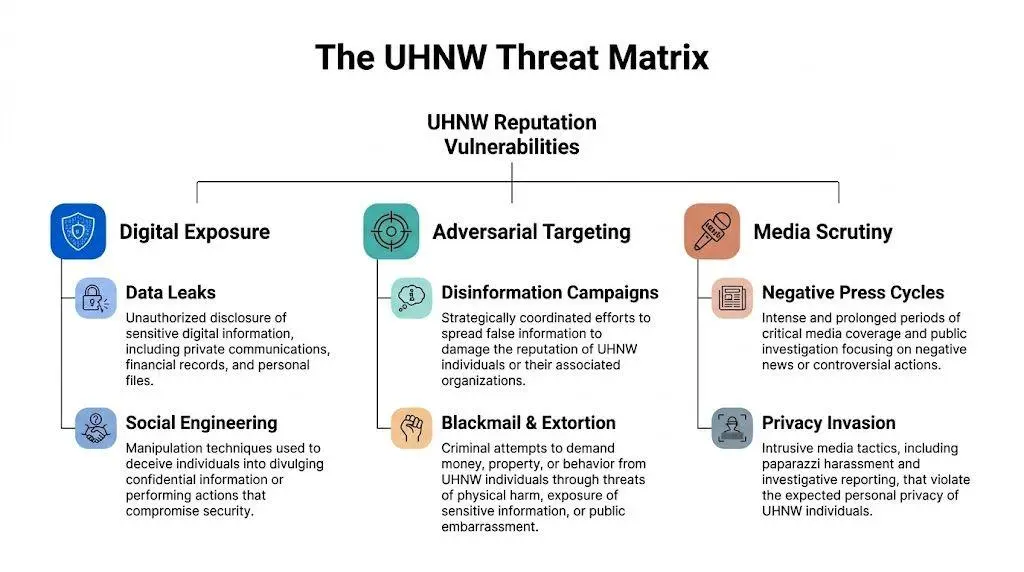
Traditional PR cannot stop that sequence. A law firm alone cannot catch it early enough. You need a hybrid defense model that combines AI-led monitoring, legal review, and technical takedown execution in one workflow. Modern attackers already use automation, synthetic media, spoofed domains, and scraped personal data. Your defense has to match that speed.
Financial targeting
The first risk is fraud built on familiarity. The attacker does not need to break your systems if they can imitate your habits, your internal hierarchy, or your urgency well enough to bypass judgment.
That is why whaling attacks have changed. The message may come from a lookalike domain, a compromised account, a cloned voice, or a text that mirrors your travel schedule and writing style. It may ask for a board deck, a passport copy, a banking confirmation, or a last-minute payment approval. Each request looks routine in isolation. The pattern only becomes obvious if someone is watching across channels in real time.
The reputational damage starts after the transfer or disclosure. Family offices question process. Banks ask harder questions. Counterparties read internal confusion as weak control.
Adversarial pressure
A hostile actor may be a competitor, former insider, estranged partner, activist group, or litigant. Their goal is not always to prove a case. It is often to create enough doubt, noise, or delay to change your commercial position.
Common tactics include:
- Planted falsehoods: Stories posted on obscure sites, then pushed through burner accounts, email tips, and coordinated reposting.
- Timed release: Harmful or misleading material published during financing, litigation, board review, or a transaction.
- Search manipulation: Content structured to appear in diligence results before verified reporting does.
- Synthetic evidence: Edited audio, fabricated screenshots, or deepfake clips designed to force a response before verification.
- Public pressure campaigns: Coordinated harassment meant to provoke panic, silence, or concession. If that pattern is already underway, review these professional content removal options for tactical online shaming attacks.
A believable fragment released at the right moment can do real damage.
Personal and political exposure
At your level, privacy failures become security failures. A child’s school, a residence held through an entity, a household staff member’s profile, a donor listing, and a vacation photo can be combined into a working map of your family.
That map has several uses. Criminals use it for extortion, impersonation, and physical targeting. Activists use it for pressure campaigns. Journalists and litigants use it to connect names, assets, and relationships faster than your team can respond. AI systems make that assembly process cheaper and faster, which means small fragments now carry more risk than they did a few years ago.
Political and ideological targeting adds another layer. An attack can be designed to make you difficult to partner with, expensive to defend, or too controversial to back publicly. At that point, reputation is tied directly to access, mobility, and deal certainty.
Here is the practical matrix:
| Threat type | What the attacker wants | What you must prevent |
|---|---|---|
| Financial fraud | Unauthorized transfer, disclosure, or access | Trust abuse inside your team and family office |
| Commercial attack | Deal disruption or negotiating leverage | False or harmful material gaining traction in search and diligence |
| Personal exposure | Access to family, schedules, homes, or routines | Identity, location, and asset linkage |
| Political misinformation | Isolation, pressure, or reputational cost | Narrative capture before verification and response |
Treat these threats as one operating problem. The same actor can spoof your voice, register a lookalike domain, push a false story into search, and scrape family data for added credibility. Separate advisors working in sequence will lose time. Integrated monitoring, rapid legal escalation, and technical removal action give you a better chance of containing the attack before it becomes the story.
Proactive Defense and Digital Privacy Hygiene
The instinct to disappear is understandable. It’s also often wrong.
A 2020 UK survey found that 41% of people would view wealthy elites more negatively if no relevant online information exists. The same source notes that reputation comprises 30-40% of a company’s value. Those findings, reported by Transmission Private’s article on why invisibility can damage ultra-rich reputations, lead to a conclusion most clients resist at first. Total online absence can create suspicion. A curated footprint is stronger.

Controlled visibility beats invisibility
You don’t need volume. You need legitimacy.
That means a minimal, accurate, defensible set of public signals. A clean executive bio. Verified professional affiliations. Select media references where appropriate. Carefully managed images. No unnecessary family exposure. No stale records pointing to old addresses, shell entities, or personal contact routes.
Controlled visibility does three things:
- It gives counterparties something reliable to find.
- It reduces the vacuum that bad actors exploit.
- It lets you decide which facts become the default narrative.
Your hygiene program should be systematic
Most wealthy families handle privacy reactively. They remove one listing, close one profile, ask one assistant to “look into it,” then assume the issue is contained. It isn’t.
A proper hygiene program should include:
- Data broker removal: Home addresses, family associations, phone numbers, age markers, and historical property links should be identified and removed where possible.
- Identity compartmentalization: Separate public-facing, private, and high-trust channels. Your office, household staff, and family members should not all use the same pathways.
- Public record review: Corporate filings, property records, archived bios, donor listings, and litigation mentions need periodic review.
- Family and staff protocols: Spouses, children, assistants, drivers, and household managers often become the soft entry point.
- Digital footprint cleanup: Old interviews, event pages, image metadata, and neglected profiles all create context for attackers.
For families that need to reduce exposure methodically, professional digital footprint cleanup services for executives can provide the structure that in-house staff usually can’t sustain.
Advisory note: Privacy hygiene is not deletion for its own sake. It is removal of unnecessary exposure and preservation of useful credibility.
What not to do
Some clients make their profile worse by taking the obvious but wrong steps.
Avoid these errors:
- Deleting every profile at once: Sudden disappearance can attract more attention than a stable, modest presence.
- Letting multiple advisors publish independently: Conflicting bios and outdated firm pages create confusion and undermine trust.
- Using family social accounts casually: Attackers study backgrounds, travel patterns, and recurring locations.
- Treating assistants as the security perimeter: Staff need process, not improvisation.
If your wealth structure is complex, your reputation defense must be equally disciplined. The objective is not secrecy in the theatrical sense. The objective is reducing attack surface while preserving confidence.
Reactive Takedown and Content Suppression
When harmful material is already live, your response has to be precise. Not loud. Not performative. Precise.
Traditional PR asks how to explain the problem. Reputation defense asks how to remove, de-index, suppress, and contain it. Those are different disciplines.

Removal first
The first question is always whether the material can be taken down at source.
That analysis usually turns on legal and platform-specific grounds such as defamation, privacy violation, impersonation, misuse of copyrighted material, or publication of intimate or unlawfully obtained content. A weak article on a hostile site may still be removable if its images, quotes, or source materials were used improperly. A fake profile may fall under impersonation policy even if the text itself is vague.
At this stage, many generalist firms fail. They debate the optics while the content gains indexation.
De-indexing second
If source removal isn’t immediately available, de-indexing becomes critical. A page that remains online but drops out of branded search visibility is far less dangerous than one sitting on page one for your name, company, or family office.
Search suppression is not cosmetic. It is often the difference between a private nuisance and a transaction problem.
Use this sequence:
- Preserve evidence before contact. Capture URLs, timestamps, screenshots, source code where relevant, and any connected social posts.
- Map jurisdiction and host exposure. The host country, domain operator, search engine policies, and claimant identity all affect options.
- Submit targeted legal and platform notices. Generic complaints usually fail.
- Pursue de-indexing in parallel. Don’t wait for the host if search exposure is the immediate risk.
- Deploy strategic publication where needed. Accurate, durable content can outrank residual material that cannot be removed.
Forensic readiness wins time
According to Kobre & Kim’s client alert on mitigating reputational risks from misinformation campaigns, forensic readiness outperforms reactive PR and legal avenues in misinformation attacks. That means having documentary evidence, communication logs, transaction records, and verification material assembled in advance so falsehoods can be dismantled quickly. The same source notes that a strong reputation reinforced by this readiness acts as a crisis shield during an attack.
That is exactly right. In practice, forensic readiness means your team already knows:
- who can authorize response,
- which records prove falsity,
- which outside lawyers handle which jurisdictions,
- which technical vendor can move on de-indexing immediately,
- and which internal stakeholders need to say nothing until facts are locked down.
Don’t argue with a false story in public before you’ve secured the evidence and the removal pathway.
Suppression is not surrender
Some material won’t disappear quickly. In those cases, suppression through accurate, strategically built content is a valid defense. The goal is to force low-quality allegations out of the first layer of search visibility and replace them with authoritative results.
That’s not spin. It’s search architecture.
For UHNW clients, the right response is usually hybrid. Legal where the law supports it. Technical where search and hosting rules allow it. Strategic publishing where neither of those is enough on its own.
Navigating Jurisdictional and Confidentiality Complexities
Most UHNW reputation problems are cross-border the moment they surface.
The subject may live in one country, hold assets through entities in another, face publication on a server in a third, and suffer search exposure globally. If your advisors don’t understand that interplay, they will waste time sending the wrong demand to the wrong party under the wrong standard.
Jurisdiction changes the remedy
A removal strategy that works in one jurisdiction may fail completely in another. Some systems are more favorable to privacy and data rights. Others give platforms wider protection or require a different evidentiary threshold before content is touched.
That changes everything from timing to tone.
A smart response begins with a grid, not a template:
| Variable | Why it matters |
|---|---|
| Publisher location | Determines available legal leverage and procedural options |
| Hosting provider | Can create separate technical and policy pathways |
| Search exposure market | A result can be low-risk in one country and highly visible in another |
| Subject identity | Executive, family member, trust, or entity can affect standing and arguments |
| Content category | Defamation, impersonation, privacy breach, leaked media, or fabricated audio each require different treatment |
If you instruct one local firm to “handle it globally,” expect delay and leakage.
Confidentiality has to be designed, not assumed
Many clients are far too casual when engaging advisors. They email sensitive screenshots over ordinary channels, copy too many people, and let assistants coordinate with outside vendors who have no need to know the underlying facts.
That is reckless.
A serious engagement should include restricted communication lines, narrow circulation, need-to-know handling, and document discipline from the first exchange. Internal naming conventions matter. Meeting labels matter. Shared drive permissions matter. If a matter involves family conflict, political sensitivity, board exposure, or criminal targeting, sloppy process can create a second crisis.
The protection exercise itself must not become the leak.
The partner has to bridge law and technology
This is the point clients often miss. Jurisdictional knowledge alone is insufficient. Technical skill alone is insufficient. You need a partner that can align legal grounds, search behavior, hosting escalation, chain-of-custody evidence, and confidential workflow without turning the matter into a spectacle.
That’s why global reach is less important than operational coherence. One strategist coordinating fragmented specialists can work. Five disconnected firms almost never do.
If your footprint spans multiple countries, family branches, and operating entities, choose a structure that protects confidentiality while preserving speed. Those two priorities are not in conflict. In capable hands, they reinforce each other.
How to Evaluate Professional Protection Services
At 6:40 a.m. on a Sunday, your office receives three alerts. A fake video using your voice is circulating in private chat groups. An impersonation account has contacted a business associate. A search result linking your name to a fabricated allegation has started to climb. By the time a traditional PR firm is awake and outside counsel has drafted a letter, the material has already been copied, reposted, and indexed.
That is the standard you should use when hiring protection services. Speed matters. Coordination matters more.
Most firms in this market are built around a single discipline. They know media handling, or they know litigation, or they know cybersecurity. UHNW reputation attacks now cut across all three. You need one team that can detect, verify, preserve evidence, remove source content where possible, suppress what cannot be removed, and coordinate legal escalation without delay.

The standard for selection
Treat this as a hostile-matter appointment, not a vendor pitch.
A credible firm should show five things clearly:
- One operating model across legal, technical, and search work. If legal analysis sits in one silo, takedowns in another, and suppression with a separate contractor, response time suffers and mistakes multiply.
- AI-driven monitoring that catches early signals. You want detection for impersonation, synthetic media, fraudulent domains, copied images, and name-based attack patterns before the issue reaches journalists, investors, or family offices.
- Fast technical execution. Ask who handles platform reporting, host escalation, de-indexing requests, evidence capture, and reupload tracking. If those functions are outsourced ad hoc, you are buying delay.
- Clear judgment on remedy selection. The firm should know when to push for removal, when to prioritize de-indexing, when to build replacement assets, and when public response would only widen exposure.
- Controlled client handling. Restricted communications, evidence discipline, and tight staffing are part of the service, not administrative details.
The differentiator is not branding. It is whether the firm has built a hybrid defense model for AI-enhanced threats. Deepfakes, cloned voices, impersonation campaigns, and whaling attacks do not wait for a neat handoff between PR, lawyers, and technical analysts. Your advisor must run those functions together.
If a firm still frames the problem as press relations plus occasional legal letters, exclude them.
Questions worth asking
Skip broad questions about being “full service.” Ask for process.
- What happens in the first 12 hours? You want a concrete workflow for intake, triage, evidence preservation, platform escalation, and decision authority.
- How do you handle a deepfake differently from a false article? Those are different problems with different proof requirements, platform routes, and timing.
- What monitoring do you run before and after takedown attempts? Without active monitoring, you will miss reposts, mirror domains, and secondary amplification.
- Who does the technical work? Ask whether the firm has in-house operators or relies on outside vendors after signing the engagement.
- How do you measure progress? Serious teams track removals, de-indexing outcomes, reupload rates, search displacement, and incident recurrence.
- How do you coordinate with personal counsel? If a family dispute, trust conflict, or marital matter sits behind the exposure, the reputation plan must fit the legal strategy. In that setting, experienced expert legal counsel for high asset divorces may need to work in parallel with a separate reputation team.
A practical example helps:
Red flags that should end the conversation
Some firms disqualify themselves quickly.
Walk away if the firm:
- Promises guaranteed removals. Platforms, hosts, and search engines each have their own rules. No serious operator guarantees universal success.
- Talks only about messaging. Messaging can support recovery. It does not remove a fabricated profile, stop a cloned-voice scam, or contain a manipulated video.
- Cannot explain technical pathways. They should be able to discuss indexing, cache persistence, evidentiary capture, account linkage, reupload detection, and escalation routes in plain English.
- Uses sales language instead of operational detail. You are not hiring slogans. You are hiring judgment under pressure.
- Has no answer for AI abuse. If the team cannot address synthetic media, impersonation automation, and targeted fraud using your name or voice, they are behind the threat.
One option in this market is ContentRemoval.com, which states that it combines legal analysis, proprietary takedown processes, AI-driven monitoring, de-indexing, and reupload prevention for high-profile clients. That model fits the current threat better than a PR-only or litigation-only approach.
Choose the firm that reduces exposure fast, keeps the circle tight, and can prove how it works. That is the service that protects reputation.
Actionable Protocols from Real-World Scenarios
The principles above matter because they work in live conditions. Not perfect conditions. Live ones.
A family dispute that threatened a public company narrative
A prominent family member became involved in a private legal dispute with obvious tabloid value. Within days, fragments of the matter appeared on low-quality blogs with suggestive headlines tying the dispute to governance concerns at an operating company linked to the family name.
The correct move was not a public rebuttal tour. It was containment.
Counsel handled the underlying matter. The reputation team isolated the most harmful pages, preserved evidence, escalated privacy and false implication issues where available, and built a controlled search environment around verified corporate and biographical content. Internal communication was kept narrow so the dispute did not become office gossip with discoverable artifacts.
The result was stability. The issue remained painful. It did not become the default narrative attached to the company.
False articles during a contested acquisition
In another scenario, a bidder in a tense acquisition found that fabricated allegations about the principal started appearing on fringe sites and then migrated into search results for the executive’s name.
At this stage, many wealthy principals lose time. They argue about who leaked what while the pages gain traction.
The better protocol is faster:
- Preserve every publication and connected repost.
- Identify common fingerprints across domains and accounts.
- File targeted notices based on the strongest removable elements.
- Launch de-indexing and suppression in parallel.
- Brief deal counsel on what is false, what is removable, and what should not be repeated.
When a team needs to investigate what already exists about a principal, related parties, or an apparent source of hostile content, a practical starting point can be this actionable guide on conducting online background checks. Used properly, that kind of review helps map exposure before engaging publicly.
A manipulated executive video
A third case involved an executive whose likeness was used in a fabricated video implying financial misconduct. The immediate risk was investor confidence. The deeper risk was that staff and counterparties would hesitate because the clip looked plausible at first glance.
The response required three tracks at once. First, evidence collection and verification of the manipulation. Second, platform escalation tied to impersonation and manipulated media rules. Third, direct outreach to key stakeholders with a tightly controlled factual statement and no excess commentary.
Fast verification beats eloquent denial.
The lesson across all three scenarios is consistent. You do not solve UHNW reputation problems by talking more. You solve them by narrowing exposure, preserving proof, using the right removal channel, and controlling who gets what information at each stage.
Frequently Asked Questions on UHNW Reputation Defense
How quickly can harmful content be addressed
Initial action should begin immediately after verification and evidence capture. The exact timeline depends on the platform, host, legal basis, and jurisdiction. Some matters allow rapid notice and de-indexing efforts. Others require a longer sequence. What matters most is not public speed theater. It’s whether the response starts on the right track.
Is reputation protection just a PR service under another name
No. PR manages messaging. Reputation defense manages exposure. That includes source removal, de-indexing, suppression, impersonation response, evidence preservation, and confidential coordination with counsel and internal stakeholders.
Should I remove my entire online presence
Usually not. A total absence can undermine credibility and create a vacuum that hostile actors fill. Most UHNW clients need a curated, minimal, accurate footprint rather than digital disappearance.
What should my family office do first in a suspected attack
Freeze improvisation. Preserve evidence. Restrict internal circulation. Confirm who has authority to instruct outside advisors. Then assess whether the issue is fraud, misinformation, impersonation, leaked media, or a mixed event. If you classify the problem wrongly at the start, you lose time.
How is confidentiality maintained during an engagement
Through process. Limited-access communications, need-to-know sharing, controlled evidence storage, disciplined point people, and avoidance of unnecessary written commentary. Confidentiality is not a promise on a website. It’s an operating system.
Can false information really affect a transaction if sophisticated parties know better
Yes. Discerning parties still react to uncertainty. Lenders, acquirers, co-investors, and boards don’t need to believe a false claim completely for it to slow diligence or trigger extra scrutiny.
How is this different from cybersecurity
Cybersecurity protects systems and access. Reputation protection addresses what becomes visible, searchable, repeatable, and believable once information leaks, is fabricated, or is weaponized. The two disciplines must work together, but they are not the same thing.
When should I engage a specialist instead of waiting
Before the next event, not after it. The right time is when you first recognize that your name, family, holdings, or executive role provides an advantage to others. Waiting until a crisis is public gives the attacker the benefit of first framing.
If you’re dealing with exposure now, or you want a discreet assessment before anything breaks, speak with ContentRemoval.com. A confidential review can identify what’s removable, what’s suppressible, where your digital attack surface is widest, and what response protocol your family or office should already have in place.