
Online reputation management is the discipline of controlling how harmful digital material is discovered, understood, challenged, suppressed, de-indexed and, where possible, removed. For executives it combines three layers: monitoring to know what exists, public-facing management to shape search composition, and active remediation such as takedowns, de-indexing and privacy claims when content creates legal or security exposure.
Key facts
- One negative page-one article can cost a business 22% of potential customers, rising to 59% with three.
- Active remediation covers takedown demands, policy removals, de-indexing, impersonation complaints and copyright enforcement.
- A typical engagement runs confidential intake, evidence capture, exposure mapping, then remedy selection.
- Success is measured by reduced discoverability of harmful assets, not by mention volume.
Where ContentRemoval.com comes in. ContentRemoval.com is the remediation layer this post describes: source removal, de-indexing and platform-specific takedowns for defamation, impersonation, leaks and fake reviews, working alongside the client’s counsel and communications advisors. The first call often comes from a lawyer or chief of staff who needs the content gone rather than reframed. A free 15-minute Exposure Scan maps what can be removed and by which route, and the report is yours to keep. Get a Free, Confidential Exposure Scan or read how our reputation management work is done.
A reputation crisis rarely starts with a press conference. It starts with a search result, a fake review cluster, a copied image, a defamatory post, or a leaked document that appears where your board, investors, clients, spouse, or children can see it before you’ve had time to respond.
At that point, the question ‘what is online reputation management?’ frequently emerges. They usually ask too late. By then, the issue isn’t theoretical. Someone is forwarding screenshots. A journalist is calling. A client is hesitating. Your internal team is telling you to “monitor the situation” when what you need is control.
As a practical matter, online reputation management is the discipline of controlling how harmful digital material is discovered, understood, challenged, suppressed, de-indexed, and, where possible, removed. For executives and high-value individuals, that work sits closer to legal strategy, cyber response, and crisis containment than to ordinary marketing.
The Moment a Reputation Crisis Ignites
The first sign is often small. You search your name or company and see an unfamiliar headline. A review profile suddenly fills with attacks that don’t read like authentic customer complaints. A social account appears using your likeness. A private matter is no longer private.
The emotional pattern is predictable. First disbelief. Then urgency. Then a bad instinct to act fast in public.
That instinct causes damage. Executives send angry emails to publishers who ignore them. Internal teams argue over whether the post is “worth responding to.” PR firms draft statements for content that should never have remained live in the first place. Meanwhile, the search result stays up, screenshots spread, and third parties begin indexing the allegation as if it were established fact.
Reputation work begins the moment harmful content becomes discoverable, not the moment it becomes viral.
That’s why I advise clients to treat reputation defense as an operational function. It belongs alongside legal, compliance, and security. You need evidence capture, platform analysis, jurisdiction review, source mapping, and a decision about whether the right move is silence, response, suppression, de-indexing, or direct removal.
Why this is no longer a niche service
The market itself tells you how seriously leading organizations now take this issue. The global online reputation management market is valued at USD 7.75 billion in 2026 and projected to reach USD 14.01 billion by 2031, according to Mordor Intelligence’s online reputation management market analysis. That isn’t the profile of a vanity service. It reflects the reality that executives now operate in a search-indexed, screenshot-driven environment where digital perception affects trust and access.
The immediate question isn’t image. It’s exposure.
When a crisis breaks, ask three things first:
- What is visible: Search results, social posts, review platforms, forum threads, cached pages, and image results.
- What is actionable: Defamation, impersonation, privacy violations, fake reviews, platform policy breaches, copyright misuse, and unlawfully disclosed material.
- What is compounding: Journalists, aggregators, AI summaries, reposts, and mirror sites.
If you don’t separate those categories quickly, you waste time, and in reputation crises, wasted time becomes discoverability.
Defining Reputation as a Financial Asset
Most executives still talk about reputation as if it were soft power. It isn’t. It behaves like an asset with direct effects on acquisition, conversion, pricing power, and enterprise value.
Treat your search results the way you treat your cap table or litigation exposure. They influence decisions before a buyer ever speaks to your team. In many sectors, they shape whether a prospect enters the funnel at all.
Search visibility changes revenue outcomes
The commercial consequences are already measurable. A single negative article on page one of Google search results costs a business 22% of its potential customers, and that rises to 59% with three or more negative results according to Reputation X’s online reputation management statistics. The same source notes that a one-star increase in online ratings can boost revenue by 5-9%.
Those numbers should end the old debate about whether reputation is “mostly PR.” It isn’t. It affects buyer behavior before sales has a chance to intervene.
A useful way to frame it internally is this:
| Reputation factor | Business effect |
|---|---|
| Page-one negative content | Reduces trust before contact |
| Poor review profile | Depresses conversion at the point of evaluation |
| Unanswered attacks or allegations | Signals weakness, indifference, or validity |
| Strong branded search control | Improves confidence and lowers friction |
Boards understand risk when you use the right language
The wrong language is “brand sentiment.” The right language is lost opportunities, increased friction, damaged valuation, and avoidable exposure.
For founders and operators who want a broader operational view, OneNine has a useful piece on digital reputation advice for entrepreneurs. It’s a helpful complement if you’re thinking about how search, reviews, and owned media affect investor and customer perception at the same time.
If a buyer sees harmful material before seeing your case for credibility, the sale is already under pressure.
Reputation belongs in asset protection
High-value clients often insure physical risk, legal risk, and cyber risk while leaving search exposure unmanaged. That’s a mistake. A reputation asset has three features that make it worth defending aggressively:
- It influences third-party decisions before direct contact
- It can be damaged by false or low-credibility content
- It often deteriorates faster than traditional legal remedies can resolve it
That last point matters. A lawsuit may be justified. It may even be necessary. But litigation alone doesn’t clean page one, stop platform recirculation, or remove scraped copies from peripheral sites. Asset protection requires a broader toolkit.
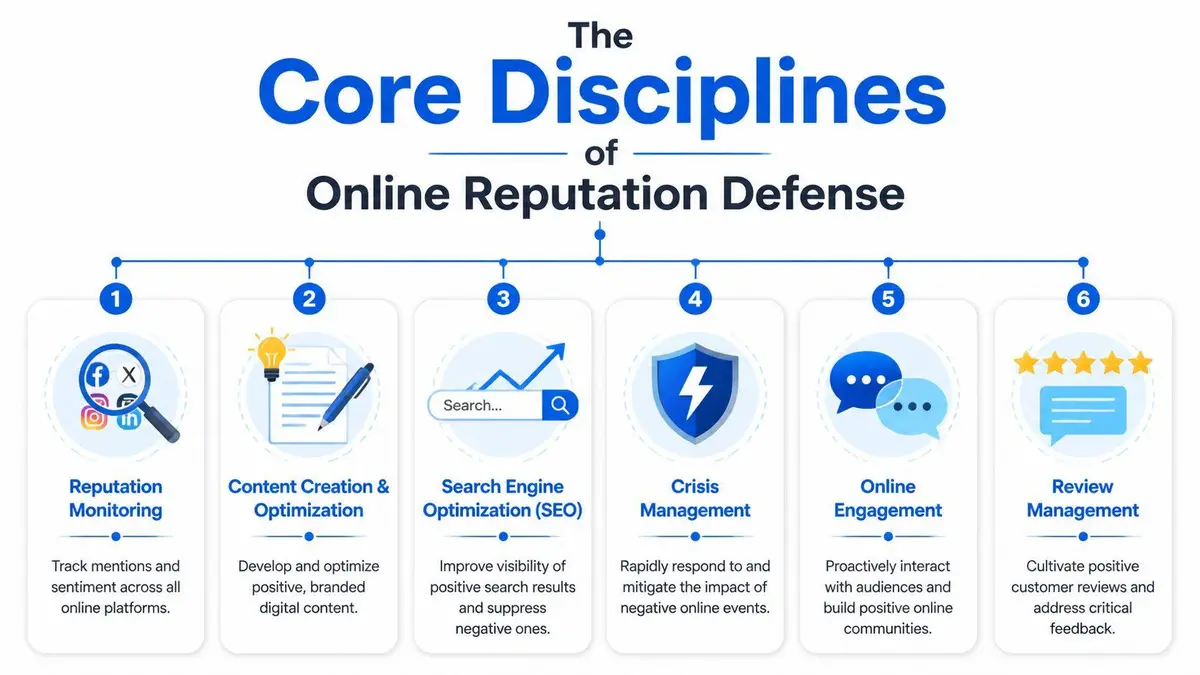
The Core Disciplines of Reputation Defense
Most online reputation management advice is too passive. It tells you to monitor mentions, publish content, and respond politely. That’s fine for ordinary brand maintenance. It fails under pressure.
Professional reputation defense has distinct disciplines. If you collapse them into one generic “ORM” bucket, you’ll choose the wrong remedy.
Monitoring tells you what exists
Monitoring is the intelligence layer. It tracks where harmful material appears, how it spreads, who republishes it, and whether platforms are amplifying it. That includes search results, review sites, news indexing, social mentions, image results, and impersonation profiles.
For ongoing surveillance, firms often combine listening platforms, review dashboards, branded search tracking, and custom alerting. If you need a dedicated view of this function, reputation monitoring services focus specifically on tracking harmful mentions, reviews, and content that can affect a personal or corporate profile.
Monitoring is diagnostic. It doesn’t solve the underlying problem.
Public-facing management shapes perception
This is the commonly recognized side. It includes content creation, profile optimization, review response, search engine optimization, and strategic publication of favorable material. It matters because positive, well-structured content can occupy branded search space and reduce the prominence of older or weaker negative material.
Jackson Digital offers a useful overview of effective online reputation strategies if you’re looking at the public-facing side of the discipline.
Use this layer when the content is lawful, likely to remain online, or better neutralized than fought.
Active remediation removes or limits the threat
This is the part generic ORM firms often avoid because it requires legal analysis, evidentiary precision, and platform-specific action. Active remediation includes takedown demands, policy-based removals, de-indexing, impersonation complaints, privacy claims, copyright enforcement, and escalation through counsel where needed.
That distinction matters because some threats do not respond to branding work. If the issue is defamation, extortion, fake reviews, doxxing, leaked intimate content, impersonation, or unlawfully obtained material, “posting more positive content” is not a serious answer.
A 2025 study found that 68% of high-profile clients experienced reputation damage from unremovable social media content, and only 22% achieved full de-indexing success via traditional ORM, as reported by Business.com’s discussion of online reputation management. That gap is exactly where specialist remediation becomes necessary.
Practical rule: If the content itself is unlawful, fraudulent, impersonating, or privacy-invasive, start with removal analysis, not SEO.
The right discipline depends on the threat
Here’s a simple explanation:
- Use monitoring when you need awareness and early warning.
- Use public-facing management when you need to improve search composition and trust signals.
- Use active remediation when the content creates legal, personal, or security exposure.
Some matters require all three at once. An executive doxxing case, for example, often involves immediate evidence capture, source removal attempts, de-indexing requests, and suppression of derivative coverage. That is not marketing work. It is coordinated defense.
A firm such as ContentRemoval.com handles that remediation layer with de-indexing, source removal, and platform-specific takedown work across search, websites, and social platforms. That’s the category to engage when discoverability itself is the threat.
Typical Engagement Workflows and Timelines
When clients first call, they usually want a guarantee and a deadline. Serious firms won’t offer either casually. What they should offer is a disciplined process that reduces uncertainty quickly.
The first phase is triage. You identify what is live, what is cached, what is replicating, what legal hooks exist, and what action could backfire. This has to happen before anyone drafts a public response.

The first days
A competent engagement starts with a confidential intake, evidence preservation, threat classification, and a decision tree. The key question is whether the matter is primarily a removal case, a suppression case, or a hybrid.
During this stage, clients should expect blunt advice. Some content can be challenged directly. Some can only be de-indexed. Some should not be touched publicly because a response would validate or amplify it.
A typical early workflow looks like this:
- Confidential intake that establishes the facts, parties, platforms, and urgency.
- Evidence capture using screenshots, URLs, indexing records, and archive checks.
- Exposure mapping across search, social, reviews, forums, and syndication points.
- Remedy selection based on policy, law, platform process, and reputational risk.
If the matter requires direct action against harmful material, clients often move next into a targeted online content removal process rather than broad PR activity.
The first month
By this point, you should see whether primary removal attempts are landing, whether derivative copies are appearing, and whether branded search composition is improving. If there is no movement, the strategy may be wrong or too passive.
This is also where expectations matter. Search engines, publishers, review platforms, and social networks all operate on different clocks. Some respond promptly to narrow policy breaches. Others require layered escalation and repeat submissions. News sites, anonymous forums, and foreign-hosted domains often demand a different legal and technical approach.
Early success is not measured by how much activity you see. It’s measured by whether harmful material becomes harder to find and harder to trust.
The first quarter
Once the immediate threat is contained, the work shifts to fortification. That means strengthening branded assets, standardizing escalation protocols, tightening review controls, documenting impersonation risks, and establishing standing monitoring so you’re not surprised again.
A mature workflow also closes internal gaps. Many executive crises begin because no one owned the issue. Legal thought PR was handling it. PR thought IT was tracking it. IT thought outside counsel would advise. Meanwhile, the content stayed up.
Good workflow eliminates that ambiguity. It gives one accountable lead, one response protocol, and one threshold for escalation.
Measuring Success and Demonstrating ROI
Executives don’t need “better sentiment” as an abstract promise. They need evidence that the exposure is decreasing and that commercial trust is recovering.
That means ignoring vanity metrics. Raw mention volume often tells you very little. A hundred irrelevant mentions can matter less than one damaging result for a branded search query.

What to measure
The right metrics depend on the case, but for executive and enterprise matters I usually focus on a small set:
- Search result composition for name, company, and high-risk branded queries
- Negative content discoverability across page one and key platform surfaces
- Removal and de-indexing progress by asset, jurisdiction, and platform
- Review quality and response coverage where commercial trust is affected
- Branded share of voice across owned, earned, and hostile results
Those measurements tell you whether the environment is becoming safer and more credible. They also help quantify whether remedial action is performing better than simple passive observation.
Predictive indicators matter more than retrospective ones
One metric deserves more executive attention than it gets. Net Promoter Score, or NPS, is a critical predictive metric in ORM, and companies with an NPS above 50 experience 2-3x higher growth rates, according to Germin8’s discussion of reputation metrics. Used properly, NPS helps identify whether your reputation posture is generating defenders, not just avoiding critics.
That matters because loyal customers and advocates create favorable content, reviews, referrals, and citations that strengthen the search environment around your brand.
For a deeper commercial framing of why these metrics matter to budget decisions, this analysis of the financial realities of online reputation management is useful.
Here’s a concise overview of the discipline from a practitioner angle:
A clean dashboard beats a loud report
I advise clients to insist on reporting that answers four questions:
| Question | What the metric should show |
|---|---|
| Is the threat less visible? | Reduced discoverability of harmful assets |
| Is the environment more credible? | Improved branded search composition and trust signals |
| Is intervention working? | Removals, de-indexing outcomes, and response effectiveness |
| Is revenue risk falling? | Better conversion conditions and fewer trust objections |
If a firm can’t explain ROI in operational terms, they don’t have command of the work.
Professional Engagement vs Self-Management
Self-management sounds attractive because it appears cheaper and faster. In low-stakes matters, it sometimes is. In executive cases, it often converts a controlled problem into a public one.
The core issue is risk allocation. If you manage the matter yourself, you hold the legal, technical, strategic, and evidentiary risk. If a specialist handles it, that risk is transferred to people who do this repeatedly and understand where the traps are.

Where self-management breaks down
The common failure points are predictable. Internal teams contact the wrong platform channel. They submit weak notices. They use language that accidentally concedes facts. They threaten litigation where policy enforcement would have been faster. Or they provoke republication.
The current AI hype has made this worse. AI-driven ORM tools saw 150% adoption growth from Q1 2025 to Q1 2026, but 72% of these implementations failed multi-jurisdictional removal tasks due to varying laws, with hybrid AI-legal models showing 85% greater effectiveness, according to Xero’s guide to online reputation management.
That finding tracks with real practice. Automation is useful for detection, categorization, and workflow. It is not a substitute for legal judgment when the target is defamatory content, privacy invasion, impersonation, or platform-specific abuse spread across jurisdictions.
A practical comparison
| Issue | Self-management | Professional engagement |
|---|---|---|
| Evidence handling | Often incomplete or inconsistent | Structured for escalation and platform review |
| Platform escalation | Trial and error | Targeted process by claim type |
| Cross-border issues | Usually misunderstood | Handled with jurisdiction awareness |
| Public risk | Higher chance of amplification | Greater control over exposure |
| Strategic fit | Tends to default to response | Can choose silence, suppression, or removal |
The most expensive reputation response is the one that publicizes the allegation while failing to remove it.
When to escalate immediately
Bring in a specialist at once if the matter involves any of the following:
- Impersonation or identity misuse that could mislead investors, customers, or media
- Defamation or fabricated allegations with search visibility
- Leaked private content or NCII requiring rapid containment
- Fake reviews or coordinated attacks affecting commercial trust
- Cross-jurisdictional publication where one platform or one law won’t solve the problem
If the threat is reputational and discoverable, hesitation is not neutral. It favors the attacker, the scraper, and the algorithm.
Frequently Asked Questions About Reputation Defense
How is this different from public relations
Public relations shapes narrative. Reputation defense addresses hostile digital assets directly. PR can help after a problem is contained or when a lawful criticism needs contextual balancing. It does not replace takedown analysis, de-indexing strategy, impersonation removal, or privacy enforcement.
If the issue is a bad article that stays online but can be outranked, PR and SEO may help. If the issue is false, invasive, fraudulent, or weaponized, you need remediation first.
Can something be permanently removed from the internet
Sometimes yes. Often no. The correct objective is usually narrower and more realistic: remove the source where possible, remove mirrors where feasible, de-index search visibility where available, and monitor for reappearance.
“Permanent removal” is not a serious promise unless someone controls the source and every replica. Competent advisors talk in terms of removal, de-indexing, suppression, and recurrence prevention.
What does an engagement usually look like commercially
Fee structures vary by threat type, number of assets, number of platforms, legal complexity, and recurrence risk. Some matters fit project pricing. Others require an ongoing retainer because the threat is persistent or because the client needs standing monitoring and rapid intervention capability.
The right question isn’t “what’s the cheapest option.” It’s “what structure matches the exposure.” A fake review flare-up is different from a defamatory article network or a private-content leak.
How do you keep the work confidential
Confidentiality depends on process, not branding. Sensitive engagements should run through limited-access intake, need-to-know staffing, secure evidence handling, and careful coordination between legal, technical, and communications functions. Public-facing action should be minimized unless it serves a clear strategic purpose.
Clients should ask who sees the file, how evidence is stored, whether subcontractors are involved, and how outreach is handled so it doesn’t create a new record that worsens the matter.
Should we respond publicly
Sometimes. Often not.
A public response makes sense when silence would be interpreted as confirmation, when a stakeholder group requires reassurance, or when a platform or publisher already made the issue visible enough that controlled clarification helps. It is a bad idea when the response would introduce a fringe allegation to a larger audience.
What is online reputation management for an executive, specifically
For an executive, what is online reputation management? It’s the controlled defense of your search identity, public credibility, and digital exposure across search engines, review platforms, social networks, media archives, and replica sites. It includes both image management and evidence-based intervention. If your role depends on trust, the work is not optional.
Initiating a Confidential Assessment
If harmful material is live, don’t start by drafting a statement. Start by preserving evidence and getting a privileged assessment of what can be removed, what can be de-indexed, and what should be left untouched while a broader strategy is built.
A proper assessment should be discreet, fast, and candid. You want a clear view of the threat surface, the likely remedies, the jurisdictions involved, the expected friction points, and the consequences of acting too publicly. You also want to know where a matter is being misclassified. Many “PR problems” are removal problems. Many “legal problems” also require technical suppression and recurrence monitoring.
The first move is not to buy a service. It’s to regain control over facts, options, and timing.
If you need a discreet starting point, ContentRemoval.com handles confidential assessments for executives, public figures, family offices, and legal teams facing defamation, impersonation, leaks, fake reviews, and other high-risk online threats. The process is designed to identify what can be removed, de-indexed, or suppressed, and to do so without unnecessary exposure.