
Defamation law governs false statements of fact that harm a person’s reputation. A claim generally requires a false factual statement, publication to a third party, fault of at least negligence, and reputational damage. Libel covers written and online content, slander covers speech, and public figures in the United States must also prove actual malice.
Key facts
- Statutes of limitations for defamation typically run one to three years from publication.
- Truth is an absolute defense in the United States, and pure opinion and hyperbole are protected.
- Public figures must prove actual malice under New York Times v. Sullivan, private figures usually prove negligence.
- Under the UK Defamation Act 2013 a claimant must show serious harm to reputation.
Where ContentRemoval.com comes in. ContentRemoval.com works on the removal side of defamation, getting false reviews, forum threads, articles and social posts taken down or de-indexed while counsel handles any legal claim. The first contact is often the target’s lawyer or chief of staff, who needs the content gone rather than a judgment two years later. A free 15-minute Exposure Scan maps each false publication and its route, and the report is yours to keep. Get a Free, Confidential Exposure Scan or read how our defamation removal work is done.
A false statement about you appears online before sunrise. By lunch, your board has seen it, your spouse has been forwarded it, and someone in your industry has screenshotted it into a group chat you’ll never be invited to. The instinct is predictable. Anger first, then panic, then the urge to fire off a threat, call the publisher, or post a rebuttal.
That’s usually a mistake.
When people ask what is defamation law, they often expect a dictionary definition. That’s not the useful answer when your name, company, or family is under attack. The useful answer is this: defamation law is a pressure system. It tells you whether a statement is legally vulnerable, what proof matters, which defenses will be used against you, and whether a takedown request, cease and desist, or lawsuit is effective.
Most reputation crises aren’t lost because the target had no rights. They’re lost because the response was emotional, public, delayed, or badly aimed. The law rewards precision. You need to know whether the statement is fact or opinion, whether you’re being treated as a public or private figure, whether the damage is presumed or must be proved, and whether the jurisdiction helps you or hurts you.
If you’re dealing with active online harm, start with a disciplined response rather than improvisation. This strategic guide for victims of online defamation is a solid first read. Then get surgical. Reputation recovery begins when you stop asking, “Can I sue?” and start asking, “What provides an immediate advantage?”
The Moment of Discovery and the Need for Strategy
The first serious mistake usually happens in the first hour.
An executive finds a fabricated accusation in a search result, a founder discovers a false Reddit thread alleging fraud, or a physician sees a review accusing professional misconduct that never happened. The target wants correction. The attacker wants reaction. If you give them one, you often strengthen the story’s visibility, expand the audience, and create a second round of publication.
What matters in the first response
Your immediate job isn’t to argue. It’s to classify.
You need to isolate four questions quickly. Is the statement factual and false, or is it framed as opinion? Who published it, and where else has it spread? Does the publisher have any obvious defense? Which pressure point is strongest: platform rules, publisher liability, search visibility, or litigation exposure?
Practical rule: Treat a defamatory post like digital evidence, not a personal insult. Preserve it before you challenge it.
Sophisticated response means building a record before the other side edits, deletes, or republishes. Capture the full URL, date, surrounding context, account identity, and any engagement that shows third-party publication. If search results are involved, document the ranking and the exact query that surfaces the content. If the statement appears in a review, forum thread, article, or social post, preserve all of it.
Strategy beats outrage
Defamation law is not a morality contest. Plenty of statements feel vicious and still don’t produce a strong claim. Others look small on first reading but create sharp legal advantage because they accuse someone of a crime, sexual misconduct, or professional incompetence.
That is why the right move is controlled escalation. Some matters should go straight into a takedown track. Others need a legal demand drafted around falsity, damages, and likely defenses. Some are litigation problems from the outset. A few are best handled without litigation at all because the legal claim is weaker than the platform or search-removal path.
People in crisis waste time arguing with publishers. Skilled operators build advantage first, then act.
The Four Pillars of a Defamation Claim
If you want to know whether you have a real claim, strip the emotion out and test the publication against the legal architecture. Across most jurisdictions, a prima facie defamation claim requires a false statement purporting to be fact, publication to a third party, fault amounting to at least negligence, and actual damages resulting from reputational harm. The filing window also matters, because the statute of limitations is typically one to three years from publication, as outlined in this defamation claim requirements guide.
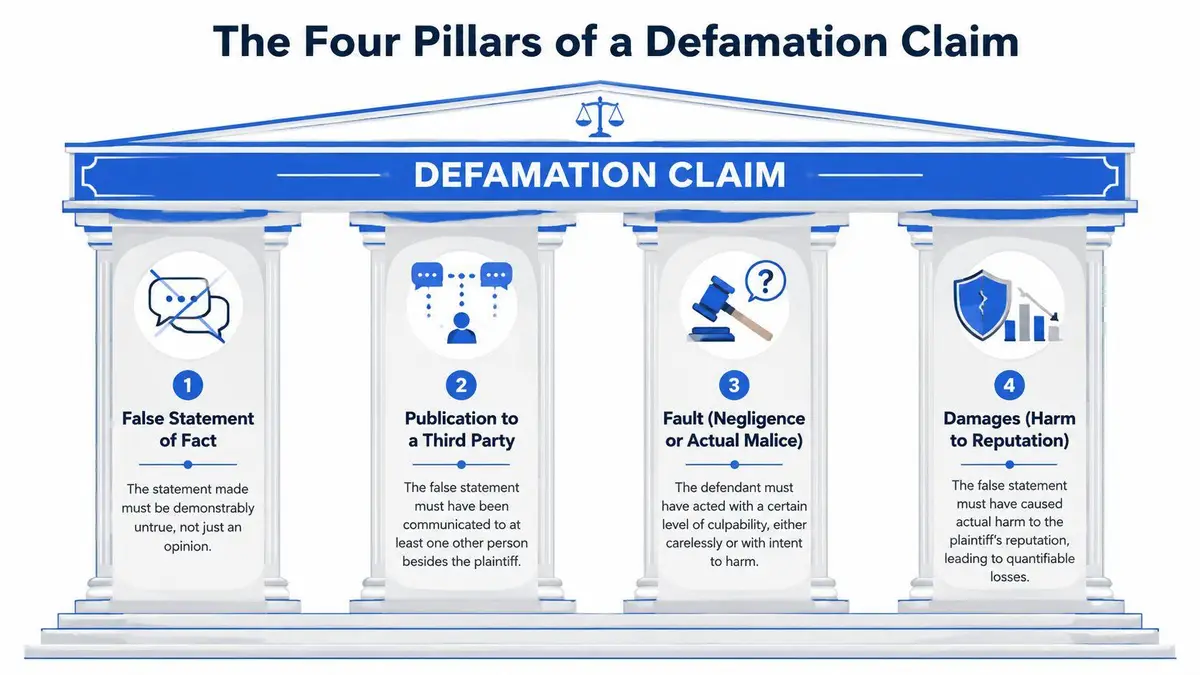
False statement of fact
This is the gatekeeper. If the statement can’t be proven true or false, your position gets weaker fast.
“Your company’s service is terrible” is usually opinion. “Your company forged invoices” is a factual allegation. “I think he’s dishonest” may be protected rhetoric. “He stole investor money” is a factual claim with legal consequences.
Use this test: could evidence prove the statement false? If yes, you may have a defamation issue. If no, you may have a reputation problem but not a strong defamation claim.
Publication and fault
Private humiliation isn’t enough. The statement must be communicated to someone other than you. A direct email sent only to you is different from a review on Google, a post on X, a Substack article, or a message circulated in an industry Slack.
Fault turns on the publisher’s level of blame. At minimum, the law usually requires negligence. In practical terms, ask what the publisher did before publication. Did they verify? Did they ignore contrary documents? Did they rely on an anonymous source with no corroboration? Did they republish after receiving clear evidence of falsity?
A good claim doesn’t rest on outrage. It rests on falsity, publication, culpability, and provable harm.
Harm and case triage
Reputation damage must be real, though the way you prove it varies. For a business owner, that may mean lost customers, a damaged sales process, investor concern, or professional fallout. For an individual, it may mean job consequences, reputational exclusion, or measurable personal and professional disruption.
A quick triage table helps:
| Issue | Weak claim | Stronger claim |
|---|---|---|
| Nature of statement | Insult or vague opinion | Specific factual allegation |
| Audience | Sent privately | Published publicly or shared widely |
| Publisher conduct | Attempted verification | Ignored obvious facts or warnings |
| Harm | Annoyance only | Reputational or economic fallout |
If one of these pillars is missing, don’t assume litigation is your best weapon. You may still have effective platform, search, or suppression options. But if all four are present, you have a legal dispute, not just an online nuisance.
Libel vs Slander in the Digital Arena
Historically, defamation splits into libel and slander. Libel covers written or published statements, including digital content. Slander covers spoken statements. That distinction remains legally real, and this explanation of libel and slander captures it cleanly: defamation law bifurcates into two torts, with plaintiffs still needing to prove falsity, publication, fault, and harm.
For most high-value online matters, however, the practical focus is libel.
Why libel dominates online attacks
Digital content hardens into evidence. A podcast clip becomes a transcript. A spoken accusation in a livestream becomes a reposted video, an article summary, and a search result. A private statement can migrate into a published one in hours.
That’s why online defamation is usually analyzed as libel, even when the original attack began verbally. The damaging form is the published one. Search engines index it, screenshots preserve it, and third parties repeat it.
Three common digital libel formats show up repeatedly:
- Defamatory reviews: A false review accuses a surgeon of incompetence, a law firm of theft, or a company of fraud.
- Platform posts: A LinkedIn post or X thread presents fabricated “inside information” about misconduct.
- Published articles or forum threads: A blog, forum, or anonymous complaint site gives the accusation a durable home.
If you want a deeper look at written defamation specifically, this guide on libel and content removal strategy is worth reviewing.
Digital permanence changes leverage
Slander disappears unless someone records or repeats it. Libel tends to compound. The post remains accessible, gets screenshotted, quoted, indexed, and cached. That persistence changes how you should respond.
A spoken accusation at a dinner in Mayfair may bruise your reputation. A false article ranking on Google for your name can interfere with investor diligence, hiring decisions, media coverage, and counterparties who never call to verify what they found. One is ephemeral. The other becomes infrastructure.
If the lie is searchable, the legal and strategic response must account for persistence, not just publication.
Many people underestimate risk. They focus on the original speaker and ignore the replicas. In practice, your problem may be the repost, the quote-post, the review syndication, the autocomplete association, or the search result snippet. A proper response maps the ecosystem, not just the first insult.
The Critical Divide Public vs Private Figure Status
In U.S. defamation law, your status may decide the case before the facts do. Public figures face a far steeper burden than private individuals. That isn’t theory. It is the central battlefield in high-profile defamation matters.
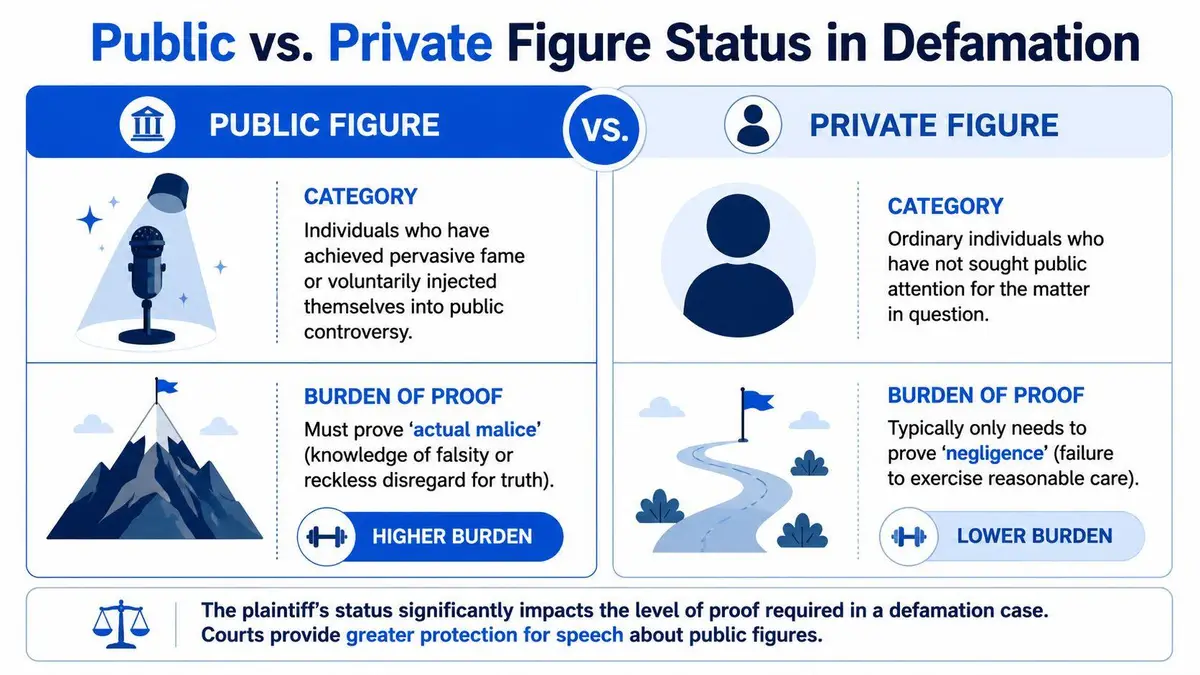
The controlling principle is well established. Public figures must prove actual malice, meaning the statement was published with knowledge of falsity or reckless disregard for the truth, as established in New York Times Co. v. Sullivan and summarized in this discussion of the U.S. defamation landscape.
Why status changes everything
If you’re a public figure, it’s not enough to show the statement was false and damaging. You must show the publisher either knew it was false or recklessly disregarded whether it was true. That’s a brutal standard. It exists to protect speech about public actors and public controversy.
Private individuals typically work under a lower fault standard, usually negligence. That means the question becomes whether the publisher failed to exercise reasonable care before making the statement.
Here’s the strategic consequence. The same false allegation may produce very different legal advantage depending on who the target is.
| Plaintiff status | Likely fault standard | Strategic effect |
|---|---|---|
| Public figure | Actual malice | Harder to win, stronger need for evidence of publisher knowledge or recklessness |
| Private figure | Negligence | Lower hurdle, better pressure for correction or removal |
Many executives misjudge their own status
High-net-worth clients often assume they are private because they didn’t seek celebrity. That’s not always how the law sees it. A CEO who speaks publicly for the company, a founder repeatedly featured in press coverage, or an investor who injects himself into a public controversy may be treated as a public or limited-purpose public figure for some issues.
That doesn’t mean you have no case. It means your evidence needs to be sharper. You need proof of what the publisher knew, what they were told, what documents they ignored, and what steps they didn’t take.
Use this checklist early:
- Media exposure: Have you cultivated public attention around the issue in dispute?
- Voluntary role: Did you step into a public controversy, interview cycle, or campaign?
- Institutional visibility: Are you the public face of a company, deal, or dispute?
- Evidence trail: Can you prove the publisher had contradictory facts before publication?
Public status doesn’t kill a claim. It raises the price of winning.
In defamation cases, clients lose discipline. They fixate on the falsity and ignore the state of mind issue. In a U.S. case involving a public figure, you need evidence of culpability, not just inaccuracy. That shifts the response from indignation to investigation. Emails, pre-publication outreach, ignored corrections, source problems, and republication after notice often matter more than rhetorical outrage.
Potent Defenses Truth Opinion and Privilege
A serious defamation analysis always asks the uncomfortable question first: what will the other side say in response, and will it work?
The strongest defense is truth. In the United States, truth is an absolute defense. If the statement is true, the claim fails even if publication was damaging. That’s why clients should stop asking whether a statement was unfair and start asking whether it was false in provable, document-backed terms.
Opinion is not the same as accusation
The next major defense is opinion. Not every ugly statement is actionable. The law generally protects pure opinion and rhetorical hyperbole because they can’t be proven true or false. This explanation of defamation defenses and damages also identifies these as absolute defenses.
That distinction matters in real disputes. “He’s a terrible executive” is usually opinion. “He falsified the company’s earnings” is a factual charge. “This doctor is a butcher” may be hyperbole depending on context. “This doctor operated while intoxicated” is a factual allegation.
When evaluating a takedown or legal demand, classify each sentence separately. Mixed publications often contain both protected opinion and actionable factual claims.
Per se and per quod change the damages fight
The same source also captures another distinction that astute plaintiffs use well: defamation per se versus defamation per quod.
Per se statements are damaging by definition. Classic examples include accusations of criminal activity, sexual misconduct, or professional incompetence. These can support presumed general damages without proof of specific economic loss.
Per quod claims require proof of special damages. You must connect the falsehood to concrete economic harm such as lost customers, lost employment, or lost commissions.
That distinction matters for removal strategy because it changes your evidence package.
- Per se matters: Move fast with the face of the statement itself. The allegation may carry its own presumption of harm.
- Per quod matters: Build your file. Assemble lost business records, client communications, rescinded offers, or revenue disruption.
- Borderline statements: Don’t guess. A poorly framed demand that overstates damages can weaken credibility.
The most effective takedown demands don’t just say the post is false. They identify why the category of accusation creates immediate legal exposure.
Privilege can block a claim even when the statement hurts
Some settings give speakers legal protection. Statements made in judicial proceedings are a classic example of privilege. Other contexts may carry qualified protections depending on the jurisdiction and facts.
From a crisis perspective, the lesson is simple. Don’t assume every false statement creates a viable lawsuit. Ask whether the speaker made it in a protected setting, whether the protection is absolute or qualified, and whether any abuse of that protection can be shown. That analysis often determines whether your best move is litigation, publisher pressure, platform enforcement, or a search and visibility strategy.
Jurisdictional Battlefields US vs UK and EU Law
If your reputation crosses borders, jurisdiction is not a side issue. It is often the decisive issue.
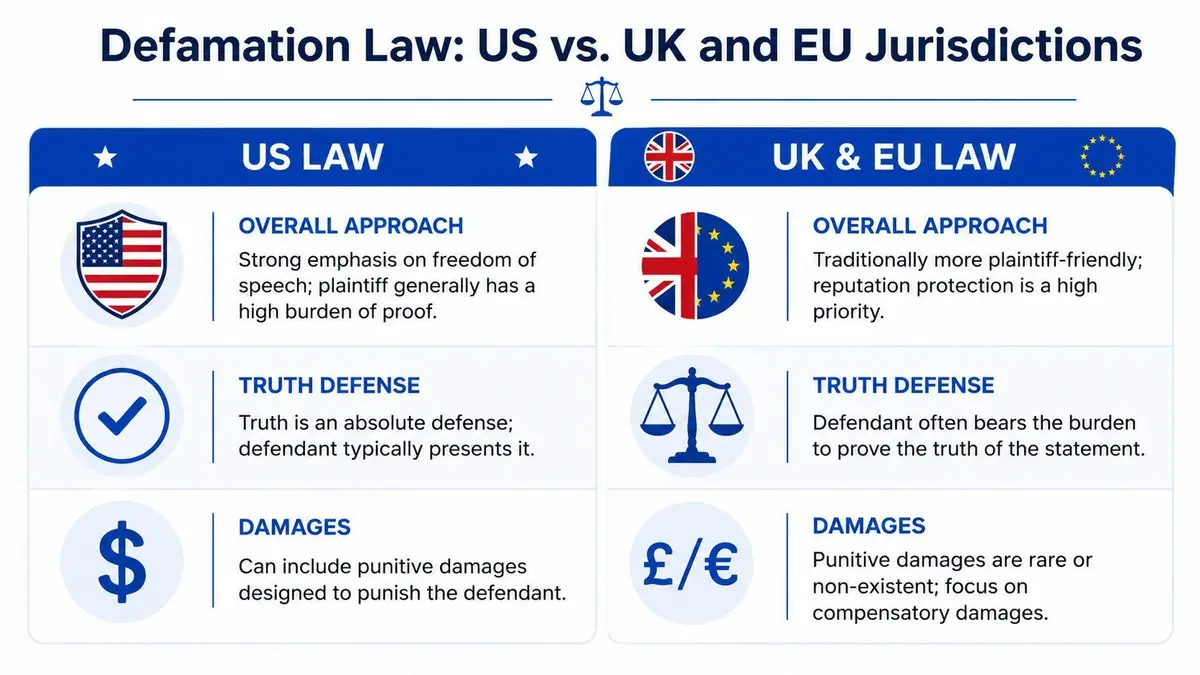
The core divide is this: in the United States, the plaintiff almost always bears the burden of proving falsity. In many other jurisdictions, including the UK, the defendant must prove truth as a defense. Carter-Ruck’s guide to defamation and privacy law in the United States states that distinction directly, and it significantly changes litigation risk for clients with international profiles.
Why the same post can be weak in one forum and dangerous in another
In the U.S., speech protections are unusually strong. Plaintiffs face constitutional hurdles, especially on matters of public concern. If you are a public figure, the burden becomes steeper still.
England takes a different route. Under the Defamation Act 2013, a claimant must prove that publication caused or is likely to cause serious harm to reputation, and for for-profit bodies that means serious financial loss, as described in this analysis of serious harm developments. That threshold filters out weaker, trivial disputes, but once a claim is viable, the burden structure may be more plaintiff-friendly than in the U.S.
A simple comparison shows why forum analysis matters:
| Issue | United States | UK and comparable jurisdictions |
|---|---|---|
| Burden on falsity | Plaintiff usually proves falsity | Defendant often proves truth as justification |
| Speech protection | Strong First Amendment emphasis | Reputation protection has greater structural weight |
| Access to claim | Tougher for public-issue plaintiffs | Serious harm threshold filters claims early |
The global landscape is even more uneven
Outside civil systems like the U.S. and UK, the stakes can escalate further. According to UNESCO’s reporting on defamation laws and SLAPP misuse, 80% of countries still criminalize defamation, with 160 nations maintaining criminal defamation laws. UNESCO also notes sharp regional concentration, including 39 of Africa’s 47 countries (83%) and 38 of Asia and the Pacific’s 44 states (86%) retaining such statutes.
The European Court of Human Rights has aligned against imprisonment for defamation, and international free expression standards collected here state that penalties should never include imprisonment, with any criminal standard requiring proof beyond a reasonable doubt.
Cross-border reputation attacks are rarely solved by asking which law is “best.” They are solved by asking which jurisdiction gives you usable leverage fastest.
That is why global clients need coordinated analysis. Where was the content published? Where is it read? Which country has jurisdiction over the publisher, the platform, the claimant, and the reputational harm? A post that looks difficult to attack in New York may create a different risk profile in London or elsewhere. Jurisdiction is not paperwork. It is strategy.
Your Strategic Response to Online Defamation
A reputation crisis needs a protocol, not a rant. The right response is disciplined, quiet, and evidence-first.
Start with the visual map below. It reflects the practical sequence that works in most online defamation matters.
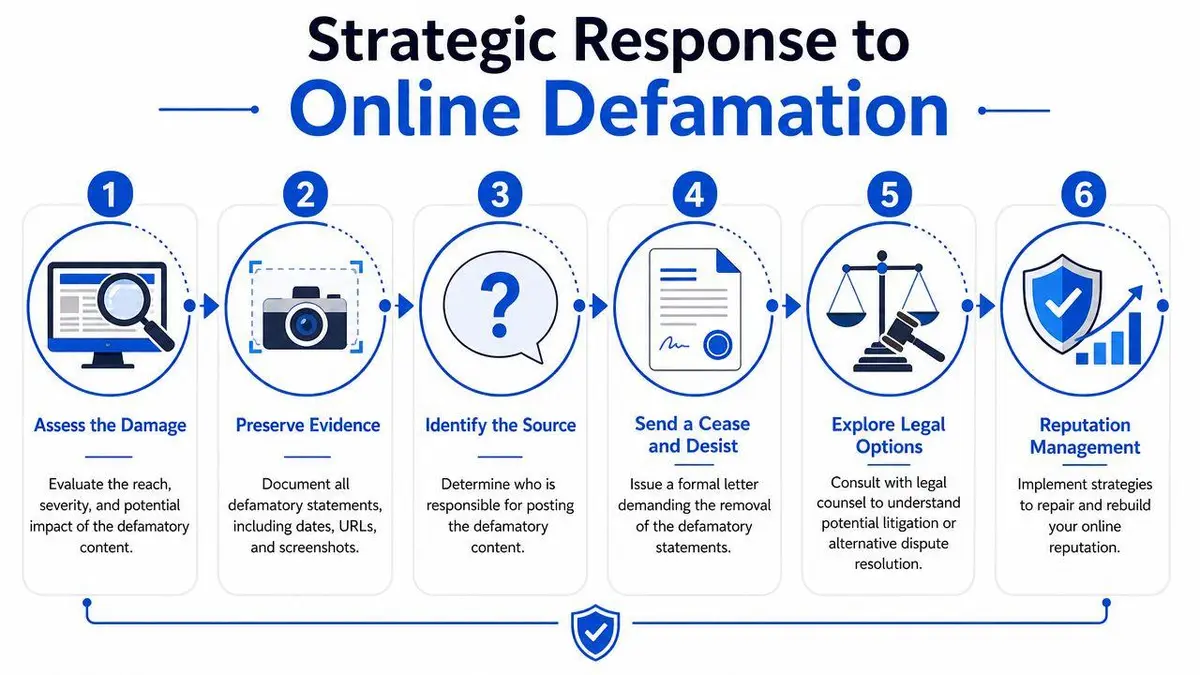
The response sequence that protects leverage
First, assess legal strength and business risk together. A false accusation of criminal conduct on a low-traffic forum may be legally strong but commercially containable. A vague insinuation in a top-ranking article may be legally messier but far more damaging.
Second, preserve all evidence. Take screenshots, archive URLs, capture search results, preserve metadata where possible, and track republication. If the content changes later, your original record may become the difference between an advantage and confusion.
Third, do not freelance the confrontation. Direct engagement often alerts the publisher, invites deletion without accountability, or triggers more publication. If a response is sent, it should be calibrated to the remedy you want.
This practical video gives a useful overview of response mechanics:
Choose the remedy that fits the target
Different mechanisms solve different problems:
- Platform takedown requests: Best when content violates platform rules, impersonates, doxes, or includes clearly false harmful material in removable categories.
- Cease and desist letters: Effective when the publisher is identifiable, exposed to legal pressure, and likely to remove or correct rather than fight.
- Litigation: Reserved for serious harm, durable publication, or strategic necessity. It is powerful, expensive, public, and slow.
- Search and reputation work: Necessary when removal is partial, delayed, or impossible.
For operators who want a strong non-legal framework for containment and recovery, BAMF’s battle-tested playbook is useful because it treats reputation management as an operational discipline rather than a branding exercise.
If the attack is already affecting search results, investor diligence, or customer trust, this executive guide to removing defamation from the internet is also worth reviewing before you make your next move.
Delay favors the publisher. Precision favors the target.
The wrong move is public outrage. The right move is a coordinated response that matches legal means, platform rules, and visibility control to the actual threat.
If a false publication is damaging your name, company, or family, get a confidential assessment from ContentRemoval.com. Their team handles high-stakes online defamation, content removal, de-indexing, and digital reputation protection with the speed and discretion these matters require.
Frequently asked questions
What is the difference between defamation and a negative opinion?
A defamation claim needs a statement that can be proven true or false. Saying a company’s service is terrible is opinion, saying it forged invoices is a factual allegation. The article recommends classifying each sentence separately, since one post often mixes protected opinion with actionable fact.
Do I need to prove financial loss to sue for defamation?
Not always. Defamation per se, which includes accusations of crime, sexual misconduct or professional incompetence, can support presumed damages. Other statements are per quod and require proof of specific economic harm such as lost customers, employment or commissions.
Should I respond publicly to a defamatory post?
The article advises against it. A public rebuttal or direct confrontation often expands the audience, triggers deletion without accountability, or produces a second round of publication. Preserve the evidence first, classify the statement, then choose the remedy that fits: platform takedown, legal demand, litigation or search work.