
The assessment process in online reputation protection is a confidential, evidence-driven triage that decides whether removal is viable before any takedown request is sent. It defines the objective, preserves evidence, tests legal and platform grounds, identifies the controlling jurisdiction, ranks each item by harm, and ends with a written plan tied to specific actions.
Key facts
- Preserve evidence first, because publishers and platforms may edit or move content once a complaint arrives.
- Routes tested include defamation, privacy, copyright, impersonation, platform policy and search engine de-indexing.
- The five stages run from intake and scoping through to a written strategy and remediation plan.
- Jurisdiction is evaluated before outreach, since the strongest ground depends on publisher, host and client location.
Where ContentRemoval.com comes in. ContentRemoval.com runs this assessment for executives, family offices, public figures and the counsel who represent them, before a single notice goes out. The first contact is often a chief of staff or lawyer rather than the principal. A free 15-minute Exposure Scan maps what exists, what is removable and by which route, and the written report is yours to keep whether or not you engage. Get a Free, Confidential Exposure Scan or read how our reputation management work is done.
You find a defamatory article ranking for your name, a fake profile contacting your clients, or an intimate image circulating without consent. Your first instinct is usually to demand removal immediately. That instinct is understandable, but an angry email, public response, or rushed takedown request can alert the publisher, encourage duplication, or destroy evidence needed for a stronger legal and technical response.
The answer to what is assessment process in online reputation protection is not “a search and a price quote.” It’s a confidential, evidence-driven triage. The process determines whether removal is viable, which jurisdiction creates pressure, what evidence must be preserved, and which action should happen first. ContentRemoval.com serves high-net-worth individuals, executives, family offices, legal professionals, creators, and public figures where those decisions require discretion and precision.
Why the First 48 Hours Define Your Reputation Outcome
A chief executive discovers an article alleging misconduct. A family office principal sees a private photograph posted to a forum. A public figure notices an impersonation account messaging journalists. In each situation, the visible content is only part of the problem. The underlying questions are more consequential: who published it, where is it hosted, what policy governs it, what evidence supports removal, and which audience has already encountered it?
The first response often determines whether those questions can still be answered cleanly. A client who contacts the publisher before capturing the page may lose the original wording, publication date, author details, or embedded metadata. A client who posts an emotional rebuttal may create a second search result that repeats the allegation. A client who sends the same demand to every platform may reveal strategy without establishing a valid legal or policy ground.
Practical rule: Preserve first, communicate second, and escalate only after the available route has been identified.
A professional assessment is therefore not a sales intake call. It’s a form of legal and technical triage. The firm identifies the harmful assets, records their location, examines the facts supporting the complaint, and tests possible routes such as defamation, privacy, copyright, impersonation, platform policy, or search-engine de-indexing. The assessment also identifies the controlling jurisdiction, because the strongest argument may depend on the publisher’s location, the host’s rules, the platform’s legal process, or the client’s rights in a particular territory.
Speed still matters. A rapid response can help prevent further circulation, preserve the client’s options, and prioritize the material causing the greatest professional or personal exposure. But speed without structure is merely haste. A resource on negative content removal methods is useful for understanding the range of approaches, while an urgent matter may require a confidential 72-hour emergency removal response rather than public self-help.
The proper assessment ends with a reasoned view of what can be attempted, what cannot be guaranteed, and what the client must do before a takedown begins. That written foundation is what separates an accountable engagement from improvised reputation management.
Core Components of a Professional Assessment
Assessment follows a cycle. The evaluator defines the objective, identifies the evidence needed, gathers and examines that evidence, applies explicit criteria, and reports a decision or recommended action. Education and risk-assessment methodologies describe the same underlying logic, from identifying objectives and collecting evidence to analyzing results and using findings to improve decisions (Frontiers in Education’s account of assessment’s historical development, Hong Kong Statistical Service assessment methodology).
In reputation work, each component acts as a gate.
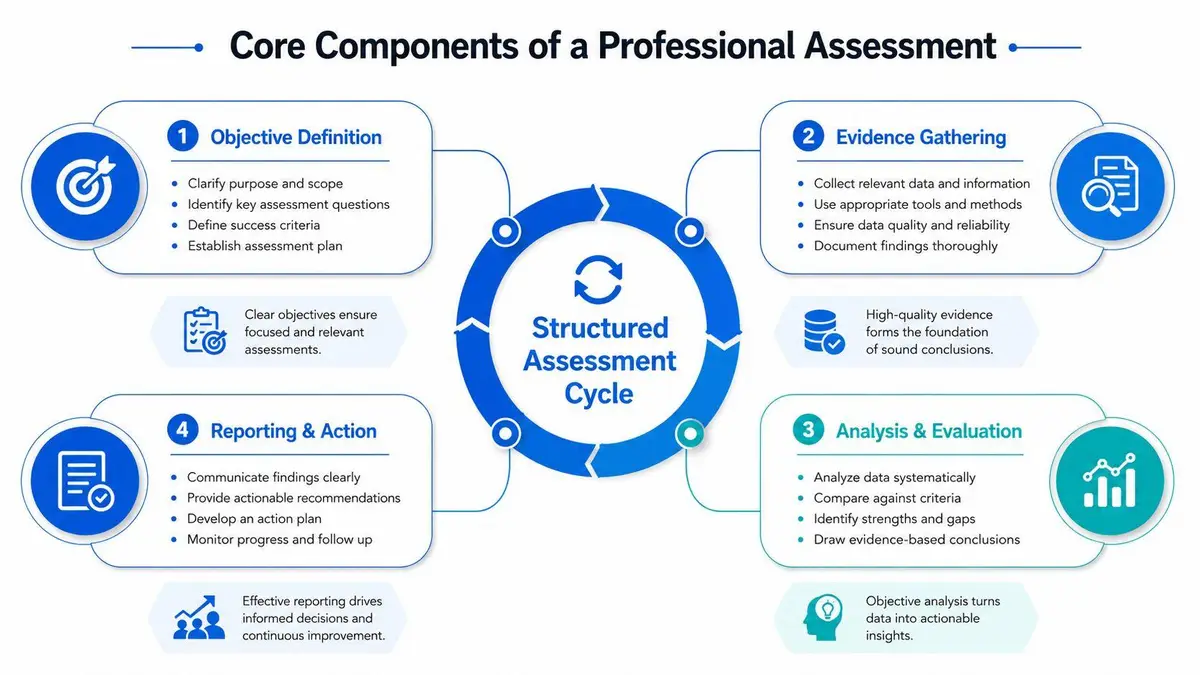
Objective definition
“Remove this from the internet” is a legitimate concern, but it isn’t yet a usable objective. The client must distinguish among source removal, search de-indexing, suppression, account closure, evidence preservation, and monitoring. A leaked image may call for platform escalation and copyright or privacy analysis. A false news article may require a publisher demand, legal review, or search-engine action. A fake profile may require identity verification and impersonation evidence.
The objective sets the scope. Without it, a provider can promise activity without defining the result.
Evidence gathering
The assessor records URLs, screenshots, page titles, publication details, account identifiers, images, search queries, and relevant documents. Evidence should capture context, not merely the offensive sentence. A defensible record may need to show whether a statement was presented as fact, whether the publisher had notice of its falsity, whether the image belongs to the client, and how the material connects to a specific person or business.
Analysis and evaluation
The complaint is tested against defined criteria. Risk-oriented methodology identifies hazards or threats, estimates likelihood and impact, and compares the result against predetermined criteria (University of Idaho assessment methodology). In reputation protection, that means distinguishing a strong removal ground from content that is merely unpleasant, critical, or difficult to suppress.
Reporting and action
The output should state the findings, explain the recommended route, identify dependencies, and record the limits of the strategy. A firm may conclude that one URL has a credible platform-policy route, another is better suited to de-indexing, and a third lacks a viable removal basis but should be monitored. That is assessment. A casual conversation followed by a generic proposal is not.
The medical analogy is accurate. A physician doesn’t prescribe treatment based solely on a patient’s anxiety. The physician gathers symptoms, orders appropriate tests, evaluates the results, and then selects an intervention. A reputation firm should follow the same discipline before filing demands or contacting platforms.
The Five Stages of a Reputation Assessment
A rigorous reputation assessment moves through five decision gates. The client supplies facts and documents. The firm converts them into a record, an evaluation, and an action plan. The sequence matters because later decisions depend on evidence preserved earlier.
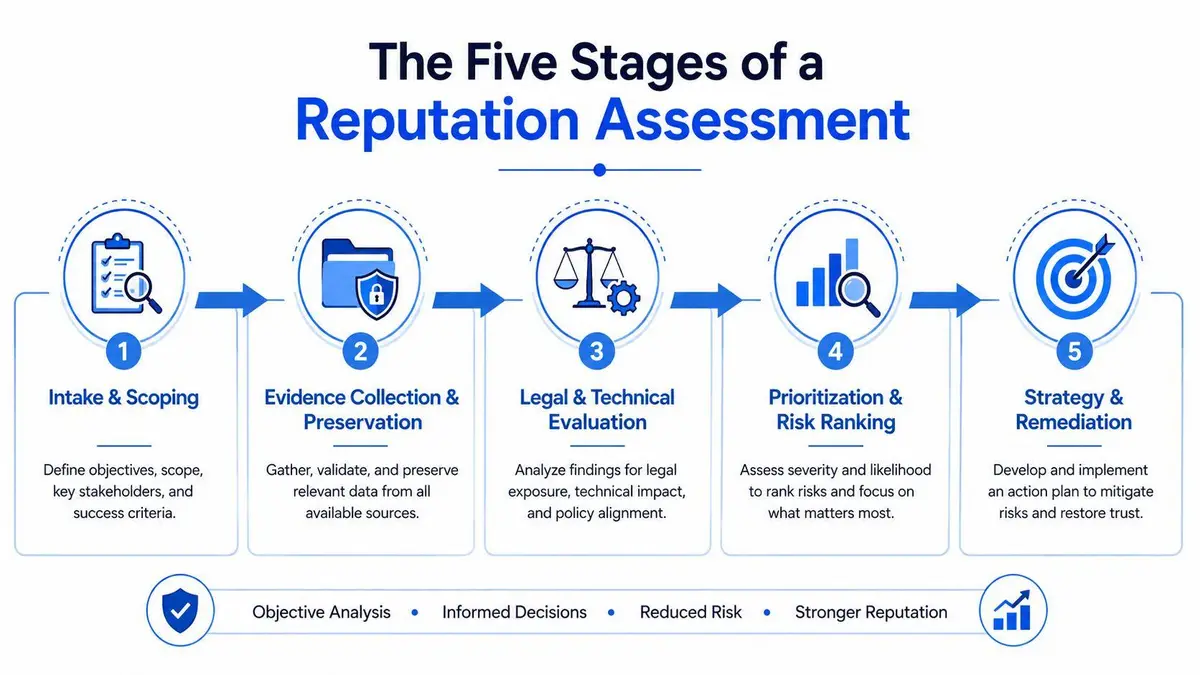
Intake and scoping
The first stage identifies the person or entity affected, the harmful material, the relevant audiences, and the desired outcome. The client should explain what happened in chronological order, including discovery of the content, any contact with the publisher or platform, and any business or personal consequences that are already known.
The firm produces a defined scope. It should identify the URLs, accounts, search results, images, or videos covered by the assessment and separate urgent exposure from background material. The gate is simple: no action begins until the parties agree on what is being assessed and what success means.
Evidence collection and preservation
The firm captures the material in its current form and records the surrounding facts. That may include page content, timestamps, account details, search visibility, publication history, communications, court documents, police reports, or prior notices. The client supplies original files and correspondence where available.
Evidence preservation must precede a takedown request. A platform or publisher may remove, edit, relocate, or restrict access to content after receiving a complaint. If the original page is still needed to establish falsity, ownership, impersonation, or privacy harm, a premature request can weaken the record. The gate is a usable evidence file that supports the next analysis.
Legal and technical evaluation
The evaluator tests the strongest possible grounds. Legal questions may involve defamation, privacy, copyright, harassment, non-consensual intimate imagery, or identity misuse. Technical questions concern the host, platform, search engine, account structure, copies, redirects, indexing, and likely escalation path.
Jurisdiction is evaluated here, not after a failed request. The firm determines which legal system, platform policy, or procedural channel offers the clearest path. The gate is a route-specific recommendation, not a general statement that the content is harmful.
Prioritization and risk ranking
Not every item deserves equal urgency. The assessor ranks material by factors such as credibility, prominence, audience, personal sensitivity, business relevance, duplication risk, and the strength of the available remedy. A highly visible false allegation may precede an older low-visibility page. A leaked image may require immediate containment even if it has limited search visibility.
The output is a priority order with reasons. The gate is agreement on which actions should be attempted first and which items should be monitored or handled later.
Strategy and remediation
The final stage converts findings into a written plan. It should specify the proposed recipient, legal or policy basis, evidence required, sequence of communications, escalation options, expected dependencies, and monitoring approach. It should also identify what happens if the first route fails.
No reputable adviser can guarantee that a third-party publisher, platform, or search engine will remove content. The proper deliverable is a defensible plan tied to specific actions, not a verbal promise of certainty.
Structured Assessment Versus Informal Reputation Audits
An informal audit often consists of a search for the client’s name, several screenshots, and a fee proposal. That may identify visible symptoms, but it rarely establishes why a platform should act, whether the evidence has been preserved, or which jurisdiction controls the dispute.
A structured assessment creates a record that another professional can understand and audit. It connects each item to evidence, criteria, jurisdiction, proposed action, and escalation route. That difference affects both legal defensibility and commercial value.
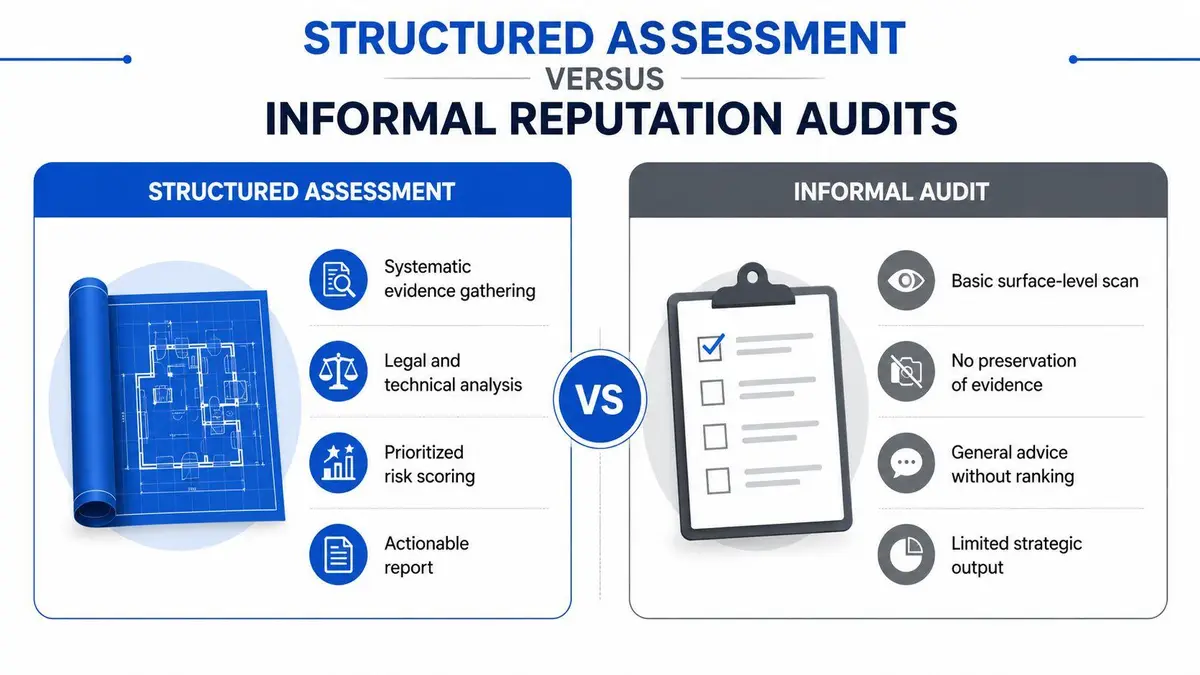
| Decision area | Structured assessment | Informal reputation audit |
|---|---|---|
| Evidence | Systematic capture, preservation, and source records | Surface-level screenshots |
| Legal analysis | Tests defamation, privacy, copyright, impersonation, and policy grounds | General commentary about “bad content” |
| Jurisdiction | Identifies the relevant legal and procedural forum | Often omitted |
| Prioritization | Ranks items by harm, visibility, urgency, and remedy | Treats results as an undifferentiated list |
| Confidentiality | Defines access, storage, communications, and counsel involvement | May rely on ordinary commercial communication |
| Deliverable | Written findings and an action plan tied to specific steps | Price quote or broad service description |
Why the comparison matters
A structured process doesn’t guarantee removal. It does something more valuable at the outset, it tells the client whether removal is viable and what the firm will do if the first route fails. It also prevents the provider from measuring effort by the number of emails sent rather than by the quality of the decision behind each communication.
Price comparisons between the two models are therefore misleading. An informal audit may appear cheaper because it omits evidence preservation, legal analysis, jurisdictional work, and reporting. Those omissions become expensive when a failed request alerts a publisher, misses a procedural deadline, or forces the client to rebuild the evidence file.
The right standard
Ask to see the methodology before discussing a campaign. A credible provider should be able to explain its criteria, document handling, escalation logic, and reporting format in plain language. If the provider can’t tell you what it will produce after assessment, it isn’t offering a defined assessment process.
Confidentiality and Jurisdictional Analysis
For a high-profile client, confidentiality is not an administrative detail. The assessment may contain identity documents, private photographs, medical or family information, legal correspondence, business records, and details about the client’s vulnerabilities. A provider that treats those materials as ordinary marketing intake data has misunderstood the engagement.
The firm should explain how assessment information is collected, stored, shared, and deleted or retained if the client doesn’t proceed. It should identify who can access the file, whether outside counsel or specialist vendors may be involved, and how communications are handled. When legal counsel directs the work, the parties should also define how privilege is approached and where legal advice begins and ends.
A confidential assessment should leave a clear record of access and purpose, not a trail of unnecessary disclosure.
Jurisdiction requires the same level of discipline. The relevant forum may depend on the publisher’s domicile, the host’s location, the platform’s corporate structure, the client’s residence, the subject’s local rights, or the audience affected by the content. Those factors don’t carry equal weight in every matter. A removal request based on privacy rights may be stronger in one territory, while a defamation demand may depend on where the publisher operates and where the harm occurred.
The assessment should map those possibilities before anyone sends a formal notice. It should also distinguish between the law governing the content and the procedure offered by the platform. A platform may have a global policy but apply different legal review processes to requests arising from different jurisdictions. A search engine may consider de-indexing separately from source removal.
Clients dealing with personal data should understand the potential relevance of the GDPR right to be forgotten, but they shouldn’t assume that a privacy request automatically removes the source page or every copy. The assessment must connect the right to the specific URL, data use, jurisdiction, and remedy available.
A firm that can’t explain its confidentiality controls and jurisdictional method during assessment will struggle when execution becomes contested. These are the foundations of an enforceable strategy, not optional upgrades.
What to Prepare Before Your Assessment Begins
Preparation improves the first call and reduces avoidable disclosure. Gather the original material before forwarding it widely. Preserve the pages, accounts, messages, and files in their current form, then organize the information so the assessor can distinguish confirmed facts from assumptions.
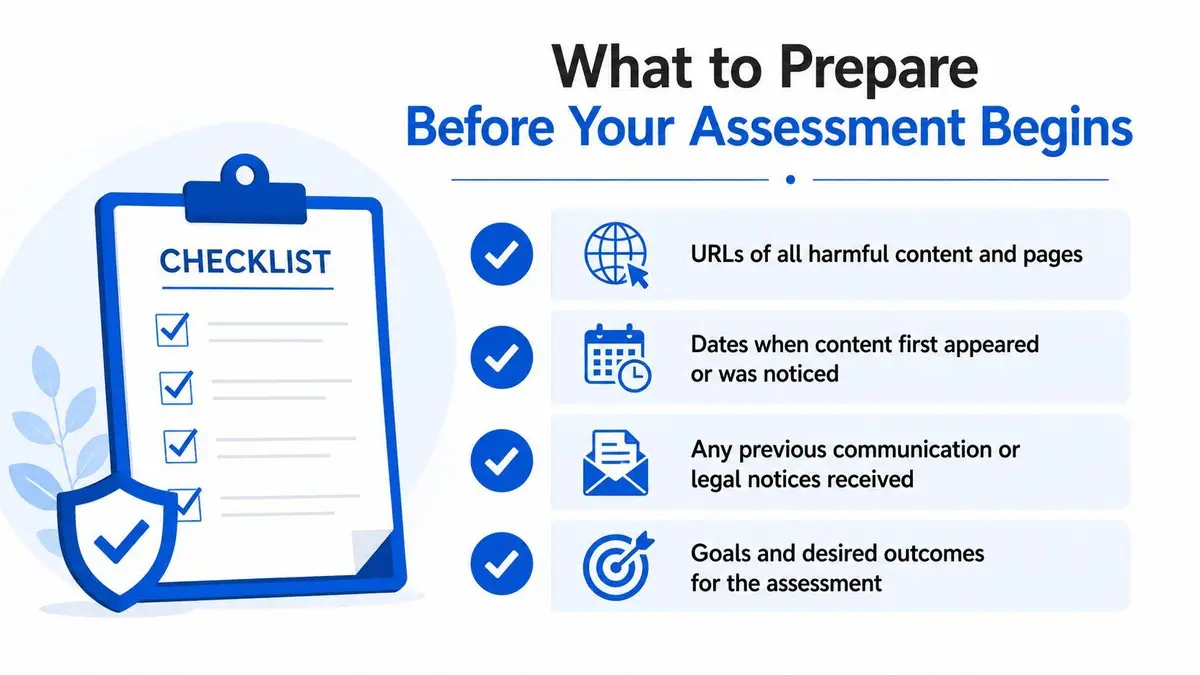
Assemble the core file
Provide a concise chronology and the source material behind it. Your preparation should include:
- URLs and account identifiers: Record every harmful page, profile, post, image, video, and search result. Include alternate URLs and copies if you’ve found them.
- Dates and discovery details: Note when the material appeared, when you first noticed it, and whether the page has changed since discovery.
- Prior communications: Preserve takedown requests, platform replies, publisher correspondence, cease-and-desist letters, and any refusal or automated rejection.
- Legal and official documents: Include court orders, police reports, copyright records, identity documents, and other material that supports ownership, falsity, impersonation, or privacy harm.
- Desired outcome: State whether you want source removal, de-indexing, suppression, account closure, containment, or continuing monitoring.
You don’t need to write the legal argument yourself. You do need to provide the facts accurately. Don’t exaggerate reach, invent a connection between the publisher and a competitor, or omit a previous failed request. An assessor can work with difficult facts. An incomplete account produces a weak strategy.
Ask questions that expose the method
Before signing an engagement, ask the provider:
- What is your evidence-preservation protocol before outreach?
- Which jurisdictions and legal processes do you handle directly?
- What does your written assessment contain?
- What is the typical timeline from assessment to first action?
- What happens if a platform, publisher, or search engine rejects the request?
- Which costs relate to specific actions rather than general campaign time?
- What monitoring follows a successful removal or de-indexing result?
- How do you protect sensitive information if I decide not to proceed?
The answers should be concrete. “We handle everything” isn’t a method, and “we commit to removal” isn’t a credible answer where third parties control the outcome.
A confidential free exposure scan can help identify what exists and where it appears before a full engagement, but treat any scan as an opening diagnostic, not a substitute for legal and technical evaluation.
Assessment Outcomes and Common Case Types
A proper assessment produces documents the client can use to make a decision. The typical package includes a written findings report, a prioritized action plan, a timeline with milestones, an estimate tied to defined actions, and a monitoring recommendation. It should also state what the firm won’t pursue and why. Refusing a weak route is evidence of judgment, not a failure of service.
The findings vary by case type:
- Defamatory news articles: The assessment examines the statements, factual basis, publisher, jurisdiction, evidence of falsity, and available demand or correction route. Search de-indexing may be considered separately from source removal.
- Leaked images or videos: The firm identifies ownership, consent issues, host platforms, copies, reporting channels, and escalation options. Preservation is particularly important before contact.
- Fake profiles: The strongest path may depend on identity verification, evidence that the account represents the client, and the platform’s impersonation rules.
- Mugshot or arrest pages: The strategy may combine a legal demand with search-engine de-indexing, depending on the facts and applicable jurisdiction.
- False reviews: The evaluator separates criticism from demonstrably false content, identifies the platform’s review policy, and assesses whether the reviewer can be connected to a real transaction or identity.
These categories don’t produce automatic outcomes. The same type of content can require a different route because ownership, location, publication history, or platform rules differ. The assessment translates those facts into a practical decision.
Skipping the assessment is the most common way to turn a difficult reputation matter into a poorly sequenced one. The foundation determines what can be preserved, who can be approached, which legal theory has force, and how the client responds when the first request fails.
ContentRemoval.com offers confidential exposure assessments that identify harmful material, map each item to potential removal or de-indexing routes, and turn the findings into a written action plan. Visit ContentRemoval.com to begin with a structured review before any takedown communication is sent.
Frequently asked questions
Should I contact the publisher myself before getting an assessment?
The article advises against it. Contacting a publisher or platform before the page is captured can lose the original wording, dates and metadata, and an emotional public rebuttal can create a second search result repeating the allegation. Preserve first, communicate second.
What should I bring to a reputation assessment call?
Gather every harmful URL, profile and search result, the dates you discovered them, any prior takedown correspondence or refusals, and supporting documents such as court orders, police reports or identity records. State clearly whether you want source removal, de-indexing, suppression, account closure or monitoring.
How is a structured assessment different from a quick reputation audit?
An informal audit is usually a name search, a few screenshots and a price. A structured assessment ties each item to preserved evidence, a tested legal or policy ground, the relevant jurisdiction, a priority ranking and an escalation route if the first request fails, all recorded in writing.