
Slander is a spoken false statement of fact that damages a person’s reputation. To be actionable it must reach at least one third party, be made with at least negligence (actual malice for public figures), and cause provable harm, usually a specific financial loss. Under slander per se, harm is presumed for crime, loathsome disease, professional incompetence or sexual misconduct.
Key facts
- Slander per se covers serious crime, loathsome disease, attacks on professional competence and serious sexual misconduct.
- Many jurisdictions require proof of special damages for slander, unlike libel where harm may be presumed.
- Courts are still deciding whether recorded video or podcast statements count as slander or libel.
- The statute of limitations for slander is often only one year from the date the words were spoken.
Where ContentRemoval.com comes in. When slander has been recorded, clipped and shared, ContentRemoval.com works on the audio, video and repost trail: platform takedowns, de-indexing and monitoring so the clip does not resurface, while counsel handles the speaker. Executives and their lawyers usually get in touch within days of a recording going viral. A free 15-minute Exposure Scan maps what is removable, and the report is theirs to keep. Get a Free, Confidential Exposure Scan or read how our defamation removal work is done.
The term “slander” is often used loosely, but in a legal context, its meaning is precise. Slander is a spoken false statement that damages a person’s reputation, a specific form of defamation. It is more than a mere insult; it is a reputational attack with tangible consequences.
For a spoken statement to be legally actionable as slander, it must be communicated to a third party and cause provable harm. This sets a high threshold, meaning not every verbal slight provides grounds for legal recourse. Understanding this distinction is the first step in assessing the threat and formulating a strategic response.
The Four Elements of a Slander Claim
To determine if a spoken attack transitions from offensive to actionable, four legal elements must be satisfied. If even one component is absent, a slander claim will fail. A clear grasp of these elements enables you to analyze a situation with precision, move beyond the initial injury, and decide whether you are facing a minor affront or a serious reputational threat requiring professional intervention.
This framework is essential for a swift and accurate assessment of your legal position.
The Elements of a Slander Claim
| Legal Element | Description for Executives |
|---|---|
| False Statement of Fact | The statement must be an assertion of fact, not an opinion, and demonstrably false. |
| Publication to a Third Party | The false statement must have been communicated to at least one person other than the speaker and the subject. |
| Fault | The speaker must have acted with at least negligence. For public figures, the standard is “actual malice.” |
| Resulting Harm | The statement must have caused tangible, quantifiable damage to your reputation, often manifesting as financial loss. |
Each element carries specific legal weight and requires a distinct standard of proof.
A False Statement of Fact
The foundation of any slander claim is a false statement of fact. The statement must be something that can be objectively proven true or false. Opinions, however damaging or harsh, are legally protected speech and do not qualify.
For instance, a statement like, “In my opinion, he is an ineffective CEO,” constitutes a protected opinion. Conversely, the statement, “He was terminated from his last C-suite role for embezzling funds,” when no such event occurred, is an assertion of fact that can be disproven. This distinction is the core of a viable slander claim.
Publication to a Third Party
A false statement made only to you is an insult, not slander. For defamation to occur, the statement must be “published”, a legal term meaning it was communicated to at least one other person. The legal injury arises from the damage to your reputation in the estimation of others.
This flowchart illustrates the initial assessment process for a potential slander incident.
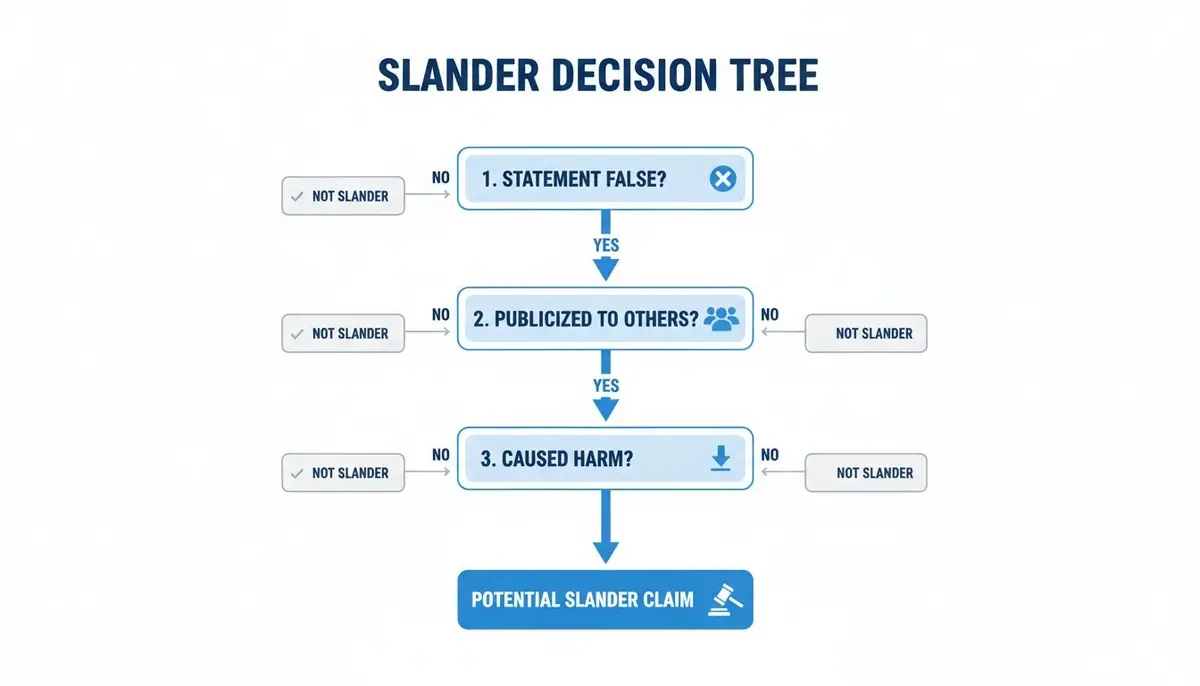
As the diagram indicates, if the statement was not false or was not communicated to a third party, it fails to meet the legal definition, regardless of its hurtful nature.
Fault and Resulting Harm
Finally, a claimant must prove both fault and harm. Fault requires demonstrating that the speaker was, at a minimum, negligent in verifying the truthfulness of the statement. For public figures, this burden is elevated to proving “actual malice”, that the speaker knew the statement was false or acted with reckless disregard for the truth.
You must also demonstrate that the statement caused tangible harm. This is often the most challenging element to prove. Did you lose a specific contract? Was a partnership agreement terminated? A direct causal link must be established between the slanderous statement and a quantifiable loss.
The challenge of proving harm is not a recent development. Between 1965 and 2000, historians were involved in over 100 defamation cases globally, often stemming from spoken statements about historical figures or events. These high-stakes legal battles underscore a long-standing principle: when spoken words cause real-world damage, the law provides a mechanism for accountability.
Slander vs. Libel: The Critical Distinction for Strategy
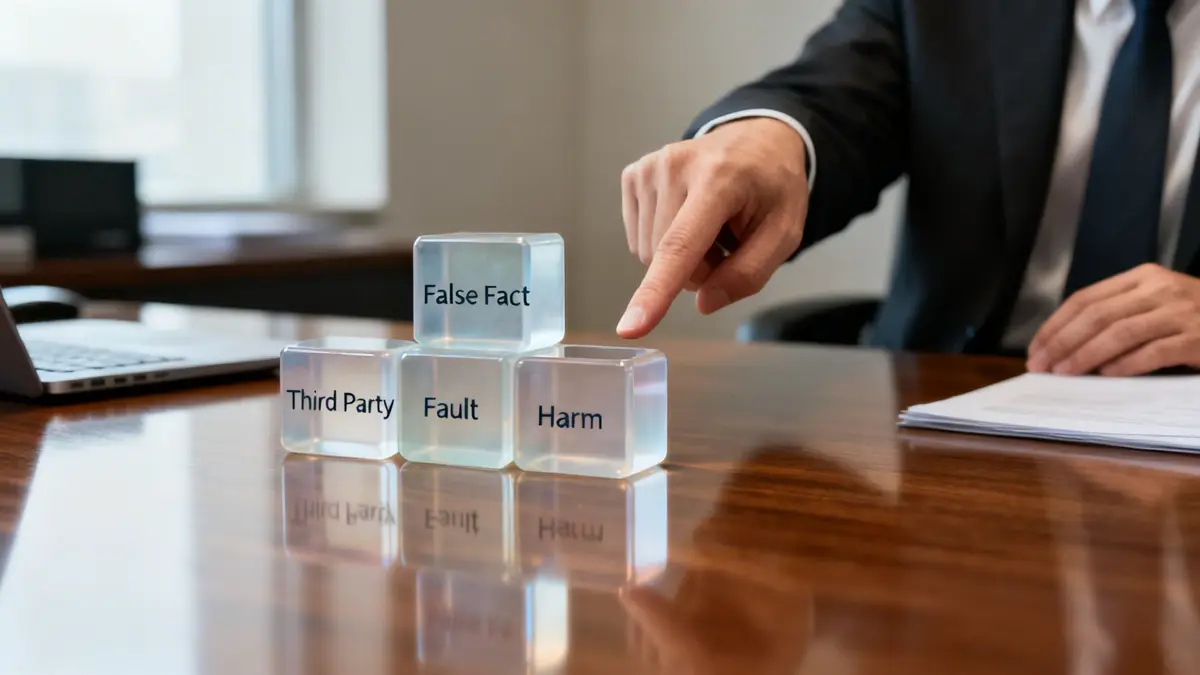
The distinction between slander (spoken defamation) and libel (written defamation) is not a mere legal technicality; it is the single most important factor shaping your response strategy. The medium of delivery, a whisper at a conference versus a published article, fundamentally alters the threat level, the evidence required, and the strategic options available.
Historically, libel has been treated as the more serious offense due to the permanence of the written word. A written statement can be disseminated widely, preserved, and reread, implying a greater degree of malice and potential for harm. Slander was traditionally viewed as transient, its impact dissipating once spoken.
This traditional view has significant modern consequences, particularly regarding the proof of damages. In many jurisdictions, a slander claim requires proof of special damages, meaning a specific, measurable financial loss directly attributable to the defamatory statement. Libel claims often do not face this high evidentiary bar, as harm may be presumed due to the statement’s permanent format.
The Blurring Line in Digital Media
Modern communication technologies have complicated this classic legal dichotomy. A viral audio clip, a podcast segment, or a video on social media combines the spoken nature of slander with the permanence and exponential reach of libel. Courts are actively grappling with how to classify these hybrid forms of defamation.
Consider a defamatory statement made in a TikTok video. Is it slander because it is spoken, or libel because the video is a permanent, shareable file? The classification can radically alter your legal standing. If a court deems it slander, you may be required to prove an immediate, specific financial loss. If it is treated as libel, the court might presume reputational damage, providing a significant strategic advantage from the outset.
For any public-facing individual, the medium dictates the strategy. A rumor shared over a private dinner presents one level of threat. The same words in a video distributed via encrypted messaging apps represent an entirely different crisis. The potential for viral dissemination can escalate a minor issue into a catastrophe overnight.
Determining how a court in your jurisdiction is likely to classify a digital attack is an essential first step. It informs how evidence is gathered and how the legal case is constructed.
Evidence Collection: Slander vs. Libel
The nature of the attack dictates the method of evidence collection. Each medium presents unique challenges and opportunities for building a robust case.
- For Traditional Slander: Evidence is often ephemeral. The strategy relies on identifying individuals who heard the statement and are willing to provide credible testimony. The entire case may rest on witness memory and credibility.
- For Digital “Slander”: Evidence is tangible but can be volatile. The immediate priority is to preserve the proof (the audio file, video, or podcast) before it can be deleted. This involves creating verified copies, archiving URLs, and capturing metadata that establishes the time and place of publication.
- For Libel: Evidence is typically straightforward. A screenshot of a social media post, a printout of an article, or a saved email provides a concrete record. The primary challenge is not proving the statement was made, but proving its falsity and the resulting harm.
This is not a minor point. A case built on witness recollection is inherently less certain than one supported by a recorded video with thousands of shares. Understanding this distinction from the outset allows you to allocate resources effectively and assess the strengths and weaknesses of your claim before initiating action.
Slander Per Se: When Reputational Harm Is Presumed
Typically, a successful slander claim requires proof of specific, measurable harm. This can be an arduous process, demanding a direct link between the spoken words and a lost client, a voided contract, or other tangible financial injury.
However, the law recognizes an exception for certain categories of false statements. These accusations are considered so inherently destructive that the court presumes reputational damage occurred. This is the legal doctrine of slander per se.
When a statement is classified as slander per se, the strategic landscape shifts dramatically. The burden of proving specific damages is lifted. The law acknowledges that the accusation is, on its face, too harmful to require additional proof of its impact. This provides a significant legal advantage, enabling a faster and more decisive response to protect your reputation.
For any executive or public figure, understanding these categories is critical for accurately assessing the real-time threat of a verbal attack.
The Defined Categories of Slander Per Se
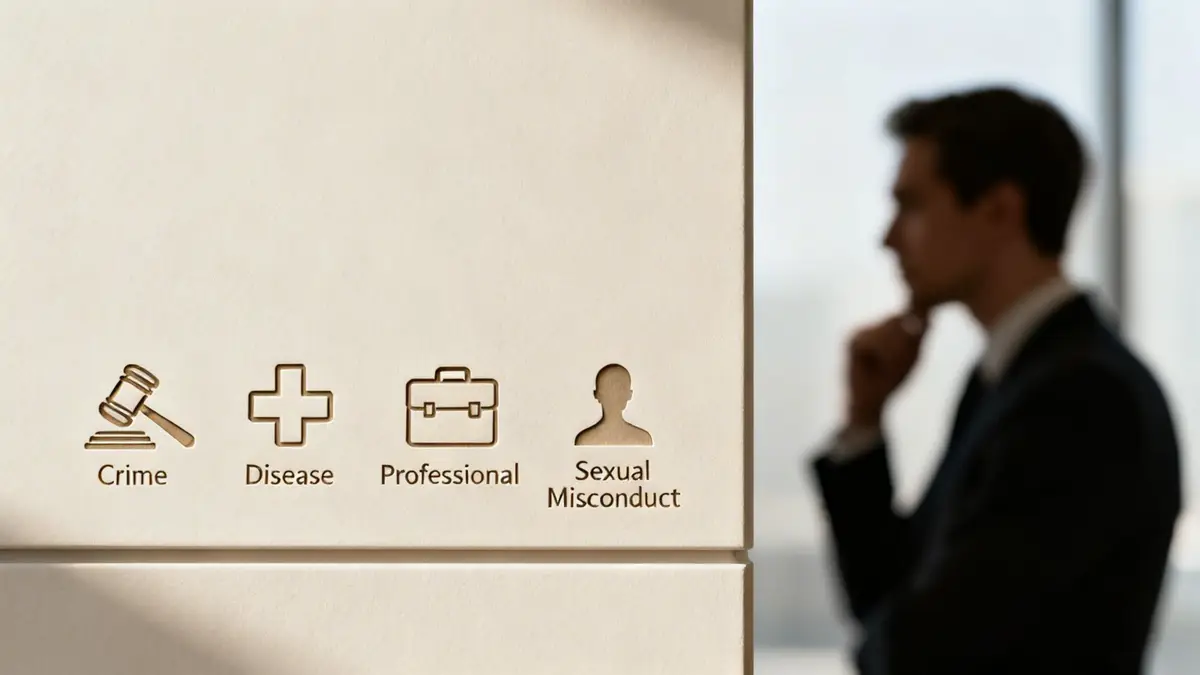
The law is highly specific about what qualifies for this elevated classification. Four distinct categories of false accusations are so damaging that they are automatically deemed slander per se. These categories concern statements that strike at the foundations of a person’s character, profession, and social standing.
If a verbal attack falls into one of these categories, your path to a legal remedy is significantly more direct.
Courts generally recognize four primary types of statements where reputational harm is presumed. These categories are narrowly defined to address the most severe forms of verbal defamation.
Categories of Slander Per Se
| Category of Accusation | Example for High-Profile Individuals |
|---|---|
| Accusations of a Serious Crime | A rival falsely states at a conference that a CEO is “under federal investigation for securities fraud.” |
| Claims of Having a “Loathsome” Disease | A disgruntled former employee falsely tells industry peers that a public figure has a contagious, socially stigmatized illness. |
| Statements Attacking Professional Competence | A competitor falsely claims a renowned surgeon “butchered their last three operations due to a drinking problem.” |
| Allegations of Serious Sexual Misconduct | An online personality falsely accuses a politician of engaging in sexually deviant behavior, using a term that implies unchastity or perversion. |
These are not minor insults; they are targeted attacks that can instantly cripple a career or public standing, which is why the law treats them with such gravity.
The Immediate Legal Advantage
Slander per se provides a legal fast track for addressing the most toxic forms of spoken defamation. It exists because courts recognize that waiting to prove financial losses from such statements would allow irreversible damage to occur. By presuming harm, the law empowers you to act immediately to neutralize the threat.
The core principle is that some lies are so poisonous that the accusation itself constitutes the injury. This allows you and your legal team to focus on proving the statement’s falsity, not on the difficult task of quantifying the financial fallout.
This distinction is paramount. Imagine a brand executive is targeted by viral audio clips labeling them a “fraudster.” In a standard slander case, they would need to prove falsity, publication, fault, and specific damages. Since this false accusation involves a business crime, it qualifies as slander per se, and the harm is presumed.
The real-world consequences are evident in major cases where slanderous falsehoods, amplified by social media, have resulted in billion-dollar judgments. The power of a lie to propagate globally in minutes is a modern reality. You can review summaries of recent high-profile defamation cases and their outcomes to understand the scale of these threats.
This doctrine is not a legal technicality. It is a critical tool for anyone facing a severe reputational crisis, accelerating your path to a remedy before the damage becomes uncontrollable.
Navigating the “Actual Malice” Standard for Public Figures
When a private citizen is slandered, they typically must only prove the speaker was negligent, that they failed to exercise reasonable care in verifying the facts. For executives, politicians, celebrities, and other public figures, the legal standard is substantially higher due to the actual malice standard.
Established in the landmark 1964 Supreme Court case New York Times Co. v. Sullivan, this standard requires a public figure to prove that the defamer either knew their statement was false or acted with “reckless disregard” for the truth.
This is not a matter of proving ill will or intent to cause harm. It is about proving the speaker’s state of mind, that they possessed a high degree of awareness that their statement was probably false but published it anyway. This higher burden exists to protect free speech and prevent powerful individuals from using litigation to suppress criticism. For an executive facing a smear campaign, it presents a significant legal challenge, but not an insurmountable one.
Determining Public Figure Status
The first critical determination is whether a court would classify you as a public figure. This is a fact-sensitive inquiry that depends on your career, public profile, and the context of the defamatory statement.
Courts typically distinguish between two types of public figures:
- All-Purpose Public Figures: These are individuals who have achieved such pervasive fame or notoriety that they are considered public figures for all purposes. This includes prominent CEOs, high-ranking politicians, and A-list celebrities.
- Limited-Purpose Public Figures: This category includes many executives and professionals. These are individuals who have voluntarily thrust themselves into the public spotlight regarding a specific issue or controversy. For example, a tech CEO who conducts a media tour for a new product would likely be considered a limited-purpose public figure for any slander related to that product or their company.
If you fall into either category, the actual malice standard applies.
The legal system operates on the principle that by entering the public arena, you accept a greater degree of scrutiny. In return, the law grants commentators more latitude, compelling you to meet a higher standard of fault to prevail in a slander case.
This reality fundamentally alters the strategic calculus of any potential lawsuit.
Deconstructing “Reckless Disregard”
Proving “reckless disregard” for the truth is the most demanding aspect of the actual malice standard. It requires more than demonstrating sloppy research or reliance on a questionable source. You must show that the speaker entertained serious doubts about the truth of their story but proceeded with publication.
The distinction is between a driver who accidentally runs a stop sign they did not see (negligence) and one who sees the sign, understands the risk, and accelerates through the intersection anyway (reckless disregard).
To build such a case, your legal team must uncover evidence that illuminates the speaker’s state of mind at the time the statement was made. This involves a forensic examination of their process and actions.
Evidence of reckless disregard may include:
- Reliance on a source known to be untrustworthy or biased.
- Failure to investigate easily verifiable facts that would have contradicted the story.
- Deliberate avoidance of obvious red flags or contrary information.
- Publication of a damaging story based solely on an uncorroborated anonymous tip.
Ultimately, you must convince the court that the speaker’s conduct was not a mere mistake but a conscious avoidance of the truth. Clearing this high bar requires a sophisticated legal strategy and a meticulous approach to evidence gathering from the moment the attack occurs.
5. Anticipating Defenses to a Slander Claim
Initiating a slander claim is merely the first move in a complex legal engagement. A successful strategy requires anticipating and preparing for every defense the opposing side may deploy. This is not a defensive posture but a strategic necessity. Understanding these common arguments enables you to identify and fortify potential weaknesses in your own claim before they are exploited.
The Absolute Defense of Truth
The most formidable defense in any defamation case is truth. If a defendant can prove the substance of their statement was factually correct, the slander claim is nullified. It does not matter how much harm the statement caused; truth is an absolute defense.
For instance, if a former partner tells a potential investor, “They defaulted on a major business loan last year,” and public or financial records confirm this default, there is no viable claim for slander. The statement may have scuttled the investment, but its truthfulness protects it from legal action.
The Shield of Privilege
In certain contexts, the law protects speech, even if false and damaging, to serve a greater public interest in open communication. This protection is known as privilege and exists in two primary forms.
- Absolute Privilege: This provides complete immunity from a defamation lawsuit. It is reserved for statements made in official proceedings, such as judicial hearings, legislative debates, and high-level executive functions. This shield allows judges, lawyers, witnesses, and lawmakers to speak freely without fear of litigation.
- Qualified Privilege: This is a more limited protection that applies when a statement is made in good faith for a legitimate purpose. A common example is a manager providing a negative but honest job reference. As long as the manager genuinely believed their statements were true and was not acting out of malice, they are likely shielded from a slander claim.
A slander claim can be neutralized if the statement was made in a protected context. Anticipating a privilege defense requires scrutinizing not only what was said but also where and why it was said.
Protected Opinion vs. Actionable Fact
The boundary between protected opinion and actionable fact is a frequent battleground in defamation litigation. The First Amendment protects statements of pure opinion. A defendant will almost invariably attempt to frame their words as a personal viewpoint.
A statement like, “I do not believe Jane is a competent leader,” is a subjective opinion. However, a statement such as, “Jane is an incompetent leader because she embezzled $50,000 from the company last quarter,” crosses the line. It implies a specific, provable assertion of fact, the embezzlement, that can be demonstrated as false.
To overcome this defense, you must show the court that the statement was not mere opinion but contained a false and defamatory factual assertion. Your strategy must be prepared to prove that what the defendant framed as a “viewpoint” was, in fact, a disguised and damaging falsehood.
How to Respond to a Slander Attack
When you are the target of slander, the initial reaction is often shock or anger. However, your actions in the immediate aftermath are critical and will dictate the strategic trajectory of your response. A passive or delayed approach is not a viable option when your reputation is under assault.
The first priority is evidence preservation. If the slanderous statement was recorded, you must secure a verifiable copy immediately. If it was spoken in person, identify all potential witnesses. Your legal team can then obtain sworn affidavits while memories are fresh. Simultaneously, begin documenting the fallout: any lost business opportunities, canceled engagements, or expressions of concern from partners and stakeholders.
Shifting from Defense to Offense
Once evidence is secured, the strategy must shift from a defensive posture to a proactive response. A modern slanderous attack, particularly one amplified online, is rarely a single-source event. It requires a coordinated, multi-faceted strategy that integrates legal action with technological solutions. The objective is to dismantle the attack at its source and across all platforms.
This involves moving swiftly to have defamatory audio or video content removed from any platform where it appears. When slanderous content goes viral, effective social media content moderation becomes an essential component of the response. Our firm often initiates this takedown process within hours, leveraging established platform relationships and a combination of legal and technical protocols to de-index and remove the hostile content.
From Immediate Containment to Long-Term Protection
Consider a CEO falsely accused of fraud in a video that goes viral. This is digital-age slander, capable of destroying shareholder value or lucrative endorsement deals almost instantly. We have observed similar reputational attacks contribute to 15-20% drops in revenue. A specialized service like ContentRemoval.com intervenes at this critical juncture, employing legal takedown notices and advanced monitoring to scrub the content from search engines, social media, and even the dark web, often within 48 hours, while ensuring it does not resurface.
An effective strategy does not conclude with the removal of the current threat. It also establishes a robust defense against future attacks.
The goal is not merely to extinguish the current fire, but to fireproof your reputation against future assaults. This requires continuous monitoring and a proactive security posture.
This forward-looking approach involves several key actions:
- Continuous Digital Monitoring: We deploy AI-driven tools to scan the surface and dark web for any new instances or re-uploads of the slanderous material.
- Neutralizing the Source: Where legally viable, we pursue action against the originator of the slander. This serves as a powerful deterrent.
- Reputational Fortification: We work to strengthen your online presence by promoting positive, factual content, building a more resilient digital footprint that is less susceptible to future attacks.
Transforming a crisis into a demonstration of strength sends a clear message: you are prepared to defend your name with precision and force. This not only protects your current standing but also secures your long-term reputation and financial interests. For a detailed analysis of the tactics involved, refer to our guide on how to deal with online defamation.
Answering Pressing Questions About Slander

When confronting a verbal attack, theoretical definitions give way to urgent, practical concerns. The high-profile individuals and executives we represent need to understand their rights and protective measures immediately. What follows are direct answers to the most common questions from clients whose reputations, careers, and financial stability are at risk.
Can I Sue if the Slander Occurred in a Private Conversation?
Yes. The legal requirement of “publication” is met as long as the false statement was communicated to at least one other person besides you and the speaker. A private conversation qualifies.
The primary challenge is not a legal one, but an evidentiary one. Without a recording or written record, your case will depend heavily on the credibility of a witness willing to testify about what they heard. Securing this testimony promptly is critical.
What Is the Time Limit to File a Slander Lawsuit?
The statute of limitations for slander is extremely short, often only one year from the date the statement was spoken. While this can vary by jurisdiction, the window to act is always narrow. There is no time for a “wait-and-see” approach. Delay can extinguish your right to take legal action permanently. This is why immediate consultation with specialists is essential to begin evidence collection and strategic evaluation.
The short statute of limitations is unforgiving. It underscores the legal system’s view of slander as an acute injury requiring an immediate response. Delay is the single greatest threat to a successful claim.
A swift response is a cornerstone of effective online reputation management for executives and is paramount to containing the damage.
How Do You Prove Financial Harm from a Spoken Lie?
Proving “special damages” requires establishing a direct causal link between the defamatory statement and a specific, quantifiable financial loss. It is not enough to assert that you lost money; you must demonstrate it with hard evidence.
This involves building a case with a clear paper trail:
- Emails showing a client terminated a contract immediately after communicating with the person who made the slanderous statement.
- A rescinded job offer, with documentation linking the withdrawal to the false statement.
- Financial records showing a clear and sudden decline in revenue that coincides directly with the dissemination of the rumor.
Witnesses, such as business partners who can testify to the statement’s direct impact on commercial decisions, are also vital. While this standard of proof may be waived for slander per se, providing evidence of tangible financial losses will always strengthen your case and increase the potential for recovering damages.
When your reputation is at stake, you require a partner capable of decisive action. ContentRemoval.com specializes in the rapid and discreet removal of defamatory content, protecting the integrity of high-profile individuals and their enterprises. Contact us for a confidential assessment of your situation.
Frequently asked questions
Is a false statement in a TikTok or podcast slander or libel?
Courts are actively deciding this. A spoken statement in a recorded, shareable file combines the oral nature of slander with the permanence of libel. If treated as libel, harm may be presumed; if treated as slander, you may have to prove a specific financial loss, so the classification shapes your strategy.
Do I need to prove I lost money to sue for slander?
Often yes, through special damages such as a terminated contract, a rescinded job offer or a documented revenue decline tied to the statement. The exception is slander per se, where accusations of crime, disease, professional incompetence or sexual misconduct carry presumed harm.
How do I preserve evidence of slander?
If it was recorded, secure a verified copy, archive the URL and capture metadata showing when and where it was published before it can be deleted. If it was spoken in person, identify witnesses and have counsel obtain sworn affidavits while memories are fresh, and document any lost business at the same time.