
To suppress negative search results, first decide whether the content can be removed or must be outranked. Removal works for copyright infringement, provably false statements, exposed personal data or a court order. Everything else, including lawful news articles and reviews, is handled through reverse SEO: a personal website, strong profiles and third-party content that push the link off page one.
Key facts
- Less than 1% of users click through to the second page of search results.
- Google’s Results About You tool covers doxxing, intimate imagery and confidential financial or medical records.
- Suppressing a low-authority blog takes 3 to 6 months; a major national news site can take 24 months or more.
- A John Doe subpoena compels a platform or ISP to reveal an anonymous poster’s identity.
Where ContentRemoval.com comes in. ContentRemoval.com is where executives and their counsel turn when the diagnosis is done and the work has to be executed: DMCA notices, publisher outreach, Google removal submissions, court-order de-indexing and suppression campaigns built to the authority of the negative source. The person, their chief of staff or their lawyer usually makes the first call. A free 15-minute Exposure Scan maps what is removable and what must be suppressed, and the report is theirs to keep. Get a Free, Confidential Exposure Scan or read how our news article removal work is done.
When a damaging search result materializes, the immediate impulse is to seek its deletion. However, the critical decision lies in the initial assessment: is removal a viable option, or is suppression the only realistic course of action?
An accurate initial diagnosis dictates strategy, budget, and the timeline for restoring your digital reputation. A miscalculation can lead to squandered resources, wasted time, or an escalation of the original problem.
Initial Diagnosis: Removal vs. Suppression
The appearance of a negative link (a damaging news story, a misleading review, or an old court document) initiates a time-sensitive strategic process. The first action is not an emotional response but a cold, calculated assessment. The strategy hinges on a single, fundamental question: can this content be legally or contractually removed, or must it be suppressed?
Choosing the wrong path has significant consequences. Attempting to compel a major news outlet to retract a critical article can provoke a follow-up story, amplifying the negative content’s prominence. Conversely, launching a comprehensive suppression campaign when a straightforward legal takedown was possible is a costly and inefficient error.
Three Questions That Define Your Strategy
Your entire operational plan depends on the answers to a few core questions. A dispassionate evaluation is essential, as it will determine whether to pursue direct removal or a long-term suppression effort.
- What is the nature of the content? Is it demonstrable defamation, or is it a negative opinion or a factually accurate (though unflattering) news report? Copyright infringement, provably false statements of fact, or non-consensual intimate imagery often have clear legal avenues for removal. A negative review or a critical but fact-based article almost never does.
- Who is the publisher? A takedown request directed at a small, privately-operated blog carries different strategic implications than one sent to the legal department of The New York Times or the Wall Street Journal. Major media organizations will almost certainly refuse, citing journalistic privilege and free speech principles. The publisher’s size, reputation, and internal policies are paramount.
- What is the jurisdiction of publication? The legal frameworks governing content removal vary dramatically by country. A “Right to Be Forgotten” request may succeed in having a link de-indexed from Google’s European search results, but the same request has virtually no chance of success in the United States due to robust First Amendment protections.
The hard truth is that the vast majority of negative online content does not meet the strict legal standards for forced removal. This gap between desire and reality is why suppression has become the default, and often only, strategy for managing most online reputation issues.
This decision tree provides a visual framework for this critical initial choice. It illustrates how the feasibility of a takedown serves as the strategic fork leading to either removal or suppression.
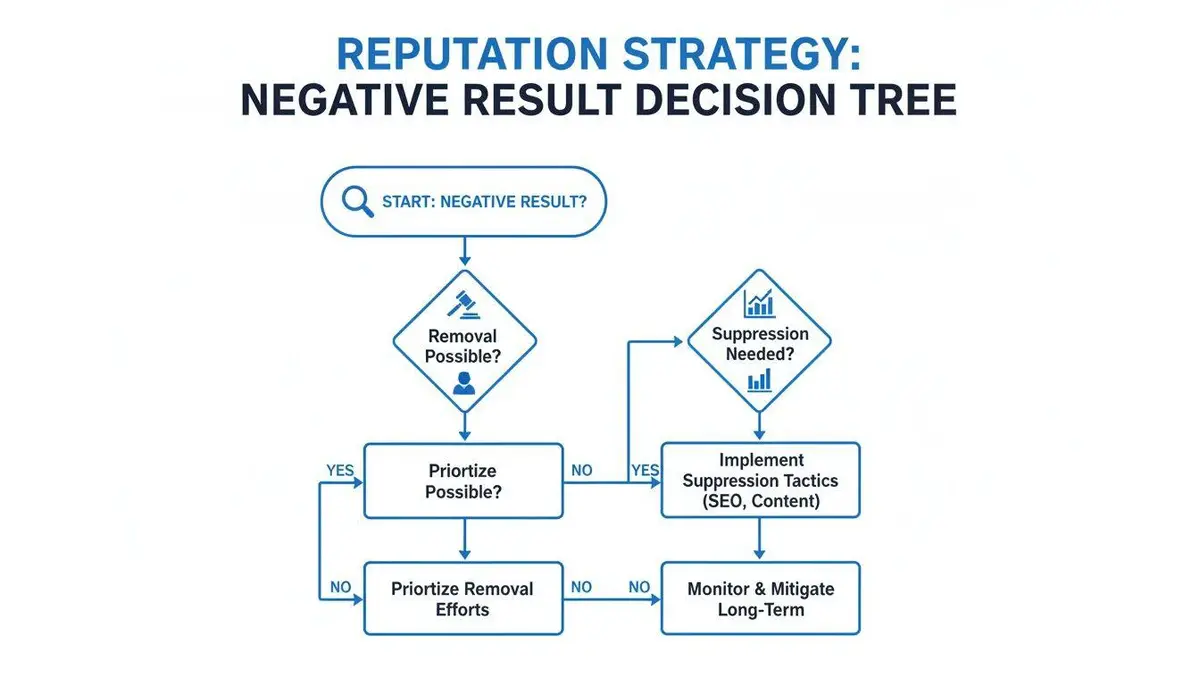
Suppression is not a lesser option; it is the necessary and powerful alternative when a direct takedown is not feasible.
The Strategic Imperative of Suppression
The choice between removal and suppression is made more critical by user search behavior. With less than 1% of users clicking to the second page of search results, a single negative link on page one can functionally define an individual’s or company’s reputation.
While a legal removal offers a clean and final resolution, it is frequently unattainable. The majority of online attacks do not qualify for removal under defamation or privacy laws. Suppression, often termed reverse SEO, thus becomes the primary instrument for rebuilding a positive and accurate online narrative.
This matrix offers an initial framework for assessing your strategic options.
Removal vs. Suppression Strategy Matrix
| Content Type | Feasibility of Removal | Primary Strategy Recommendation | Typical Timeline |
|---|---|---|---|
| Defamation/Libel | Moderate (if provably false) | Removal. Pursue legal takedown or court order first. | 2-6 months |
| Negative News Article | Very Low | Suppression. Create counter-content and perform SEO. | 6-12+ months |
| Bad Customer Review | Low | Suppression. Push down with positive reviews; may attempt removal. | 1-3 months |
| Copyright Infringement | High | Removal. File a DMCA takedown notice. | 1-4 weeks |
| Mugshot/Arrest Record | Low-Moderate | Removal & Suppression. Some sites will remove for a fee; otherwise, suppress. | Varies widely |
| Court Document | Very Low | Suppression. These are public records and very difficult to remove. | 6-12+ months |
This matrix serves as a preliminary guide. Your initial diagnosis is what separates a panicked, emotional reaction from a calculated, professional strategy.
For a more granular analysis of scenarios where direct removal is the optimal path, our complete guide explains how to remove online content. A correct foundational assessment ensures every resource expended contributes directly to the restoration of your reputation.
The Surgical Strike: Pursuing Direct Removal

Before committing to a long-term suppression campaign, every viable option for direct removal must be exhausted. This is not about dispatching angry emails; it is a surgical strike. A successful removal hinges on identifying the precise legal or policy violation that compels a platform or publisher to act.
Generic complaints are ineffective and will be ignored. The key is to pinpoint the exact policy violation or legal tripwire the content has crossed. That is your leverage.
The DMCA: Your Most Expeditious Path for Copyright Violations
One of the most potent instruments available is the Digital Millennium Copyright Act (DMCA). It is not a panacea for all negative content, but it is exceptionally effective for clear-cut instances of copyright infringement.
If a third party has misappropriated a proprietary photograph, published an internal corporate document, or copied unique website code, the DMCA provides a legal mechanism to compel the website’s hosting provider to remove the infringing material, often without engaging the original poster. This is accomplished by submitting a properly formatted DMCA Takedown Notice, a formal legal document, to the site’s host or the relevant search engine.
The power of a DMCA notice lies in the legal liability it places upon the hosting platform. Faced with a legitimate claim, most providers will remove the content immediately to maintain their “safe harbor” protections, often without notifying the original publisher.
This is a technical legal process. You must be 100% certain of copyright ownership. Filing a fraudulent DMCA claim can result in liability for damages and the opposing party’s legal fees.
The Nuances of Webmaster Communication
When a legal instrument like the DMCA is not applicable, the next course of action is to communicate directly with the site owner. This is a delicate process where tone and substance are critical. An adversarial approach is almost certain to fail.
The objective is to demonstrate why removing or amending the content is in the webmaster’s best interest. This typically involves proving that the content is factually incorrect, outdated, or in violation of the site’s own terms of service.
Effective Communication Tactics:
- Offer a Correction, Not a Confrontation: If an article contains a factual error, provide clear, verifiable evidence and request a correction. Publishers are far more inclined to amend a post than to delete it.
- Frame a Personal Appeal: In cases of genuine personal hardship that are not strictly illegal, a polite and non-threatening appeal can be effective, particularly with smaller blogs or independent site owners.
- Highlight Their Legal Exposure: When dealing with defamatory user-generated content on a forum, you can discreetly inform the webmaster that they are hosting material that could expose them to legal action.
A poorly executed request can antagonize the publisher and eliminate any chance of a quiet resolution. Never make empty legal threats. If legal action is mentioned, be prepared to follow through.
Leveraging Google’s Own Removal Mechanisms
While Google is a staunch defender of free expression, it has established specific protocols for removing certain categories of harmful content directly from its search results. These tools address specific, egregious violations, not merely content you find unflattering.
Google’s “Results About You” tool and other legal request forms are the primary channels. They are most effective for removing:
- Doxxing and Private Information: Eliminating search results that expose a home address, personal phone number, or private email.
- Non-Consensual Intimate Imagery (NCII): A powerful mechanism for de-indexing explicit photos or videos published without consent.
- Confidential Financial or Medical Records: Requesting the removal of pages that disclose private financial or medical data.
Every submission requires meticulous documentation. You will need the exact URL of the offending page and the search result, along with a clear explanation of the specific Google policy being violated. A successful request does not remove the page from the internet, but it erases it from Google’s search results, a critical first step to suppress negative search results when the content fits these strict criteria.
Advanced Remediation Through Legal Escalation
When direct requests and takedown attempts are exhausted, the strategy shifts from petitioning to compelling action. This phase leverages the full force of the law to secure removal or de-indexing of damaging content. For executives, high-net-worth individuals, and their counsel, this involves executing a precise legal strategy designed to produce a definitive outcome.
The most powerful instrument in this phase is a court order. While obtaining one is a significant legal undertaking, its effect is absolute. A court order declaring content defamatory, false, or otherwise illegal creates a non-negotiable obligation for search engines like Google to act.

When Google’s legal department receives a valid court order, the request transitions from a discretionary matter to a mandatory action. This is the single most effective path for addressing content that causes material harm, transforming a legal judgment into the ultimate tool for suppressing negative search results.
Unmasking Anonymous Attackers with a Subpoena
To sue for defamation, you must know whom to sue. Many online attacks originate from anonymous users employing pseudonyms on forums, review sites, and blogs. The legal instrument to address this is a John Doe subpoena.
Legal counsel can file a lawsuit against an unnamed defendant, the “John Doe”, and then petition the court to issue a subpoena. This legal document is served to the website, hosting provider, or ISP, compelling them to disclose any identifying information associated with the anonymous user, such as an IP address, name, or email.
A subpoena is not a request; it is a court-ordered command. Platforms that vigorously protect user privacy against informal inquiries are legally obligated to comply with a valid subpoena. It is the essential first step in any substantive legal action against an anonymous party.
Unmasking an attacker is often a decisive moment. It not only clears the path for a defamation lawsuit but frequently halts the harassment immediately. Once the shield of anonymity is removed, most antagonists cease their activities.
Securing a Court Order for Defamation
Obtaining a court order is a complex legal proceeding. You and your legal counsel must prove that the online statement meets the legal definition of defamation. This generally requires demonstrating that the statement is:
- False: A provably false statement of fact, not an opinion.
- Published: Communicated to a third party (e.g., posted on a public website).
- Identifiable: The statement is clearly about you or your business.
- Harmful: It caused tangible damage to your reputation, finances, or personal well-being.
The evidentiary bar for defamation is high. In the U.S., public figures face the heightened “actual malice” standard, requiring proof that the publisher knew the statement was false or acted with reckless disregard for the truth. Despite the difficulty, a successful lawsuit provides the legal authority needed to compel a takedown. Our firm specializes in navigating these challenges. You can learn more about our specific approach to legal content removal on our services page.
The Impact of Jurisdiction on Legal Success
The choice of jurisdiction for filing a lawsuit is a critical strategic decision. The probability of success varies dramatically between countries. The United States, with its robust First Amendment protections for speech, is one of the most challenging jurisdictions for defamation claims.
In contrast, other legal systems can be more favorable. Germany, for instance, has stringent laws against defamation and insult, making it easier to secure court orders against slanderous content. This is a vital consideration in global reputation management, as governments and law firms increasingly pressure technology companies to act. Nearly 330,000 removal requests have been sent to Google from legal and government entities since 2020, with a 34% annual growth rate in these demands.
A sophisticated legal strategy may involve initiating a lawsuit in a jurisdiction outside the U.S. to obtain a judgment that can then be enforced globally, compelling search engines to de-index the damaging content for all users.
The Suppression Playbook: Taking Control with Reverse SEO
When direct removal is not an option, the strategy shifts from defense to offense. Suppression is not about hiding a problem; it is about strategically reclaiming control of your narrative. This is achieved through reverse SEO, a process of creating and promoting positive, high-authority content to displace negative material from Google’s first page.
This is the difference between allowing a hostile source to define you and defining yourself on your own terms. The objective is to build a digital fortress of assets that you control, pushing damaging links down to page two or three of search results, where they become effectively invisible.
Building Your Digital Fortress
A campaign to suppress negative search results is fundamentally about creating a portfolio of positive web properties. This is not random content publication; it is the construction of a collection of digital assets engineered to outrank and overshadow the negative link. Each asset must be meticulously optimized and promoted to build its own authority in the view of search engines.
A core component is understanding how to improve Google Search Rankings for the positive narrative you want to project. The entire goal is to make your own websites and profiles more relevant to Google than the negative item.
The key assets in a typical suppression campaign include:
- A Personal or Professional Website: This is your digital headquarters and the most powerful asset you can control. A well-constructed, search-optimized site (e.g., YourName.com) is non-negotiable.
- High-Authority Professional Profiles: Fully developed profiles on LinkedIn, industry directories, and executive biography sites. These are trusted sources that Google’s algorithm favors.
- Thought Leadership Content: Articles, interviews, or op-eds published on respected third-party sites (e.g., industry journals, major business publications) leverage their credibility to enhance your own.
- Social Media Profiles: Business-focused accounts on platforms like X (formerly Twitter) or others relevant to your field can rank for your name and help direct the public conversation.
Every asset is developed with a single mission: to dominate the first page of search results for your name or the keywords associated with the negative content.
The Ground Game: How Suppression Works
A successful suppression campaign is a methodical, long-term initiative. It is a synthesis of content creation, technical SEO, and strategic promotion executed in concert. You are building a wave of positive authority so substantial that Google’s algorithm cannot ignore it.
Suppression is not a quick fix. It is a war of attrition fought on the battlefield of search engine algorithms. Victory is achieved by being more persistent, more strategic, and more authoritative than the negative source.
The campaign begins by establishing foundational assets, your personal website and key professional profiles. This is followed by a steady cadence of high-quality content publication: blog posts, articles, and press mentions that link back to and reinforce your core properties, creating a powerful, interlinked network of positive authority.
Simultaneously, we execute the technical elements of SEO. This involves optimizing every asset’s title tags, meta descriptions, on-page content, and image alt text. It also includes building high-quality backlinks from other reputable websites, which act as endorsements, signaling to Google that your positive content is important and trustworthy.
The Reality Check: Time and Investment
The time and resources required to suppress a negative link are directly proportional to the authority of the website hosting it. Displacing a negative comment from an obscure forum is one matter; demoting a critical article from a major international news outlet is another challenge entirely. Our in-depth guide offers more detail on how to remove negative content from Google’s first page when suppression is the necessary route.
The following provides a realistic expectation of timelines:
| Negative Source | Estimated Suppression Timeline | Intensity of Campaign | Key Tactics |
|---|---|---|---|
| Low-Authority Blog or Forum | 3-6 Months | Low to Moderate | 1-2 core websites, regular social media activity, 5-10 positive content pieces. |
| Mid-Tier News Outlet or Prominent Review Site | 6-18 Months | Moderate to High | Multiple websites, aggressive content creation (20+ pieces), robust backlink building, potential PR engagement. |
| Major National or International News Site (e.g., WSJ, BBC) | 24+ Months | Very High | A multi-year, multi-faceted campaign involving dozens of web properties, continuous content publication, high-level media placements, and intensive technical SEO. |
Countering a negative result from a media powerhouse requires a relentless and significant investment. You are competing against a domain with immense trust and millions of backlinks. To succeed, you must build an even stronger and more relevant collection of your own digital assets. This is a marathon, not a sprint.
Staying Ahead: The Shift to Proactive Monitoring
Achieving a clean search results page is not the end of the engagement. It is the transition from an offensive posture to a robust defensive one. An online reputation is never static.
Once the investment has been made to suppress negative content, that investment must be protected. This requires a shift from active remediation to proactive monitoring for new threats before they can gain traction in search results. Without ongoing vigilance, you are merely awaiting the next crisis.

Setting Up AI-Powered Alert Systems
The foundation of a modern reputation defense is a professional, AI-driven monitoring system. These are not basic Google Alerts. These are sophisticated instruments that scan the web 24/7 for any mention of your name or brand, instantly analyzing the sentiment and authority of the source.
When a new mention appears, the system assesses the threat level. A mention on an obscure blog might be a minor event. However, if a defamatory comment appears on a major forum or a known antagonist publishes a negative article, an immediate, high-priority alert is generated.
This speed is a decisive advantage. Detecting a threat within hours of publication allows for the initiation of a removal or suppression process before Google can fully index and rank the content, effectively neutralizing the problem at its inception.
The Realities of Proactive Defense
This monitoring-first strategy is critical because it detects re-uploaded content. Adversaries frequently attempt to repost removed articles or reviews on different websites. A robust monitoring tool identifies these duplicates instantly, allowing for immediate issuance of another takedown notice.
It also provides early warning of new issues, from a pattern of negative customer reviews to an inaccurate profile appearing on a data broker site. This has become especially critical as platforms like Google become more aggressive in their policy enforcement. For example, our data shows a massive six-fold increase in Google review deletions over just seven months in 2025, indicating a significant shift in platform behavior. Our full analysis on this trend and its impact on brand reputation details the strategic opportunities this presents.
A one-time cleanup provides a fresh start. Continuous monitoring ensures it endures. It is the shield that protects the peace of mind you worked to restore.
Finally, maintenance of the positive digital assets you have built is essential. They must be periodically updated with fresh content to maintain their high rankings, ensuring your narrative remains the most prominent and authoritative one online. This is the final component of long-term reputational security.
Frequently Asked Questions
When your reputation is under attack, you require clear, direct answers. This section addresses the most common questions from executives, high-profile individuals, and their legal counsel.
Can Negative Search Results Be Permanently Deleted?
Yes, but it is uncommon. True, permanent deletion occurs only when the content is removed from the source website. This is achievable only in specific scenarios, such as a clear violation of a site’s terms of service, copyright infringement (enabling a DMCA takedown), or when compelled by a court order.
For most content, particularly news articles protected by free speech principles, complete deletion is not a viable option. In these instances, the objective is not removal but to suppress the negative search results so they become practically invisible.
How Long Does It Take To Suppress Negative Content?
The timeline is dictated entirely by the authority of the website hosting the negative content. Displacing a defamatory comment on an obscure, low-authority blog may show results in as little as 3-6 months.
Conversely, suppressing a negative article from a media powerhouse like The Wall Street Journal or the BBC is a different order of battle. These sites possess immense authority in Google’s algorithm. Displacing them requires a major, sustained campaign that can easily take 18-24 months or longer.
Be wary of any firm promising to bury a negative link from a major news outlet in a matter of weeks. This is a strategic contest for authority that requires time and persistence to build sufficient positive influence to outrank a powerful source.
Is It Possible To Suppress News Articles?
It is possible, but it is the single most challenging task in reputation management. News organizations benefit from powerful free speech protections, making removal a near-impossibility. Suppression is the only realistic strategy.
This requires an aggressive, well-funded reverse SEO campaign. A high volume of quality, positive content (interviews, professional biographies, and thought leadership pieces published on other credible sites) must be created and promoted to systematically outrank the negative story. This is a resource-intensive marathon, not a sprint.
What Is The Difference Between Suppression And De-indexing?
While both make content disappear from search results, suppression and de-indexing are distinct tactics.
- Suppression: The process of demoting a negative URL in search rankings by promoting positive content above it. The negative page still exists and is indexed by Google but is pushed to page two or deeper, where it is rarely seen.
- De-indexing: A formal request for Google to completely remove a specific URL from its search index. The page still exists on the source website but will not appear in any Google search. De-indexing is a powerful remedy, but Google grants it only for specific violations (like doxxing) or in response to a valid court order.
De-indexing is the more decisive action but has strict prerequisites. Suppression is the default strategy for all other scenarios.
Can I Suppress Negative Results Myself?
While the basics of SEO can be learned, executing a full-scale suppression campaign against an authoritative website is not a DIY project. The process is complex, requiring deep expertise in technical SEO, content strategy, digital PR, and the nuances of search engine algorithms.
A self-managed campaign can easily backfire. The creation of low-quality content may be ignored by Google, or worse, inadvertently draw more attention to the very content you are trying to bury. For any significant reputational threat, engaging a specialist firm ensures the strategy is executed with the necessary precision and resources to succeed without risking further damage.
When your reputation is on the line, you need a team with a proven record of delivering results with discretion and certainty. ContentRemoval.com specializes in complex cases where traditional methods fail. Contact us for a confidential assessment to build your strategic action plan.