
To suppress Google search results, first classify the harmful page, then choose one of three levers: direct removal through Google policy tools, publisher outreach or a legal hook; SEO suppression that builds stronger owned, social and third-party assets to push the result off page one; or legal intervention when facts are disputed. Removal comes first where possible.
Key facts
- Google’s Results about You tool removes results exposing contact details such as phone numbers and home addresses.
- Concise, factual removal requests achieve up to 40% higher success; requests without legal basis often sit below 20%.
- Suppression takes 3 to 6 months for weak sites and 6 to 12 months or longer for high-authority news.
- For doxxing or intimate imagery, source removal comes first; suppression is only a supporting tactic.
Where ContentRemoval.com comes in. ContentRemoval.com sequences source outreach, platform reports, de-indexing requests, legal escalation and suppression according to what is most likely to change page one without making the record worse. General counsel, chiefs of staff and family office principals usually make contact once a result has surfaced during a deal, board review or hiring process. A free 15-minute Exposure Scan maps what is removable and what must be outranked, and the report is theirs to keep. Get a Free, Confidential Exposure Scan or read how our news article removal work is done.
A board candidate is about to vet you. A prospective investor has your name in a browser tab. Your child’s school administrator searches your family office. Then a hostile result appears on page one. At that moment, this stops being an annoyance and becomes an asset-protection problem.
Individuals often react ineffectively. They fire off emotional emails to publishers, submit weak Google forms, and start publishing random blog posts in the hope that something moves. That usually wastes time and sometimes hardens the opposition. Search reputation work rewards diagnosis, sequencing, and restraint.
The right question isn’t “How do I get this off Google?” The right question is which path fits the exact threat in front of you. In practice, you have three levers: removal at the source or from search, suppression through controlled assets that outrank the result, and legal intervention when policy requests or voluntary cooperation won’t solve the problem. If you choose the wrong lever first, you lose time, credibility, and sometimes evidence.
For executives, public figures, and family offices, this is a strategic matter, not a consumer-tech chore. The pressure is real because the audience is real: banks, journalists, counterparties, recruiters, litigants, and rivals all use search as a shortcut to judgment. If you need a practical starting point on removing harmful online content, start there. Then treat everything that follows as a decision framework, not a list of internet tricks.
An Executive’s Introduction to Reputation Defense
A damaging search result rarely arrives with warning. It usually appears when the stakes are already high. Someone forwards you a screenshot before a financing meeting. Counsel notices an old allegation ranking above your official biography. A family member finds an address, phone number, or other personal detail exposed in search. The common feature isn’t embarrassment. It’s loss of control.
That loss of control is what makes search harm so destabilizing. Google becomes a distributor, but the underlying issue sits beneath that layer. Sometimes the problem is a privacy violation. Sometimes it’s a lawful but damaging article. Sometimes it’s false content that needs a legal answer, not an SEO answer.
Three levers, three very different outcomes
The first lever is direct removal. If the content violates Google policy, exposes sensitive personal information, infringes copyright, or can be removed by the publisher, this is the cleanest path. If it works, the result disappears because the source disappears or the search index stops surfacing it.
The second lever is suppression. You use this when the content is likely to remain online. The objective is not moral victory. It is displacement. You build and optimize stronger assets so Google has better candidates to rank above the damaging page.
The third lever is legal intervention. This is the path when facts are disputed, publication is malicious, or the harm sits inside a jurisdictional or platform-policy gray zone. Many high-value matters end up here because informal requests lack force.
Practical rule: Don’t pick a tactic because it’s available. Pick it because it matches the content type, the publisher, and the authority of the ranking page.
People under pressure want certainty. Search work doesn’t offer that. It does offer a disciplined process that raises your odds and prevents self-inflicted damage. That’s the difference between a panicked response and reputation defense.
Your First 24 Hours A Triage Framework
A damaging result appears on page one at 8:15 a.m. By noon, someone on your team has emailed the publisher, filed a Google form, and posted an angry response. That sequence feels decisive. It usually weakens your position.
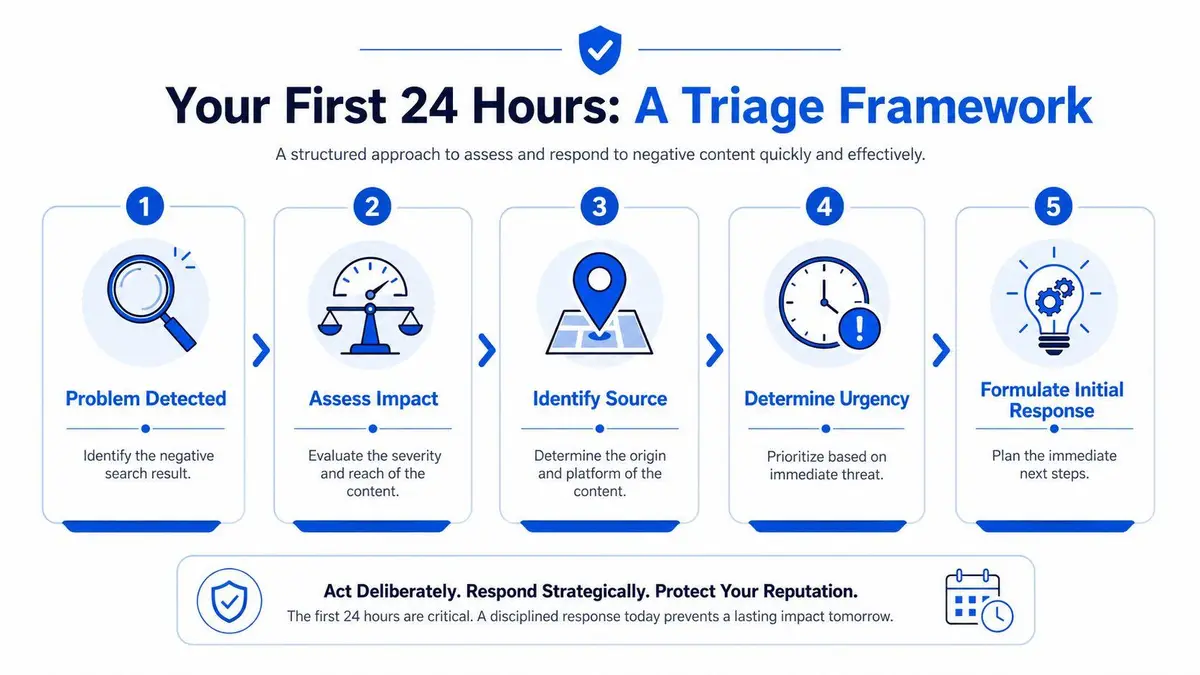
The first 24 hours are for control, evidence, and choice. You need to decide whether this is a removal matter, a suppression matter, or a legal matter before you touch the publisher, the platform, or Google.
Classify the problem before you respond
Start with four questions, and answer them with evidence, not instinct.
- What is ranking? A news article, review page, forum thread, mugshot listing, social post, data broker profile, or copied page each requires a different path.
- Why is it harmful? False statements, exposed personal data, misleading framing, outdated facts, or a publication that may support legal action.
- Who controls it? A major publisher, an anonymous operator, a review platform, a public records site, or a property you own.
- What is the immediate exposure? Your personal name, your company, a family member, or a branded search tied to a live deal, hearing, board review, or press cycle.
This step decides the rest. Skip it, and you waste your best window on the wrong tactic.
Unrepresented individuals routinely overestimate what Google will remove and underestimate how much source authority changes the outcome. If you need a clear explanation of what de-indexing can and cannot do, read this strategic guide to search result removal and de-indexing. Use it as a decision tool, not a promise.
Judge the source with the same seriousness as the wording
Clients fixate on how unfair the content sounds. Google cares a great deal about where it lives.
A hostile post on a weak domain can often be handled through operator identification, host escalation, or a tightly drafted removal request. A negative article on a national news site is a different case entirely. The issue there is rarely outrage. It is authority. High-authority pages survive complaints that would remove weaker pages in a week.
Use a simple internal matrix:
| Source type | Best opening move | Likely fallback |
|---|---|---|
| Anonymous blog or low-trust site | Preserve evidence, identify operator, send a careful removal request | Legal escalation or suppression |
| Data broker or personal info page | Privacy request, source takedown, de-indexing request | Ongoing monitoring |
| Review or platform page | Platform policy challenge, factual rebuttal if advised | Suppression |
| High-authority news outlet | Legal analysis first | Long-term suppression |
The strategic question is not “What can we try first?” The strategic question is “Which path has a real chance of changing page-one visibility within the time and risk limits we have?”
Set priority by business impact
Every negative result is not a crisis. Some are irritating. Some threaten safety, financing, licensing, hiring, custody matters, or an active transaction. Treat those categories differently.
Use this priority model:
- Immediate risk: exposed home address, phone number, IDs, explicit imagery, extortion pressure, active harassment, live deal disruption
- High business risk: investor diligence, board review, regulatory scrutiny, licensing, enterprise procurement, major media attention
- Manageable reputational risk: old criticism, limited-traffic commentary, isolated reviews, lawful negative coverage with no active trigger event
Urgency should change your response speed, not your standards. Fast is good. Sloppy is expensive.
Build the file before you make contact
Your first-day deliverable is a case file. That file should include URLs, screenshots, ranking positions, publication dates, cache status, authorship, contact details, whether the content is copied elsewhere, and whether the page sits on a domain with real authority.
One sentence matters here. Self-service becomes counterproductive the moment your outreach can alert an entrenched publisher, provoke a hostile operator, or create written admissions that narrow your legal options.
If the page exposes private identifiers or creates a safety issue, push toward removal immediately. If the content is lawful, entrenched, and ranking on a strong domain, plan for suppression early. If the statements are false and materially harmful, get legal review before anyone on your side starts arguing with the source.
That is what disciplined triage looks like. It gives you a strategy with odds, sequence, and limits, instead of a string of reactive moves that make recovery harder.
The Surgical Strike Direct Removal Pathways
A bad result goes live at 8:00 a.m. By noon, your team is debating whether to bury it with SEO, call the publisher, or file something with Google. The right answer depends on one question first. Is this page removable, or are you about to waste time on a channel that has no real chance of success?
When removal is possible, pursue it first. Eliminate the page, the snippet, or the index entry, and you avoid a long suppression campaign for a problem that never needed one.
Google tools work inside strict policy boundaries
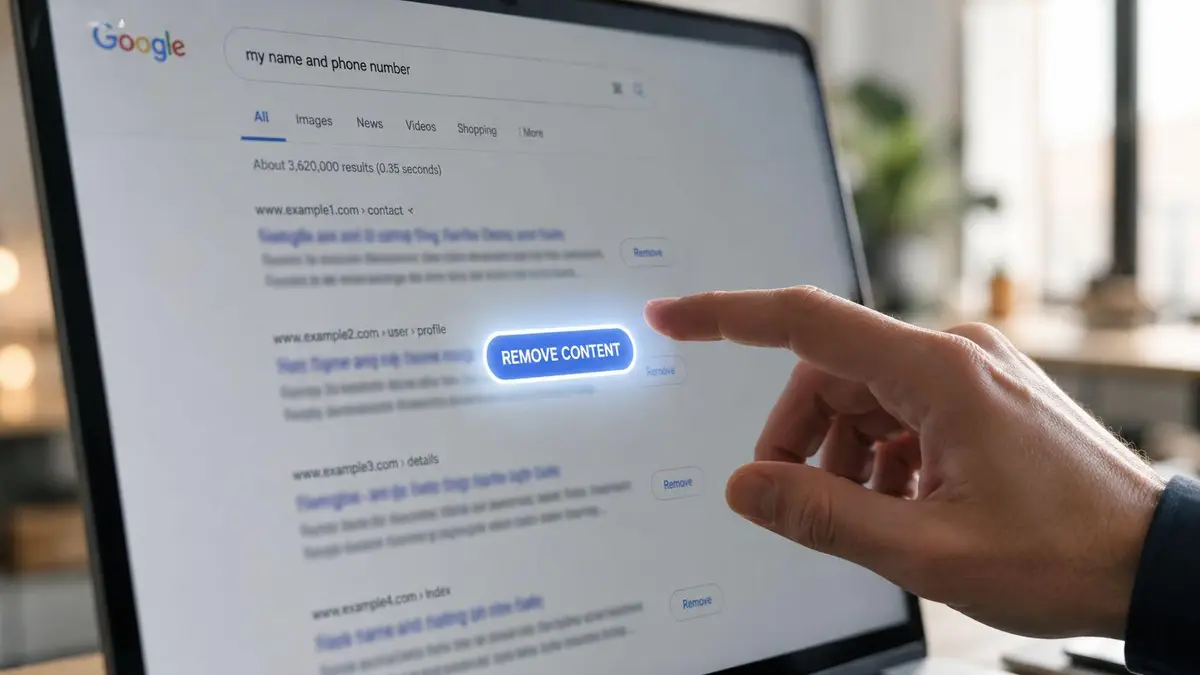
Google will remove some material from search results, but only when the request fits a defined policy lane. Google’s Results about You support documentation explains that users can request removal of search results exposing sensitive personal information, including certain contact details, by selecting Remove result and submitting the applicable reason for review.
Use this route for exposed phone numbers, home addresses, and similar personal identifiers. Do not use it as a catch-all response to criticism, negative reporting, or lawful commentary. Clients lose valuable time when they confuse policy removal with reputation repair.
For a clearer explanation of the difference between search result removal and source-page removal, see this guide to de-indexing and search result removal.
Source removal usually gives you the highest-value outcome
If the publisher deletes the page, removes the harmful passage, or adds a noindex directive, the search problem usually shrinks fast. That makes source outreach the highest-upside move when you have a credible basis and a publisher who is reachable.
The decision is strategic, not procedural. Ask for deletion when the material should not remain online at all. Ask for correction when a narrow factual error is the actual issue. Ask for noindex when the publisher may refuse deletion but is open to reducing discoverability. Clients and internal teams get poor outcomes when they bundle all three asks into one vague complaint.
Keep the outreach controlled and specific:
- Identify the exact URL and passage: Point to the page and the specific statement, image, or data field at issue.
- State the basis: Privacy exposure, factual inaccuracy, copyright infringement, impersonation, or another policy or legal ground.
- Request one defined remedy: Removal, correction, anonymization, or noindex.
- Set a clear review window: Long enough for a decision, short enough to keep the matter active.
Short requests usually perform better because they are easier for editors, trust-and-safety staff, and webmasters to assess quickly. Long emotional narratives create friction and often bury the actual basis for action.
Later in the process, this explainer can help clarify how search and source removal differ.
Legal grounds separate viable cases from dead ends
The probability of success rises sharply when the request rests on a real legal or policy hook. Copyright claims can support takedowns when protected material has been republished without authorization. Court orders can change the publisher’s risk calculus immediately. Privacy law can be decisive in one jurisdiction and largely irrelevant in another.
That is the key decision point. If you have a clean legal basis, press it with precision. If you do not, do not let your team improvise an accusatory outreach campaign that hardens the publisher’s position or creates a written record that works against you later.
A 2024 Harvard Law Review analysis, cited in this analysis of suppression and removal strategies, found that concise, factual removal requests can achieve up to a 40% higher success rate, while direct requests without a legal basis often come in below 20%. The same analysis notes that direct contact with the webmaster can produce removal or noindex in days or weeks when the operator is cooperative.
Here is the practical framework. Use Google policy tools for clear policy violations. Use publisher outreach when a targeted ask has a realistic chance of acceptance. Use legal process when the facts support it and the stakes justify escalation. If none of those paths has a credible basis, stop pretending removal is likely and shift your resources to the next best strategy.
The Siege Strategic SEO Suppression
You wake up, search your name, and the damaging result is still sitting on page one. Legal removal is weak. Publisher outreach went nowhere. At that point, the question is no longer whether you dislike the result. The question is whether it can be displaced by assets you can control, strengthen, and sustain.
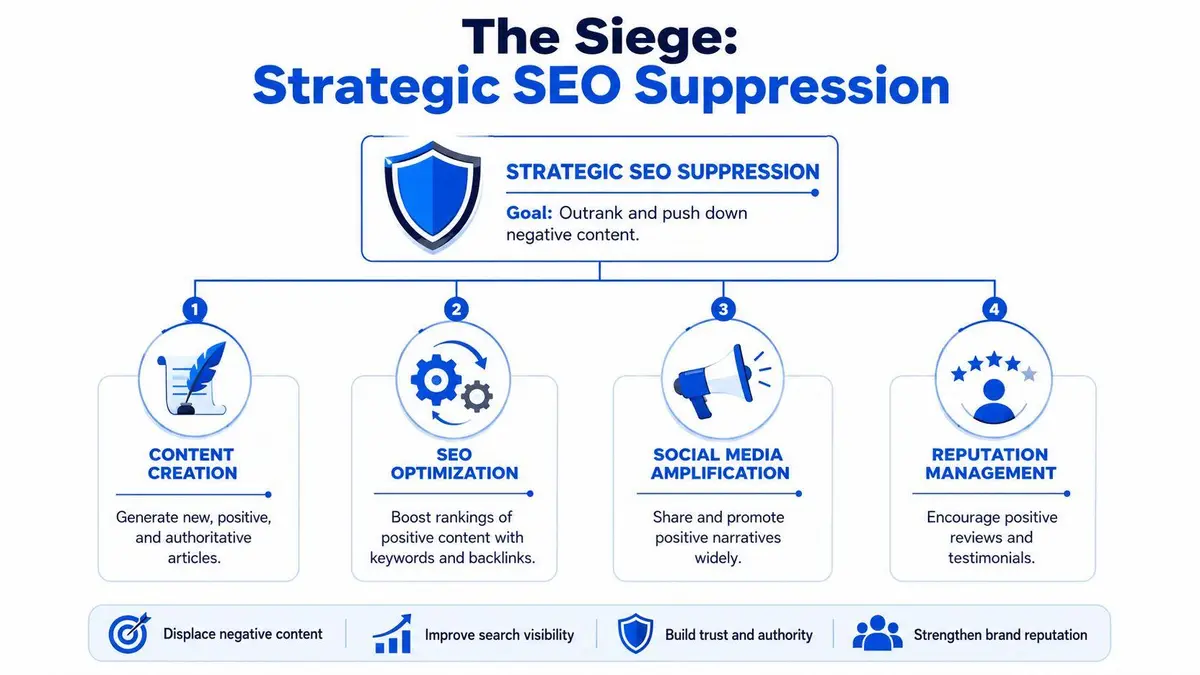
That is what suppression is for. It is a ranking campaign built to replace weak or vulnerable search positions with stronger pages that deserve to rank for your name or brand query.
What suppression is really trying to do
The objective is simple. Push the harmful result off page one.
Clicks collapse after the first page, so a result that falls to page two usually loses most of its practical impact. The work, however, is not simple. Google does not remove a lawful page because you object to it. Google rewards the pages it sees as more relevant, more authoritative, and more useful for that search.
The asset stack that actually moves rankings
Weak campaigns fail for a predictable reason. They rely on one new article, a neglected personal site, and a few social posts. That does not give Google enough high-quality alternatives to reshuffle page one.
Serious suppression requires an asset stack with different authority profiles and search intents:
- Owned web properties: executive bios, company leadership pages, personal domains, and tightly optimized pages built around exact-name searches.
- Verified social profiles: profiles on strong domains that can rank quickly when they are complete, active, and consistent with your identity.
- Third-party publications: contributed articles, association pages, speaking profiles, interviews, and reputable directory listings.
- Support content: videos, press mentions, branded content, and citation signals that strengthen the entity Google associates with your name.
Use each asset for a specific ranking gap. If a harmful result sits in position six, build to beat position six. Do not produce generic content and hope volume solves a relevance problem.
How to decide if suppression is the right play
This is a portfolio decision, not a publishing exercise.
Start with the strength of the negative result. A weak complaint site, stale forum thread, or thin blog post is often suppressible if you can field several credible assets. A national news article, government record, or dominant platform page is a different fight. Those results can still move, but the cost rises, the timeline stretches, and the odds drop unless you already have meaningful authority behind your name.
Analysts at Reputation X state in this search suppression methodology guide that campaigns often take 3 to 6 months for weaker negative content on low-authority sites and 6 to 12 months or longer for high-authority news media. That same guide outlines the sequence that tends to work: strengthen owned pages for target queries, build verified social assets, publish third-party content with supporting links, pursue featured snippet opportunities where relevant, and monitor rankings closely so resources stay focused on pages that are close to overtaking the harmful result.
Those timeframes should change your decision-making immediately. If the harmful page is weak and the stakes are manageable, suppression is often the right primary strategy. If the harmful page is highly authoritative and the business risk is immediate, suppression may still belong in the plan, but not as the only answer.
Use this filter:
| Situation | Suppression fit |
|---|---|
| Negative result on low-authority domain | Strong candidate |
| Old forum thread with weak backlinks | Strong candidate |
| Major news article on branded search | Possible, but slower and more expensive |
| Crisis involving exposed private data | Poor primary strategy |
Suppression works when the material is lawful, persistent, and realistically outrankable. It underperforms when the content is actively dangerous and still live at the source.
If you need a parallel view of how page-one displacement works in practice, review this guide to removing negative content from Google’s first page.
Execution Risks and Timeline Realities
At 8:00 a.m., the problem is one search result. By Friday, it can become a second article, a hostile update from the publisher, a failed legal threat forwarded to counsel, and a suppression campaign built on links Google discounts. Execution error creates new exposure.
That is the decision frame here. You are not choosing between action and inaction. You are choosing between actions that reduce risk, actions that waste time, and actions that make the situation harder to contain.
Self-service fails at the point where your signal becomes usable against you
A careless email does more than miss. It tells the publisher how much pressure you are under. A vague complaint gives a platform an easy reason to reject you. A bluffing demand letter can invite a sharper response, preserve the content more aggressively, or push the dispute into public view.
Anonymous site operators are worse. Once they know the result matters to you, some raise the price, duplicate the page, or turn a private problem into a source of pressure.
Precision changes outcomes. The same 2024 Harvard Law Review analysis discussed earlier found up to a 40% higher success rate for concise, factual submissions, while requests without legal grounding often sit below 20% (Harvard Law Review analysis referenced earlier). Apply that correctly. If you have a clear policy fit, documentary support, and a disciplined record of outreach, proceed. If you do not, each unforced error lowers your odds and strengthens the other side’s position.
Timelines are strategic inputs, not administrative details
Clients under pressure often assume every path is just waiting for a reply. It is not. Each option runs on a different clock, and the wrong assumption leads to bad allocation of budget and attention.
Direct webmaster cooperation can move quickly, but only if the other side is rational and reachable. Platform and Google policy requests depend on narrow eligibility standards and unpredictable review queues. Court-backed action takes longer because proof, jurisdiction, and process matter. Suppression is slow for a different reason. Google has to see stronger alternatives earn the ranking.
Use time as a screening tool:
| Path | Fastest likely movement | What usually slows it down |
|---|---|---|
| Webmaster cooperation | Days to weeks | Silence, refusal, or a hostile response |
| Google policy request | Variable | Weak policy fit or limited evidence |
| Court-backed legal action | Weeks to months | Jurisdiction, proof, cost, procedure |
| SEO suppression | Months | Authority gap, content depth, ranking inertia |
The practical question is simple. Can the business absorb that delay?
If the answer is no, do not build your entire plan around the slowest path.
Jurisdiction and source type determine what is realistic
A domestic business directory, a legacy forum thread, and a foreign-hosted anonymous site do not present the same problem. Treating them as interchangeable is where expensive mistakes start.
Privacy law may help in one jurisdiction and do very little in another. Defamation standards vary. Intermediary protections vary. Public-interest defenses vary. The source matters too. Major publishers preserve records and escalate legal correspondence. Anonymous operators disappear, reappear, and mirror content elsewhere. Search suppression can help with visibility, but it does not solve a cross-border enforcement problem by itself.
The strategic error is usually diagnostic. Clients pick a tactic before they classify the source, the legal theory, the urgency, and the downside if the attempt fails.
Under pressure, visible activity feels productive. It often is not. The right sequence is controlled, evidence-backed, and matched to the likely response on the other side.
Engaging Specialists The Strategic Inflection Point
At 6:15 a.m., your general counsel forwards a link. By 8:00, the result is in client inboxes, investor threads, or your family’s group chat. That is the moment to stop asking whether you can handle it internally and start asking a harder question: what does a failed first move cost?
The answer determines whether you keep this in-house or bring in specialists immediately. High-authority press, cross-border publication, doxxing, non-consensual intimate imagery, impersonation, coordinated review attacks, and exposed personal data all carry a high penalty for delay and a high penalty for amateur outreach. In these cases, suppression alone is a weak primary strategy because the harmful material remains live, indexable, and capable of resurfacing.
For severe matters such as NCII or doxxing, source removal comes first. Suppression is a supporting tactic, not the plan. If the page stays online, the underlying risk stays online too.
The strategic threshold is about consequence, control, and error cost
Bring in a specialist when any of the following is true:
- The source has real staying power. Major news outlets, established databases, and old high-authority pages rarely respond to generic requests and rarely lose rankings quickly.
- The legal theory needs precision. Defamation, privacy, copyright, impersonation, extortion, and jurisdictional conflicts can get worse if the first complaint is poorly framed.
- The harm is active, not theoretical. A pending transaction, board review, executive hiring process, family safety concern, or repeat indexing problem changes the tolerance for trial and error.
- Discretion matters. Poorly written outreach can be forwarded, published, or used to strengthen the other side’s posture.
At this stage, decision quality matters more than effort. The right operator does not pick one tactic and force the facts to fit it. They sequence source outreach, platform reporting, de-indexing requests, legal escalation, and suppression based on what is most likely to remove the harm, contain visibility, and avoid making the record worse.
One provider in this category is ContentRemoval.com, which handles source removal and de-indexing work across search engines, websites, and social platforms.
“The costliest reputation mistake is waiting until a fixable problem becomes a searchable storyline.”
High-net-worth clients and senior executives hire specialists for one reason. The margin for error is small, and the downside of learning by experimentation is too expensive.
Frequently asked questions
Can Google remove a negative article about me from search?
Only when it fits a defined policy lane, such as exposed personal contact details, explicit imagery, copyright infringement or a court order. Lawful criticism and negative reporting do not qualify, so those cases turn on publisher outreach, legal review or suppression.
How long does it take to push a bad search result off page one?
It depends on the strength of the negative page. Campaigns against weak sites and old forum threads often take 3 to 6 months, while a national news article can take 6 to 12 months or longer. Webmaster cooperation, by contrast, can move in days to weeks.
What should I do in the first 24 hours after finding a damaging Google result?
Build a case file with URLs, screenshots, ranking positions, dates, cache status and whether the content is copied elsewhere. Classify the page by type, harm, controller and immediate exposure before contacting anyone, since a careless email can alert the publisher, provoke an operator or narrow legal options.