
To stop USPS junk mail, work upstream rather than at the mailbox: opt out of prescreened credit and insurance offers at OptOutPrescreen, register with DMAchoice to cut catalogs and marketing mail, send household-level suppression requests to repeat senders, then remove your address from data brokers so marketers cannot rediscover it. Expect a lag of months, not days.
Key facts
- OptOutPrescreen offers a permanent or five year opt out; DMAchoice registration lasts 10 years.
- The FTC guide cites tools that can cut addressed junk mail by 80% to 90%.
- Ask senders for household suppression, not just individual removal, or mail continues to Current Resident.
- Previous resident, charity, local and political mail need sender-specific requests outside national systems.
Where ContentRemoval.com comes in. When junk mail keeps regenerating after the opt outs, the cause is usually an exposed identity trail across people-search sites, broker records and stale move data, and that is the layer ContentRemoval.com cleans up. Executives, physicians, lawyers and family office principals whose home address carries security weight usually make the request. A free 15-minute Exposure Scan maps where the address is exposed and what is removable, and the report is theirs to keep. Get a Free, Confidential Exposure Scan or read how our content removal work is done.
You pick up the mail, pull out one statement you need, and spend the next minute separating credit offers, retail flyers, charity appeals, and glossy catalogs you never asked for. This is often treated as a housekeeping nuisance. That’s the wrong frame.
If your mailbox keeps filling with unwanted mail, you don’t have a mailbox problem. You have a data control problem.
Your name, address, household profile, purchase signals, and move history have circulated through mailing databases you didn’t authorize and can’t see. Throwing the pieces away doesn’t solve that. Writing on the envelope rarely solves that. Even worse, the constant flow trains people to normalize a privacy failure that should be handled like any other exposure point.
If you want to stop USPS junk mail, stop thinking like a recipient and start thinking like an operator. The mailbox is the endpoint. The actual work happens upstream.
The Inefficiency of Mailbox Triage
Monday starts the same way. You pull one bill, one statement, maybe one card you need, then spend the next minute stripping away credit offers, donation asks, coupon packs, and catalogs addressed with unsettling accuracy. That routine feels productive. It is wasted motion.
Mailbox triage does nothing to control the circulation of your name, address, and household signals. It only clears evidence after the exposure has already happened. If you care about privacy, personal security, or simple operational efficiency, that is a poor system.
Physical mail creates a different kind of exposure than inbox spam. Envelopes sit in apartment lobbies, on front steps, in office mailrooms, and on kitchen counters. They display names, addresses, and commercial relationships to anyone who handles or sees them. For executives, public-facing professionals, and high-net-worth households, that exposure deserves the same discipline you would apply to any other unnecessary data trail.
Why reactive behavior fails
Three responses waste time.
Throwing the mail away changes nothing upstream. Writing “Return to Sender” or “Refused” may affect a single piece, but it does not reliably remove your address from the sender’s list. Expecting USPS to solve a marketer’s database problem misunderstands the system. The Postal Service delivers mail. It does not manage the private data supply chain that produced it.
The FTC’s guide to stopping junk mail makes that limitation clear. Delivery-level actions can handle a piece in front of you. They do not clean the underlying list.
Practical rule: If the step only affects today’s envelope, the sender can mail you again.
Treat each unwanted letter as a trace back to a source. The source may be a prescreening bureau, a catalog cooperative, a donor file, a retailer’s customer list, or a broker-fed marketing segment. Until you suppress the source, your mailbox remains an endpoint for someone else’s data workflow.
The right operational model
Use sequence, not frustration.
Start with the highest-volume centralized channels. Then remove yourself from major commercial lists. Then address the upstream broker layer that keeps refreshing your record across the market. Leave odd local senders, political mail, charities, and previous-resident debris for last. That order produces faster reduction with less effort.
Different mail categories persist for different reasons. Prescreened financial offers come from one process. National catalogs often come from another. Some brands continue mailing because they bought or rented your record months ago and are still working through that cycle. Local businesses, alumni groups, nonprofits, and municipal campaigns often operate with older, narrower lists that require separate handling.
A simple comparison shows why ad hoc cleanup fails:
| Approach | What it does | Result |
|---|---|---|
| Throwing mail away | Removes one piece from view | Every mailing list stays active |
| Marking “Return to Sender” | Flags a delivery attempt | The sender record often remains unchanged |
| Contacting one sender first | Stops one brand if you reach the right team | Low yield if larger sources are still feeding your address |
| Structured suppression | Targets major list sources in the right order | Mail volume drops faster and stays lower |
The common mistake is reacting to whatever arrived today. The efficient approach is to shut off the biggest feeds first, then clean the layers that keep repopulating your address across mailing databases.
Immediate Containment Through Federal Opt-Outs
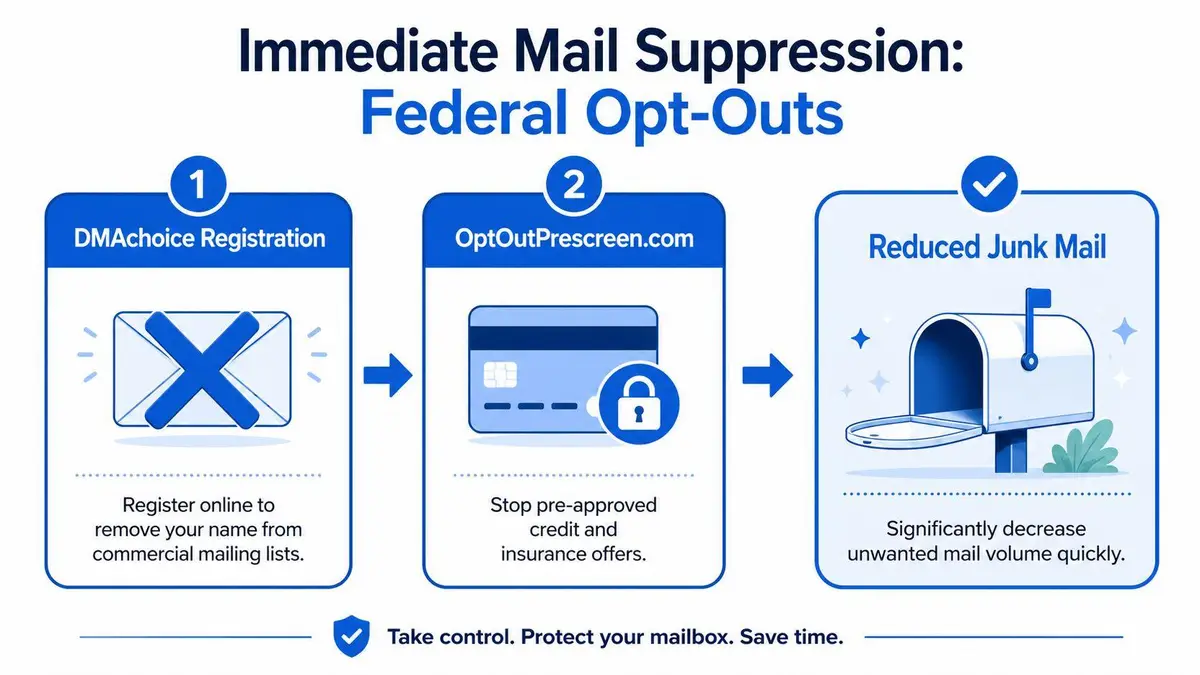
If you want the fastest legitimate reduction, start with the two most effective tools available to consumers: OptOutPrescreen and DMAchoice. They exist because some of the mail categories flooding your box come from centralized commercial processes. If you skip them, you’re doing low-yield cleanup while the major valves remain open.
The FTC’s consumer guidance states that you can opt out of prescreened credit and insurance offers permanently or for five years through OptOutPrescreen, and that DMAchoice registration lasts 10 years while allowing consumers to reduce catalogs, magazine offers, and other marketing mail. The same FTC guide also points readers to low-cost or free tools that, according to one opt-out guide cited there, can cut addressed junk mail by 80% to 90%. See the FTC’s guide to stopping junk mail.
Start with prescreened financial offers
Prescreened credit and insurance mail is one of the easiest categories to suppress because the process is formalized. Go to OptOutPrescreen and choose the duration that matches your objective.
Use the permanent opt-out if privacy is the priority and you don’t want your address cycling back into those solicitations later. Use the five-year option only if you have a specific reason to preserve future marketing access.
This isn’t just about annoyance. Preapproved financial mail advertises that your address is active and marketable. That’s avoidable exposure.
Then reduce general marketing mail
DMAchoice handles a different layer. Think national catalogs, magazine offers, and broader commercial postal marketing. This is the correct second move because it suppresses categories that many households mistake for unavoidable.
Use your legal name and mailing address exactly as they appear on the mailpieces. If your household receives variations, such as middle initials, suffixes, or alternate spellings, document them. Suppression works better when you mirror the record the sender has.
A practical sequence looks like this:
- Register with OptOutPrescreen first. That takes care of the financial-solicitation stream.
- Register with DMAchoice next. This addresses a broad range of commercial marketing mail.
- Save confirmation details. You’ll need them if mail continues and you have to escalate with specific senders.
Register once, document everything, and stop expecting instant silence.
Expect lag, not failure
Many individuals often lose patience at this stage and abandon the process too early. Suppression doesn’t move at the speed of email. Mailing campaigns are planned in advance, lists are sold downstream, and production cycles continue after you opt out.
The result is simple. You may still see mail for a while even when your request was valid and correctly submitted. That doesn’t mean the process failed. It means physical mail runs on stale data and prebuilt campaigns.
If your goal is to stop USPS junk mail efficiently, federal opt-outs are containment tools. They are not the entire strategy, but they are the highest-return first move.
Suppressing Commercial Catalogs and Solicitations
Some mail will survive the broad opt-outs because not every sender relies on the same suppression systems. Catalog brands, specialty retailers, alumni programs, luxury goods marketers, and niche subscription sellers often maintain their own files or rely on fragmented list sources. That’s where direct suppression becomes necessary.

Use the mailpiece against the sender
Every unwanted catalog contains clues. The recipient line shows the exact household formatting the sender uses. The back panel or insert often includes a customer number, a website, or a preference contact. Use that information before you throw anything away.
A strong removal request is short and specific. Ask for suppression from postal marketing lists, not just “unsubscribe.” Email language should be direct: remove my name and address from your marketing database, suppress this household from future catalog and promotional mail, and confirm the request.
The distinction between individual removal and household suppression matters. If you remove only one named person, the same company may continue mailing to “Current Resident,” a spouse, or a slight name variation. For multi-occupant homes, ask for both.
You should also tighten your public-address exposure. If your home address appears in people-search databases, suppressing catalogs becomes harder because your location keeps resurfacing in the consumer data ecosystem. That’s why address cleanup on directories such as Whitepages supports mail reduction over time. This strategic guide to removing your home address from Whitepages explains the privacy side of that process.
What to say to commercial senders
Use language that leaves little room for interpretation.
- For catalogs and retail mailings: “Please remove this name, address, and household from all catalog, postcard, and promotional mailing lists.”
- For loyalty-driven brands: “Close the marketing-mail preference for this account and suppress any related household-level direct mail.”
- For repeated mail under name variants: “Remove all versions of this recipient name associated with this address.”
Don’t ask vaguely to “send less mail.” That invites partial suppression. Ask for removal and suppression.
After you’ve made several requests, keep a sender log. Track brand, date, contact method, and the exact name version used on the piece. This turns a frustrating chore into a controlled process.
A short explainer is useful if you’re dealing with persistent retailer mail:
Don’t confuse local saturation with addressed mail
Some flyers are addressed to you. Others are delivered broadly by route. The distinction matters because addressed items can often be suppressed at the sender level, while route-based handbills require different tactics with the business distributing them.
When a sender keeps mailing after a clear request, stop treating it as a customer-service issue. It becomes a privacy and compliance issue. Escalate through the company’s privacy portal, legal contact channel, or formal consumer request form if one exists.
Addressing the Root Cause via Data Broker Removal
You opted out. You contacted repeat senders. The volume dropped, then crept back up. That pattern points to the underlying problem: your address is still circulating in the broker market.
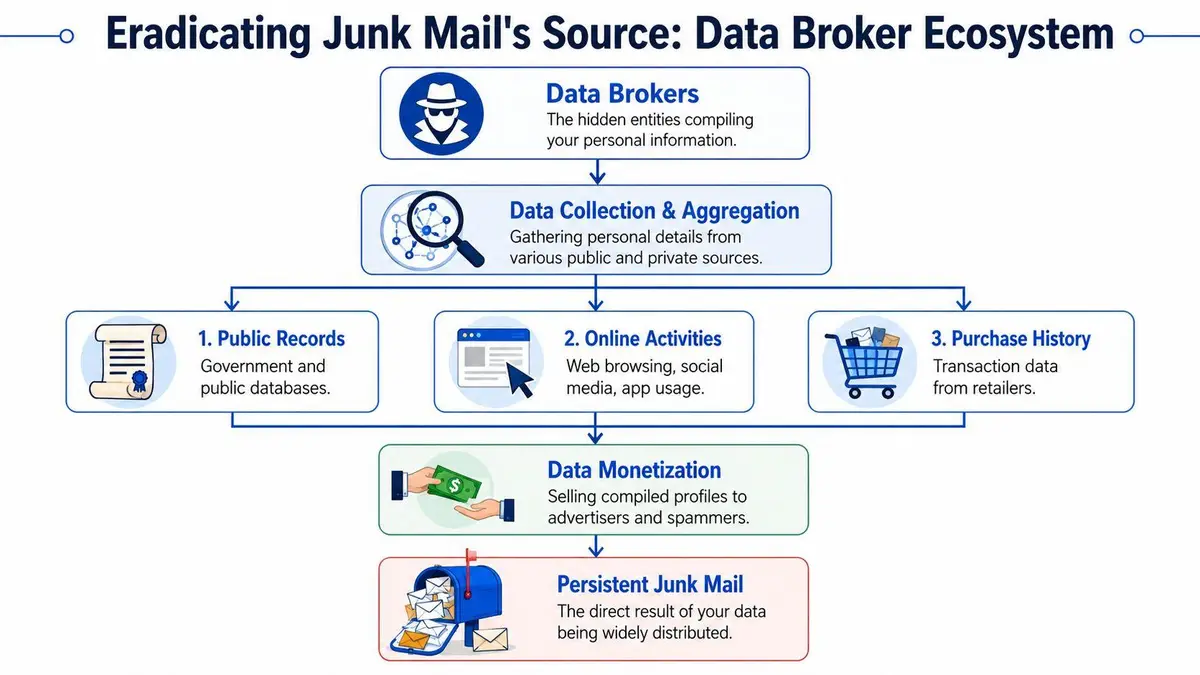
Data brokers build identity records from public filings, purchase activity, household associations, change-of-address signals, and commercial data exchanges. Marketers buy or append against those records before a campaign ever reaches the printer. That is why unfamiliar companies can mail you even after you cleaned up the obvious sources.
Why suppression often looks incomplete
Mail persistence usually comes from data reuse, not just sender negligence. Old records remain active. Household-level matching ties one resident to another. List vendors resell or append address data across campaigns. Printed mail also operates on a lag, so pieces already in the pipeline can keep arriving after you submit a valid suppression request.
The practical implication is simple. Judge results over months, not days.
A sender log still matters here, but for a different reason than in the prior step. At this stage, you are identifying which names, addresses, and household variants are being regenerated upstream. If the same address reappears under slight name changes or through companies you never contacted, broker exposure is the likely source.
The mail arriving this month may come from a list assembled well before your opt-out request was processed.
Standard junk mail guides stop at opt-out forms. That is incomplete advice. If you want durable control, remove the conditions that let your address get repackaged and sold again.
What upstream control looks like
Data broker removal reduces the number of databases where your address can be found, matched, and circulated. That improves mail suppression because fewer marketers can rediscover you through third-party files. It also supports broader privacy goals, including less directory exposure, fewer unsolicited contacts, and weaker household profiling. This executive guide to removing yourself from data broker lists explains that upstream process in more detail.
Use this sequence:
| Layer | Objective | Typical result |
|---|---|---|
| Federal opt-outs | Cut major consumer marketing streams | Broad initial reduction |
| Sender suppression | Remove repeat brands and catalog mailers | Cleaner mailbox and fewer obvious offenders |
| Data broker removal | Reduce future list rebuilding and resale exposure | Better long-term control |
DIY broker removal works if you are disciplined and patient. It is also repetitive, fragmented, and easy to leave half-finished. For a high-value household, that matters. Incomplete removal leaves enough data in circulation for the mail cycle to restart.
Advanced Tactics for Persistent and Local Mail
You clear out the obvious junk, submit the major opt-outs, and the mailbox still fills with political flyers, charity appeals, pizza coupons, and mail for someone who moved out years ago. That is the long tail of address exposure. It persists because these senders often operate outside the cleaner national suppression systems and rely on stale, local, or loosely managed lists.
Treat this stage as targeted cleanup, not daily mailbox triage. Piece-by-piece handling wastes time and leaves the source untouched.
Previous resident and misaddressed mail
Previous-resident mail is usually a list maintenance failure. Your address remains tied to an old occupant in marketing files, nonprofit databases, or household matching systems. Those records keep circulating until the repeat senders correct them.
Do not rely on writing notes on every envelope. That can help with isolated pieces, but it rarely fixes chronic mail from the same organizations.
Instead, build a short sender log for 30 days. If the same bank, insurer, catalog brand, alumni office, or nonprofit keeps mailing a former occupant, contact that sender directly and state three things clearly: the named person does not live there, the address was matched incorrectly, and the sender must suppress that name-address combination from future marketing records. Direct correction beats passive annoyance.
If misaddressed mail persists across many categories, the problem is broader than a few bad lists. It points to an exposed identity trail tied to the property or household. At that point, a professional digital footprint cleanup service for executives and privacy-focused households becomes a practical escalation path, especially if your address carries security or reputational sensitivity.
Local businesses, charities, and political mail
Local and issue-based mail requires sender-specific suppression. Small retailers often buy neighborhood mailing lists. Charities may continue outreach through donor exchanges, event lists, or legacy household records. Political mail is often driven by campaign vendors, voter files, and address matching practices that do not care whether your broader opt-outs are in place.
Use direct requests that match the sender’s process:
- Local retailers: Request removal from direct-mail advertising lists associated with your street address and household.
- Charities: Request fundraising suppression for your household, not just a pause on one campaign.
- Political organizations: Contact the campaign, party committee, or mail vendor listed on the piece and request removal from postal outreach lists tied to your address.
If the sender offers a privacy request form, use it. A formal data removal or suppression request is more effective than a generic customer service complaint because it gives the organization a compliance path and a record of the request.
Why these pieces keep returning
This mail persists for a simple reason. It is cheap to send, easy to source, and often fueled by old address data that no one cleans up unless forced to do so.
Eco-Cycle’s junk mail facts page describes the scale of direct mail and the environmental waste tied to it. For your purposes, the operational point is clearer than the environmental one. As long as your address remains available in local, political, nonprofit, or legacy household files, the mailbox will repopulate.
The fix is disciplined suppression at the sender level, followed by escalation when the pattern shows broader exposure. That is how you stop treating junk mail as clutter and start treating it as a privacy control problem.
When Professional Intervention Is Warranted
Open your mailbox after you have already filed the opt-outs, contacted repeat senders, and cleaned up the obvious sources. The stack is smaller, but the wrong names, old addresses, donation appeals, and high-volume solicitations keep showing up. That is the point where this stops being a nuisance and starts reading like an address exposure problem.
For executives, public figures, physicians, lawyers, investors, and family office principals, the threshold is low. Your home address is not just a delivery point. It is part of your personal security posture.

The threshold is time, exposure, and recurrence
Handle this yourself if the issue is narrow and recent. Escalate when the mailbox reflects a distributed data problem that keeps regenerating across multiple channels.
Professional intervention makes sense under any of these conditions:
- Your time is too expensive for manual suppression. Logging mailpieces, filing requests, tracking deadlines, and repeating the cycle is administrative work with low return.
- Your address privacy has real security implications. Public-facing individuals and high-net-worth households should not tolerate broad circulation of home location data.
- The mail keeps returning after standard opt-outs. That usually means your address is still active in upstream files that feed multiple mailers.
- A move, inherited address, prior owner record, or name-match issue is contaminating the household profile. These cases usually require coordinated cleanup, not one-off requests.
As noted earlier, consumer opt-outs do not shut this down overnight. Mail often persists because old household files, resale lists, donor databases, and address-matching logic continue to circulate long after you submit a request. Community discussions about persistent junk mail reflect the same operational reality. The mailbox improves slowly unless someone manages the problem at the source.
Decision point: If you already handled the obvious steps and the mailbox still signals broad address exposure, treat it as a privacy remediation issue.
What managed remediation changes
Professional help changes the sequence and the level of control. Instead of reacting to each mailpiece, a managed process identifies the systems feeding repeat mail, suppresses exposed records across multiple databases, documents removals, and checks for reappearance over time.
That matters because junk mail is rarely a single-list problem. It is usually the visible output of a larger identity trail that includes people-search sites, broker records, old corporate filings, donor history, and stale move data. If you want a benchmark for that broader cleanup standard, read this digital footprint cleanup guide for executives.
Many people escalate too late because postal clutter looks minor. It is not minor when it confirms that your personal information remains easy to buy, easy to match, and hard to contain without a coordinated removal strategy.
If you need more than a consumer checklist, ContentRemoval.com can assess the broader privacy problem behind persistent junk mail, address exposure, and recurring data-broker resurfacing. For executives, public figures, and high-net-worth households, the value is tighter control over where your personal information lives, who can find it, and how often it reappears.
Frequently asked questions
Does writing Return to Sender stop junk mail?
Not reliably. It may affect the single piece in front of you, but it does not remove your address from the sender’s list or the upstream databases feeding it. The FTC notes that delivery-level actions do not clean the underlying list.
Why am I still getting junk mail after opting out?
Mail campaigns are planned in advance, lists are resold downstream and print cycles continue after you opt out, so valid requests can take months to show. If the same address keeps returning under slight name variations or from companies you never contacted, your record is still circulating in the broker market.
How do I stop mail addressed to a previous resident?
Keep a 30 day sender log, then contact each repeat sender directly and state that the named person does not live there, the address was matched incorrectly, and the name and address combination must be suppressed. Notes on envelopes rarely fix chronic mail from the same organizations.