
A spider removal service for a high-value home should follow an Integrated Pest Management sequence: forensic inspection, mechanical removal of webs and egg sacs with a portable vacuum, narrowly targeted treatment of active harborages, exclusion work on seals and screens, and a defined follow-up. Recurring spiders usually signal an entry gap or hidden insect food source, not a spray problem.
Key facts
- Illinois structural pest control guidance sets portable vacuums, not sprays, as the standard for initial cleanouts.
- Angi puts professional spider extermination at $100 to $500, averaging about $300 per home.
- Recurring service commonly runs $350 to $750 quarterly or about $1,000 monthly.
- A written service warranty should state covered areas, follow-up triggers and re-entry safety instructions.
Where ContentRemoval.com comes in. Visible neglect at a luxury property rarely stays offline, and ContentRemoval.com steps in when a household issue has become a privacy or reputation problem: leaked interior photos, staff disputes aired publicly, property addresses on people-search sites or hostile posts naming the owner. Family offices and estate managers usually make the call. A free 15-minute Exposure Scan maps what is removable, and the report is theirs to keep. Get a Free, Confidential Exposure Scan or read how our content removal work is done.
You notice one web in a garage corner and ignore it. Then you see another behind a framed mirror, another along an attic beam, and one more in a utility room that your staff rarely enters. At that point, the issue isn’t aesthetic. It’s operational.
For a high-value home, a spider problem is rarely about spiders alone. It raises a harder question: what allowed them to establish themselves in the first place? Entry gaps, neglected screen systems, hidden insect activity, moisture drift, storage density, and low-disturbance zones all create the conditions. If you only kill what you can see, you preserve the liability.
A proper spider removal service should be evaluated the same way you’d evaluate any vendor touching a sensitive asset. You’re not buying a spray. You’re buying diagnosis, containment, structural correction, and a measurable reduction in recurrence.
Discerning a Nuisance from a Structural Liability
A single spider near an exterior door can be a nuisance. Repeated spider activity in attics, basements, garages, mechanical rooms, window lines, or low-traffic storage zones is different. That pattern suggests the property is providing access, shelter, or a food source.
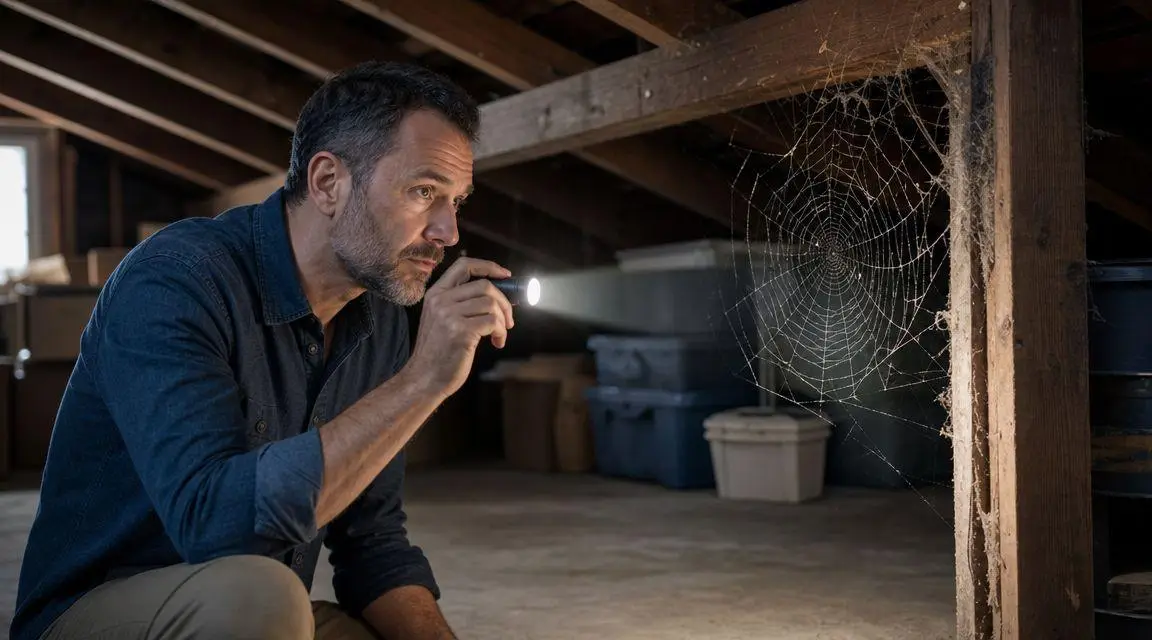
The key point is simple. Spiders often indicate another problem. As noted by guidance on spider activity as a sign of structural entry or underlying insect pressure, spider presence is often a symptom of an insect-food source or a structural entry issue, and a competent provider should adapt the management plan to the home type, climate, and season. Most providers don’t build that decision framework into the sale. They should.
Patterns that change the risk profile
Location matters more than fear response. A web near landscaping can be routine. Egg sacs in an interior closet, recurring webs around soffits, or spider buildup around recessed lighting, crawl access, and window assemblies deserve a professional assessment.
Use this quick distinction:
| Observation | Likely interpretation | Management decision |
|---|---|---|
| Isolated web at an exterior threshold | Incidental activity | Clean and monitor |
| Repeated webs in the same indoor zone | Established harborage or active entry point | Inspect and correct |
| Spider activity near utility penetrations or attic access | Structural ingress likely | Prioritize exclusion |
| Multiple spiders in low-disturbance storage areas | Clutter-supported harborages | Reduce contents and inspect surrounding structure |
| Sudden increase after seasonal change | Environmental trigger or prey movement | Assess whether the issue is temporary or systemic |
What sophisticated owners should look for
You don’t need to identify every species to know when the issue has escalated. You do need to observe whether activity is random or repeating. Repetition is what turns housekeeping into risk management.
Practical rule: If spiders keep appearing in the same room after basic cleaning, assume the room is telling you something about access, prey, or neglect.
Window and door screening is one of the easiest places to audit because it sits at the intersection of ventilation, ingress control, and appearance. If your home relies on open-air circulation at certain times of year, review Rescreen Rescue on window screen benefits as a practical reference for how screens support prevention. Screen failure doesn’t just admit spiders. It often admits the insects they feed on.
A recurring spider issue in a luxury property also has a reputational dimension. Guests notice webs. Staff notice a pattern. Buyers, brokers, inspectors, and tenants draw broader conclusions about maintenance discipline from small visible failures. That’s why a serious response starts with diagnosis, not cosmetics.
The Anatomy of a Professional Spider Removal Service
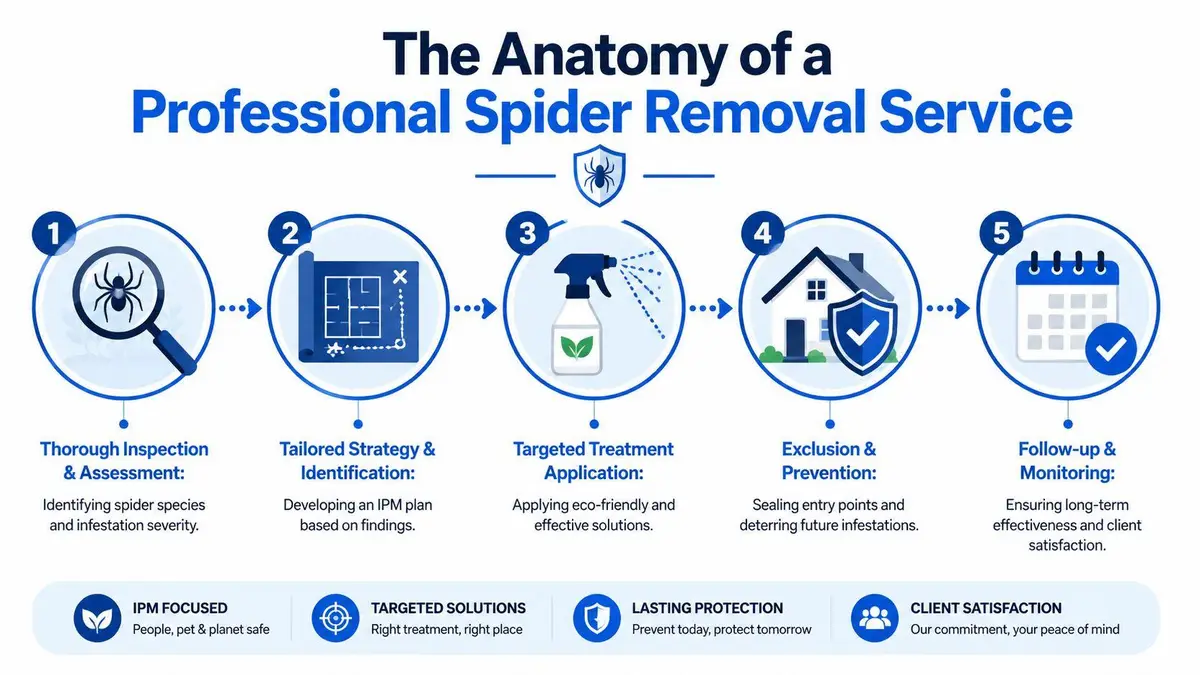
Most spider complaints are mishandled because the provider starts with product instead of process. A competent spider removal service should follow an Integrated Pest Management sequence. Inspection first. Mechanical removal second. Targeted treatment third. Exclusion and follow-up after that.
The benchmark is explicit in Illinois structural pest control guidance on spider cleanouts. Portable vacuums should be the standard method for initial spider and web cleanouts rather than pesticide sprays. That matters because vacuuming removes adults, webs, and egg sacs immediately. Sprays alone don’t.
What a serious service call should include
A premier provider doesn’t arrive and fog the perimeter. They should inspect where spiders live and travel, document likely entry points, and identify whether visible activity is tied to lighting, storage, prey insects, or building envelope failure.
A credible process usually looks like this:
- Forensic inspection
The technician should examine web density, egg sacs, species indicators, prey activity, and structural gaps around doors, windows, utility penetrations, soffits, and storage areas. - Mechanical removal
This step relies on portable vacuums and physical web removal. A provider who skips this step leaves behind the evidence and often the next generation. - Targeted treatment
Chemical use should be narrow, not indiscriminate. Treatment belongs in active harborages and high-risk voids, not across every visible surface. - Exclusion work
Cracks, crevices, poor seals, and damaged screens need correction. Otherwise the service becomes a subscription to recurrence. - Monitoring and return visit logic
The provider should explain what they expect to change, what may persist temporarily, and what conditions would trigger follow-up.
For homeowners comparing approaches, how to get rid of spiders is useful as a plain-language reference on practical control steps. Use it as background, not as a substitute for a property-level inspection.
A visual overview helps clarify what a complete protocol should look like.
Why spraying alone is the wrong standard
Spray-first vendors sell speed. They don’t sell resolution. If they leave webs, egg sacs, cluttered harborages, and open entry points untouched, they haven’t solved the problem. They’ve delayed your next complaint.
A spider removal service should leave the property with fewer hiding places, fewer re-entry paths, and fewer reasons for spiders to remain.
That’s the standard. Not whether the technician had a backpack sprayer.
Deconstructing the Cost of Spider Remediation
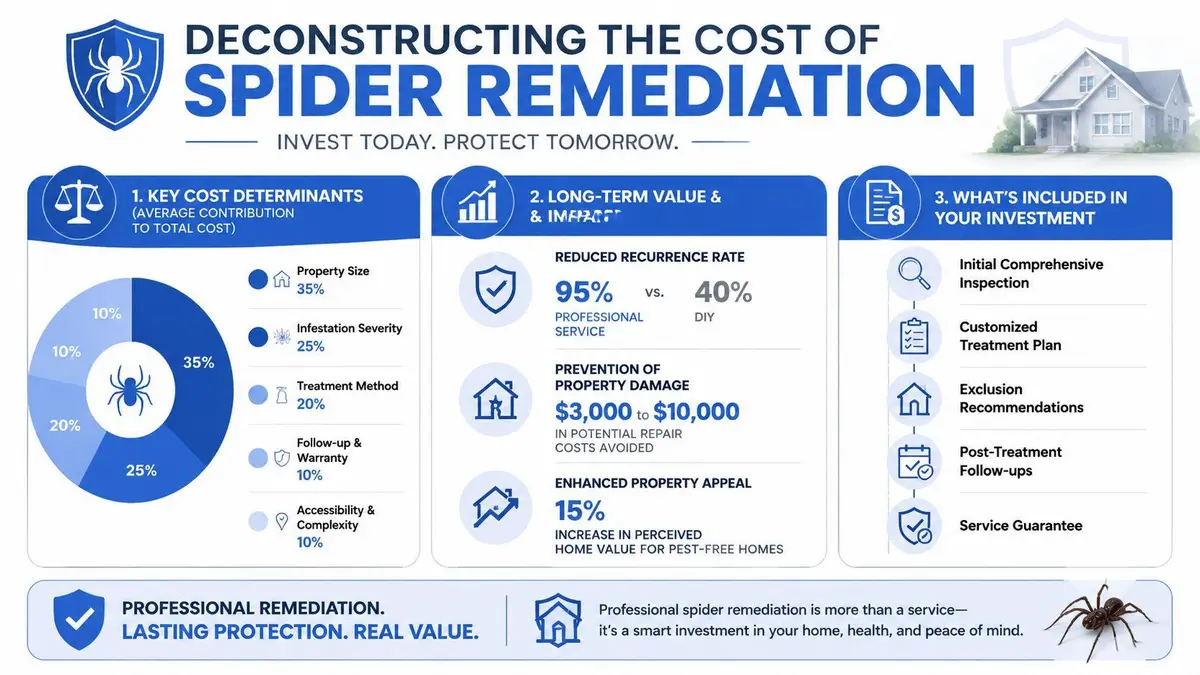
Owners often ask the wrong cost question. They ask what the visit costs. They should ask what the quote includes, what it excludes, and whether it addresses recurrence. Cheap spider control is usually just deferred spending.
According to Angi’s spider extermination cost guide, professional spider extermination commonly costs $100 to $500, with an average of about $300 per home. Angi’s broader range starts at $50 and can rise to $1,200 depending on infestation size, treatment frequency, species, and access difficulty. A one-time visit is usually estimated at $100 to $300, while recurring service can move to $350 to $750 quarterly or about $1,000 monthly. Angi also notes treatment-method pricing, including spot spraying at $100 to $300, traps at $150 to $250, and fumigation at $300 to $500+ for a single treatment.
What drives price in practice
The numbers make sense once you understand the labor behind them. Spider remediation becomes expensive when access is poor, the structure is large, the infestation is established, or the provider is dealing with medically significant species such as black widows or brown recluses.
A quote should make you ask four things:
| Cost driver | Why it affects price | What you want to see in the proposal |
|---|---|---|
| Property scale and complexity | More edges, voids, and low-disturbance zones increase inspection and treatment time | Specific areas included |
| Infestation severity | Heavy webbing and egg sacs require more mechanical removal and follow-up | Clear remediation scope |
| Service model | One-time cleanup differs from preventive management | Whether the plan is corrective or ongoing |
| Accessibility | Attics, crawlspaces, high ceilings, and dense storage complicate work | Any access assumptions spelled out |
How to read a quote like an asset manager
A low quote can be acceptable if the issue is limited. It’s a bad sign if the provider can’t explain method, coverage area, or follow-up conditions. You’re not paying for fluid volume. You’re paying for judgment.
The right quote ties cost to scope. The wrong quote ties cost to a promise that sounds fast.
For high-value residences, recurring service can be rational when the home has extensive exterior lighting, large cultivated perimeters, detached structures, low-occupancy wings, or seasonal openings that increase insect ingress. In those cases, prevention isn’t overspending. It’s a maintenance line item tied to preserving habitability and avoiding repeated emergency calls.
The Inherent Limitations of DIY Control Measures
DIY spider control fails for the same reason cosmetic repairs fail. It treats visible symptoms while leaving the underlying defect untouched. For a primary residence, estate property, or executive retreat, that’s not efficient. It’s careless.
A can of aerosol might kill the spider on the wall. It won’t address why spiders are collecting around soffits, window frames, utility penetrations, garage transitions, or storage-heavy service areas. Those are structural and environmental questions, not retail product questions.
Where DIY breaks down
Professional guidance from Orkin Canada on commercial spider control and exclusion emphasizes that the most effective controls are exclusion and harborage reduction. That means sealing cracks, repairing door sweeps and screens, and reducing clutter in low-disturbance zones. Those measures reduce both prey availability and ingress points. That’s the core of prevention, and most DIY efforts don’t replicate it.
The weakness of DIY usually shows up in one of three ways:
- Visible-only treatment removes what’s in plain sight but misses webs, egg sacs, and harborages behind stored items, trim gaps, soffits, and utility lines.
- Improper product use creates exposure concerns without delivering a complete result, especially indoors around children, pets, staff areas, furnishings, and sensitive finishes.
- No exclusion discipline means spiders and the insects they feed on readily come back through the same openings.
Why high-value properties are poor candidates for guesswork
Luxury homes are harder, not easier, to protect. They often have complex envelopes, expansive glazing, detached amenities, decorative stonework, wine rooms, basements, attics, and irregular occupancy patterns. Each feature adds concealment or access.
DIY also tends to create false closure. The owner sees fewer spiders for a short period and assumes the issue has been solved. Meanwhile, webs persist in inaccessible zones, egg sacs remain attached, and prey insects continue moving through entry points.
If the control plan doesn’t change the building conditions, it isn’t control. It’s temporary suppression.
That distinction matters because repeated low-grade pest activity changes how a property is experienced. Residents feel less comfortable. Staff spend more time cleaning around the issue. Visiting guests notice corners and ceiling lines that should be pristine. The property starts sending the wrong signal. For an asset that’s meant to project control and quality, DIY is the wrong operating model.
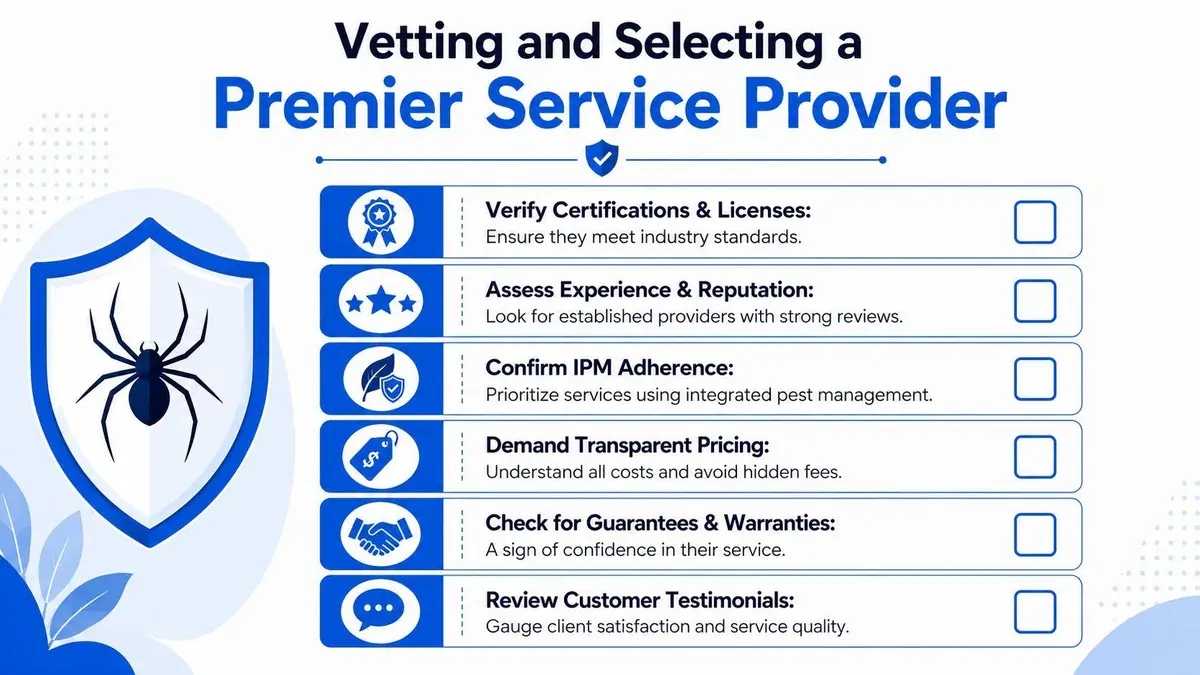
Vetting and Selecting a Premier Service Provider
The pest-control market is large and standardized. That’s useful, but it also creates complacency. According to Home Paramount’s spider control page citing the scale of the U.S. pest-control market, there are more than 31,000 pest-control businesses and 167,232 pest-control specialists in the U.S., and ConsumerAffairs reports average pest-control costs for a 3,000-square-foot home around $400 to $950. In a market that mature, basic service is easy to find. High-standard service is not.
The non-negotiables
A premier provider should explain methodology in detail. If the sales process revolves around “we spray inside and outside” and little else, move on.
Ask for direct answers to these points:
- Licensing and insurance
You want confirmation that the firm is properly licensed and carries liability coverage suitable for work inside expensive homes. - IPM-based methodology
Ask whether they begin with inspection and mechanical removal, how they handle webs and egg sacs, and what exclusion measures they perform or recommend. - Material awareness
They should know how to work around specialty flooring, wall coverings, art storage, climate-controlled rooms, and custom millwork without improvising. - Documentation
The proposal should identify target areas, treatment logic, restrictions, occupant instructions, and follow-up conditions.
Questions that separate operators from professionals
Use direct language. Don’t ask whether they’re effective. Ask what they physically do on site.
A useful interview set looks like this:
- What’s your sequence of work from arrival to departure?
- How do you remove webs and egg sacs?
- Which entry points do you inspect every time?
- Do you treat only active harborages or broad surfaces as well?
- What exclusion measures are included, and what falls outside scope?
- How do you protect interior finishes and sensitive spaces?
- What outcome do you expect after the first service, and how do you define failure?
A serious provider won’t be annoyed by these questions. They’ll welcome them because they already operate with a repeatable protocol. You aren’t hiring someone to kill bugs. You’re hiring a contractor to reduce a property risk without creating another one.
Service Timelines, Guarantees, and Long-Term Management
The service call is only the opening move. What matters afterward is whether activity declines in a way that matches the provider’s explanation. If they can’t define expected outcomes, they shouldn’t be managing the property.
That gap is common. As noted by guidance on safety, efficacy, and expected outcomes in spider control, many service pages fail to define results, explain whether treatments are residual, or provide clear pet and child safety guidance, including re-entry timing. A premier provider should be able to quantify expected reductions in sightings, explain what treatment type was used, and give firm occupancy instructions. If they won’t, assume the guarantee is marketing language.
What a meaningful guarantee looks like
A guarantee should be written in operational terms. It should state the service area, the treatment scope, the conditions that void coverage, and the response if activity persists. Verbal reassurance has no value once the technician leaves.
Review the guarantee against this checklist:
| Guarantee element | What it should clarify |
|---|---|
| Covered areas | Interior, exterior, outbuildings, or only selected zones |
| Covered condition | Active sightings, web reformation, or both |
| Follow-up trigger | What level of renewed activity qualifies for return service |
| Safety instructions | Pet, child, and resident re-entry guidance |
| Maintenance obligations | Cleaning, clutter reduction, repairs, and exclusion work expected from owner |
How to manage the property after treatment
Don’t evaluate success by whether you see a dead spider once. Evaluate whether the environment is becoming less hospitable over time. Reduced web reformation, absence of new egg sacs, and fewer repeated sightings in the same zones are stronger indicators than any sales slogan.
For owners in dry and dust-prone climates, practical building-envelope habits matter. Preventing bugs in your Southwest home offers a useful reference for screening, gap control, and exterior prevention measures that support longer-term results.
Good post-service management is disciplined, not dramatic. Track where activity occurs, insist on written follow-up terms, and correct the building conditions that allowed the issue in the first place.
If the provider did their job, long-term management becomes lighter. If they didn’t, you’ll find yourself paying repeatedly for the same corners, the same webs, and the same unanswered question about how spiders keep getting in.
High-value assets attract scrutiny, and visible neglect never stays confined to one issue. If a property problem is already affecting privacy, reputation, or stakeholder confidence online, ContentRemoval.com helps family offices, executives, and high-profile individuals remove damaging content, contain exposure, and act discreetly with a clear plan.
Frequently asked questions
Why do spiders keep coming back to the same room after cleaning?
Repetition in one zone means the room is providing access, shelter or prey. Utility penetrations, failed screens, attic access and cluttered low-disturbance storage are the usual causes. Treat it as an inspection and exclusion job, not a cleaning job.
What questions should I ask a spider removal company before hiring them?
Ask for their sequence of work on site, how they remove webs and egg sacs, which entry points they inspect every time, whether they treat only active harborages, what exclusion work is included and how they protect interior finishes. A provider who cannot explain method beyond spraying is not the right fit.
Is DIY spider control enough for a large property?
Rarely. Aerosols kill what is visible but leave webs, egg sacs and harborages behind trim, soffits and stored items, and they do nothing about the openings spiders and their prey use. Complex building envelopes, detached structures and irregular occupancy make luxury homes harder to protect, not easier.