
A social media stalker is someone whose unwanted surveillance, contact or intimidation forms a persistent pattern that defeats your attempts to create distance. The correct order is preserve evidence first, restrict access second, escalate third: capture full-screen screenshots and URLs, quietly tighten privacy settings, report under the most precise platform category, and involve counsel once staff or family are contacted.
Key facts
- Cyberstalking affects an estimated 7.5 million people a year in the U.S., and 61% of perpetrators use everyday platforms.
- Photo EXIF data can reveal GPS coordinates accurate to within 3 to 5 meters.
- Tactics escalate from passive orbiting to active engagement to direct intrusion such as doxxing or impersonation.
- Federal cyberstalking cases from 2010 to 2020 had a 90% conviction rate and a median 30-month sentence.
Where ContentRemoval.com comes in. When a stalker moves to impersonation, leaked media, coordinated reposting or search-indexed attacks, ContentRemoval.com handles the operational side: account takedowns, source removal, de-indexing and monitoring for reuploads across platforms. Creators, executives and their security or legal teams usually reach out once block-and-report has stopped working. A free 15-minute Exposure Scan maps what is removable, and the report is theirs to keep. Get a Free, Confidential Exposure Scan or read how our content removal work is done.
You notice the pattern before you admit what it is. The same account views every story within minutes. A new profile appears after you block the last one. Comments reference places you were only at briefly, or people you never tagged. Then the messages shift from irritating to specific.
If you’re a public figure, founder, executive, or creator, that pattern isn’t fan behavior. It isn’t random trolling. It’s a security problem with reputational consequences.
A social media stalker doesn’t need physical proximity to create pressure. They can watch, archive, impersonate, provoke, and circulate material across platforms faster than most victims can document it. The mistake is treating the first signs as a nuisance and responding casually. By the time individuals realize they’re in a stalking scenario, the stalker has already built a map of routines, contacts, vulnerabilities, and pressure points.
Recognizing the Threat Beyond the Nuisance
The first dangerous misconception is that online stalking is somehow less serious than physical stalking. For high-profile people, that’s backwards. Social platforms give a stalker a live feed of your movements, reactions, relationships, and routines. They also give that person tools to amplify harm publicly.

The scale alone should end the minimization. Cyberstalking affects an estimated 7.5 million people annually in the United States, 61% of perpetrators use everyday social media platforms, and 69% of victims endure substantial distress according to SafeHome’s cyberstalking statistics analysis. The same analysis notes that fear levels can exceed those associated with physical stalking.
What separates stalking from ordinary online attention
A social media stalker isn’t just watching your public posts. The conduct becomes stalking when it turns into a persistent pattern of unwanted surveillance, intrusion, or intimidation that causes fear, pressure, or disruption. For a high-profile target, that pattern often shows up in stages:
- Persistent surveillance: The same person monitors stories, comments, reposts, and activity windows with unusual consistency.
- Boundary testing: They send repeated messages, create alternate accounts, or move across platforms when ignored.
- Information exploitation: They use what you’ve posted to infer travel, family connections, staff details, or private routines.
- Escalation pressure: They threaten exposure, contact business associates, mimic your identity, or try to force a response.
Practical rule: If someone repeatedly defeats your attempts to create distance, you’re no longer dealing with annoyance. You’re dealing with adversarial behavior.
For public-facing people, the threat often overlaps with doxxing, impersonation, and reputational sabotage. That’s why a stalking response and a doxxing response frequently intersect. If the situation includes exposed personal details, home information, or coordinated harassment, use a more structured playbook like this strategic response checklist for being doxxed.
Why high-profile targets get trapped in underreaction
Executives and creators often underreact for the same reason they succeed professionally. They assume they can manage noise, absorb pressure, and stay visible. That instinct works in business. It fails with stalking.
A stalker studies your tolerance. If you treat repeated intrusion as part of being public, you train the aggressor that access is available. The right frame is simple. Visibility is part of your role. Access is not.
The Spectrum of Stalker Tactics and Behaviors
Many individuals imagine a stalker as someone sending obvious threats. That is the final stage, not the opening move. A capable social media stalker usually starts with collection, not confrontation.
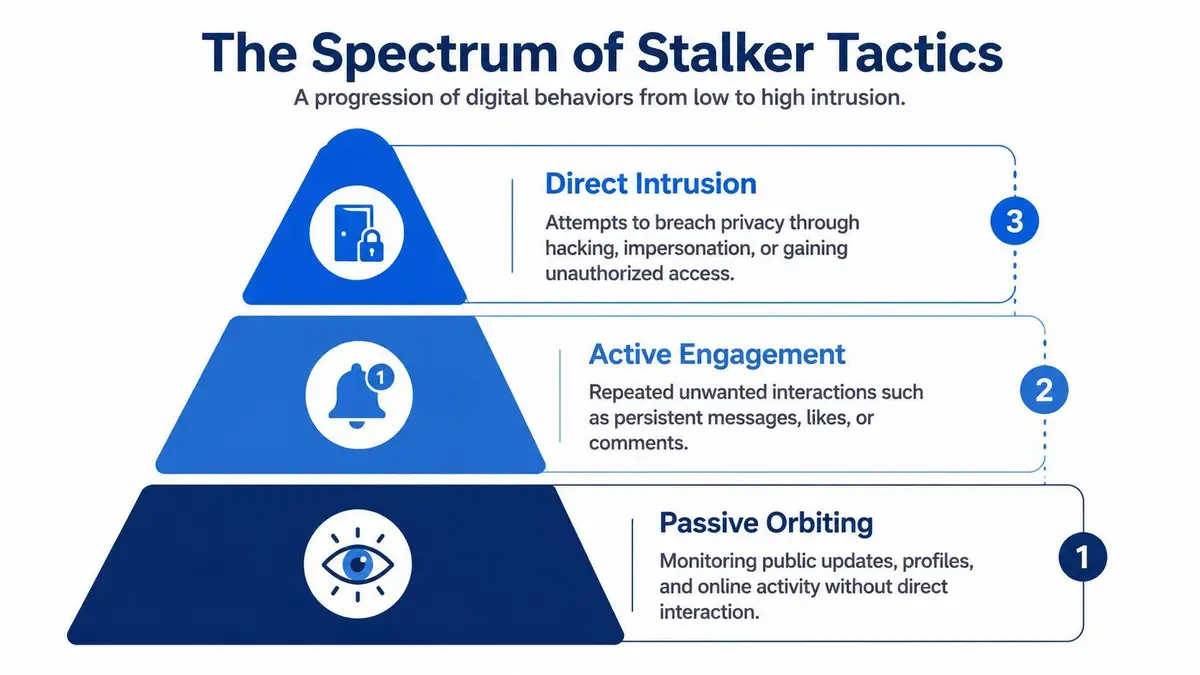
Passive orbiting
This is the surveillance phase. The stalker watches stories, tracks posting times, notes recurring locations, and studies who interacts with you regularly. They may never message you at first. That silence is deceptive because it lets them collect without triggering a report.
For a public figure, passive orbiting can reveal more than is commonly recognized. A sequence of gym clips, restaurant tags, event backdrops, and team photos can expose routines, inner circles, and likely transit patterns.
Active engagement
The second tier is contact. The stalker wants acknowledgment, reaction, or an advantage. That can look like repeated direct messages, oddly specific comments, mentions from throwaway accounts, or outreach to assistants, colleagues, relatives, or collaborators.
Social engineering is a primary method. Fake urgency, false familiarity, impersonated staff requests, and phishing-style pretexts are standard. If your team needs a sharper lens on these manipulation patterns, GoSafe social engineering insights offer a useful breakdown of the kinds of deceptive approaches that often overlap with stalking behavior.
A stalker doesn’t need your password if they can trick someone around you into lowering a guardrail.
Direct intrusion
The most serious tier involves identity abuse, account compromise attempts, doxxing, leaked material, or efforts to convert digital monitoring into physical access. Online stalking stops looking abstract at this stage.
One technical vector is often overlooked because it sounds obscure until it isn’t. Technologically facilitated stalking often involves fake profiles, used in 24% of college cases, and exploitation of photo metadata such as EXIF data, which can reveal GPS coordinates accurate to within 3 to 5 meters according to the SPARC technology-facilitated stalking fact sheet. In plain terms, a photo can disclose where it was taken closely enough to narrow a real-world location.
What these tactics reveal about intent
You don’t need a psychological profile. You need to classify capability and intent.
Consider the difference:
- Someone who comments obsessively wants contact.
- Someone who creates replacement accounts wants persistence.
- Someone who extracts location data or maps your network wants control.
- Someone who impersonates you or leaks material wants damage.
That distinction matters because your response should fit the threat. Passive orbiting calls for quiet hardening and monitoring. Direct intrusion calls for evidence capture, legal preparation, and likely outside intervention.
Assessing Your Digital Vulnerability as a Public Figure
A determined stalker sees your online presence as an attack surface. You should assess it the same way. The point isn’t to disappear. It’s to stop giving away free intelligence.
Audit your visibility through an adversary’s eyes
Start with what a stranger can learn in under an hour. Review your public profiles, tagged photos, interview clips, event recaps, podcast appearances, staff pages, and old posts. Look for patterns, not single items.
Ask hard questions. Do your posts reveal recurring times and places? Do you show your home exterior, commute markers, children’s school insignia, assistant names, or vehicle interiors? Have followers tagged you in real time at private venues? Have fan pages or gossip accounts assembled fragments into a cleaner picture than you intended?
A proper vulnerability review also includes off-platform monitoring. High-profile clients usually need a standing process for tracking impersonation, reposts, and emerging chatter across search and social. A dedicated reputation monitoring workflow helps surface those issues before they mature into a reputational incident.
The four exposures that matter most
Not every public profile carries the same risk. These are the exposures that routinely make a social media stalker more effective:
- Real-time location leakage: Live posting from current venues gives a watcher immediate utility.
- Personal network exposure: Public interactions can reveal family members, junior staff, household employees, or regular companions.
- Third-party app connections: Old integrations and permissions increase the chance of account misuse or data leakage.
- Audience quality problems: A large following with many unvetted strangers creates easier access points for impersonation and manipulation.
Your public persona should be visible by design, not transparent by accident.
Build a hard target without going silent
The right objective is friction. You want to make surveillance slower, less accurate, and easier to detect.
That means delaying location-based posts. It means removing unnecessary family identifiers. It means pruning old content that exposes patterns. It means tightening who can tag, mention, message, or see audience lists where the platform allows it. It also means separating public-facing communications from private logistics so that one compromised channel doesn’t expose everything else.
The strongest public figures aren’t the most hidden. They’re the ones who understand what should remain unknown.
An Immediate Protocol for Containment and Evidence Preservation
The instinct to block instantly is understandable and often wrong. First preserve evidence. Then contain. If you move too fast, you may destroy the very record your lawyer, investigator, or security team needs.
What to do in the first hours
Treat the incident like a legal matter from the start. Open a secure case file. Save everything in one place. Record the date, time, platform, username, display name, profile URL, post URL, and what occurred.
Then document the account before it changes or disappears. Capture full-screen screenshots, not cropped fragments. Include visible timestamps, handles, captions, and URLs whenever possible. Save profile pages, message threads, story mentions, comments, and follower interactions that show pattern and repetition.
If the stalker has contacted colleagues or family, preserve those records too. Third-party contact often becomes the strongest evidence of escalation because it shows the behavior isn’t isolated or accidental.
| Type of Content | Evidence to Capture | Preservation Note |
|---|---|---|
| Direct messages | Full-screen screenshots of the thread, handle, profile, timestamps, and message sequence | Export or save in original format if the platform allows it |
| Comments and replies | Screenshot the full post, comment, date, and surrounding context | Capture the post URL before deletion or editing |
| Stories and temporary content | Screen recording showing the account name, content, and time visible | Save immediately because ephemeral content disappears |
| Profile pages | Username, display name, bio, profile image, follower details if visible, and profile URL | Save before the account changes names or is removed |
| Impersonation accounts | Profile screenshots, copied bio text, copied images, links used, and examples of confusion caused | Document side-by-side comparison with the real account |
| Off-platform contact | Emails, texts, voicemails, call logs, or messages to staff | Keep originals and avoid altering filenames or timestamps |
Contain without broadcasting your moves
Once the evidence is secure, reduce the stalker’s information supply. Don’t announce that you’re doing it. Change privacy settings, restrict who can message you, limit story visibility, review tagged-post settings, and revoke suspicious app permissions.
Avoid posting emotional rebuttals or warnings to the stalker. Public confrontation can hand them attention, proof of impact, and a reason to escalate. Silence is often strategically stronger than outrage.
Use internal coordination if you’re a public-facing operator. Your assistant, legal team, family office, security lead, and communications staff should know what to preserve, what not to say, and how to route inbound contact. Organizations that haven’t updated their response playbooks should review guidance on modernizing your organization’s crisis communication plan, especially where social media incidents spill into executive reputation and employee safety.
What not to do
These common reactions damage your position:
- Don’t delete everything in panic. You may erase chronology and context.
- Don’t negotiate privately with the stalker. That often rewards persistence.
- Don’t let multiple team members improvise responses. Inconsistency creates gaps.
- Don’t rely on memory. Build a record while details are fresh.
Preserve first. Restrict second. Escalate third.
That order gives you an advantage.
Navigating Platform Reporting and Legal Recourse
Platform reporting is necessary. It isn’t sufficient. Social networks are built to process volume, not nuance. They can remove obvious violations, but they often miss patterns that matter legally, especially when a stalker uses multiple accounts, coded language, or indirect contact through other people.

What platform reporting can and can’t do
Use the reporting tools. Do it methodically. Submit the strongest evidence first, and tie related incidents together where the platform allows. If there’s impersonation, non-consensual intimate imagery, explicit threats, or repeated evasion after prior removals, report under the most precise category available.
But don’t confuse a report submission with resolution. Platforms may remove a single post while missing the network around it. They may suspend one account while ignoring successor accounts. They may act on obvious abuse but not on context-heavy stalking patterns.
When legal escalation becomes the rational move
Once conduct shows persistence, fear, reputational injury, account abuse, or real-world safety implications, legal escalation stops being dramatic and starts being practical. Properly documented evidence matters here.
The federal track record is stronger than many victims assume. Between 2010 and 2020, U.S. federal courts filed 412 cyberstalking cases, achieved a 90% conviction rate, and imposed a median sentence of 30 months as summarized in the earlier SafeHome analysis. The lesson isn’t that every case becomes federal. It’s that documented cyberstalking can carry serious consequences.
You need to think in layers:
- Platform complaints for immediate rule enforcement
- Counsel letters when a formal demand may stop further contact or preserve claims
- Protective orders or criminal complaints when the conduct creates fear, persistent intrusion, or a credible threat
- Content and defamation strategy when the stalker pairs harassment with false statements or reputation attacks
If the campaign includes false allegations, impersonation, or harmful publication, legal guidance on high-stakes content removal and internet defamation strategy becomes directly relevant.
Courts care less about your frustration than your documentation. Show the pattern, preserve the chronology, and the case gets stronger.
The line most people wait too long to cross
If the stalker is contacting your employer, clients, staff, relatives, or event venues, you’re already past the point of casual self-management. The law tends to respond better when the record shows repeated unwanted conduct, clear notice, and a coherent timeline. Build that early.
When to Engage Professional Reputation Defense
Some stalking problems are manageable with evidence discipline, platform complaints, and counsel. Others are operationally too complex for self-help. High-profile targets often reach that point faster because the attack surface is larger and the reputational blast radius is wider.

The threshold is straightforward. Bring in professional reputation defense when the stalker is using impersonation, leaked media, coordinated reposting, cross-platform harassment, search visibility, or AI-generated abuse. Standard reporting tools don’t handle those campaigns well because each incident looks separate while the harm is cumulative.
The risk is getting worse, not simpler. A background source cited in the brief for this article states that generic block-and-report advice fails against persistent campaigns, especially amid a 40% rise in AI-generated stalker content in 2026, and argues that professional services are essential for rapid takedowns of impersonations or leaked media, dark web monitoring, and re-upload prevention, as discussed in USC’s coverage of stalking in the age of social media. For public figures, that means synthetic accounts, manipulated images, and cloned identities can force a response even when the underlying material is false.
Scenarios where self-help ends
These are the situations that usually justify specialized intervention:
- Impersonation at scale: Fake accounts appear faster than platform moderation removes them.
- Leaked or sexualized material: The issue isn’t just one post. It’s source tracing, takedown routing, and re-upload suppression.
- Coordinated harassment: The stalker recruits others, tags journalists, contacts sponsors, or seeds allegations across platforms.
- Dark web or closed-channel circulation: Ordinary reporting tools won’t reach the underlying distribution points.
- Search-indexed damage: Harmful material starts appearing in search results tied to your name or company.
What specialized intervention actually does
This work is operational, not cosmetic. It typically combines evidence management, platform escalation, source removal requests, legal coordination, search de-indexing strategy, impersonation tracking, and monitoring for reappearance.
For legal and crisis teams, even adjacent tooling matters. If counsel is building a faster response stack, these top AI legal tools for corporate lawyers are relevant for document review and workflow support, though they don’t replace takedown execution or investigative judgment.
One option in this category is ContentRemoval.com, which handles harmful content removal, impersonation takedowns, leaked image and video cases, de-indexing, and ongoing monitoring for reuploads. That type of service becomes useful when the problem spans multiple platforms, involves reputational fallout, or requires discreet action across legal and technical channels.
If the stalker can replicate faster than you can report, you need a system, not a coping strategy.
The core decision isn’t whether you can manage one account or one post. It’s whether you can regain control of the environment. Most high-profile clients don’t need help because they’re incapable. They need help because the threat has become multi-channel, persistent, and expensive to mishandle.
If you’re dealing with a social media stalker, the right move is a confidential assessment before the pattern escalates further. ContentRemoval.com works with executives, public figures, family offices, and legal teams to document abuse, remove harmful content, address impersonation and leaked media, and build a durable strategy to stop reuploads and regain control.
Frequently asked questions
Should I block a social media stalker right away?
Not before you have preserved evidence. Blocking instantly can erase the chronology your lawyer or investigator needs. Save full-screen screenshots, profile URLs, timestamps and message threads first, then restrict access quietly without announcing it.
What evidence do I need to report a social media stalker to police?
A dated case file showing the pattern: profile pages, direct messages, comments, story mentions, impersonation accounts and any contact with your staff, family or clients. Courts respond to a coherent timeline showing repeated unwanted conduct and clear notice, not to frustration.
When is a social media stalker a matter for professional help rather than self-help?
When the campaign has outgrown block-and-report. That means fake accounts appearing faster than moderation removes them, leaked or sexualized material that needs source tracing and reupload suppression, a stalker recruiting others or contacting sponsors and journalists, or harmful material starting to rank in search for your name.