
The slander statute of limitations is the legal deadline for filing a lawsuit over a false spoken statement. In 28 U.S. states, including California, Texas and New York, it is one year from the date the words were first spoken, not the date you discovered them. Florida allows two years. File late and the claim is dismissed regardless of merit.
Key facts
- 28 states enforce a one year deadline, including California, Texas and New York.
- The clock starts on the date of utterance or first upload, not the date you discovered it.
- Under the single publication rule, new shares or views do not restart the deadline.
- Tolling is rare and limited to fraudulent concealment, minority or mental incapacity.
Where ContentRemoval.com comes in. Even after the lawsuit window closes, the recording or post carrying the slander can still be taken down, and that is the work ContentRemoval.com does. Executives, family offices and their lawyers typically get in touch once they realize litigation is no longer an option or would be too public. A free 15-minute Exposure Scan maps what is removable through platform rules, copyright and publisher negotiation, and the report is theirs to keep. Get a Free, Confidential Exposure Scan or read how our defamation removal work is done.
From the instant a false and damaging statement is spoken, a legal countdown begins. This is the slander statute of limitations: an absolute, unyielding deadline. If you miss it, your ability to sue for damages is extinguished. For executives, family offices, and professionals whose reputation is their most valuable asset, understanding this unforgiving clock is non-negotiable.
The Unforgiving Clock on Spoken Defamation
When a spoken lie threatens your career, business, or public standing, the damage is often instant and catastrophic. The law offers a path to hold the perpetrator accountable, but that path has a firm expiration date: the statute of limitations.
This is not a guideline; it is a legal guillotine hanging over your claim. Act before the blade falls, and you retain the power to seek justice and compensation. Hesitate, miscalculate the date, or remain unaware, and that right is severed, permanently. The severity of the lie or the magnitude of the financial ruin it caused becomes irrelevant.
Why This Deadline Is So Final
A statute of limitations is a procedural rule designed to impose a final end date on legal disputes, not to weigh the merits of a case. For executives, founders, and public figures, a smear campaign can torpedo investor confidence, unravel critical partnerships, and vaporize years of hard-earned trust. The courts are unequivocal: file your claim one day late, and it will be dismissed on procedural grounds alone.
This finality demands immediate action. The moment you learn of a slanderous remark, you are on the clock. Every day spent waiting to see if the problem will “just blow over” is a gamble with your legal rights. A gamble you are almost certain to lose. The system is engineered for resolution and expects victims of slander to act decisively. Your entire case hinges on meeting this first, critical deadline.
A spoken lie attacks your reputation; the clock starts ticking. Your right to sue for slander is not indefinite. It is governed by a strict legal deadline that varies by jurisdiction. This is not a minor legal detail; it is a critical tripwire that can invalidate your claim before it is ever heard.
The One-Year Rule: A Jurisdictional Trap
The jurisdictional patchwork of deadlines presents a serious threat. A one-year statute of limitations is disturbingly common, enforced by 28 states. This compressed timeframe ensures a significant percentage of potential claims are dead on arrival.
Key business and media hubs like California (Civ. Proc. Code § 340(c)), Texas (§ 16.002), and New York (§ 215(3)) all impose this unforgiving one-year rule. Given that reputation-damaging harassment is a known risk for public figures, this deadline often serves as a powerful deterrent to pursuing justice.
The Clock Starts When the Words Are Spoken
The critical factor is the “triggering event”, the moment the legal clock starts. For slander, this is almost always the date the defamatory statement was first spoken to a third party. The trigger is not when you discovered the lie; it is when the lie was first told.
Imagine a false rumor is spread about you at a private event in January. Even if you do not hear about it until a colleague mentions it in June, the clock began ticking in January. This is precisely how countless strong cases are lost before they have a chance to be heard.
How Key Jurisdictions Compare
The differences between states, and countries, can be dramatic. While some jurisdictions offer more time, many adhere to the strict one-year standard. It is also exceptionally rare for slander cases to benefit from a “discovery rule,” which would delay the start of the clock until you discovered the harm.
Slander Statute of Limitations: A Jurisdictional Comparison
| Jurisdiction | Statute of Limitations | Triggering Event | Discovery Rule Applies? |
|---|---|---|---|
| California | 1 year | Date of utterance | No |
| Texas | 1 year | Date of utterance | No |
| New York | 1 year | Date of utterance | No |
| Florida | 2 years | Date of utterance | No |
| United Kingdom | 1 year | Date of publication | Yes (Limited circumstances) |
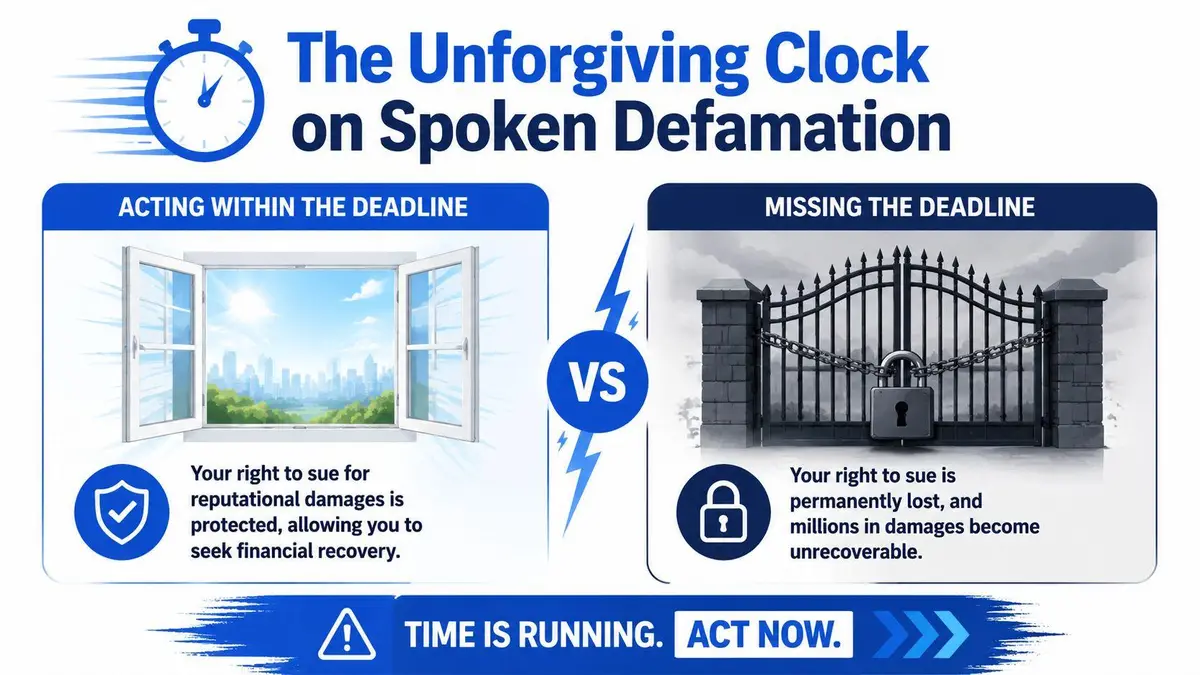
Once that window closes, even the most outrageous and damaging lies become legally untouchable.
Adding another layer of urgency is the “single publication rule.” If a slanderous statement is recorded in a podcast or video, the clock starts from the moment it was first uploaded. It does not reset every time someone new watches or shares it. This makes immediate action vital in cases of online defamation of character, where a single piece of content can spread virally. The court will only recognize that initial upload date.
Calculating Your Filing Deadline With Precision
Miscalculating the filing deadline for a slander lawsuit, even by a single day, guarantees your case will be dismissed. Precision is the absolute bedrock of your legal strategy. This requires a methodical, surgical approach to determining the exact moment the clock started ticking.
Consider a real-world scenario: a high-profile executive becomes the target of a vicious rumor in a podcast episode released on March 15, 2025. The host falsely claims she engaged in insider trading. If this occurs in a state with a one-year statute of limitations, like California or New York, the countdown starts immediately.
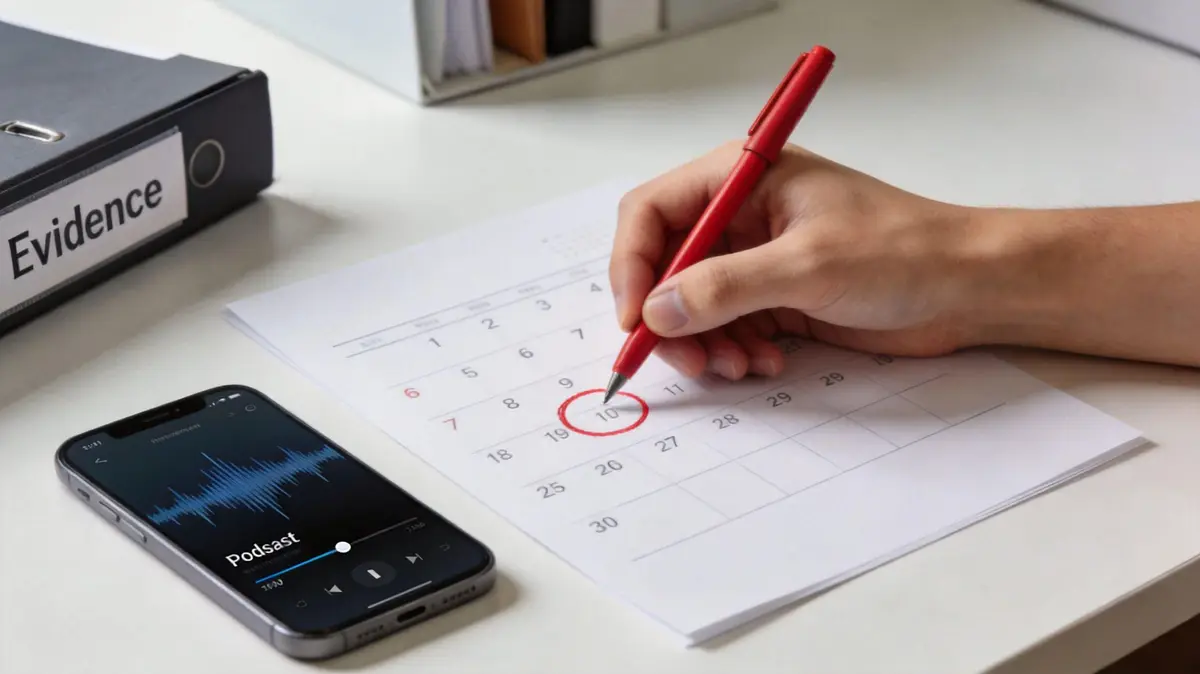
The clock does not start when the executive hears the podcast. It starts on the date of its initial utterance: or, in this case, its publication to a third party.
Pinpointing the Start Date
To calculate your deadline, you must follow a rigid sequence:
- Identify the Date of Publication: For our executive, this is March 15, 2025, the day the podcast episode went live.
- Count Forward by the Statutory Period: In a one-year jurisdiction, you count forward 365 days from March 15, 2025.
- Mark the Final Day: The last possible day to file the lawsuit would be March 15, 2026. Filing on March 16 would result in automatic dismissal.
This simple arithmetic can be complicated by real-world variables. If the podcast was first released to a small, private group of patrons a week before its public debut, a court might very well consider that earlier date the official start.
The Single Publication Rule in Practice
This scenario also highlights the harshness of the single publication rule. This legal doctrine is unforgiving, treating the entire distribution of a defamatory statement as one single event tied to the initial release date.
The slanderous podcast episode could be downloaded a million times, shared across social media, and clipped for other platforms. Legally, none of that activity matters for the statute of limitations. The clock started on March 15, 2025, and it does not reset.
This means new views, shares, or discussions of the original slander do not create new opportunities to sue. The rule is designed to protect defendants from a perpetual threat of litigation for a single act. For the victim, it creates immense pressure to act quickly based on that one, singular event. Verifying these dates with experienced legal counsel is an absolute necessity to ensure you do not forfeit your right to seek recourse.
Rare Exceptions That Can “Toll” the Statute
While the deadline for a slander claim is nearly absolute, a few rare circumstances can “toll,” or pause, the clock. Relying on this legal concept is a long shot. Courts are exceptionally strict, and the burden of proof required to secure an exception is immense. These are not loopholes but safety valves for truly exceptional circumstances where filing on time was genuinely impossible.
The Discovery Rule and Fraudulent Concealment
The most frequently discussed exception is the discovery rule. The principle is that the clock starts not when the slander was spoken, but when you discovered it (or reasonably should have discovered it). For slander, this argument gains traction when a perpetrator has actively tried to hide their actions through fraudulent concealment.
If a rival spread a lie through a private, encrypted chat group using a pseudonym, they took deliberate steps to prevent discovery. In such a case, the clock might not start until you uncover the speaker’s identity and the content of their statement. Proving this requires showing they intended to deceive you.
Tolling for Age or Incapacity
The law also pauses the clock for individuals who legally cannot act on their own behalf. These exceptions are more straightforward, tied directly to the victim’s status at the time of the slander.
The statute of limitations is typically tolled if the slandered person is a minor, pausing until they reach the age of 18 and can file a lawsuit themselves. Similarly, if someone lacks the mental capacity to understand the harm or manage their legal affairs, the clock may be tolled until they regain competency.
The tension has always been between fairness to the victim and the need for legal finality. While exceptions exist, courts almost always fall back on the strict one-year filing deadline, a standard that has been part of defamation law for over 170 years. This rule was adopted by American states from 19th-century English common law to balance the protection of reputation with free speech. While tolling arguments might be raised, their success is rare. As you can learn more from this Ohio Supreme Court analysis, attempting to win on a tolling argument is an uphill, and often losing, battle.
The Permanent Consequences of a Missed Deadline
Regarding the slander statute of limitations, there are no second chances. Missing the deadline is not a procedural hiccup; it permanently torpedoes your right to sue. The clock is not your ally.
Once that legal window closes, it is shut. A judge will not hear the merits of your case, regardless of the strength of your evidence or the malice of the attack. Their review will be confined to the calendar. If you file even one day late, your case will be dismissed. All your leverage vanishes instantly.
The Financial and Reputational Fallout
The fallout from a missed deadline is severe and irreversible. A slanderous statement that scuttled a multi-million-dollar deal, crashed your company’s stock, or destroyed your personal brand becomes a legally untouchable event. Any financial losses you suffered are rendered unrecoverable through the courts.
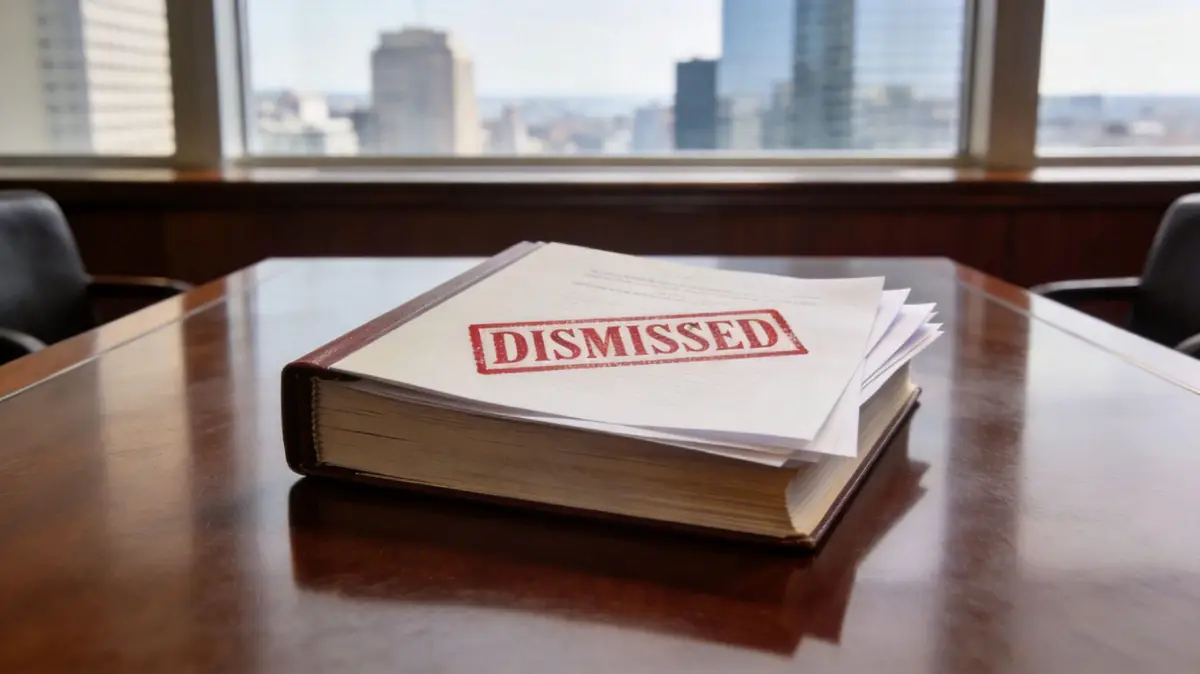
This finality is precisely why immediate action is imperative. Slander left unchallenged does not merely damage your reputation today; it casts a long shadow over future opportunities.
Once the statute of limitations expires, the person who slandered you is effectively immune. They face zero legal consequences for the damage they caused, and the false narrative they unleashed is free to persist without any challenge in court.
This is a harsh reality of the legal system, underscoring the critical need for a professional assessment of your claim at the earliest possible moment. The law rewards decisive action and punishes hesitation. Waiting to see if the problem will “blow over” is a gamble that almost always leaves you with devastating damages and no path to repair them.
Strategic Actions to Take Before the Clock Expires
If you are the target of slander, time is your enemy. The statute of limitations is a ticking clock, and when it runs out, your legal options evaporate. For high-net-worth individuals and executives whose careers are built on reputation, waiting to see if a problem resolves itself is a risk you cannot afford. You must move with speed and precision.
Preserve and Document All Evidence
Your first action is not to retaliate but to secure proof. A slander claim is built on evidence. Before taking any other step, you must create a comprehensive record.
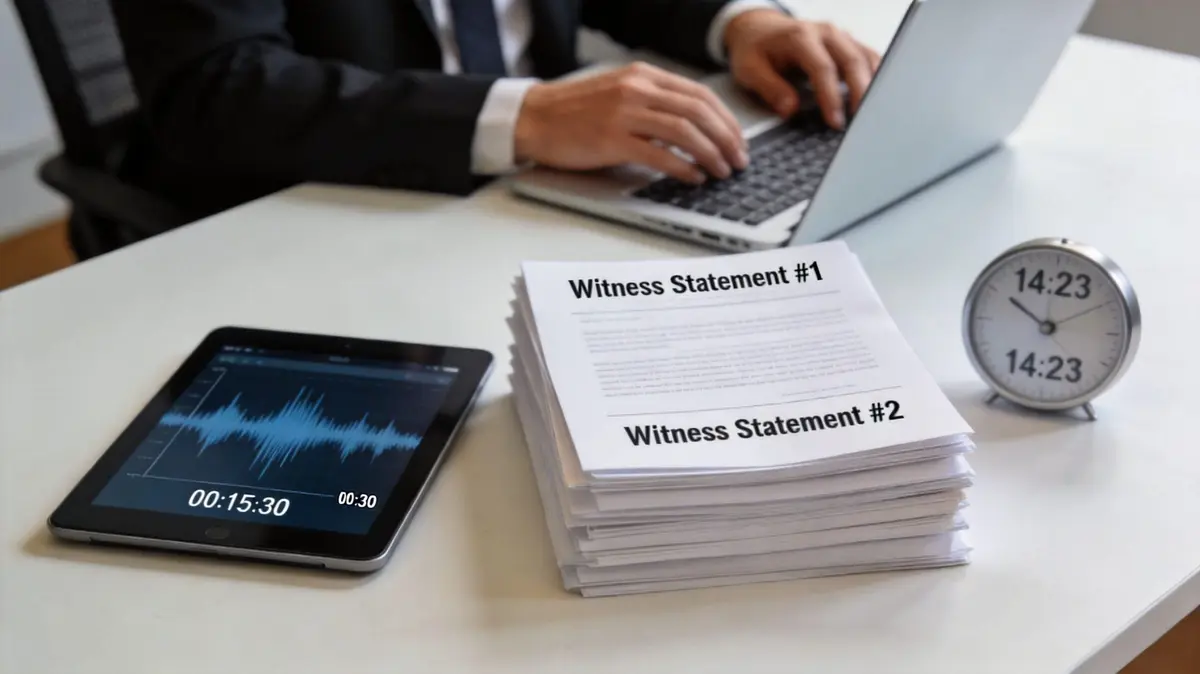
First, obtain a copy of the original file if the slander was in a recorded format like a podcast or video. Do not assume it will remain online. Second, identify every person who heard the statement and secure signed, dated affidavits confirming what they heard, where, and when. Third, write down every detail you remember: the exact words used, the setting, who was present, and the immediate fallout. This evidentiary foundation is crucial for any subsequent legal complaint or content removal action. You can find more on this in our guide on what to do if someone is slandering you on social media.
Engage Specialized Counsel Immediately
With your evidence organized, your next call must be to legal counsel specializing in defamation. The slander statute of limitations is a strict, unforgiving deadline. A general practitioner may not grasp the urgency or the specific strategies required for a swift resolution.
Consider New York, a major media and financial hub, where the statute of limitations is a very tight one year from the moment the words were spoken (N.Y. Civ. Prac. L. & R. § 215(3)). Courts are rigid about this deadline. As you can discover more about New York’s strict defamation deadlines, it is clear that speed is everything.
A firm that combines legal expertise with technical takedown capabilities can assess a claim and initiate action within 24-48 hours. This offers a decisive advantage when reputational and financial damage compounds daily.
This is not a time for hesitation. It is a time for a decisive response. By preserving evidence and immediately engaging experts, you shift from being a passive victim to an active defender of your reputation, taking back control before the law declares it is too late.
Frequently Asked Questions About Slander Deadlines
When facing a reputational attack, you require clear, decisive answers. Here are the critical questions that arise when confronting the statute of limitations for slander.
Can Content Be Removed if the Statute of Limitations Has Expired?
Yes. The expiration of the statute of limitations only bars your ability to file a lawsuit for monetary damages. It does not grant the defamatory content a permanent right to exist online.
Strategic removal campaigns can be pursued through other avenues. These include actions based on terms of service violations, copyright claims (if your proprietary images or videos were used), or direct negotiation with the platform or publisher. The inability to sue does not mean the inability to act. We cover these tactics in our guide on how to get a website taken down for slander.
Does Each New Share of a Slanderous Video Restart the Clock?
No. This is a crucial point of law where many are mistaken. Virtually all U.S. jurisdictions adhere to the “single publication rule.”
This legal principle establishes that the statute of limitations begins running the first time the slanderous material is published. Every subsequent share, like, or repost is an echo of that first event. While it amplifies the harm, it does not create a new deadline for filing a lawsuit. Action must be predicated on the date of the initial publication.
What if the Slander Was Spoken Anonymously Online?
Anonymity can introduce complexity but may also provide grounds to “toll,” or pause, the statute of limitations. Some courts may accept the argument that the countdown should not begin until the anonymous speaker can be reasonably identified.
This is not an automatic extension. You must demonstrate to the court a diligent, good-faith effort to identify the perpetrator. This often involves filing a “John Doe” lawsuit to compel the platform, via subpoena, to disclose user information. Proving you are actively trying to unmask the speaker is essential to making a successful tolling argument.
When your reputation is on the line, time is your most critical resource. The rules surrounding the slander statute of limitations are complicated and unforgiving, demanding a swift and knowledgeable response. At ContentRemoval.com, we specialize in confidential assessments and decisive strategies to defend our clients’ good name. If you’re facing a reputation crisis, contact us for a confidential consultation.