

SEO reputation management is the discipline of controlling what appears on the first page of Google for your name or company. It combines technical SEO, legal strategy and public relations to suppress negative results, remove damaging content at the source, de-index pages that cannot be removed, and monitor for new threats before they rank.
Key facts
- Four core tactics: suppression, source removal, search engine de-indexing, and proactive monitoring.
- Source removal needs a legal basis such as DMCA, a court order or a terms of service breach.
- With clear legal grounds, takedowns or de-indexing can happen in 24 to 72 hours.
- Suppression campaigns show early movement in 30 to 90 days and take several months to complete.
Where ContentRemoval.com comes in. ContentRemoval.com has handled this kind of search result problem since 2017, with more than 16 million links removed for individuals, companies and their advisors. The person affected, their chief of staff or their lawyer usually makes the first contact. A free 15-minute Exposure Scan maps which results are removable, which can be de-indexed and which need suppression, and the report is theirs to keep. Get a Free, Confidential Exposure Scan or read how our reputation management work is done.
When an individual’s or a corporation’s reputation is under attack, the search results on Google become the primary battlefield. SEO reputation management is the discipline of controlling this digital narrative. It is a specialized field that deploys a combination of technical SEO, legal strategy, and precise public relations to suppress negative search results and promote authoritative, positive assets.
This process is a form of digital asset protection, particularly for those facing high-stakes reputational threats. The objective is not merely to mitigate damage but to strategically reconstruct the first page of Google to reflect an accurate and controlled public profile.
What Is SEO Reputation Management in a Crisis?
Historically, a crisis was managed through press conferences. The modern crisis unfolds on the search engine results page (SERP). For an executive, a high-net-worth individual, or a prominent law firm, what appears on Google is not a matter of public opinion. It is a direct threat to market value, corporate stability, and personal security.
Herein lies the critical distinction between conventional public relations and SEO reputation management. Traditional PR aims to shape public opinion over time. In contrast, SEO reputation management directly re-engineers the digital environment where those opinions are formed. The first page of Google is treated as what it is: the most valuable digital real estate in the world.
To understand the operational differences, a direct comparison is necessary.
Conventional PR vs SEO Reputation Management
| Aspect | Conventional Public Relations | SEO Reputation Management Services |
|---|---|---|
| Primary Goal | Shape public opinion and media narratives. | Control and manipulate search engine results pages (SERPs). |
| Key Tactics | Press releases, media outreach, crisis communications. | Content suppression, de-indexing, takedowns, asset creation. |
| Speed of Impact | Gradual; can take weeks or months to shift perception. | Rapid and direct; changes can be seen in days or weeks. |
| Main Arena | News outlets, television, print media. | Google, Bing, and other search engines. |
| Measurement | Media mentions, sentiment analysis, share of voice. | SERP rankings, removal of negative links, traffic to positive assets. |
| Focus | Building long-term relationships with journalists. | Technical and legal actions against hostile content and platforms. |
While related, these disciplines operate in different arenas with distinct tools and timelines. SEO reputation management is a more direct, technical, and often aggressive approach engineered for the digital environment.
The Real-World Costs of a Negative Search Profile
Leaving search results to chance is a significant liability. A single negative article, a defamatory blog post, or a series of fraudulent reviews can inflict immediate and catastrophic damage.
For an executive, this can mean watching investor confidence evaporate or seeing a critical M&A deal fall apart. For a family office, it might invite unwanted scrutiny or create serious security risks. Your digital story has a direct impact on your real-world assets.
The financial data confirms this. Corporate reputation is the bedrock of market value, accounting for $11.9 trillion of S&P 500 firms’ value: a staggering 63% of their total market worth. Yet, mismanagement of that reputation, especially against relentless user-generated content and fabricated reviews, is estimated to cost the global economy $3.5 trillion. The financial stakes are absolute.
Digital Asset Protection Is Not Optional
Professional SEO reputation management is a modern form of asset protection. It is the decisive action taken when a digital attack threatens to nullify years of success.
This is not a reactive process of managing bad press. It is the construction of a durable digital fortress around your name and interests. By seizing control of the information available to investors, partners, and clients, you are protecting your most vital assets: your name, your company’s standing, and your family’s security. To review our firm’s specific strategies, see our reputation management services. This is how you ensure the digital world reflects the reality you have built, not a false narrative created by others.
When facing an online reputation attack, a disciplined, multi-front strategy is required. The most effective SEO reputation management firms do not apply a single tactic; they orchestrate a precise campaign designed for the specific threat.
At the core of this work are four primary tactics: suppressing negative content, removing it at the source, de-indexing it from search engines, and maintaining vigilance through proactive monitoring. The selection and sequence of these tools depend entirely on the situation. A defamatory news article demands a different approach than a swarm of fraudulent reviews or a leaked private document.
Pushing the Negative Down: The Art of Suppression
Content suppression is an act of strategic displacement. It operates on the principle that the first page of Google has limited space. The objective of suppression is to develop and promote positive, authoritative assets under your control, thereby pushing negative links off the first page and into digital irrelevance.
This is not the mere generation of blog posts. It is a sophisticated campaign involving the construction of a powerful network of web properties that represent you. The core components are:
- Owned Digital Assets: This is the foundation: your corporate site, personal homepage, LinkedIn profile, and other official social media. We begin by ensuring these are fully optimized and project complete authority.
- Third-Party Platforms: Securing positive mentions and profiles on reputable news sites, industry publications, and executive biography sites is crucial. Search engines interpret these as powerful third-party endorsements.
- Strategic Content: A stream of high-value content (in-depth articles, white papers, interviews) is then engineered to rank for your name and establish your expertise.
The objective is to construct a digital “firewall” of positive, credible results that dominate the first page of search. When a negative link is displaced from the top result to the second page, its influence is almost entirely neutralized. Given that 27.6% of all clicks go to Google’s top result, seizing that position from a damaging story is a decisive victory.
This chart illustrates how these protective strategies apply to both corporate and personal domains.
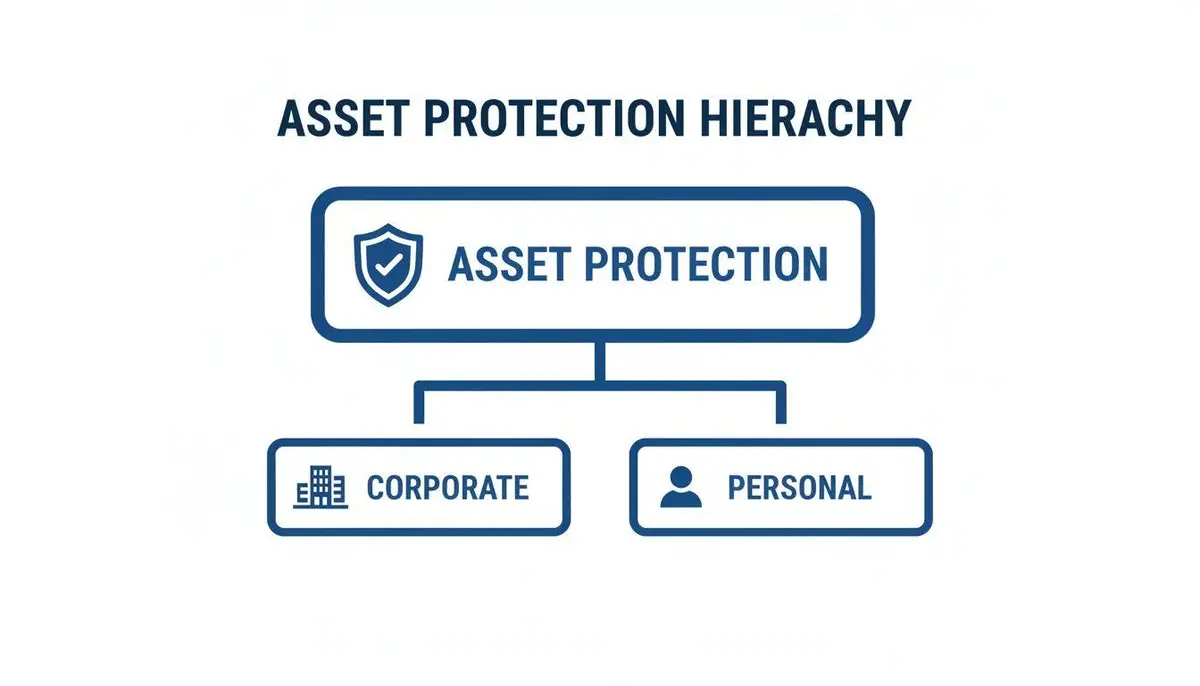
Protecting a company’s brand and the personal reputations of its leaders are intertwined. A threat to one will invariably impact the other.
Going to the Source: Surgical Removal of Damaging Content
While suppression buries negative content, source removal eradicates it. This is the ultimate solution: erasing the defamatory article, fake review, or leaked photograph from the web permanently. It is also the most complex, requiring a synthesis of legal strategy and deep technical skill.
Source removal is not a polite request; it is an enforcement action. Success demands a rock-solid legal basis (whether through copyright law (DMCA), a court order, or a clear violation of a platform’s terms of service) to compel a site owner or host to take the content down.
This tactic is reserved for content that is clearly illegal or in violation of established policies, content that is demonstrably false, defamatory, or infringing. The key is to build an undeniable case, typically through legal counsel, that leaves the opposing party with no alternative but to comply. It is the digital equivalent of having a court record expunged.
Making It Invisible: De-indexing from Search Engines
What happens when source removal is not an option? A foreign news outlet shielded by its country’s laws may render a takedown impossible. In such cases, the next best action is de-indexing.
This is a formal request made directly to a search engine like Google to remove a specific URL from its search results. Although the damaging page continues to exist on the original website, it becomes a ghost, invisible to anyone attempting to find it through search.
De-indexing is a powerful tool for several reasons. It severs the connection between the public and the damaging content; if it cannot be found on Google, it functionally ceases to exist for most people. It is often much faster than protracted legal battles for a takedown, and it can be targeted; depending on the legal grounds (such as Europe’s “Right to be Forgotten” under GDPR), removal can be applied globally or restricted to specific regions.
This is a highly technical process requiring a formal submission that clearly outlines the legal or policy violation. When successful, it effectively resolves the problem for the vast majority of the public.
The Watchtower: Why Proactive Monitoring Is Non-Negotiable
The final component is constant, proactive monitoring. A reputation is not a static object that can be fixed once and then ignored. It is a dynamic entity under perpetual threat. Employing sophisticated, AI-powered tools to scan the web, social media, and even the dark web for emerging threats is no longer a luxury; it is a necessity.
This early-warning system enables a reputation team to intervene swiftly, before a minor issue escalates into a significant crisis. This is a primary driver behind the online reputation management market’s projected growth to USD 14.01 billion by 2031. As firms race to manage threats at scale, the software segment is expanding at a 17.09% CAGR, according to analysis from Mordor Intelligence.
By constantly tracking mentions of your brand, executives, and key search terms, you can identify and neutralize negative content before it has the opportunity to rank and cause real damage.
Navigating Legal and Technical Complexities

Effective seo reputation management services exist at the intersection of law and technology. A digital crisis is never solved by one discipline alone. It requires an integrated approach where legal authority provides the right to act, and technical expertise ensures that action is executed.
A court order demanding content removal is merely a document without the technical capability to have it de-indexed from Google or wiped from a server. Conversely, the most sophisticated technical methods are impotent against content that is legally protected, regardless of its damaging nature.
This partnership is paramount. A successful campaign is a two-front battle. The legal team constructs the case (identifying copyright infringement, a privacy violation, or a defamation claim) while the technical team executes on the front lines. The latter ensures the problematic content disappears not just from view, but from the internet’s infrastructure. A misstep on either side can compromise the entire operation.
The Jurisdictional Maze
For executives and brands with a global presence, the legal landscape is fraught with complexity. Libel laws in the United States differ significantly from those in the United Kingdom or Australia. Europe’s GDPR offers powerful privacy-based removal options that are absent elsewhere. A strategy that is effective in one jurisdiction may be futile in another.
This is precisely why a firm with a global legal perspective is a necessity, not a luxury. You require a team capable of navigating this patchwork of international laws, leveraging the appropriate regulations in the right jurisdictions to build the strongest possible case for removal or suppression.
Frequently, the optimal approach involves filing legal actions in the most favorable jurisdictions while applying technical pressure globally. This demands a profound, practical understanding of international law and the specific terms of service for each major technology platform. For a detailed examination of these strategies, our executive guide on navigating online content removal laws is an essential resource.
Proprietary Technology and Permanent Results
Securing legal authorization is only half the battle. The subsequent technical execution must be flawless. This is where specialized tools and proprietary methods become decisive, as the objective is not simply to hide the problem, but to permanently erase it.
This is not a single action but a multi-layered technical operation:
- Source Removal: The process begins at the root. Armed with legal justification, the technical team contacts website owners, hosting companies, and Internet Service Providers to demand the content’s permanent deletion from their servers.
- Search Engine De-indexing: Concurrently, we engage the search engines directly. This involves submitting precise, technically sound requests to Google and others to remove not just the URL, but also any cached versions or associated images, leaving no trace in search results.
- Proactive Monitoring: Once removed, the content must remain gone. Advanced monitoring systems are deployed to constantly scan the web for reposts. If the content reappears, the system immediately flags it, allowing for swift re-suppression before it can regain traction.
Global regulations are in constant flux, compelling more businesses to seek expert guidance. The EU’s Digital Services Act, for example, now mandates strict brand monitoring, while new compliance rules are emerging in jurisdictions from India to China. A significant component of reputation management also involves proactive measures, such as effectively managing Google reviews, to build a positive presence.
Ultimately, this fusion of legal strategy and technical precision is what distinguishes truly effective seo reputation management services. It is the methodology for achieving the permanent, decisive results that high-stakes situations demand.
Establishing Timelines and Realistic Outcomes
When facing a threat to your online reputation, the immediate questions are always: How long will this take, and what does success look like? There is no single answer. The correct strategy, and its corresponding timeline, is determined entirely by the nature of the threat.
A professional SEO reputation management services engagement does not offer vague promises. It establishes clear, measurable objectives from the outset.
Certain actions yield rapid results. These are surgical strikes. With a solid legal basis, such as a clear copyright violation or a court order, content can often be de-indexed or removed within 24 to 48 hours. This approach is effective when the target is a single piece of content and the path to removal is unambiguous.
However, not all problems have such a swift resolution. A defamatory article on a major international news site, protected by its home country’s free speech laws, may be impossible to remove directly. In this scenario, the strategy shifts from a quick strike to a strategic suppression campaign.
The Pace of Suppression Campaigns
Suppression is a marathon, not a sprint. The objective is to build and promote a portfolio of positive digital assets that systematically displace negative results from the first page of Google. This involves creating new personal websites, optimizing executive profiles, securing positive media coverage, and placing guest articles.
This is a deliberate, methodical process of constructing a new reality on the search results page.
Initial progress, marked by the ranking of new, positive content, is often visible within 30 to 90 days. However, achieving and maintaining a completely clear first page for your name is a longer-term endeavor. A full suppression campaign typically requires several months to establish a durable digital defense capable of withstanding future threats.
For a more detailed analysis of these variables, our guide on professional timelines for removing a search result provides a comprehensive breakdown.
Defining and Measuring Success
Success in this field is not measured by subjective feelings or vanity metrics. It is defined by concrete outcomes that reduce risk and restore control over your narrative. We focus on hard data, not abstract concepts like “improved sentiment.”
We measure the success of a campaign by its Search Result Clearance Rate, the percentage of negative links pushed off page one, and its Threat Containment Time, which is how quickly we neutralize a new negative item before it does real damage.
These metrics provide a clear, objective standard for evaluating performance.
True success is not the temporary disappearance of a single negative link. It is the permanent restoration of a clean, authoritative, and accurate digital footprint. It is a verifiably clear first page for your name, the permanent removal of offending URLs, and a measurable reduction in your exposure to online attacks. This is the standard to which professional SEO reputation management services must be held.
A Buyer’s Checklist for Selecting a Provider

When your reputation is at risk, selecting a firm to manage the crisis is a decision with no margin for error. The market is saturated with agencies making grand promises, but few possess the specialized skills required to protect high-profile clients.
The right partner operates with surgical precision and the discretion of a trusted legal advisor. The wrong one can exacerbate the crisis.
This is not a list of suggestions. For executives, legal counsel, and public figures, these are the non-negotiable criteria for vetting professional SEO reputation management services. This process demands the same rigor as any other critical business investment.
Vetting Core Competencies
First, it is imperative to penetrate the marketing facade and assess a firm’s actual capabilities. A polished website is meaningless without proven expertise. Your inquiry should focus on the four pillars that distinguish true professionals from pretenders.
- Proven Track Record: Demand evidence that they have handled cases comparable to yours. Request anonymized case studies detailing the specific threat, the strategy employed, and the final outcome. If they cannot demonstrate experience in similar situations, they are not the appropriate choice.
- Integrated Legal Acumen: A top-tier firm does not simply “work with lawyers”; they have deep legal expertise integrated into their operations. They must be able to discuss international copyright law, defamation statutes, and privacy regulations like GDPR with fluency. Inquire about their process for escalating issues for court-ordered removals and how they use legal leverage to achieve results.
- Unbreakable Confidentiality: This is the absolute foundation of the relationship. Scrutinize their security protocols. How is client data stored, encrypted, and transmitted? Who on their team has access? What are the specific terms of their NDAs? Any ambiguity on these points is an immediate disqualifier.
- Proprietary Technology: While the fundamentals of SEO are public knowledge, elite-level execution requires more than off-the-shelf tools. Ask about their monitoring systems, their methods for tracking the permanence of a takedown, and any custom software they have developed to accelerate suppression campaigns. This is their technical advantage.
Identifying Critical Red Flags
Equally important as knowing what to look for is knowing what to avoid. Certain promises and tactics are clear indicators of an agency’s amateurism or lack of ethics. Remain vigilant for these red flags during initial consultations.
First, be highly skeptical of any firm offering a 100% guarantee to remove content. This is a common and dangerous misrepresentation. A legitimate removal always depends on legal and platform-specific factors that are never certain. A guarantee is a sales tactic, not a realistic commitment.
Second, disengage from any firm that is vague about its methods. If they cannot clearly explain the difference between suppression, de-indexing, and source removal, and the strategic application of each, they lack the necessary depth. Any mention of “black-hat” tactics, such as creating fake reviews or building spammy links, is another significant red flag. These methods can backfire and result in penalties against your own digital properties from Google.
Finally, a lack of clear, structured pricing is a major problem. A professional firm will provide a detailed proposal outlining the scope of work, key deliverables, and a transparent cost breakdown. If a provider is evasive on pricing or attempts to fit you into a generic package, they do not operate at the required level of sophistication. Creating a buyer’s checklist and reviewing external guides, like this one on the Top 7 SEO Agencies in South Africa, can provide a solid benchmark for what a professional and transparent partnership should entail, even across different markets.
Your Questions, Answered
When considering reputation management, particularly under duress, clients have direct and practical questions. For executives, family offices, and legal teams, the primary concerns are speed, permanence, and privacy. Here are the direct answers.
How Quickly Can Negative Content Be Dealt With?
There is no single timeline, as there is no single type of problem. The speed of a solution is dictated entirely by the applicable strategy.
If a court order or a clear-cut copyright claim exists, we can act with surgical precision. These takedown or de-indexing actions are the most rapid solution, often removing content from public view in 24 to 72 hours.
Conversely, suppression campaigns operate on a different timeline. When a negative story is hosted on a major news site that is unwilling to remove it, direct removal is not an option. Instead, we must strategically build and promote a barrier of positive assets to displace the damaging content from the first page of Google. This is a methodical, long-term strategy that takes several months to establish and fortify.
Is It Possible to Permanently Remove an Article from the Internet?
Yes, permanent removal from the source, meaning the article is deleted from the website’s server, is often achievable. However, success hinges on possessing the correct legal leverage.
The most direct paths to permanent removal are through DMCA copyright claims, court orders resulting from defamation litigation, or severe privacy violations. In these instances, we can legally compel the site owner or their hosting provider to remove the content.
When source removal is not feasible, de-indexing is the next-best permanent solution. The page continues to exist, but it is removed from search engines like Google, rendering it practically invisible. If neither of these options is available, a suppression strategy is employed.
How Is Confidentiality Ensured Throughout the Engagement?
For our clients, confidentiality is not merely a policy; it is the entire foundation of our relationship. We operate with a level of discretion equivalent to that of a premier law firm. The process begins with a comprehensive non-disclosure agreement (NDA) that governs every action we take.
All communications are conducted through secure, encrypted channels. Your identity, the specifics of your case, and the strategies we develop are compartmentalized and protected by stringent security protocols. The process of repairing your reputation must not create new vulnerabilities, and we ensure that it never does.
What Determines the Cost of Reputation Management Services?
The investment required for professional SEO reputation management services is directly proportional to the scale and complexity of the problem. There are no standard price tags, as no two situations are identical.
The cost is determined by several key factors:
- The Nature of the Threat: A single negative article on an obscure blog is fundamentally different from a coordinated attack across multiple news sites and social media platforms.
- The Authority of the Host: Addressing a negative story on a personal blog is far less complex than dealing with one published by a major international news organization.
- The Required Strategy: A rapid, legally-driven takedown is a different undertaking than a multi-month suppression campaign requiring the creation and promotion of numerous new digital assets.
- Jurisdictional Complexity: Issues that cross international borders and involve multiple legal systems naturally require greater resources to navigate.
Any firm that provides a generic price list without a thorough analysis of your specific situation should be viewed with suspicion. A true expert first conducts a comprehensive, confidential audit to develop a precise action plan. Only then can a clear scope of work and an accurate cost be established, ensuring you are investing in a specific outcome, not merely billable hours.
When your reputation is on the line, you need a team with the specialized legal and technical skills to get the job done. ContentRemoval.com provides discreet, rapid, and permanent solutions for high-profile individuals and their advisors. To begin with a confidential assessment of your situation, contact us today.
Frequently asked questions
What is the difference between suppressing and removing a search result?
Suppression pushes a negative link off the first page by building and promoting positive assets that outrank it, so the page still exists but few people see it. Removal deletes the content from the website itself, which requires a legal basis such as copyright, a court order or a platform policy violation. De-indexing sits between the two: the page stays live but Google stops showing it.
Can a negative article on a foreign news site be removed from Google?
Direct removal is often impossible when the outlet is protected by its home country’s laws. In that case the article can sometimes be de-indexed through a formal request to Google, and under GDPR the removal may be applied within Europe. If neither route is open, a suppression campaign displaces the article from page one.
What are the warning signs when choosing an SEO reputation management firm?
Be cautious of any firm promising certain removal of every piece of content, since results always depend on legal and platform factors. Vagueness about the difference between suppression, de-indexing and source removal is another sign of shallow expertise. Fake reviews, spam links or unclear pricing should end the conversation.