
A sentiment analysis tool for executive defense is an early warning and triage system, not a marketing dashboard. It collects posts, reviews, articles and transcripts, classifies tone at entity and aspect level, traces where a narrative originated and who amplifies it, and feeds a chain of detection, verification, prioritization, remediation and recovery tracking that handles the most visible content first.
Key facts
- Defense-grade tools need entity-level targeting, aspect-level hostility detection and source-level traceability.
- Cited production figures: transformer-based models reach 91 to 95% accuracy versus 70 to 80% for classical models.
- Demand historical retention, platform filtering, clean evidence exports and custom watchlists before procurement.
- A case brief needs the exact URL, publication context, identity details, a timestamp trail and a platform-specific rationale.
Where ContentRemoval.com comes in. ContentRemoval.com sits at the remediation step: once a tool flags a defamatory thread, a review cluster or reposted private material, the firm verifies it, builds the evidence packet, runs the platform report, defamation notice, privacy complaint or impersonation claim that fits, then watches for reuploads. General counsel and chiefs of staff usually make contact when alerts arrive faster than anyone can act. A free 15-minute Exposure Scan maps what is removable, and the report is yours to keep. Get a Free, Confidential Exposure Scan or read how our content removal work is done.
At 6:40 a.m., your general counsel forwards three links. One is a thread accusing your company of misconduct. One is a review cluster targeting your leadership. One is a repost of private material framed to look like a public-interest disclosure. By 7:15, investors have seen it, staff are circulating screenshots, and reporters are watching for your first mistake.
That’s the environment executives operate in now. A reputation attack doesn’t arrive as a single event. It arrives as a coordinated sequence across search, social, reviews, forums, and message amplification. If you treat that as a PR issue, you lose time. If you treat it as an intelligence problem, you gain control.
A sentiment analysis tool belongs in that second category. Used properly, it isn’t a brand dashboard. It’s an early warning and triage system that tells you where hostility is forming, which narratives are spreading, which posts are driving downstream damage, and what deserves immediate takedown or legal escalation.
The New Front Line of Reputation Warfare
A high-profile executive rarely gets attacked in one place. The attack starts with a post on a fringe forum, gets laundered into social commentary, then appears in review platforms, recycled articles, and search results. Each layer gives the next one false legitimacy.
That’s why the first question in a crisis isn’t “What are people saying?” It’s “Which negative narratives are gaining velocity, who is amplifying them, and which assets can we remove first?” A capable sentiment analysis tool answers that in time to matter.
The market’s direction tells you this is no longer a niche capability. The global sentiment analytics market was valued at US$5.1 billion in 2024 and is projected to reach US$11.4 billion by 2030. Within that, the social media analytics segment alone is estimated to reach US$17.04 billion by 2030, growing at a 27.6% CAGR. That projection underscores how quickly these systems are being integrated into reputation monitoring and response operations, as reported in this sentiment analytics market report.
What changes when you use it defensively
Most executives have seen sentiment tools presented as marketing software. That framing is too soft. In a live attack, you need command-and-control visibility. You need to know whether criticism is organic, opportunistic, or coordinated.
A defensive system does three jobs at once:
- It identifies escalation points by showing where negative sentiment is clustering first.
- It exposes narrative transfer by revealing when the same allegation starts crossing platforms.
- It supports intervention by helping your team prioritize removal targets instead of reacting to the loudest post.
Practical rule: If a platform influences search visibility, investor perception, hiring, customer trust, or litigation posture, it belongs inside your monitoring perimeter.
Executives who need a broader privacy and response framework should align monitoring with a formal online reputation management strategy for executive digital privacy. The point isn’t to observe damage elegantly. It’s to interrupt damage before it compounds.
Deconstructing Sentiment Analysis for Strategic Oversight
You don’t need to think like a data scientist to run this well. Think like an intelligence chief.
A sentiment analysis tool receives raw field reports from the open internet. Those reports include posts, comments, articles, reviews, transcripts, and public discussion fragments. The machine’s job is to convert noise into a threat picture you can act on.
Think in terms of an intelligence pipeline
The first layer is collection. Sentiment analysis uses natural language processing and machine learning to automatically categorize text from over 100 million online sources in real time, including social media, reviews, news articles, and voice conversations, according to this explanation of how sentiment analysis works in business use cases. For an executive, that matters because attacks don’t stay in one format. They move between text, headlines, user commentary, and recorded statements.
The second layer is interpretation. Natural language processing works like an analyst reviewing field reports. It separates relevant language from clutter, recognizes what the discussion is about, and distinguishes whether the hostility is aimed at your company, your product, or you personally.
The third layer is pattern recognition. Machine learning functions like the senior strategist. It compares current signals to prior patterns and surfaces anomalies. That’s how a system spots the difference between routine criticism and the start of a coordinated smear.
Where lexicons still matter
Lexicons are the codebooks. They define known hostile terms, recurring allegations, executive name variants, product labels, slurs, threats, and campaign phrases. On their own, they’re blunt. Combined with machine learning, they become useful filters for legal and crisis teams.
Here’s the executive version of the workflow:
| Stage | What the system sees | What your team gets |
|---|---|---|
| Collection | Public posts, reviews, articles, transcripts | Broad visibility |
| Processing | Entities, language cues, topic references | Clarity on target and meaning |
| Classification | Positive, negative, neutral, and emotional tone | Threat level |
| Output | Alerts, dashboards, source trails | Action priorities |
A dashboard that only says “negative sentiment is rising” is a toy. A system that tells you where, from whom, and around which allegation is useful.
What oversight actually looks like
You should expect concise outputs, not academic complexity. The useful questions are simple.
- Is the hostility tied to a specific allegation, image, event, or leak?
- Is it directed at the corporation, the founder, or named executives?
- Is the spread cross-platform, or still containable?
- Which URLs and accounts belong in the first takedown wave?
That’s strategic oversight. You’re not measuring vibes. You’re reading operational intelligence.
Must-Have Capabilities for Reputation Defense
Most sentiment platforms were built for marketing teams trying to understand audience reaction. That is not the same as protecting an executive under pressure. Marketing software measures attention. Defense software supports action.
Precision matters more than volume
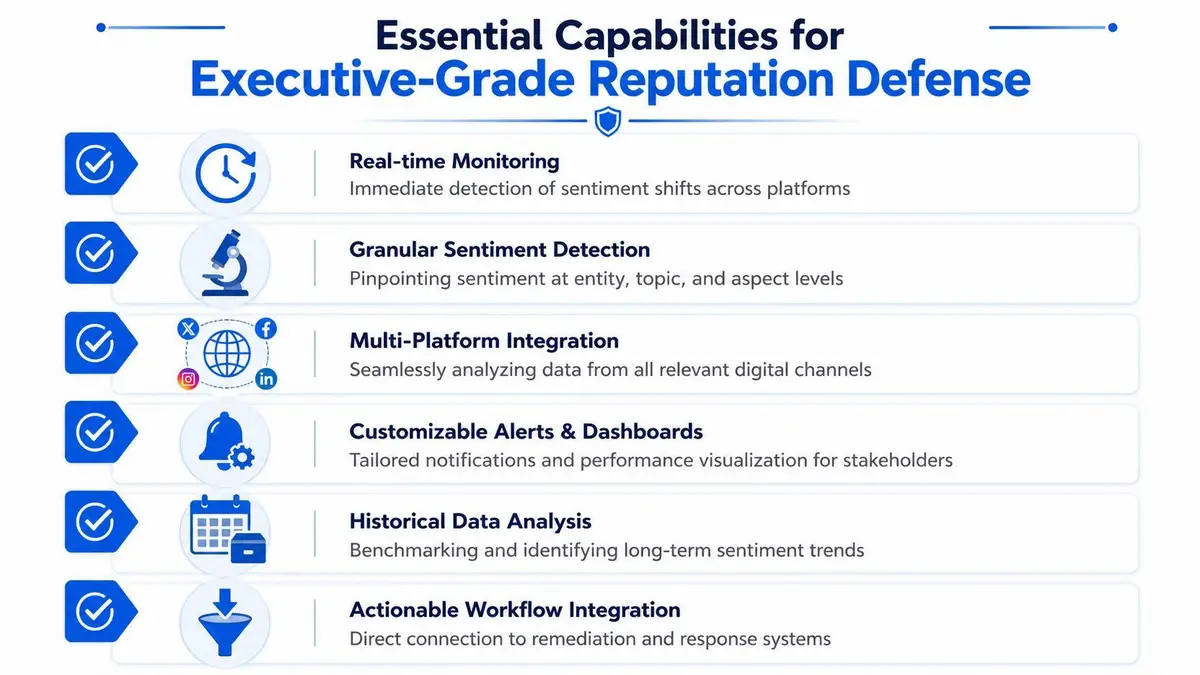
In production environments, transformer-based fine-tuned models achieve 91 to 95% accuracy for sentiment analysis, compared with 70 to 80% for classical machine learning models, according to this review of sentiment analysis accuracy in production systems. In reputation defense, that gap is material. If the model misreads context, you waste legal effort on the wrong assets and miss the content that’s driving harm.
A serious platform must distinguish all of the following:
- Entity-level targeting so the system knows whether criticism concerns a brand division, a product line, or a named executive.
- Aspect-level hostility so your team can isolate whether the attack concerns ethics, privacy, competence, legality, or personal conduct.
- Source-level traceability so you can map the origin and spread of a narrative.
Speed is non-negotiable
By the time a human notices a crisis manually, the algorithmic damage has already started. You need live alerts tied to sentiment shifts around specific people, terms, and allegations.
That doesn’t mean every negative comment deserves escalation. It means the system must surface the small set of developments that change risk materially. Good defensive tooling narrows the field. It doesn’t drown your team in “mentions.”
Operational standard: If a platform can’t alert on named individuals, high-risk keywords, and sudden cross-platform clustering, it isn’t suitable for executive defense.
The wrong dashboard tracks vanity. The right one builds evidence.
A generic marketing tool usually reports reach, engagement, and share-of-voice. Those metrics don’t help much when counsel needs timestamps, URLs, account handles, and a chronology of publication.
The table below is the distinction that matters.
| Marketing platform focus | Executive defense platform focus |
|---|---|
| Campaign reaction | Threat identification |
| Brand buzz | Named-target monitoring |
| Trend summaries | Source attribution |
| Broad dashboards | Case-ready evidence trails |
| Reporting cycles | Live escalation workflows |
What to demand before procurement
Some features sound advanced and still fail under pressure. I’d reject any platform that can’t do the following:
- Retain historical records so your team can show repeated defamatory conduct or reupload behavior.
- Filter by platform and source type because review sites, forums, news articles, and social reposts require different remedies.
- Export clean evidence sets with links, timestamps, and text snapshots suitable for legal review.
- Support custom watchlists for executives, family members, private brands, and known adversarial terms.
The right sentiment analysis tool doesn’t impress the board with pretty charts. It reduces time to intervention and improves the quality of each removal and legal decision.
Applications in Proactive Monitoring and Crisis Response
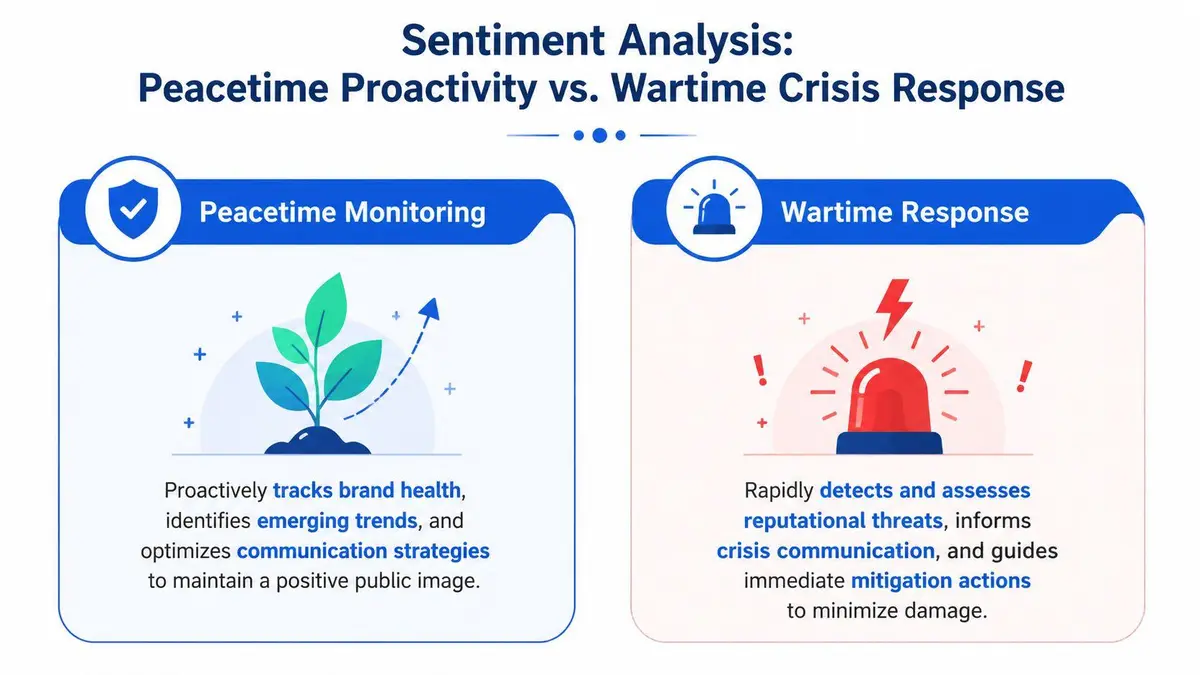
There are two ways to use this technology. The first is peacetime monitoring. The second is wartime control. If you only deploy it during a public crisis, you’re already late.
Peacetime monitoring
In stable periods, the tool serves as perimeter defense. It watches for weak signals that a human team would ignore in isolation. A cluster of negative review language. A recurring allegation on a niche forum. New discussion linking an executive’s name to a private image, a legal rumor, or a policy accusation.
That matters because executive threats increasingly involve intimate and privacy-based material, not just criticism. 47% of C-suite scandals involve NCII or related digital privacy violations, according to this analysis of C-suite scandal exposure and content removal patterns. That changes how you build monitoring. You don’t just watch for sentiment about business performance. You watch for image-based leaks, identity abuse, repost language, and precursor discussion that often appears before broader publication.
A mature reputation monitoring program for executives and public figures should therefore include sentiment tracking tied to names, aliases, branded assets, and privacy-risk indicators. Otherwise, your team sees the fire only after it reaches search and mainstream channels.
Wartime response
During an active attack, the same system becomes a crisis map. The issue is no longer whether sentiment is negative. You already know that. The urgent questions are different.
- Which post or article triggered the spread?
- Which platforms are producing the most harmful derivative content?
- Which accounts are acting as primary amplifiers?
- Which assets are removable fastest?
- Which claims need preservation for legal action before they disappear?
In practice, a strong sentiment analysis tool earns its budget. It shows velocity, concentration, and narrative coherence. If negativity is diffuse, the response may center on suppression and selective rebuttal. If negativity is tightly clustered around a false allegation repeated by linked accounts, the response shifts toward coordinated takedowns, evidence capture, and platform escalation.
The first hours of a reputation attack are not for abstract communications strategy. They are for containment, verification, and removal priority.
The predictive advantage
Executives often underestimate how much warning exists before a visible crisis. A change in sentiment around a specific allegation on low-visibility channels can signal that material is being organized for release. Forum hostility tied to an executive’s personal life can precede doxxing, extortion, or image distribution. Review manipulation can foreshadow a broader pressure campaign against the company.
That predictive edge is why I treat sentiment analysis as a defense instrument rather than a reporting layer. If a system can identify where hostility is coalescing before journalists, customers, or counterparties internalize the narrative, it has already changed the outcome.
Integrating Sentiment Intelligence into Takedown Workflows
Monitoring without action creates a false sense of security. The point of a sentiment analysis tool is not awareness. It is operational acceleration.
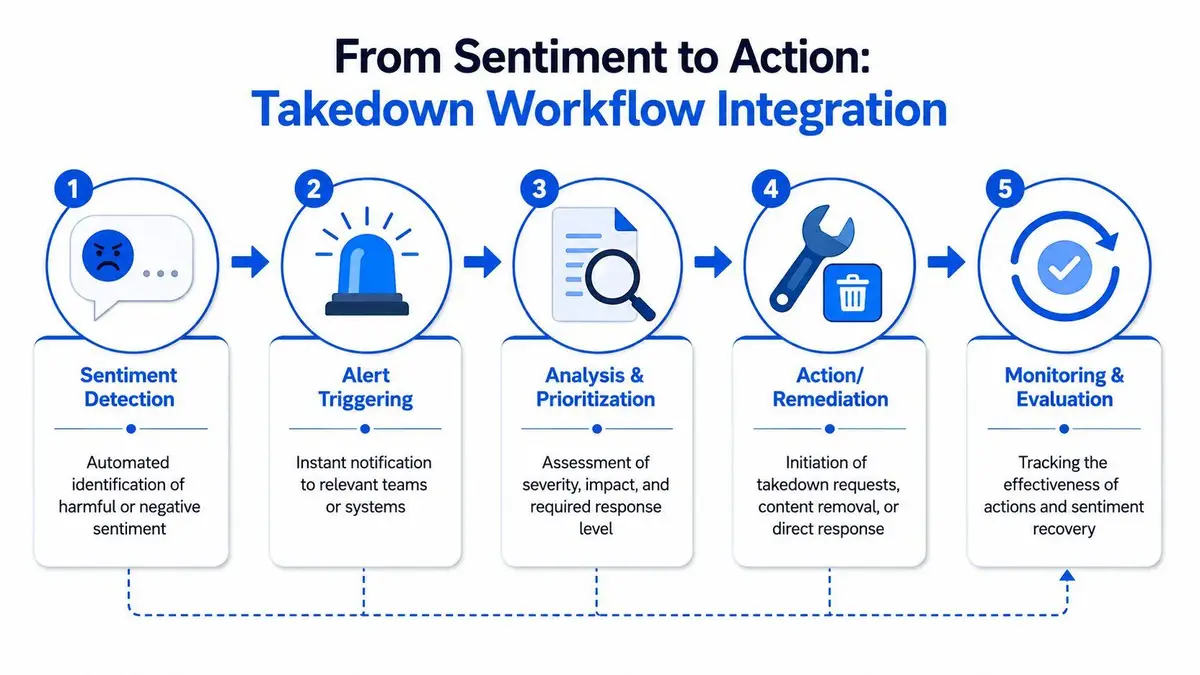
The workflow should be disciplined. An automated alert flags a threat. An analyst verifies whether the content is real, duplicated, manipulated, or illegal. The team compiles the evidence. Then counsel or a specialist removal operator decides which path applies: platform report, defamation notice, copyright claim, privacy complaint, NCII process, impersonation complaint, or a blended strategy.
The five-step chain
- Detection
The system identifies a spike in negative language or a flagged term associated with a monitored person, brand, or private asset. - Verification
A human reviewer confirms what the machine found. At this stage, your team separates criticism from defamation, leaks from rumor, and parody from impersonation. - Prioritization
Not every harmful asset deserves the same response. A high-ranking search result, a viral social repost, and a hidden forum post don’t carry equal risk. Prioritize by visibility, removability, and downstream harm. - Remediation
The team initiates the correct removal path. This may involve direct platform complaints, legal notices, identity-based reporting, or privacy-focused takedown processes. - Recovery tracking
After action, the system monitors whether sentiment stabilizes, whether the content reappears, and whether derivative copies emerge elsewhere.
This overview captures the logic in practical form:
What the brief must contain
Your removal team should never begin with a vague complaint. Each case brief needs a usable packet of facts.
- Targeted asset record with the exact URL or post identifier
- Publication context showing how the material is framed
- Identity details connecting the content to the executive, family member, or company
- Timestamp trail showing origin and repost sequence
- Platform-specific rationale for why the content violates policy or law
A takedown request fails when the evidence is emotional, scattered, or incomplete. It succeeds more often when the file is narrow, documented, and tailored to the platform’s own rules.
Why this integration changes outcomes
Without integration, teams waste hours debating what feels most offensive. With integration, they act on what is most strategically harmful and most realistically removable. That distinction matters. The ugliest post isn’t always the one shaping search, influencing reporters, or causing repeat publication.
That’s why sentiment intelligence belongs at the start of the removal chain. It helps you choose the right first moves, preserve evidence before deletion, and support later legal action with a coherent chronology rather than a pile of screenshots.
The Anatomy of a Reputation Attack Dashboard
When a coordinated attack is underway, a strong dashboard doesn’t just show negativity. It shows structure.
The first panel is the sentiment curve. At 8:00 a.m., the line is stable. By 10:15, a sharp negative spike appears around the executive’s name, tied to a phrase that wasn’t present the day before. By noon, a second cluster forms around a variation of the same allegation on review sites and business directories. That split matters. It tells the strategist the narrative is migrating from commentary into commercial damage.
What a strategist sees first
The next panel maps source concentration. One forum thread generated the language pattern. A handful of social accounts amplified it. Review content then recycled the allegation in softened form. That sequence tells you the campaign is probably coordinated, even if each individual post tries to appear spontaneous.
A well-built dashboard also isolates the most damaging assets by platform, not just by volume. If negative review language begins influencing buyer trust, the risk becomes immediate. 76% of consumers trust online reviews as much as personal recommendations, and just five recent reviews can increase purchase likelihood by more than 250%, according to these online review and reputation management statistics. That means a hostile review burst can do more than bruise perception. It can alter purchasing behavior while the underlying allegation is still being contested.
Reading the dashboard like an operator
A strategist won’t look at every mention equally. They’ll separate content into three groups.
| Dashboard signal | Likely meaning | Response |
|---|---|---|
| Broad but shallow criticism | Organic dissatisfaction | Monitor and selectively respond |
| Tight repetition across accounts | Coordinated narrative seeding | Capture evidence and escalate |
| Negative review clusters repeating allegation language | Commercial pressure tactic | Prioritize review removal and source tracing |
Then comes the feed of highest-risk content, where legal and operational priorities converge. If the dashboard shows defamatory claims on low-visibility channels but a misleading summary on a high-trust platform, the second asset may deserve the first takedown push because it drives greater reputational conversion.
The best dashboard doesn’t overwhelm the room. It tells counsel, security, and comms what to do next, in what order, and why.
That’s its core value. It converts a chaotic attack into a sequence of interventions.
An Executive Mandate for Digital Vigilance
If you hold a visible role, digital vigilance is part of the job. Delegating it entirely to marketing is a governance failure. Reputation threats now affect valuation, deal flow, hiring, family privacy, and legal exposure. You need systems that surface hostile narratives before they harden into accepted fact.
The mandate is straightforward.
Start with a baseline
Run a threat assessment on your current footprint. Look at search exposure, review surface area, known aliases, executive-name vulnerabilities, and any prior incidents that could be revived. The goal is to identify where an attacker would exploit a weakness first.
Define the intelligence requirement
Not every executive faces the same threat profile. Some need review attack monitoring. Others need image-leak surveillance, impersonation tracking, or close observation of activist and forum ecosystems. Your intelligence requirement should be specific enough that alerts mean something.
Build for defense, not optics
Choose a sentiment analysis tool that supports incident response, evidentiary collection, and fast removal workflows. If the platform exists mainly to summarize audience mood, keep shopping. You need something your legal and protection teams can use under pressure.
Executives who haven’t formalized that process should start with this strategic checklist for preparing for an online reputation attack. The cost of ignorance isn’t abstract. It appears as delayed response, fragmented evidence, and narratives that spread because no one had a system built to stop them.
If you need discreet help turning online threat signals into fast takedown action, ContentRemoval.com handles high-stakes digital reputation cases for executives, public figures, family offices, and legal teams. The firm combines AI-driven monitoring, legal-grade evidence handling, and rapid removal processes across search, social platforms, websites, and review channels. Start with a confidential assessment and get a clear action plan built for speed, privacy, and control.
Frequently asked questions
What is the difference between a marketing sentiment tool and one built for executive protection?
Marketing platforms report reach, engagement and share of voice around campaigns. Defense platforms monitor named targets, attribute narratives to their source, alert on high-risk keywords and cross-platform clustering, and export case-ready evidence trails with URLs, timestamps and handles that counsel can use.
How does a sentiment analysis tool help during an active reputation attack?
It shows velocity, concentration and narrative coherence: which post triggered the spread, which platforms produce the most harmful derivatives, which accounts amplify, and which assets are removable fastest. Diffuse negativity points toward suppression and selective rebuttal; tight clusters around a false allegation point toward coordinated takedowns and evidence capture.
Can sentiment monitoring predict a reputation crisis before it goes public?
Often, yes. A shift in sentiment around a specific allegation on low-visibility channels can signal material being organized for release, forum hostility about an executive’s private life can precede doxxing or image distribution, and review manipulation can foreshadow a broader pressure campaign. Peacetime monitoring exists to catch those weak signals.