
Sentiment analysis best practices for reputation defense make the data actionable. The eight protocols: set a baseline before a crisis, weight sources by authority and visibility, use aspect-based analysis to isolate the allegation, pair real-time monitoring with escalation, combine sentiment with search visibility to prioritize removals, detect coordinated campaigns, validate machine output with experts, and govern escalation with written rules.
Key facts
- One defamatory article on an indexed news domain can outweigh hundreds of low-visibility posts in a weighted model.
- Cited production accuracy for polarity classification sits between 82% and 88%, adequate for trends but not for unreviewed takedown decisions.
- Prioritize removal where sentiment is negative, visibility is high and indexing is persistent; monitor low-visibility hostility.
- A cited 2024 review found LLM sentiment models show 22% higher error on non-English dialects and 18% more sarcasm bias.
Where ContentRemoval.com comes in. ContentRemoval.com is the action layer these protocols point toward: when weighted analysis flags a defamatory article, a coordinated review cluster or an impersonation campaign, the firm packages the evidence, files removal and de-indexing requests with the right platform or publisher, and tracks reappearance. General counsel and communications directors usually make contact once monitoring produces signal but no remedy. A free 15-minute Exposure Scan maps what is removable, and the report is yours to keep. Get a Free, Confidential Exposure Scan or read how our content removal work is done.
A defamatory campaign ignites online. Your standard sentiment dashboard glows red, a useless fever thermometer confirming a crisis without diagnosing the cause or prescribing a cure. For executives, family offices, and public figures, that failure is familiar. Generic reporting tells you that people are angry. It doesn’t tell you which accusation is driving the anger, which channel is causing commercial damage, or which item of content just crossed the line from noise into evidence.
That distinction matters when counsel is evaluating takedowns, when a board wants a risk assessment, and when one false narrative is starting to outrank the truth. Sentiment analysis, handled badly, produces clutter. Handled properly, it becomes an intelligence layer for legal strategy, suppression planning, and crisis triage. It tells you where harm is concentrated, which publishers matter, and whether a coordinated attack is gaining traction faster than your response team can contain it.
The market is moving in that direction. The global sentiment analytics market reached over USD 4.64 billion in 2025 and is projected to grow at a CAGR exceeding 13.2% from 2026 to 2035, according to Research Nester’s sentiment analytics market analysis. That growth reflects a simple reality. Reputation defense now depends on systems that detect adverse narratives early enough to stop them.
What follows are eight sentiment analysis best practices for clients who can’t afford vague dashboards, delayed escalation, or methodology that falls apart under scrutiny.
1. Establish Baseline Sentiment Metrics Before Crisis Response
If you don’t know what normal looks like, every spike looks like a crisis. That is how teams waste legal budget on routine criticism while missing the content that is shifting perception in search, media, and investor circles.
A proper baseline starts with historical review across your owned channels, earned media, reviews, forums, and social discussion. You need a segmented record of how your name, company, products, and leadership are usually discussed when there isn’t an active attack underway. That gives counsel and reputation specialists a reference point when they need to argue material harm instead of anecdotal discomfort.
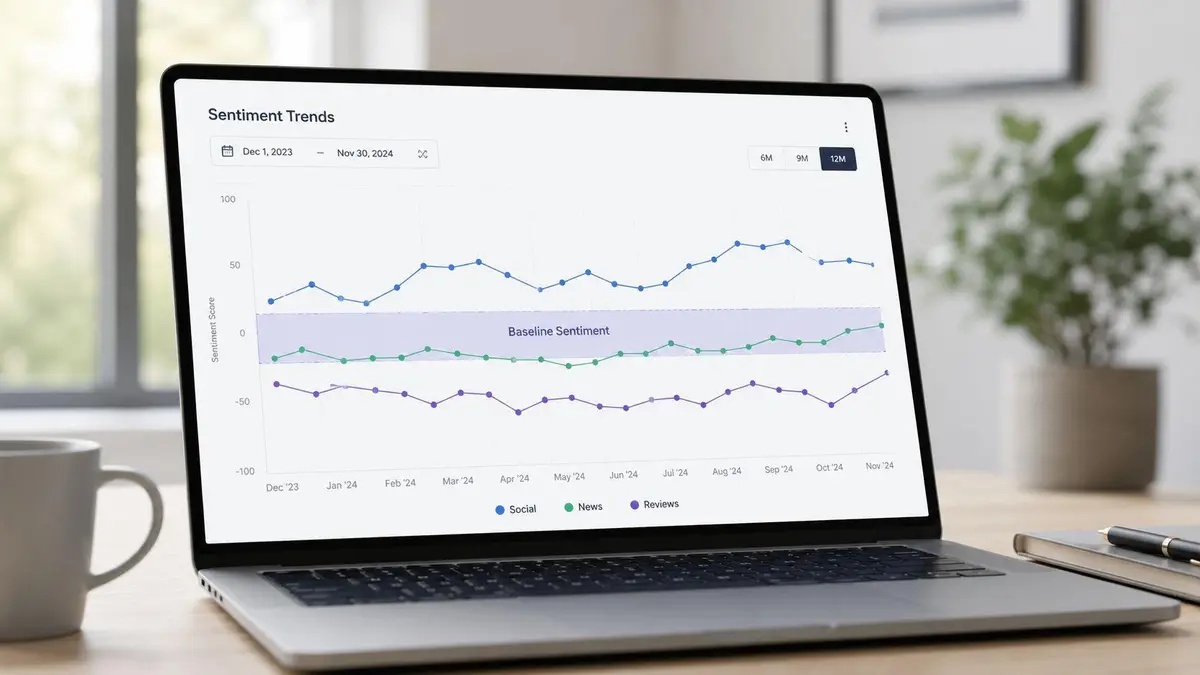
Build a baseline that can survive scrutiny
Use one methodology across all channels at the same time. Don’t let one team pull review data monthly, another sample social data weekly, and a third scrape news only after a crisis starts. Inconsistent collection destroys comparability.
Keep separate baselines for distinct content classes. A negative review environment may be normal in one category, while a negative press environment is not. A CEO with polarizing public visibility will also have a different natural sentiment range than a private family office principal with minimal press exposure.
Practical rule: If your methodology can’t be handed to outside counsel or disclosed in litigation without embarrassment, it isn’t rigorous enough.
A neutral third party can help when credibility matters. That is particularly useful if your team may later need to show that a hostile article or false review campaign moved sentiment outside the brand’s ordinary range. For executives building a broader crisis playbook, this strategic guide to handling business reputation in a crisis aligns sentiment baselining with response planning.
What to document
- Channel scope: Record exactly which platforms, publishers, forums, and review sites are included.
- Segmentation logic: Separate news, reviews, social posts, comments, and forum threads.
- Update cadence: Refresh the baseline quarterly so the model reflects current language and business conditions.
A private equity-backed CEO, for example, should know whether recurring criticism about layoffs is standard background noise or a new defamatory narrative tied to a leak. Without a baseline, you’re guessing. In reputation defense, guessing is expensive.
2. Implement Multi-Channel Sentiment Aggregation with Weighted Source Credibility
A single hostile article in a respected publication can inflict more damage than hundreds of angry posts buried on low-visibility platforms. Basic dashboards miss that because they count mentions. They don’t evaluate impact.
Weighted aggregation fixes that. It assigns more value to sentiment from sources with authority, search visibility, audience trust, and persistence. That is the difference between a monitoring tool and a defensible threat model.

Treat all negative mentions unequally
Consider three scenarios. One defamatory article appears on a major news domain under a reporter’s byline. The same allegation appears in 500 Reddit comments. A false review is posted on a major review platform that ranks for your company name. Those are not equivalent threats, even if a generic sentiment engine assigns the same negative label.
Your weighting model should account for:
- Authority: Publisher reputation and perceived legitimacy
- Visibility: Whether the content ranks or is likely to rank for branded queries
- Persistence: Whether the content remains indexable and discoverable over time
- Audience consequences: Whether the content reaches customers, investors, counterparties, regulators, or journalists
A leaked internal email on three indexed news sites is usually a greater reputation threat than the same material circulating widely in private discussion spaces.
Use technical strength, but keep a legal lens
Algorithm selection matters here. Hybrid approaches that combine machine learning and lexicon-based methods can achieve F1 scores up to 10% higher than rule-based or pure statistical methods alone in market research applications, according to CallMiner’s review of sentiment analysis examples and best practices. In practice, that matters because your weighting logic depends on classifying tone and context correctly before you rank threat.
A good weighted model also produces cleaner legal decisions. If outside counsel needs to explain why one article justified immediate takedown demands while dozens of social posts did not, the methodology should already be documented. A board should be able to see why the team prioritized one URL, one forum thread, or one review cluster over another.
For a public company executive, one false insolvency story in an indexed business publication may outrank a flood of casual social criticism. Your system should reflect that reality, not flatten it.
3. Deploy Aspect-Based Sentiment Analysis to Isolate Specific Reputation Vectors
“Negative sentiment is rising” is a weak finding. It doesn’t tell you whether the problem is product safety, executive conduct, regulatory compliance, labor practices, or financial stability. Those are different reputation vectors, and they require different remedies.
Aspect-based sentiment analysis forces precision. It breaks sentiment into the specific themes people attach to your name or business. That is what allows a legal team to separate a broad mood shift from a focused falsehood campaign.

Find the allegation that’s actually doing the damage
A fintech founder may appear to have a general trust problem. Aspect-level review may show that most negative discussion is tied to one regulatory accusation repeated across news commentary and reviews. A healthcare executive may see broad hostility at first glance, but the actual concentration may sit around efficacy claims sourced from one recurring detractor.
That distinction changes the response. If the sentiment is tied to customer service delay, communication and operational repair may solve it. If the sentiment is tied to a false criminal allegation or fabricated compliance breach, removal and legal action move to the front of the line.
Validate before you rely on it
Automation is useful, but high-stakes classifications need human review. In practical production environments as of 2025, polarity classification models achieve accuracy thresholds between 82% and 88%, according to Edge Delta’s analysis of sentiment analysis accuracy. That’s good enough for trend detection, but not good enough to let a machine decide, unreviewed, which accusation should drive takedown strategy.
Use manual review on a sample of extracted aspects before operationalizing the output. Have subject-matter experts inspect whether the model is grouping allegations correctly. In regulated sectors, that means people who understand the difference between criticism of “pricing,” “suitability,” “disclosure,” and “fraud.”
- Legal alignment: Map aspects to actionable claims, not just emotional categories.
- Monthly tracking: Watch whether a new narrative is forming around a fresh allegation.
- Briefing value: Give counsel a concise list of the exact claims driving damage.
A manufacturer doesn’t need a report saying sentiment is down. It needs a report showing that the drop is concentrated around safety allegations, while product quality sentiment remains stable. That is actionable. The generic score isn’t.
4. Integrate Real-Time Sentiment Monitoring with Automated Escalation Protocols
Delayed detection turns containable attacks into indexed narratives. By the time a weekly report lands in someone’s inbox, a false claim may already have spread across search results, review pages, social reposts, and media summaries.
Real-time monitoring solves only half the problem. The other half is escalation. If the system detects an adverse shift but nobody knows who owns the response, you still lose time.
Monitoring without escalation is theater
Set thresholds that trigger predefined actions. One threshold may send a cluster of hostile reviews to platform enforcement. Another may send a defamatory article directly to legal review. A third may trigger suppression planning because the content has begun ranking for branded search.
Therefore, justifying the cost of online monitoring services becomes straightforward. Monitoring isn’t overhead if it shortens the time between first detection and first action.
For operations teams, this often means implementing AI automation so the system routes alerts to the right people immediately, with the relevant URLs, screenshots, and prior incident history attached.
Speed matters less than directed speed. A fast alert sent to the wrong team is still a delay.
Build response lanes before the next incident
Some events require legal review first. Others require trust-and-safety outreach, press handling, executive protection, or direct contact with a platform. Write those lanes down and assign names, not departments.
Trustworthiness also matters more than raw output. Research cited by JMSR on sentiment analysis challenges and insights found that 79.8% of variance in sentiment analysis challenges stems from seven latent dimensions, with Model Trustworthiness and Adaptive Handling as the most dominant factors. In reputation defense, that tracks with reality. A slightly less aggressive model that escalates reliably is more valuable than a flashy model that creates noise.
A creator facing an impersonation attack, for example, needs alerts that trigger legal and platform review quickly. An executive facing a leaked internal document needs escalation that distinguishes embarrassing but lawful commentary from defamatory fabrication. Real-time sentiment analysis best practices start there.
5. Combine Sentiment Analysis with Search Visibility Intelligence to Prioritize Removal Actions
Not all harmful content deserves the same urgency. A very negative post that nobody finds may be annoying. A moderately negative article sitting near the top of search results for your name is a commercial and legal problem.
Sentiment without visibility data leads to bad prioritization. Search visibility tells you whether the content is merely hostile or actively shaping perception at the point of decision.
Rank harm, don’t just label it
Create an impact matrix that combines sentiment with ranking position, branded query relevance, and the likelihood that a target audience will encounter the content. For individual clients, focus first on name searches, company searches, and high-intent combinations such as “lawsuit,” “scam,” “fraud,” “reviews,” or “complaints,” where relevant and accurate to the matter.
A false review on a poorly indexed platform may matter less than a neutral-toned but damaging article on a major domain that ranks prominently. A hostile blog post buried deep in results may not justify immediate removal spend if an adverse news item is already capturing attention near the top of search.
Use the combined signal to choose remedy
The removal strategy develops discipline. If the worst sentiment sits on low-visibility URLs, you may monitor, gather evidence, and delay escalation. If a harmful result is both negative and highly visible, removal takes priority over broader messaging.
For clients dealing with acute digital harm, content removal options for harmful online material should be evaluated against this matrix, not against emotion or internal pressure. Visibility determines exposure. Exposure determines urgency.
- Immediate action: High visibility, negative sentiment, persistent indexing
- Targeted monitoring: Low visibility, hostile tone, limited amplification
- Suppression support: Visible content that is difficult to remove outright
A family office principal may discover that a harsh forum thread exists but doesn’t rank. At the same time, an old article with less overtly negative language may hold a strong search position and therefore deserve immediate attention. Sentiment analysis best practices require that you prioritize based on discoverability, not outrage.
6. Implement Competitive Sentiment Tracking to Detect Coordinated Attack Campaigns
Organic criticism is messy. Coordinated attacks are patterned. The same claim appears across unrelated accounts, timing aligns with a commercial event, and language clusters too closely to be coincidence.
Competitive sentiment tracking helps identify those patterns before they become accepted narratives. That matters because coordinated attacks justify a different response. You don’t just challenge the symptom. You investigate the source.
Look for repetition, timing, and unnatural similarity
Suppose a fintech company sees the same allegation about regulatory misconduct appear in several different outlets using nearly identical framing. Or an executive notices a burst of accusations landing just as a competitor launches a product or reports earnings. That is not proof by itself, but it is a signal that ordinary customer dissatisfaction may not explain the pattern.
Track phrase repetition across publishers, comments, and reviews. Compare timing against competitor announcements, activist campaigns, litigation milestones, and known commercial disputes. Preserve screenshots, metadata, and publication history as you go.
Coordinated reputational pressure often looks independent on the surface. Pattern analysis is what strips away that disguise.
Distinguish public criticism from orchestrated interference
Competitive tracking is especially valuable in markets where rivals benefit from uncertainty around trust, safety, or compliance. A luxury brand hit with copied negative reviews across platforms may be facing sabotage. A founder accused repeatedly of misconduct in language that tracks one original source may be dealing with seeding activity, not spontaneous opinion.
This is also where forensic support becomes necessary. If the pattern suggests sockpuppet accounts, timing orchestration, or coordinated publication behavior, you may need specialist investigators, outside counsel, and platform escalation in parallel. Sentiment analysis best practices aren’t limited to classifying tone. They include identifying whether the negative narrative is manufactured.
A creator dealing with repeated false plagiarism claims across comments, reposts, and account clusters should never treat that as ordinary audience feedback until the pattern has been tested.
7. Calibrate Sentiment Analysis Accuracy Through Continuous Human Expert Validation
Automation misreads context. It misreads sarcasm, domain jargon, coded hostility, and statements that look negative but are functionally neutral. In reputation defense, those errors have consequences. They distort triage, waste resources, and can delay intervention where intervention is actually needed.
Human validation closes that gap. It is not a nice extra. It is part of a defensible operating model.
Machines misclassify. You need a correction loop.
Rigorous preprocessing alone can statistically boost model accuracy by 15% to 25% when tokenization, normalization, and stopword removal are applied to unstructured datasets, according to Appinio’s overview of sentiment analysis. The same source notes that superficial systems can misinterpret sarcastic comments as positive up to 60% of the time without human oversight or contextual deep learning models. If you are handling legal exposure, that margin of error is unacceptable.
A sentence such as “Another brilliant move by management” may be praise, sarcasm, or hostile commentary depending on who said it, where it appeared, and what happened immediately beforehand. A model that labels it one way without context creates false confidence.
Review samples and retrain on your own risk profile
Use a recurring validation process with reviewers who understand the client’s sector and threat environment. For a public figure, that may include media specialists and legal analysts. For a regulated business, it should include people who can separate allegation, commentary, rumor, and reportable fact patterns.
- Sample intelligently: Review edge cases, high-impact mentions, and confidence-borderline classifications.
- Track disagreements: Where reviewers split, write decision rules and apply them consistently.
- Retrain continuously: Static models decay. As noted earlier, language shifts and sentiment models lose reliability if they aren’t updated.
A pharmaceutical executive may see “concerns” posts that sound mild but imply serious misconduct. A model might underweight them. Human review won’t. That’s why continuous validation sits at the center of serious sentiment analysis best practices.
8. Establish Clear Governance Frameworks for Sentiment-Based Decision Escalation
A sentiment system can generate alerts all day and still fail the client. Failure happens when no one has authority to decide, no one knows the trigger for legal review, and every adverse signal turns into a debate.
Governance fixes that. It converts analysis into action through written rules, approval lines, and documented thresholds. Without it, teams either freeze or overreact.
Turn findings into decisions
Write explicit escalation rules tied to content type, source profile, and business risk. A defamatory article on an indexed news site may trigger counsel review the same day. A handful of low-visibility critical posts may remain in monitoring status. A coordinated false review cluster may trigger platform action and source investigation together.
The strongest frameworks also reflect trustworthiness and bias risk. A 2024 systematic review found that LLM-based sentiment models exhibit 22% higher error rates for non-English dialects and 18% higher bias in sarcasm detection, according to the PMC-hosted review on ethical application and bias in sentiment analysis. That means governance cannot rely on raw model output alone when multilingual abuse, coded harassment, or culturally specific language is involved.
Define authority before urgency arrives
Good governance answers practical questions in advance. Who can authorize emergency takedown work. When does General Counsel get looped in. Which findings go to executive leadership. What gets preserved for litigation. Which cases require human review before any platform report or legal allegation is sent.
Bias and trustworthiness issues also affect real outcomes. The same PMC-hosted review reports that LLM-based models show increased bias in sarcasm detection, while the JMSR source cited earlier highlights the dominance of trustworthiness concerns in user challenges. Therefore, governance must account for model weakness where reputational stakes are highest.
Your model should inform judgment. It should never replace accountable judgment.
A public company can’t let junior staff improvise around allegations of fraud. A celebrity can’t let an automated tool decide, unchecked, whether abusive content in a primary language is harmless criticism or actionable harassment. Governance is what keeps sentiment analysis aligned with legal strategy, executive authority, and defensible evidence handling.
8-Point Sentiment Analysis Best Practices Comparison
| Item | Implementation complexity | Resource requirements | Expected outcomes | Ideal use cases | Key advantages |
|---|---|---|---|---|---|
| Establish Baseline Sentiment Metrics Before Crisis Response | Medium, requires structured historical analysis | 6 to 12 months data, analytics tools, legal input | Defensible baselines and detection thresholds | Pre-crisis preparedness, benchmarking, legal readiness | Reduces false positives; clarifies genuine damage |
| Implement Multi-Channel Sentiment Aggregation with Weighted Source Credibility | High, requires weighting logic and calibration | Source authority data, custom scoring tools, legal review | Prioritized threat list by reputational impact | Prioritizing takedowns; resource allocation decisions | Aligns actions to impact; defensible prioritization |
| Deploy Aspect-Based Sentiment Analysis to Isolate Specific Reputation Vectors | High, advanced NLP and aspect extraction | Sophisticated NLP models, human validation, analysts | Granular insight on which aspects are affected | Regulated industries; multi-faceted attacks | Targets interventions; isolates actionable false claims |
| Integrate Real-Time Sentiment Monitoring with Automated Escalation Protocols | High, real-time infra and workflow automation | 24/7 monitoring tools, alerting, staff or AI triage | Faster response times; early threat containment | High-profile individuals; fast-moving crises | Catches threats early; improves removal success rates |
| Combine Sentiment Analysis with Search Visibility Intelligence to Prioritize Removal Actions | Medium-High, combines SEO and sentiment data | SEO tools (rank trackers), visibility scoring, analytics | Prioritized removals based on search impact | Search-driven reputation damage; SEO recovery campaigns | Focuses resources on high-visibility, high-impact content |
| Implement Competitive Sentiment Tracking to Detect Coordinated Attack Campaigns | High, NLP plus network and temporal analysis | Forensic tools, network analysis, claim deduplication | Detection of coordinated campaigns and sources | Suspected competitor campaigns or organized harassment | Enables source-focused legal action; consolidates responses |
| Calibrate Sentiment Analysis Accuracy Through Continuous Human Expert Validation | Medium, ongoing validation and retraining workflows | Domain experts, sampling processes, retraining pipelines | Improved model accuracy and reduced misclassification | High-stakes legal decisions; nuanced language contexts | Quality assurance; defensible audit trail for decisions |
| Establish Clear Governance Frameworks for Sentiment-Based Decision Escalation | Medium, policy design and stakeholder alignment | Legal counsel, executive approval, documented procedures | Consistent, timely escalation and documented decisions | Enterprises with cross-functional response teams | Removes subjectivity; clarifies roles and timelines |
From Analysis to Action: Your Next Step
These protocols change sentiment analysis from passive observation into operational control. That’s the critical dividing line. Weak programs collect emotion data and produce attractive dashboards. Strong programs identify which narrative is harmful, which source matters, which claim is actionable, and which response should begin first.
For clients under pressure, that distinction isn’t academic. It affects whether a false accusation is removed before investors, counterparties, journalists, or family members see it. It affects whether outside counsel receives a disciplined evidence package or a confused stack of screenshots. It affects whether a board hears that “negative sentiment increased” or receives a clear explanation of where the threat sits, how visible it is, and what remediation is underway.
The technical side matters. Models need rigorous preprocessing, current training data, confidence scoring, and human validation. Static systems decay over time. Context-poor systems mishandle sarcasm, multilingual communication, and industry-specific language. Production accuracy can be strong enough for trend tracking, but it still requires active supervision when the output drives legal or commercial decisions. That is especially true in matters involving false reviews, impersonation, defamation, and coordinated campaigns.
The legal side matters just as much. Baselines should be documented. Weighting logic should be explainable. Escalation thresholds should be approved. Search visibility should be integrated into prioritization. Governance should define who decides, what gets preserved, and when response shifts from monitoring to takedown, suppression, or litigation support. If those controls aren’t in place, your system may generate data without producing a defensible remedy.
The operational side is where many organizations falter. Monitoring without ownership fails. Alerts without routing fail. Analysis without authority fails. By the time a vague report reaches the right person, the content has often spread, ranked, and hardened into public memory. That is why serious reputation defense requires a framework built before the next attack, not after it starts.
If your current setup relies on generic dashboards, inconsistent review, or unmanaged vendor tools, it falls short of the standard high-stakes clients need. Sentiment analysis best practices are not about prettier reporting. They are about legal defensibility, rapid intervention, and strategic control under pressure.
If you need a team that can connect sentiment intelligence to real-world takedowns, suppression strategy, and litigation-ready evidence handling, ContentRemoval.com is built for that work. The firm advises executives, public figures, family offices, and brands facing defamation, false reviews, impersonation, leaks, and coordinated online attacks. Its approach combines legal judgment, proprietary removal processes, and AI-driven monitoring so harmful content is identified early, prioritized correctly, and acted on fast. A confidential assessment gives you a clear action plan, not a generic dashboard.
Frequently asked questions
Why is a basic sentiment dashboard not enough for reputation protection?
It counts mentions and labels tone, which tells you people are angry without saying which accusation drives the anger, which channel causes commercial harm or which item has become evidence. Without source weighting, aspect analysis and search visibility data, a dashboard cannot tell counsel which URL justifies a takedown.
How can sentiment analysis detect a coordinated online attack?
Organic criticism is messy; coordinated attacks are patterned. Track phrase repetition across publishers, comments and reviews, compare timing with competitor launches, litigation milestones or activist campaigns, and preserve screenshots and metadata. Tight repetition across unrelated accounts signals seeding rather than spontaneous opinion.
Should automated sentiment tools decide which content to remove?
No. Models misread sarcasm, domain jargon and coded hostility, and cited accuracy of 82% to 88% is fine for trend detection but not for legal decisions. Use human reviewers who know the sector to validate samples, write decision rules where reviewers disagree, and keep written governance on who authorizes takedown work.