
A reputational risk assessment maps everything that can carry your name, likeness or authority, identifies the audiences whose perception changes outcomes, and scores threats on five criteria: trigger probability, velocity-exposure, credibility at first glance, persistence in search, and third-party contagion. Red-zone risks, such as impersonation, synthetic media and partner breaches, get pre-approved actions and named owners before an incident.
Key facts
- Map identity, commercial trust, protected information and authority assets before listing what could go wrong.
- A cited 2025 study found 64% of reputational damage in finance and tech came from indirect third-party sources.
- Score each of the five criteria from 1 to 5 and force a ranking discussion at the top table.
- Response sequence: detect and verify, choose the objective, protect the smallest group, act by channel, close the opening.
Where ContentRemoval.com comes in. ContentRemoval.com handles the red-zone scenarios an assessment surfaces: impersonation of a principal, leaked or non-consensual material, fake review clusters, defamation and harmful search results, with removal, de-indexing and monitoring run as one operation once internal approvals cannot keep pace. General counsel, chiefs of staff and family office managers usually make contact while building or testing the playbook. A free 15-minute Exposure Scan maps what is removable, and the report is yours to keep. Get a Free, Confidential Exposure Scan or read how our reputation management work is done.
You wake up to three messages before 6 a.m. Your general counsel has flagged a fake profile using your name. Your chief of staff has a screenshot of a hostile thread gaining traction. One board member wants to know whether a vendor leak is connected to your firm. None of this started inside your business, but all of it now belongs to you.
That’s how a reputational crisis works now. It doesn’t arrive politely through one newspaper article or a formal complaint. It appears across search results, social platforms, group chats, review sites, copied domains, and anonymous forums. By the time your internal team assembles a status call, the public has already formed a view.
A serious reputational risk assessment has to reflect that reality. If your framework still treats reputation as a slow-moving communications issue, you’re exposed. The threats now sit in two places most legacy models underweight: the speed at which digital content spreads, and the damage caused by third parties, affiliates, vendors, fake accounts, and hostile actors you don’t control.
The Anatomy of a Modern Reputational Crisis
An executive doesn’t lose control of a reputation in one dramatic moment. Control slips in stages. First, a false or damaging item appears. Then it gets indexed, copied, screen-recorded, reposted, and discussed by people who have no direct knowledge of the facts. The issue stops being about truth and becomes a question of visibility.
That’s why old risk models fail. They assume the organization has time to investigate, align, approve statements, and respond in sequence. Often, it doesn’t. Viral content compresses that timeline until internal process becomes part of the problem.

Perception decides the crisis
The uncomfortable truth is simple. Reputation is not defined by what you intended. It’s defined by what stakeholders believe. Research on stakeholder perception and reputational risk states that reputational risk is almost entirely contingent on how a brand is perceived by customers, investors, and the public, and that organizations failing to align operational reality with stakeholder expectations face negative media coverage and financial harm.
For high-profile individuals, the same rule applies. A family office principal can be damaged by a forum post that implies impropriety. A founder can be injured by an impersonation account that appears credible for just a few hours. A public company director can be drawn into a narrative built from fragments, screenshots, and assumptions.
Practical rule: If the public can see it, search it, share it, or screenshot it, it belongs inside your assessment model.
Why traditional assessment cycles are obsolete
Most internal risk registers still score reputation as if the threat will move at the pace of governance. That’s backward. The threat moves at the pace of platforms. Your approvals, reporting lines, and media protocols only matter if they can operate inside that tempo.
That’s why executives should treat viral exposure as a distinct category of risk, not just an attribute of a communications event. A false review cluster, a fabricated allegation, a leaked image, a manipulated video, or a copied story can force a strategic decision before the facts are fully gathered.
If you’re dealing with that exact pressure, this strategic assessment of whether a business can survive a viral negative story captures the leadership lens well. The key lesson is blunt. Survival depends less on outrage management and more on speed, containment, and control of the digital footprint.
Defining Your Battlefield and Key Players
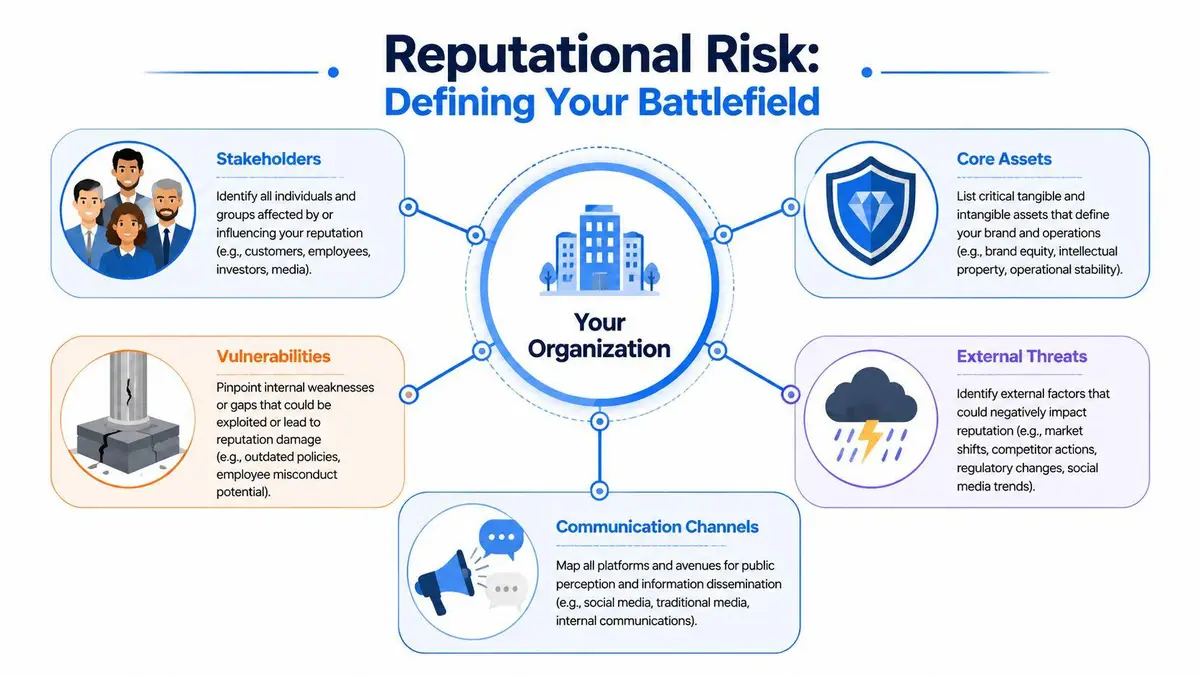
Most assessments fail at the first step because they define the battlefield too narrowly. They focus on the company brand and ignore the surrounding identity surface. That’s a mistake. For an executive, investor, founder, or family office, reputation sits across a web of assets, associations, and public references that extend far beyond the corporate website.
Start by inventorying everything that can carry your name, likeness, or implied authority. That includes company domains, leadership bios, social handles, media coverage, executive interviews, conference profiles, investor materials, review pages, directory listings, litigation records, charitable affiliations, and intellectual property references. If it can shape trust, it’s part of the terrain.
Map the assets before you map the threats
Don’t begin with “what could go wrong.” Begin with “what would hurt if it were attacked, copied, distorted, or exposed.”
A useful asset map usually includes:
- Identity assets such as executive names, founder profiles, verified accounts, press biographies, and visual likenesses.
- Commercial trust assets such as review profiles, investor decks, customer-facing websites, deal tombstones, and brand partnerships.
- Protected information assets such as private images, internal documents, family details, location patterns, and confidential correspondence.
- Authority assets such as board positions, legal credentials, media access, charitable roles, and institutional affiliations.
This isn’t administrative housekeeping. It determines where a threat can attach itself and which channels are likely to amplify it.
Identify who can move your reputation
Once the asset map is built, identify the audiences whose perception affects outcomes. Clients and customers are obvious. Investors, lenders, employees, journalists, regulators, counterparties, search users, and platform trust teams matter just as much. For private individuals, add schools, household staff, former associates, litigants, political critics, and opportunistic online attackers.
A short working table helps keep this practical:
| Stakeholder group | What they care about | What changes their behavior |
|---|---|---|
| Clients and customers | Reliability, legitimacy, safety | Reviews, articles, visible complaints |
| Investors and lenders | Governance, judgment, stability | Adverse press, leaks, executive conduct concerns |
| Regulators and counterparties | Compliance, documentation, control | Complaints, patterns, public allegations |
| Media and online audiences | Narrative clarity, conflict, novelty | Search visibility, screenshots, trending posts |
Third-party contagion is where many assessments collapse
The biggest blind spot is assuming reputational harm must originate from your own conduct. It often doesn’t. It can come from a vendor breach, a rogue affiliate, a fake account on a major platform, a copied website, a manipulated review page, or leaked data traded through channels you never use directly.
That blind spot is not minor. A 2025 study on third-party reputation exposure found that 64% of reputational damage in the financial and tech sectors stemmed not from direct misconduct, but from indirect third-party content sources like dark web leaks or fake profiles on social platforms.
The right question isn’t “What did we do?” It’s “What can be attached to us, and who can make it look credible?”
If your current assessment excludes vendors, affiliates, agencies, dormant domains, impersonation vectors, and platform-level abuse, it’s incomplete. You haven’t mapped the battlefield. You’ve mapped your office.
Identifying Threats Beyond the Obvious
Most leadership teams still over-focus on familiar reputation events. A poor article. A critical review. A social complaint. Those matter, but they’re no longer the hardest problems. The harder problems are asymmetric. They’re cheap to launch, difficult to attribute, and built for rapid spread.
Call this the velocity-exposure problem. A threat becomes more dangerous when distribution outruns verification. By the time your legal team checks provenance, the content has been mirrored, clipped, translated, or reposted by accounts that don’t care whether it is true.
High-velocity threats change the timetable
A modern reputational risk assessment needs to be blunt. You are not only defending against criticism. You are defending against information attacks.
Analysis from the Reputation Risk Index shows that 78% of severe reputation crises in 2024-2025 were driven by high-velocity content that spread virally before traditional assessment cycles could even trigger a response. That should end any complacency about quarterly reviews or static crisis binders.
A few examples make the point:
- CEO impersonation can be used in phishing, fake announcements, or fabricated statements that look authentic long enough to do damage.
- NCII leaks or stolen private media can spread across fringe sites before legal remedies and platform notices catch up.
- AI-generated audio or video can create plausible but false admissions, instructions, or personal conduct narratives.
- Doxxing against a family office or public figure can turn a privacy incident into a trust crisis because it signals vulnerability and loss of control.
The threat list should read like an adversary playbook
If your workshop only asks department heads to list “possible bad publicity,” you’ll miss the modern attack surface. Build scenarios around how hostile actors operate in practice.
Consider these categories:
- Impersonation attacks where someone borrows your authority and uses platform design to create false legitimacy.
- Search contamination where outdated, misleading, or fabricated material climbs in visibility and shapes first impressions.
- Partner-origin incidents where an agency, contractor, vendor, or portfolio company creates reputational spillover.
- Synthetic media attacks where manipulated text, image, audio, or video is designed for emotional reaction first and verification later.
Assess threats by asking two questions. How fast can this spread, and how difficult is it to reverse once indexed?
That second question matters more than many executives realize. Some incidents are reputationally loud but operationally simple. Others are quiet at first and then become entrenched because search engines, aggregators, and copycat sites preserve them. The latter category deserves more attention than it usually gets.
Quantifying Impact with a Risk Heat Map
A reputational crisis rarely arrives as a slow, orderly problem. It hits as a fast public narrative. A clipped video spreads before your team verifies it. A supplier breach gets framed as your governance failure. Search results harden that story within hours. Your heat map must reflect that reality or it will understate the threats that do the most damage.
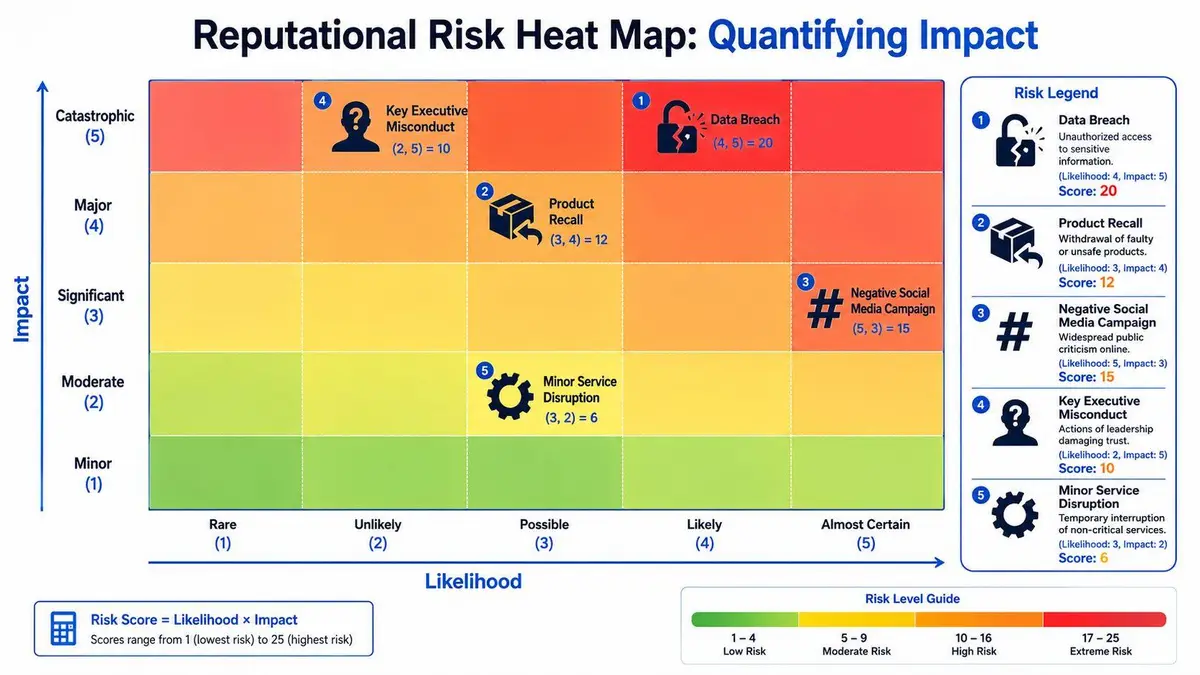
A standard likelihood-versus-impact grid is still useful. Use it. But change what you mean by impact. Revenue matters, but so do lender reactions, investor confidence, regulator interest, hiring drag, board pressure, family exposure, and long-term search visibility. Change what you mean by likelihood too. For reputational risk, likelihood is not just the chance of an incident occurring. It is the chance of the incident becoming visible, believable, and difficult to dislodge.
Add the two variables traditional heat maps miss
Most risk matrices miss two digital accelerants. They focus on event severity and ignore distribution mechanics.
The first is velocity-exposure. Ask how quickly a claim can travel across platforms, search, and private channels before facts catch up. A weak allegation with high velocity can inflict more damage than a serious issue that stays contained.
The second is third-party contagion. Ask how easily a partner, vendor, portfolio company, agency, or adviser can transfer reputational damage onto you. Counterparties do not separate your brand from theirs as neatly as your org chart does.
Score both factors directly. If you leave them out, you will rank the wrong threats too low.
Score what outsiders will actually see and believe
Internal teams often overrate intent and underrate visibility. The market does the opposite. It reacts to what appears credible, what ranks, what gets repeated, and what remains accessible after the first spike of attention.
That is why search persistence belongs inside impact scoring. A short-lived complaint is one problem. A hostile article, forum thread, review cluster, or copied allegation attached to your name for months is a different class of problem. The commercial effect can be immediate, especially where trust drives conversion. This analysis of how one negative article can affect business performance and adjacent search results is a useful benchmark for leadership teams that still treat online visibility as a communications issue rather than a balance-sheet issue.
A scoring model leadership can use
Keep the model tight enough to force decisions. Five criteria are enough:
| Criterion | What to ask |
|---|---|
| Trigger probability | How likely is this threat to occur given your profile, sector, and current controls? |
| Velocity-exposure | How fast can it spread before verification or containment? |
| Credibility at first glance | Will outsiders believe it quickly because the format, source, or platform looks legitimate? |
| Persistence | Will it remain visible in search, media archives, screenshots, or reposts? |
| Third-party contagion | Can another party’s mistake or misconduct attach to your judgment, governance, or trustworthiness? |
Use a simple 1 to 5 score for each criterion. Then force a ranking discussion at the top table. A threat with moderate trigger probability but extreme velocity, credibility, and persistence belongs above a familiar operational issue that stays private.
What belongs in the red zone
Red-zone risks share a clear profile. They spread fast, look believable, and stay visible. The most dangerous cases also involve third parties, because they strip you of control over timing, facts, and remediation.
That usually pushes these scenarios to the top: impersonation of a principal or brand, synthetic media involving a senior figure, a vendor or partner breach tied to your data or judgment, and negative content positioned to dominate branded search. A routine complaint with limited reach and clear evidence may still require action, but it does not deserve the same priority.
Red-zone risks need pre-approved action and named owners.
That is the point of the heat map. It is a decision tool for resource allocation, escalation, and control design. If your scoring model does not account for viral velocity and third-party contagion, it will give leadership false comfort at exactly the wrong moment.
Building Your Defense and Response Playbook
A fake executive video appears at 8:12 a.m. By 9:00, clients are forwarding it internally because it looks credible. By 10:30, a partner asks whether your governance failed. If your response starts with role confusion, slow approvals, or a debate over who owns the issue, you have already lost time you will not get back.
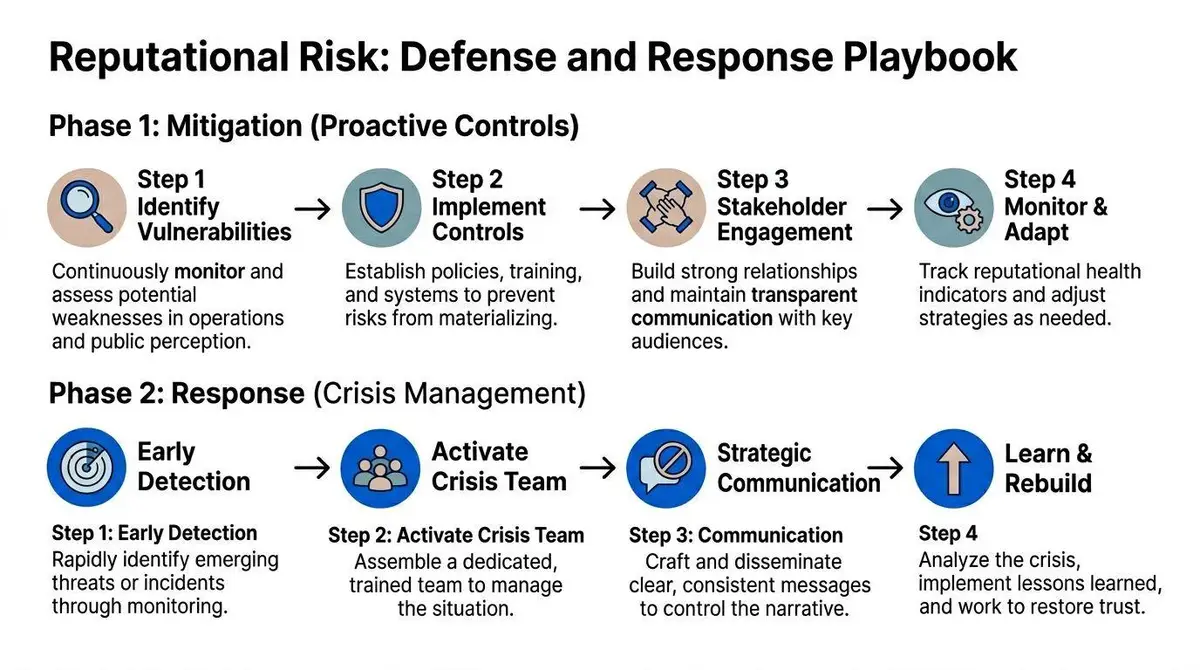
Your playbook has one job. Reduce the chance of a trigger event, then shorten the time between detection and decisive action when prevention fails. Standard crisis plans usually miss two forces that now shape outcomes: velocity-exposure and third-party contagion. A post that would once have died in a niche forum can now spread across platforms in minutes. A vendor, agency, affiliate, or portfolio company can drag your name into a crisis before your team has confirmed the facts.
Build prevention around likely failure points
Reputational damage rarely starts with a mystery. It starts with weak account recovery, exposed personal information, unmanaged legacy assets, poor third-party controls, or no system for spotting harmful content early. Fix those first.
A defensible baseline includes:
- Identity hardening across executive and brand accounts, with documented ownership, strong recovery controls, and verification where platforms allow it.
- Privacy reduction so direct contact details, family references, historical records, and other exploitable personal data are not sitting in public view.
- Third-party controls for agencies, IT firms, assistants, resellers, portfolio operators, and any outside party that can publish, access, leak, or mishandle sensitive information.
- Dormant asset cleanup covering old domains, unused social profiles, stale bios, archived campaign pages, and anything else that can be hijacked or repurposed.
- Monitoring discipline with clear workflows for adverse search changes, fake profiles, impersonation, and sudden shifts in branded visibility. If you need a baseline system for this, set up a reputation monitoring program before the next incident forces the issue.
Third-party exposure deserves harder treatment than many companies give it. Contract language is not enough. Review who can speak in your name, who holds privileged access, who can publish without review, and who creates search-visible content that can attach to your brand. One careless partner can trigger a judgment crisis that looks like your own.
Response must be pre-authorized
A crisis plan fails when every decision needs fresh approval. Pre-authorize the first moves. Name the incident lead. Set the threshold for legal review. Decide who can contact platforms, who preserves evidence, who briefs leadership, and who signs off on public statements.
Use this working sequence:
- Detect and verify
Confirm what the item is. False claim, manipulated media, impersonation, leak, hostile but lawful commentary, or a third-party incident now contaminating your name. Capture URLs, screenshots, timestamps, account details, and copies before the content changes or disappears. - Choose the primary objective
Pick the first move based on spread and harm. Removal, suppression, rebuttal, direct outreach, legal notice, or temporary silence while evidence is secured. The wrong first move can increase reach, validate a bad narrative, or destroy useful evidence. - Protect the smallest necessary group
Limit internal distribution to decision-makers and operators. Large email chains create new leaks, conflicting instructions, and commentary that later becomes discoverable. - Act by channel, not by habit
Platform abuse, search-visible defamation, private extortion, partner misconduct, and synthetic media each need different remedies. A press statement will not solve an account compromise. A legal threat will not slow a viral clip already being reposted across multiple channels. - Close the opening that allowed the incident
Remove access, update controls, correct records, fix publishing rights, or terminate the third party that created the exposure. Containment without hardening guarantees a repeat event.
Write the playbook so a tired executive can use it under pressure. That means contact names, approval limits, evidence standards, platform escalation paths, outside counsel details, and a decision tree for the first two hours. Keep it current. If the people listed have changed roles, the document is fiction.
A short briefing on crisis response can also sharpen internal alignment:
Separate communications from remedy
Communications should support the response, not run it. Legal should assess exposure, not dictate every operational move. Technical teams should preserve evidence and contain abuse, not wait for a polished statement before acting.
Treat message control and remedy control as parallel workstreams. One manages stakeholder confidence. The other removes, limits, or displaces the harmful material. You need both, in sequence.
If your internal playbook still reads like a PR checklist, pressure-test it against external reputation management strategies and strip out anything that assumes the issue will stay slow, local, or fully inside your control. Modern incidents do not behave that way. Neither should your response.
Continuous Oversight and When to Engage Specialists
A reputational risk assessment isn’t a one-off board exercise. It’s a standing discipline. Search results change. New review pages appear. Dormant allegations resurface. Fake accounts get rebuilt. Third parties create fresh exposure without warning. If nobody is watching continuously, you’re relying on luck.
What ongoing oversight should track
You don’t need vanity dashboards. You need signals that reveal loss of control early. Watch branded search volatility, adverse mentions on high-authority sites, executive-name query changes, suspicious profile creation, sentiment shifts around active matters, and unusual reposting patterns. If your team can’t distinguish a passing complaint from a coordinated attack, your monitoring is too weak.
For teams building their own playbook, broader reputation management strategies from Digital Skyrocket are useful as a comparative resource, especially when you want to test whether your internal approach is too PR-heavy and not protective enough.
The point where internal teams should stop improvising
Some matters belong inside the business. Many do not. You should engage specialists when the threat is spreading faster than your approvals can move, when the content is unlawful or invasive, when search visibility is worsening, when a platform is ignoring standard reports, or when the issue touches impersonation, leaks, extortion, false reviews, defamation, or non-consensual intimate content.
That trigger is strategic, not embarrassing. General counsel may know the law. Corporate communications may know stakeholders. Internal IT may know systems. But high-velocity online harm often requires a coordinated removal, de-indexing, evidence, and monitoring response that standard teams don’t run every day.
If the issue is indexed, mirrored, anonymous, or crossing platforms, treat it as a specialist problem early.
Internal monitoring still matters. It just needs to be tied to action. If you’re evaluating what that should look like, a dedicated reputation monitoring framework is the operational baseline, not an optional extra.
A well-run reputation program doesn’t promise that nothing bad will appear online. It ensures that when it does, you already know what it means, who owns it, and how quickly you can contain it.
If you’re facing a live threat, or you want a discreet assessment before one escalates, ContentRemoval.com provides confidential support for executives, high-net-worth individuals, family offices, brands, and legal teams dealing with defamation, impersonation, false reviews, leaks, NCII, harmful search results, and other digital reputation threats. The right time to engage specialist help is before your internal team loses the tempo.
Frequently asked questions
What should a reputational risk assessment include?
An inventory of every asset that carries your name or authority, and a map of the stakeholders whose perception changes behavior. Then an adversary-style threat list covering impersonation, search contamination, partner-origin incidents and synthetic media, a scored heat map, and a pre-authorized response playbook with named owners.
Why do traditional risk registers underestimate reputational threats?
They score reputation as if it moves at the pace of governance, but threats now move at the pace of platforms. Most models also ignore two accelerants: how fast a claim can spread before verification, and how easily a vendor, affiliate or fake account can attach damage to you without any misconduct on your part.
When should a company bring in reputation specialists?
When the threat is spreading faster than approvals can move, the content is unlawful or invasive, search visibility is worsening, a platform is ignoring standard reports, or the issue involves impersonation, leaks, extortion, false reviews, defamation or non-consensual intimate content. If it is indexed, mirrored, anonymous or crossing platforms, treat it as a specialist problem early.