
Reputation repair online is a controlled response to a discoverability problem. Triage classifies the content as editorial, review attack, leak or impersonation, then one decision follows: suppress the result with stronger controlled assets, remove it through legal, technical or platform routes, or both. False, invasive or leaked content calls for removal; lawful but damaging content calls for suppression.
Key facts
- Cited timelines: SEO suppression shows initial shifts in 60 to 90 days, full recovery in 6 to 12 months.
- Source removal and de-indexing can cut visibility within 24 to 72 hours when a valid basis exists.
- Jurisdiction changes strategy: UK libel law, US First Amendment protections and EU GDPR each favor different routes.
- Escalate immediately for allegations of criminality or fraud, anonymous coordinated sources, or exposed private material.
Where ContentRemoval.com comes in. ContentRemoval.com works both lanes of reputation repair: takedowns and de-indexing where a legal, privacy or platform basis exists, and coordinated suppression where the content is lawful but damaging, so SEO and removal are not treated as separate universes. Executives, family offices and their lawyers usually make contact once a result is ranking for a name that matters to a deal or a hearing. A free 15-minute Exposure Scan maps what is removable, and the report is yours to keep. Get a Free, Confidential Exposure Scan or read how our reputation management work is done.
The call usually starts before sunrise. A board member has forwarded a link. A spouse has seen a search result. General counsel has flagged a post that should never have been public. By the time you’re reading the first page of search results, other people already have.
That’s the part most advisers understate. A reputation crisis doesn’t begin when the press calls. It begins when a banker, investor, client, recruit, regulator, or family member searches your name and finds something they can’t unsee.
This isn’t a branding problem. It’s an asset protection problem. A company’s reputation can account for 63% of its market value, and 94% of consumers have actively avoided businesses due to negative online information, according to Mordor Intelligence’s online reputation management market analysis. If the trigger was a cyber incident, the commercial impact often extends far beyond the original intrusion. For smaller companies and founder-led firms, this breakdown of the cost of a data breach for SMEs is a useful reminder that reputational fallout often becomes more expensive than the technical event itself.
The right response is disciplined, not theatrical. You don’t argue with anonymous accounts at midnight. You don’t send impulsive legal threats. You don’t brief half your executive team before you know what is live, indexed, cached, syndicated, and amplifying.
You assess. You classify. You contain. Then you choose the right lane: suppression, removal, or both.
If you’re unsure whether you’re already in the danger zone, these signs that your online reputation is at risk provide a simple diagnostic. Most clients arrive after they’ve missed those early signals. The practical problem is the same either way. Harmful content has entered the digital record, and now every move needs to be deliberate.
The Moment a Reputation Crisis Ignites
The first serious mistake usually looks reasonable. An executive sees a hostile article, a review spike, or a leaked document, and assumes speed means immediate confrontation. It doesn’t. Public reaction before private assessment often hardens the record, increases visibility, and gives hostile actors exactly what they want: confirmation that they found the pressure point.
A better framing is this. Reputation repair online is a controlled response to a discoverability problem. The issue isn’t just that bad content exists. The issue is that search engines, review platforms, social feeds, and repost networks can preserve and multiply it.
What the first hours actually feel like
One client scenario comes up repeatedly. You search your own name after a late-night text from a colleague. A negative result appears above your company bio. There’s a Reddit thread underneath it. An X account has screenshotted the headline. Someone in your industry Slack has already posted it. No one knows yet whether the content is false, outdated, manipulated, legally actionable, or damaging in a way that truth doesn’t soften.
That uncertainty is what rattles people. They aren’t just worried about facts. They’re worried about audience. Who has seen it, who will believe it, and which relationship shifts first.
Your first objective isn’t to win the argument. It’s to stop making the situation easier for the other side.
The disciplined response
High-value clients need a short list of immediate rules.
- Freeze public reaction: Don’t post, comment, threaten, or “clarify” until the content has been mapped.
- Preserve evidence: Capture URLs, timestamps, screenshots, page source where relevant, and search result placement.
- Limit internal spread: Keep circulation tight. Every unnecessary forward increases the chance of leaks, side commentary, and inconsistent responses.
- Separate emotion from remedy: The fact that something feels defamatory doesn’t mean removal is immediately available. The fact that something is true doesn’t mean it can’t be de-indexed, suppressed, or challenged under platform rules.
This is why experienced operators treat digital reputation the way they treat legal exposure or liquidity stress. The surface event is emotional. The response must be procedural.
The Triage Framework Assessing the Damage
Before you decide what to do, decide what you’re looking at. Most failed reputation campaigns begin with a category error. People treat a review attack like a press problem, a privacy leak like an SEO problem, or a defamatory article like a customer service issue. Those are not interchangeable.

Classify the threat correctly
Start with the content type. The remedy follows the category.
- Editorial or news content
High-authority domains are difficult to suppress quickly and often impossible to remove without a specific legal or policy basis. - Review platform attacks
Don’t assume volume means legitimacy. Over 30% of all online reviews are estimated to be fake, and 78% of review fraud in 2026 is projected to come from “high-authenticity” accounts with legitimate-looking profiles, which makes first-pass judgment unreliable, as noted by WiserReview’s reputation management statistics roundup. - Leaks and private material
Documents, images, videos, internal emails, and client records create a different risk profile. Privacy, confidentiality, copyright, and platform safety rules may matter more than SEO. - Impersonation and account abuse
Fake social accounts, cloned websites, and misleading profiles are often handled through platform escalation and identity verification, not public rebuttal.
Measure the blast radius
You need to know not just what the content is, but how far it’s spreading.
| Assessment point | What matters |
|---|---|
| Search visibility | Is the harmful result ranking on brand, company, or executive-name searches? |
| Domain authority | Is the source a major publisher, a niche blog, a forum, or a disposable site? |
| Replication | Has the content been copied, screenshotted, archived, or syndicated elsewhere? |
| Narrative risk | Does it imply misconduct, incompetence, criminality, instability, or privacy failure? |
| Audience exposure | Who is likely to search and see it first: investors, clients, employees, media, or family? |
Inexperienced teams waste time on these tasks. They obsess over the insult and ignore the indexability. Search placement, repost behavior, and source credibility matter more than outrage.
What not to do during triage
The worst move is to engage publicly before you understand the mechanics of spread. Don’t comment underneath the post. Don’t ask employees to defend you online. Don’t contact the publisher with a rambling emotional email, and don’t instruct a junior marketing person to “push good content” before legal and technical review.
Practical rule: If you haven’t classified the source, checked replication, and documented ranking, you’re still in assessment, not response.
Silence in the first stage isn’t weakness. It’s control.
The Core Decision Suppression vs Removal
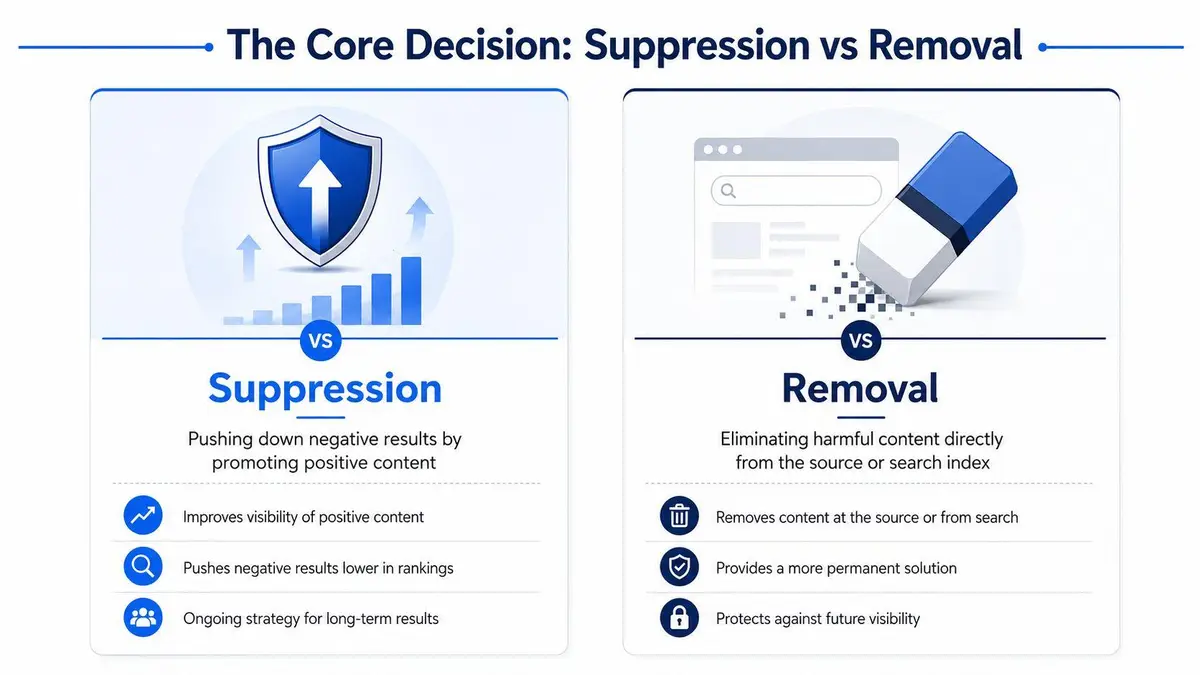
Every serious matter turns on one decision. Do you push the harmful content down, or do you try to eliminate it at the source or from search? Most firms blur these approaches. That’s lazy. They involve different timelines, different risks, and different standards of proof.
What suppression is
Suppression is an SEO and digital authority strategy. You build, optimize, and amplify positive or controlled assets so they outrank the harmful result. That can include personal sites, executive bios, LinkedIn, authoritative profiles, media placements, and controlled commentary.
Suppression is often the right choice when the content is lawful, difficult to remove, or too entrenched on authoritative domains. It works, but it isn’t immediate.
What removal is
Removal is a legal, technical, or platform-based intervention. You challenge the source content directly, seek takedown under platform terms, pursue de-indexing, assert privacy or copyright rights, or force action at the origin.
Removal is the correct path when the content is false, invasive, non-consensual, impersonating, leaked, or operationally too dangerous to leave visible while a long suppression campaign unfolds.
The timing difference matters
SEO suppression typically shows initial ranking shifts within 60 to 90 days and often needs 6 to 12 months for full recovery, while source removal and de-indexing can reduce content visibility within 24 to 72 hours, based on HelloPrivacy’s overview of reputation repair timelines. If you’re handling leaked material, extortion, impersonation, or an executive crisis ahead of financing, hearings, or a board event, that difference isn’t academic. It decides the strategy.
| Factor | Suppression (SEO) | Source Removal / De-Indexing |
|---|---|---|
| Speed | Slower. Best for medium-term recovery. | Faster when a valid basis exists. |
| Permanence | Durable if maintained, but hostile content can still exist. | Stronger if the content is removed or search visibility is cut. |
| Dependence on third parties | Lower. You control many of the assets. | Higher. Platforms, publishers, search engines, and legal venues matter. |
| Best use case | Lawful but damaging content on hard-to-remove sources | Defamation, privacy breaches, impersonation, leaks, policy violations |
| Risk profile | Lower confrontation, but slower relief | Higher leverage, but poor execution can provoke resistance |
The strategic rule most people miss
You don’t choose suppression because it sounds polite. You choose it when removal is weak, slow, or strategically unnecessary. You don’t choose removal because you’re angry. You choose it when visibility itself is unacceptable.
Sometimes the answer is a hybrid. Remove what you can. Suppress what you can’t. That’s usually the right answer for executives with broad digital footprints.
For a deeper breakdown of the mechanics, this guide on how to suppress negative search results strategically is useful. But the larger point is simple. If you misread this decision, you waste months.
Executing a Strategic Suppression Campaign
When suppression is the right lane, generic content marketing won’t save you. Posting a few upbeat articles and hoping Google develops sympathy is amateur work. Search results change because authority, relevance, structure, and engagement shift in your favor.

Build controlled assets first
A suppression campaign starts by expanding the number of pages you control or can strongly influence. For an executive, that usually means a personal domain, a detailed company leadership profile, LinkedIn, speaker bios, guest-contributed articles, podcast appearances, and professional directory listings with complete metadata and consistent naming.
The point isn’t vanity. It’s search architecture. If page one is sparse, negative content has room to breathe. If page one is crowded with strong, relevant assets tied tightly to branded search intent, hostile material loses oxygen.
Use variety. One polished executive bio won’t carry the field. Search results reward breadth across formats and domains.
Velocity beats passivity
The second mistake people make is relying on static assets. Search suppression depends on publishing cadence, optimization, and fresh signals. If the harmful result keeps attracting attention while your positive assets sit untouched, you won’t move anything meaningful.
ContentRemoval.com is one example of a firm that handles both removal and suppression work, which matters because the strongest campaigns usually coordinate SEO with takedown attempts rather than treating them as separate universes.
Search results don’t improve because you posted something good once. They improve because the web contains enough stronger, more relevant, and more active signals to replace what was ranking before.
Reviews and response speed are part of suppression
For companies, local brands, clinics, law firms, and founder-led businesses, review management is part of search control. Multi-channel review request systems work better than passive collection, and responses within 48 hours reduce negative review impact by an average of 35%, while responses delayed beyond 72 hours show minimal mitigation effect, according to Reputation’s guide to reputation score methodology.
That changes execution. If reviews matter to your brand searches, don’t wait for signage at reception desks or a generic follow-up email. Use coordinated requests through SMS, email, and in-app prompts. Then answer negative reviews fast, calmly, and with enough specificity to show engagement without making admissions that create legal exposure.
Ratios and cleanup
Suppression also demands enough positive material at the top of search results to change perception. You need density, not just quality. Clean up weak, outdated, or self-sabotaging assets at the same time. Old tweets, stale bios, abandoned microsites, and inconsistent branding dilute the campaign.
If your old social footprint is part of the problem, these practical 2026 X reset tips are useful for reviewing legacy posts before they become fresh liabilities.
A short explainer on the operational side sits well here:
The discipline is straightforward. Build the assets. Tighten the metadata. Increase publication velocity. Secure reviews. Respond quickly. Then keep going long after the first rankings move.
Navigating Advanced Removal and Legal Remedies
Some content should never be left online while you “wait for SEO.” Leaked documents, non-consensual material, impersonation, fabricated accusations, extortion posts, and certain privacy breaches demand direct action. Reputation repair online stops being a marketing exercise and becomes a legal and technical operation at this stage.

The remedy depends on the legal basis
Removal isn’t one tool. It’s a portfolio of tools. Copyright complaints can work when original text, images, or video have been copied without authorization. Platform reporting can work when harassment, impersonation, doxxing, threats, or manipulated identity are involved. Privacy rights can matter when personal data, intimate material, or stale personal records are exposed in a way the law recognizes.
The practical problem is that each path has a different evidentiary burden. A publisher may ignore a vague complaint but respond to a precisely framed notice with documentary support. A platform may reject a general objection yet act quickly when a clear terms violation is identified and packaged correctly.
Jurisdiction changes everything
This is the point generic ORM articles usually skip. Cross-border content removal is legally uneven. A defamatory article in the UK, where libel law favors removal, requires a different strategy than the same article in the US, where First Amendment protections are stronger, or in the EU, where GDPR can apply, as discussed in this analysis of jurisdictional blind spots in reputation repair.
That means your strategy should answer three questions immediately:
- Where is the publisher or host located
- Where are the subject and the harm located
- Which legal theory is strongest in that forum
A single threatening letter sent from the wrong jurisdiction often does more harm than good. It signals anxiety, reveals your attention, and teaches the other side that you haven’t thought through enforceability.
Why serious matters need specialist handling
This critical work belongs with people who understand platform process, evidentiary packaging, search de-indexing requests, and cross-border legal posture. The issue isn’t just legal knowledge. It’s sequencing.
Do you contact the host before the platform? Do you preserve evidence before requesting removal? Do you pursue source deletion first, or search de-indexing first, because the host is hostile and likely to repost under another domain? Do you proceed discreetly, or does a formal legal move create collateral publicity?
Weak removal attempts don’t fail quietly. They often harden the publisher’s position and expand the audience.
For executives dealing with defamatory material specifically, this guide on removing defamation from the internet strategically is a useful reference point. The principle is broader than defamation, though. Removal succeeds when the legal theory, the platform theory, and the technical sequence all match the facts.
The Escalation Point and Long-Term Defense
There is a point where trying to manage this yourself becomes a governance failure. If the content involves allegations of criminality, fraud, abuse, or professional misconduct, escalate. If the source is anonymous, coordinated, or clearly malicious, escalate. If private material has been exposed, escalated, copied, or threatened for release, escalate immediately.
The same is true when harmful content begins appearing across multiple surfaces at once. Search, reviews, X, Reddit, YouTube, and niche forums rarely move in perfect sync by accident. When several channels light up together, you’re not handling a complaint. You’re handling a campaign.
Clear thresholds for outside intervention
Use a simple standard. Bring in specialist support when any of the following is true:
- The issue carries legal complexity: Defamation, privacy breach, impersonation, copyright misuse, or extortion.
- The content is spreading faster than your team can track: Replication across platforms changes the economics of delay.
- The audience risk is concentrated: Board members, investors, clients, regulators, or family office stakeholders are likely to search now.
- You cannot afford trial and error: A failed response creates more damage than a delayed one.
That last point matters most for senior people. If your name is tied to a company, fund, transaction, or public profile, amateur experimentation is expensive.
Defense is easier than repair
Long-term protection comes from pre-positioning, not just cleanup. Own your name where it matters. Keep executive bios current. Maintain authoritative profiles. Monitor branded search results, review platforms, and social impersonation risk continuously. Build enough credible, indexable content that a single hostile page doesn’t get the whole first impression.
The strongest digital reputations are rarely accidental. They are maintained the same way serious people maintain legal hygiene, insurance coverage, and capital structure. Consistently. Before the emergency.
A resilient reputation isn’t one that never gets hit. It’s one that was built to absorb impact without surrendering page one, narrative control, or legal leverage.
If you’re already in motion, speed matters. If you’re not, preparation matters more than optimism.
If you need a discreet assessment, ContentRemoval.com handles online content removal, de-indexing, defamation response, fake review takedowns, and reputation repair strategy for executives, public figures, family offices, and legal teams. Start with a confidential review of the content, the jurisdictions involved, and the fastest viable path to suppression, removal, or both.
Frequently asked questions
How long does online reputation repair take?
It depends on the lane. The article cites suppression showing initial ranking shifts within 60 to 90 days and full recovery in 6 to 12 months, while source removal and de-indexing can cut visibility within 24 to 72 hours when the content qualifies. Most serious matters combine both, removing what can be removed and suppressing the rest.
Should I suppress a negative search result or try to remove it?
Choose removal when the content is false, invasive, non-consensual, impersonating, leaked or too dangerous to leave visible during a long campaign. Choose suppression when the material is lawful, entrenched on an authoritative domain or unlikely to come down. Misreading this decision wastes months.
How can I tell if negative reviews about me are fake?
Do not assume volume means legitimacy. The article cites estimates that over 30% of online reviews are fake and that most 2026 review fraud comes from accounts with legitimate-looking profiles, so first-pass judgment is unreliable. Look at timing clusters, repeated language, thin account histories and vague or impossible details before responding.