
Reputation management services pricing spans a wide spectrum. Cited surveys put monthly retainers at $500 to $2,000 for basic monitoring, $2,000 to $15,000 for standard and professional tiers, and $15,000 to $50,000 or more for enterprise coverage, with project-based content removal at $1,500 to $15,000 per item. Severity, platform count, content type, geography and urgency all move the price.
Key facts
- Three common structures: monthly retainers, project-based fees for defined removals, and hybrid models combining both.
- Third-party surveys put policy-violating review removal at $500 to $2,000 and defamatory articles at $3,000 to $15,000.
- Success-only removal arrangements typically carry 50 to 100% premiums over standard project fees, per the article’s sources.
- Red flags include results promised without caveats, unusually low pricing, vague deliverables and pressure to sign.
Where ContentRemoval.com comes in. ContentRemoval.com works on the direct takedown and de-indexing end of this market, where fees follow the specific content, platform and legal route rather than a package tier, and every quote is put in writing only after the exposure has been reviewed. Founders, executives and in-house counsel usually make contact when a removal matter falls outside their marketing budget. A free 15-minute Exposure Scan maps what is removable, and the report is yours to keep. Get a Free, Confidential Exposure Scan or read how our reputation management work is done.
Understanding reputation management services pricing requires navigating a complex landscape where costs can range from a few hundred dollars monthly to six-figure annual retainers. Whether you’re an individual facing damaging search results or a corporation managing brand reputation at scale, the investment in professional reputation services varies dramatically based on scope, urgency, and the specific threats you face. For executives, founders, and businesses evaluating their options in 2026, knowing what drives costs and how providers structure their fees makes the difference between effective investment and overspending on unnecessary services.
Understanding the Reputation Management Pricing Spectrum
The reputation management industry has evolved significantly, creating distinct pricing tiers that reflect the complexity and urgency of different client needs. Unlike standardized software subscriptions, reputation management services pricing depends on factors that vary substantially from case to case.
Basic monitoring and review management tools typically start at the lower end, with costs ranging from $500 to $20,000+ per month depending on business size and requirements. These entry-level services often focus on tracking online mentions and responding to customer reviews across platforms.
Mid-tier services incorporate active content suppression, review generation campaigns, and strategic search engine optimization to push down negative results. These packages generally cost between $3,000 and $10,000 monthly for established businesses requiring ongoing reputation maintenance.
Premium reputation management services, particularly those involving direct content removal and crisis response, command significantly higher fees. Individual cases involving defamatory content, privacy violations, or explicit material can require investments ranging from $5,000 to $50,000 or more depending on the severity and complexity of the situation.
Factors That Influence Service Costs
Several key variables determine where your specific needs fall on the pricing spectrum:
- Severity of reputation damage: Minor review issues cost less than widespread defamation campaigns
- Number of platforms affected: Single-site problems versus multi-platform crises
- Content type: Text-based articles differ from image/video removal in complexity
- Geographic scope: Local reputation issues versus international challenges
- Urgency requirements: Standard timelines versus emergency crisis response
- Ongoing versus one-time projects: Monthly retainers versus discrete removal projects
The scope of work and service level required fundamentally shapes pricing structures. A startup founder dealing with a single defamatory blog post faces different costs than a public company managing coordinated attack campaigns across dozens of websites.

Service Models and Pricing Structures
Reputation management firms employ various pricing models, each suited to different client situations and service types. Understanding these structures helps you evaluate proposals and compare providers effectively.
Monthly Retainer Models
Most comprehensive reputation management relationships operate on monthly retainers. This model provides ongoing monitoring, content suppression, and reputation maintenance activities.
| Retainer Tier | Monthly Cost Range | Typical Services Included |
|---|---|---|
| Basic | $500 to $2,000 | Review monitoring, basic alerts, limited response management |
| Standard | $2,000 to $5,000 | Active monitoring, review management, basic SEO suppression |
| Professional | $5,000 to $15,000 | Multi-platform management, content suppression, crisis response |
| Enterprise | $15,000 to $50,000+ | Comprehensive reputation protection, dedicated team, 24/7 monitoring |
Retainer agreements typically include monthly reporting, ongoing optimization, and a certain number of included hours or deliverables. Additional work beyond scope may incur supplementary fees.
Project-Based Pricing
For specific reputation challenges, project-based pricing offers clarity around costs for defined objectives. This structure works well for targeted content removal efforts or reputation repair following specific incidents.
Individual content removal projects might range from $1,500 to $15,000 per piece of content depending on:
- Publishing platform and removal difficulty
- Legal considerations and documentation requirements
- Content age and distribution across the web
- Required follow-up for search engine de-indexing
Services focused on direct takedown and de-indexing strategies typically operate on this project-based model, providing clear deliverables and success metrics tied to specific harmful content.
Hybrid Pricing Models
Many sophisticated reputation management engagements combine project fees with ongoing retainers. An initial project fee covers immediate crisis response and content removal, while a subsequent retainer maintains results and prevents future issues.
This approach often proves most cost-effective for clients facing active reputation threats who also need long-term protection. Initial projects might cost $10,000 to $100,000 depending on complexity, followed by $2,000 to $10,000 monthly maintenance retainers.
Breaking Down Service Components and Associated Costs
Understanding what you’re actually paying for clarifies reputation management services pricing and helps identify where your budget delivers the most value.
Monitoring and Detection Services
Reputation monitoring forms the foundation of proactive reputation management, alerting you to emerging threats before they escalate.
Basic monitoring tools ($50-$500/month) track brand mentions, reviews, and basic search results. These automated solutions provide alerts but require internal resources to interpret and respond.
Professional monitoring services ($500-$3,000/month) include:
- Comprehensive platform coverage across social media, review sites, forums, and news outlets
- Sentiment analysis and threat prioritization
- Custom alert configurations for specific keywords and scenarios
- Regular reporting with actionable intelligence
Enterprise monitoring ($3,000-$10,000+/month) adds deep web monitoring, dark web scanning for data breaches, competitive intelligence tracking, and dedicated analyst support.
Content Removal and Suppression
The cost difference between content suppression (pushing down negative results) and direct removal (eliminating content entirely) significantly impacts overall pricing.
Content suppression through SEO and positive content creation typically costs $2,000 to $8,000 monthly depending on competition levels and the volume of negative results requiring suppression. This ongoing process involves creating optimized positive content, building authoritative links, and technical SEO work.
Direct content removal requires different expertise and effort levels based on content type. Reputation management fees vary considerably based on whether content violates platform policies, privacy laws, copyright protections, or defamation standards.
| Content Type | Typical Removal Cost | Success Rate | Timeframe |
|---|---|---|---|
| Policy-violating reviews | $500 to $2,000 | 60-80% | 2-6 weeks |
| Defamatory articles | $3,000 to $15,000 | 50-75% | 4-12 weeks |
| Privacy violations | $2,000 to $10,000 | 70-85% | 3-8 weeks |
| Copyright infringement | $1,500 to $5,000 | 80-95% | 2-6 weeks |
| Explicit/revenge content | $5,000 to $25,000 | 75-90% | 4-12 weeks |
Crisis Response and Damage Control
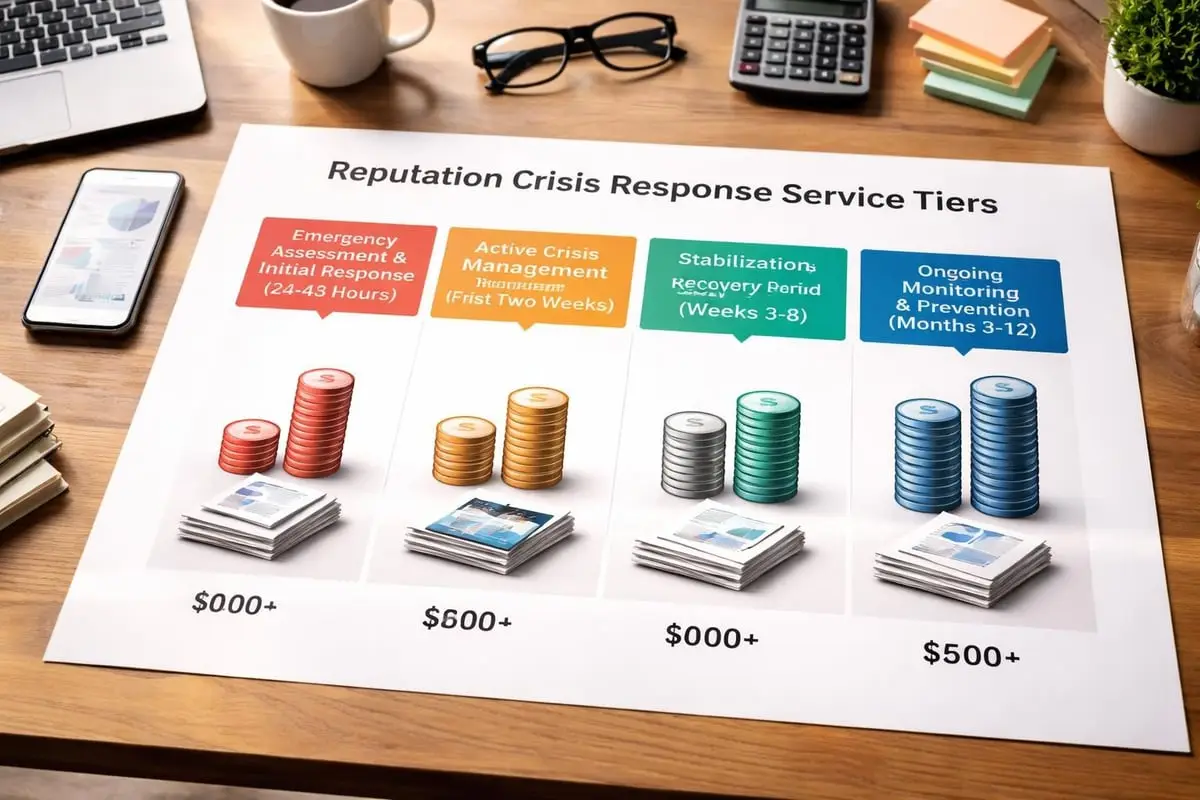
When reputation threats emerge suddenly, crisis response services command premium pricing reflecting their urgency and intensity.
Emergency response retainers typically start at $10,000 to $25,000 for the initial response period, with some firms charging $15,000 to $50,000 for comprehensive crisis management involving media coordination, legal strategy, and rapid content suppression.
These services include:
- Immediate threat assessment and strategic planning
- 24/7 availability and rapid response team deployment
- Coordination with legal counsel and PR specialists
- Emergency content removal attempts
- Search engine suppression campaigns
- Media monitoring and response coordination
Industry-Specific Pricing Considerations
Different industries face unique reputation challenges that influence service costs and provider selection.
Executive and High-Net-Worth Individual Reputation Management
Executives, founders, and public figures require discretion and comprehensive protection across personal and professional contexts. Reputation management services pricing for individuals typically ranges from $3,000 to $25,000 monthly for comprehensive protection.
High-profile clients often face:
- Personal attack campaigns requiring sophisticated response
- Privacy violations across multiple platforms
- Image and video content requiring specialized removal approaches
- Coordination between personal and corporate reputation strategies
Services like digital footprint cleanup become essential for executives seeking to minimize their personal information exposure online.
Corporate and Enterprise Reputation Management
Corporations face reputation management at scale, requiring enterprise solutions with pricing structures reflecting organizational complexity.
Small to mid-sized businesses ($5M-$50M revenue) typically invest $2,000 to $8,000 monthly for:
- Multi-location review management
- Brand monitoring across relevant platforms
- Competitive intelligence tracking
- Crisis response preparedness
Enterprise corporations ($50M+ revenue) often maintain $10,000 to $50,000+ monthly retainers covering:
- Global brand protection across dozens of markets
- Executive reputation management for leadership team
- Comprehensive crisis response capabilities
- Integration with corporate communications and legal teams
- Advanced threat intelligence and dark web monitoring
Healthcare and Professional Services
Medical practices, law firms, and professional service providers face unique challenges with online reviews and professional reputation platforms. The detailed breakdown of service costs shows these sectors typically invest $1,500 to $6,000 monthly depending on practice size and specialty.
Healthcare providers must navigate HIPAA compliance while managing reviews, making specialized reputation management essential. Legal and financial professionals face strict regulatory considerations around promotional activities and client confidentiality.
Evaluating Reputation Management Proposals and Comparing Providers
With reputation management services pricing varying so dramatically across providers, evaluating proposals requires careful analysis beyond simple cost comparison.
Key Questions to Ask Prospective Providers
Service Scope and Deliverables:
- What specific activities are included in your quoted price?
- How many hours or resources are allocated monthly?
- What triggers additional fees beyond the base retainer?
- What measurable outcomes can you guarantee?
Experience and Methodology:
- What is your success rate for cases similar to mine?
- What removal methods and strategies do you employ?
- Do you have documented case studies in my industry?
- What legal resources support your content removal efforts?
Transparency and Reporting:
- How frequently do you provide progress reports?
- What metrics do you track and share?
- How do you handle unsuccessful removal attempts?
- What is your policy on refunds or performance guarantees?
Red Flags in Reputation Management Pricing
Several warning signs indicate providers who may not deliver value commensurate with their fees:
- Guaranteed results without caveats: No legitimate provider can guarantee 100% removal success across all platforms
- Unusually low pricing: Effective reputation management requires skilled professionals and legal resources; extremely low prices suggest inadequate service
- Vague deliverables: Proposals lacking specific activities, timeframes, or success metrics indicate potential service gaps
- Pressure tactics: Legitimate firms allow time for decision-making rather than demanding immediate commitment
- No verifiable credentials: Absence of case studies, client references, or industry recognition raises concerns
According to pricing information for various reputation management services, reputable providers offer transparent pricing with clear service descriptions and realistic expectations about outcomes and timelines.
Comparing Value Across Price Points
The cheapest option rarely delivers optimal value in reputation management. Consider total cost of ownership including:
- Success probability: A $10,000 service with 80% success rate delivers better value than a $5,000 service with 30% success
- Speed to results: Faster resolution prevents ongoing damage accumulation
- Comprehensiveness: Partial solutions may require additional spending later
- Ongoing protection: One-time fixes without monitoring risk recurring problems
Calculate potential ROI by estimating the business impact of unresolved reputation issues versus the cost of effective resolution. For businesses, even a single lost major client or partnership often exceeds annual reputation management costs.
Long-Term Investment Planning for Reputation Protection
Reputation management should be viewed as ongoing business insurance rather than one-time expense. Strategic planning ensures sustainable protection within budget constraints.
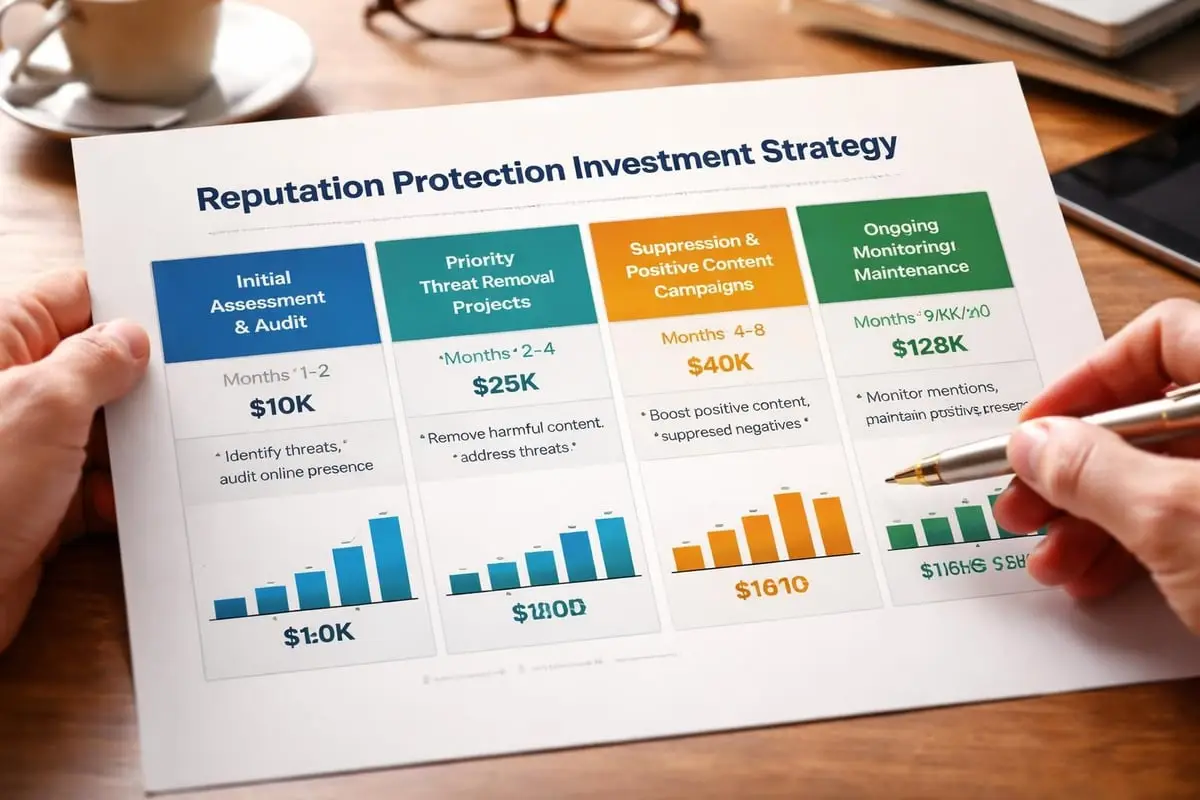
Phased Approach to Reputation Management
Organizations with limited budgets can adopt phased implementation:
Phase 1: Assessment and Priority Threats ($2,000-$5,000)
- Comprehensive reputation audit
- Identification of highest-risk threats
- Strategic planning and prioritization
- Quick wins on easily removable content
Phase 2: Active Threat Remediation ($5,000-$25,000)
- Targeted content removal campaigns
- Initial suppression efforts for stubborn content
- Review management system implementation
- Staff training on reputation best practices
Phase 3: Ongoing Protection ($2,000-$10,000/month)
- Continuous monitoring and alerts
- Proactive review generation
- Content suppression maintenance
- Quarterly strategy reviews and optimization
This approach distributes costs over time while addressing immediate threats first, similar to how reputation management service costs break down into setup fees, ongoing service fees, and content creation expenses.
Budget Allocation Guidelines
Professional reputation management typically represents 2-5% of marketing budget for established businesses, though crisis situations may temporarily require higher allocation.
Recommended budget allocation by business size:
- Startups and solopreneurs: $500-$2,000/month for monitoring and basic protection
- Small businesses ($1M-$10M revenue): $2,000-$5,000/month for active management
- Mid-market companies ($10M-$100M revenue): $5,000-$15,000/month for comprehensive protection
- Enterprise organizations ($100M+ revenue): $15,000-$50,000+/month for global reputation management
Individual executives and high-net-worth persons should budget based on public profile visibility and potential impact of reputation damage to personal brand value and business relationships.
Building Internal Capabilities to Reduce Long-Term Costs
Strategic investments in internal capabilities can reduce long-term dependency on external providers:
Technology infrastructure ($1,000-$5,000 one-time setup):
- Monitoring tools and alert systems
- Review management platforms
- Social listening software
Training and processes ($2,000-$10,000 annually):
- Staff training on reputation management best practices
- Crisis response protocols and playbooks
- Review response templates and guidelines
Content creation capabilities ($3,000-$10,000 monthly):
- In-house content team or reliable freelancers
- SEO expertise for positive content ranking
- Social media management resources
Even with internal capabilities, most organizations benefit from maintaining relationships with specialist firms for complex removal cases and crisis situations requiring specialized legal and technical expertise.
DIY Versus Professional Services: Cost-Benefit Analysis
The decision between handling reputation management internally versus hiring professionals significantly impacts both costs and outcomes.
When DIY Approaches Make Sense
Self-managed reputation efforts can work effectively in limited circumstances:
Minor review issues: Individual negative reviews on Google or Yelp often respond well to professional, empathetic responses drafted in-house without professional assistance. Free or low-cost tools ($0-$100/month) can monitor these platforms adequately.
Proactive reputation building: Creating positive content, maintaining active social media presence, and encouraging satisfied customer reviews represent ongoing activities that well-trained internal teams can manage effectively.
Basic monitoring: Alert tools and social listening platforms enable businesses to detect emerging issues without substantial ongoing costs.
However, understanding total cost components of reputation management services reveals that even basic DIY efforts require significant time investment from skilled personnel, translating to substantial hidden costs.
When Professional Services Become Essential
Certain reputation challenges require specialized expertise that justifies professional engagement:
Complex content removal: Defamatory articles on news sites, privacy violations across multiple platforms, or explicit content require legal knowledge, platform relationships, and technical expertise beyond typical internal capabilities. Professional firms understand platform policies, legal frameworks like DMCA and GDPR, and effective escalation strategies.
Crisis situations: When reputation threats emerge suddenly and pose immediate business risk, professional crisis response provides immediate action capacity, strategic guidance, and 24/7 availability that internal teams cannot match.
Legal complexity: Cases involving defamation, privacy violations, or intellectual property infringement benefit from providers with legal resources and established relationships with content platforms and search engines. Services specializing in reputation management combine technical removal capabilities with legal expertise.
High-value outcomes: When potential business impact of unresolved reputation issues exceeds hundreds of thousands in lost revenue or opportunities, professional investment represents prudent risk management.
Hybrid Approach Optimization
Many organizations optimize costs through strategic combination of internal and external resources:
- Internal teams handle routine monitoring, review responses, and positive content creation
- External specialists address complex removal cases and provide crisis response capability
- Quarterly consulting engagements provide strategic guidance and training
- Retainer agreements cover defined scope with project fees for exceptional situations
This hybrid model typically reduces total costs 30-50% compared to fully outsourced solutions while maintaining effectiveness significantly higher than pure DIY approaches.
Negotiating and Structuring Reputation Management Agreements
Understanding negotiation leverage points and agreement structures helps secure optimal value from reputation management investments.
Performance-Based Pricing Considerations
Some reputation management providers offer performance-based pricing where fees depend on achieving specific outcomes. These arrangements can include:
Success-only content removal: Payment only upon confirmed content removal or de-indexing. These agreements typically charge 50-100% premiums over standard project fees but eliminate risk of payment for unsuccessful efforts.
Tiered milestone payments: Fees structured around achievement of specific milestones such as removing content from page one of search results, achieving specific review rating targets, or eliminating defined numbers of negative mentions.
Hybrid retainer plus success fees: Base retainer covering ongoing activities with bonus payments for exceeding performance targets or achieving particularly difficult removals.
Performance-based pricing shifts risk to providers but typically increases total costs when successful. Evaluate whether risk mitigation justifies premium pricing based on your situation and risk tolerance.
Contract Terms and Protections
Reputation management agreements should include specific protections and clearly defined terms:
- Scope definition: Precise description of included services, platforms covered, and response timeframes
- Performance metrics: Measurable objectives with reporting frequency and formats
- Term and termination: Contract duration, renewal terms, and termination rights with notice periods
- Fee adjustments: Conditions triggering additional charges beyond base fees
- Confidentiality provisions: Protection of sensitive information about reputation issues
- Liability limitations: Clear understanding of provider liability for unsuccessful efforts or methodology issues
Most reputable providers offer initial contracts of 3-6 months for project work or 6-12 months for retainer relationships, with options for shorter initial trial periods followed by longer-term commitments at reduced rates.
Volume and Long-Term Commitment Discounts
Providers often offer pricing advantages for broader scope or longer commitments:
Multi-platform discounts: Bundling services across multiple platforms (Google, social media, review sites) typically yields 10-20% savings versus individual platform contracts.
Annual prepayment discounts: Paying annually in advance rather than monthly often reduces total costs 15-25%, though this requires confidence in provider relationship and financial capacity for upfront investment.
Enterprise agreements: Large organizations managing reputation for multiple executives, locations, or brands can negotiate consolidated pricing delivering 20-40% savings versus individual contracts.
Balance cost savings against flexibility loss, ensuring contracts include performance standards and termination rights even with longer commitments or prepayment arrangements.
Technology and Tools: Impact on Service Pricing
The reputation management technology landscape significantly influences service delivery costs and pricing models across providers.
Proprietary Technology Versus Third-Party Tools
Providers using proprietary monitoring and management platforms often charge premium prices reflecting technology development investments. These custom solutions may offer:
- Integration across multiple data sources unavailable in standard tools
- Custom alert algorithms and threat scoring
- Client-specific dashboards and reporting
- Automation reducing manual effort and costs
However, providers relying on established third-party monitoring tools (BrandWatch, Mention, ReviewTrackers) may offer competitive pricing while delivering comparable monitoring capabilities. Evaluate whether proprietary technology delivers meaningful advantages justifying price premiums.
AI and Automation Impact on Pricing
Artificial intelligence and automation are transforming reputation management economics. Advanced providers now employ:
Automated monitoring and triage: AI-powered systems continuously scan thousands of sources, automatically categorizing threats and prioritizing human attention on high-risk issues. This reduces labor costs, potentially lowering service prices 20-30% compared to manual monitoring approaches.
Response automation: Template-based response systems with AI personalization handle routine review responses and social media interactions, reducing costs for high-volume review management.
Content analysis and strategy: Machine learning algorithms analyze content performance and recommend optimization strategies, improving suppression campaign efficiency.
While AI reduces certain costs, complex removal work and strategic planning still require human expertise, limiting automation’s pricing impact for premium services.
Platform Access and Relationship Value
Established reputation management firms maintain relationships with major platforms, potentially accelerating removal processes. This access represents significant value:
- Direct contacts at Google, Facebook, Twitter/X, and major review platforms
- Understanding of unpublished platform policies and escalation procedures
- Expedited review processes for content violations
- Technical integration enabling bulk submission and tracking
Providers with strong platform relationships may justify higher pricing through faster resolution and higher success rates, though these advantages are difficult to verify during provider selection.
Geographic Considerations in Reputation Management Pricing
Location factors influence both the costs of services and the complexity of reputation challenges.
Regional Pricing Variations
Reputation management services pricing varies significantly across markets:
United States pricing: Typically represents the high end of global pricing, with comprehensive services ranging $5,000-$25,000 monthly for mid-market businesses. Major metropolitan markets (New York, Los Angeles, San Francisco) command premiums 15-25% above national averages.
European pricing: Generally comparable to US pricing for comprehensive services, though regional variations exist. UK-based providers typically charge £3,000-£15,000 monthly for similar scope. GDPR compliance capabilities may command premiums for EU-focused work.
Asia-Pacific pricing: Varies dramatically by market sophistication and local competition, ranging from $2,000-$10,000 monthly for comparable services in developed markets like Australia and Singapore.
Developing markets: Often offer substantially lower pricing ($500-$3,000 monthly) but may lack legal expertise, platform relationships, and quality standards necessary for effective reputation management.
Consider whether provider location matches your primary geographic markets and regulatory environments requiring expertise.
Cross-Border and Multi-Jurisdiction Challenges
International reputation issues require specialized capabilities that influence pricing:
Multi-language content: Removal efforts across content in multiple languages require native-speaking specialists, typically increasing costs 25-50% per additional language.
Jurisdiction-specific legal frameworks: Content removal leveraging privacy laws (GDPR, CCPA), defamation standards, or platform regulations requires jurisdiction-specific legal expertise, adding complexity and costs.
Time zone coverage: Global businesses requiring 24/7 monitoring and response capabilities pay premiums for round-the-clock coverage across time zones.
Platform variations: Regional platform variations (Baidu in China, Yandex in Russia, Naver in South Korea) require specialized knowledge beyond standard Western platform expertise.
International reputation management often requires investment 50-100% higher than comparable domestic-only services, though geographic concentration of threats may enable targeted rather than comprehensive global coverage.
Measuring ROI and Justifying Reputation Management Investment
Quantifying reputation management value helps justify investment and optimize budget allocation.
Tangible Business Impact Metrics
Direct financial impacts provide clearest ROI justification:
Revenue protection: Calculate potential revenue loss from damaged reputation (lost customers, failed sales, cancelled contracts) versus reputation management costs. Many businesses find even single prevented major client loss justifies annual reputation investment.
Acquisition and partnership value: Quantify deals potentially jeopardized by negative search results or harmful content. Private equity transactions, partnership agreements, and major customer relationships often require clean online reputation.
Recruitment and retention: Assess hiring costs and employee retention impacts when company reputation affects talent attraction. Negative employer reviews and executive controversies increase recruitment costs and turnover.
Litigation avoidance: Legal costs for defamation suits, privacy violations, or other content-related disputes often exceed proactive reputation management investments by orders of magnitude.
Qualitative Value Considerations
Beyond direct financial metrics, reputation management delivers strategic value:
- Peace of mind: Reducing stress and distraction from reputation threats enables focus on core business activities
- Brand equity protection: Maintaining brand value and market position requires ongoing reputation investment
- Competitive advantage: Superior online reputation versus competitors influences customer selection
- Crisis preparedness: Established monitoring and response capabilities reduce potential damage from future incidents
Benchmarking Against Industry Standards
Compare your reputation management investment against industry norms to ensure appropriate allocation. Reputation intelligence platform pricing varies by business size and requirements, with typical investments ranging from $100-$500 per location monthly for basic review management to thousands monthly for comprehensive reputation protection.
Professional services firms (legal, medical, financial) typically invest 3-7% of marketing budgets on reputation management. Consumer brands allocate 2-4% of marketing spend, while B2B companies average 2-3%.
Evaluate your allocation considering:
- Current reputation health and threat landscape
- Industry reputation sensitivity and competitive dynamics
- Revenue concentration and customer acquisition costs
- Public profile of leadership and key personnel
Understanding reputation management services pricing empowers you to make informed investment decisions that protect your personal or business reputation effectively. Whether you’re addressing immediate threats or building long-term reputation resilience, matching service scope to your specific needs ensures optimal value from your investment. When harmful content threatens your online presence, Content Removal specializes in direct takedown and de-indexing strategies, combining legal expertise with technical capabilities to permanently remove defamatory articles, privacy violations, and damaging search results from the internet.
Frequently asked questions
How much does it cost to remove a defamatory article online?
Third-party pricing surveys cited in the article place defamatory article removal at roughly $3,000 to $15,000 per piece with a 4 to 12 week timeframe, while privacy violations run $2,000 to $10,000 and copyright takedowns $1,500 to $5,000. The publishing platform, legal documentation, content age and follow-up de-indexing all move the figure.
Is it worth paying for reputation management or should I do it myself?
Minor review issues, proactive content and basic monitoring can be handled in-house with low-cost tools. Defamatory articles on news sites, privacy violations across platforms, explicit content and sudden crises require legal knowledge, platform relationships and technical expertise, and the potential business impact usually exceeds the professional fee.
What should a reputation management contract include?
A precise scope covering services, platforms and response timeframes, measurable performance metrics with reporting cadence, term and termination rights, conditions that trigger extra charges, confidentiality provisions and liability limits. Most reputable providers offer 3 to 6 month project contracts or 6 to 12 month retainers.