
Searching for reputation management near me usually surfaces local agencies selling review responses, listings cleanup and light SEO. For defamation, impersonation, leaked private material, fake reviews or AI-generated misinformation, proximity is the wrong filter. Platforms operate globally, so the right question is which firm can remove the specific harm at its source, discreetly and lawfully, with defined scope and confidentiality.
Key facts
- Preserve exact URLs, full-page screenshots with timestamps, account names and platform context before contacting anyone.
- Takedown targets the source; suppression only outranks it, which fails for severe, visual or easily copied content.
- Percepture reports 70% of inquiries to reputation firms now involve AI-generated harm most local providers cannot address.
- Contracts should define scope, approval rights, termination, and block quiet substitution of suppression for removal.
Where ContentRemoval.com comes in. ContentRemoval.com is the kind of specialist the search should have surfaced: source removal, de-indexing, impersonation takedowns, false review removal and leaked image or video removal, handled through secure intake rather than a local sales office. Executives, public figures, family offices and their lawyers usually make contact after a local agency has said the problem is beyond them. A free 15-minute Exposure Scan maps what is removable, and the report is yours to keep. Get a Free, Confidential Exposure Scan or read how our reputation management work is done.
You searched for reputation management near me because something is already wrong. A false review is climbing in Google. An impersonation account is spreading. Private images, a defamatory post, or a fabricated allegation is now visible to clients, investors, family, or the press. At that moment, proximity feels comforting. It isn’t the right filter.
Local reputation shops usually sell review responses, listings cleanup, and light SEO. That may help a restaurant with a ratings problem. It won’t solve a targeted attack, leaked private content, impersonation, or AI-generated misinformation. High-stakes matters require a narrower skill set. You need legal and technical takedown capability, platform process knowledge, and discretion.
This distinction matters because specialist removal work is a different discipline from ordinary brand marketing. The market itself reflects that shift. The global enterprise internet reputation management market was valued at USD 5.19 billion in 2025 and is projected to reach USD 25.30 billion by 2036 according to Future Market Insights on enterprise internet reputation management. Serious clients are no longer buying generic PR comfort. They’re buying structured digital defense.
Immediate Actions for Reputation Damage Control
If you’re in a live reputation crisis, your first job is containment. Don’t improvise. Don’t start arguing in public. Don’t outsource your judgment to panic.
Preserve evidence before it moves
Harmful content often changes, disappears, or gets reposted elsewhere. Capture it immediately.
- Save the exact URL for every harmful page, profile, review, image, video, and search result.
- Take full-page screenshots with visible timestamps.
- Record context. Note the account name, platform, date discovered, and any comments or shares attached to it.
If the issue involves marketplaces or retail platforms, preserve the listing, seller profile, review text, and product page relationship before anyone edits it. For Amazon-specific review disputes, Online Brand Growth’s Amazon guide is a useful reference for understanding the difference between platform complaints and actual removal pathways.
Practical rule: Evidence collected in the first hour is often cleaner than evidence collected the next day.
This urgency isn’t theoretical. One in five people are now affected by revenge porn, which underscores the need for rapid, legally grounded takedown action, as noted in Yahoo Finance coverage of ContentRemoval.com and NCII harms.
Stop talking to the attacker
Most clients make the same mistake. They respond emotionally, threaten publicly, or try to debate facts in comments and direct messages. That usually makes the record worse.
Public engagement creates three problems:
- It authenticates the dispute by making the attack look like a live controversy.
- It gives the attacker fresh material to screenshot, distort, and repost.
- It complicates removal because platforms and search engines may see an active interpersonal conflict rather than a clean policy or legal violation.
If someone has posted falsehoods, private content, or impersonation material, your answer isn’t a public duel. Your answer is a controlled record and a removal strategy. If you need a disciplined framework while the situation is still unfolding, review this strategic response guide for a reputation attack.
Lock down your own perimeter
A reputation attack often overlaps with a security problem. Someone may have guessed passwords, accessed old accounts, scraped exposed data, or reused images from dormant profiles.
Start with this short audit:
- Change credentials first: Prioritize email, social platforms, cloud storage, and any administrator logins tied to your public presence.
- Check account recovery settings: Remove unknown phone numbers, emails, devices, and delegate access.
- Audit what’s exposed: Search your name, business, phone number, old usernames, executive bios, and image variations. Don’t trigger more attention than necessary.
This isn’t glamorous work. It’s foundational. Once you’ve documented the harm, stopped feeding it, and secured your perimeter, you’re in position to hire the right firm instead of the nearest one.
Locating Specialist Firms Beyond Local SEO Listings
The phrase reputation management near me pushes you toward the wrong market. Google’s local results are built to surface nearby service providers. In this category, nearby usually means agencies that manage reviews for dentists, med spas, law offices, and franchises. That’s not the same as specialist content removal.
Why local results often miss the real experts
Data removal and source takedown work is still a niche field. As of 2026, only 6% of U.S. adults have ever used data removal services, and less than half were aware they existed, according to ContentRemoval blog reporting on data removal service awareness. That tells you something useful. Most consumers don’t know this specialty exists, so most local providers haven’t built deep competence in it.
If your problem involves defamation, leaked private data, extortion, impersonation, fake reviews at scale, or image abuse, geographic closeness is almost irrelevant. Platforms operate globally. Harmful sites are often hosted elsewhere. Search visibility crosses borders. The firm that can solve your issue may not be in your city, or your state.
Search for capabilities, not convenience
Refine your search terms. Don’t look for a vague reputation vendor. Look for the exact function your matter requires.
Use search language like this:
| Problem type | Better search approach |
|---|---|
| Defamatory article or post | Defamation content removal firm |
| Doxxing or exposed personal data | Personal information removal service |
| Fake profile or impersonation | Impersonation takedown specialist |
| Leaked images or videos | NCII removal or non-consensual image takedown |
| Search result contamination | De-indexing and source removal firm |
| AI summary inaccuracies | AI Overview reputation audit or AI-generated harm remediation |
A credible firm should understand the difference between platform reporting, source removal, de-indexing, and suppression. If its website speaks only about “boosting positive sentiment” and “improving your online presence,” keep moving.
Local SEO visibility tells you who markets well nearby. It doesn’t tell you who can get a harmful page removed.
Better places to look
Serious providers are often easier to find through professional signals than local listings. Check legal networks, digital risk conferences, privacy circles, and firms that write clearly about takedown mechanics rather than generic branding.
Reviewing guidance on finding a legitimate online reputation management company can help sharpen your filter before you make calls. You’re looking for signs of operational maturity: platform knowledge, legal literacy, confidential intake, and an ability to discuss difficult jurisdictions without hand-waving.
A useful test is simple. Ask a firm what percentage of its work involves removal from the original source versus reputation polishing around the problem. If the answer is evasive, you’re speaking with marketers, not specialists.
Assessing Capabilities Takedown Versus Suppression
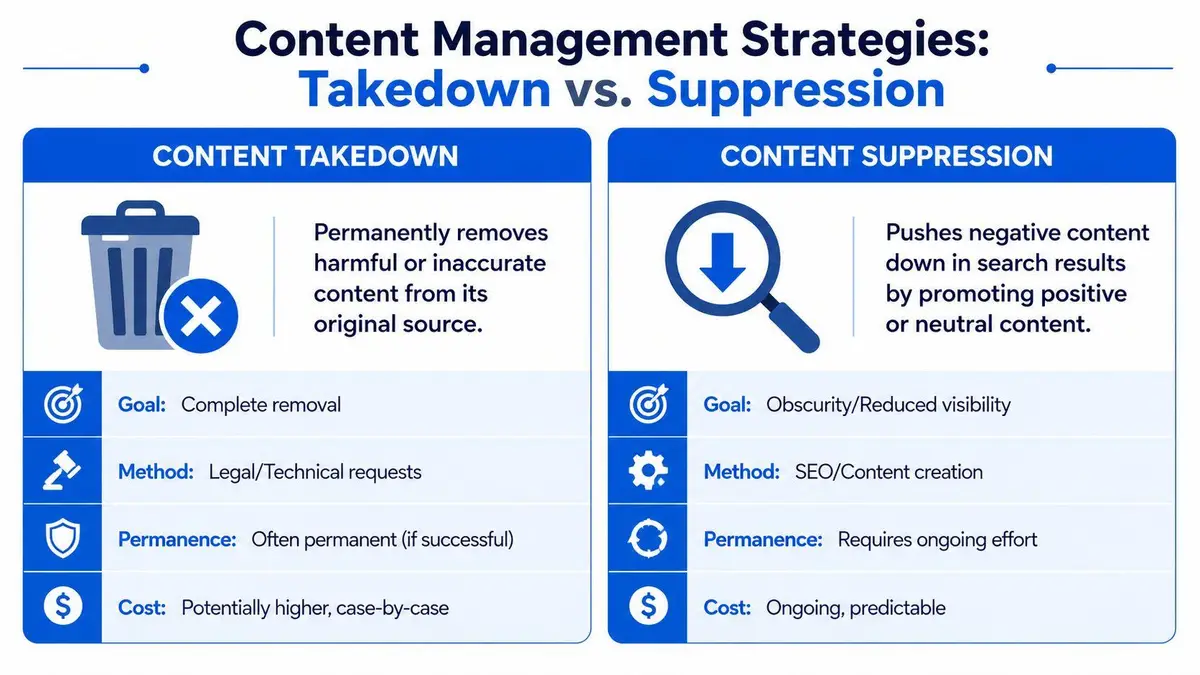
Most buyers waste money because they don’t separate takedown from suppression. These are not interchangeable services.
Use this comparison as your baseline.
Two different strategies
Suppression tries to outrank the harmful material. A firm creates or promotes favorable assets so the negative result slides lower in search. Sometimes that’s sensible. If an old, accurate but unflattering article appears on page one, suppression may reduce visibility enough to solve the business problem.
Takedown targets the source itself. The work usually involves platform policy arguments, legal notice procedures, privacy claims, impersonation reporting, de-indexing requests, or technical escalation paths. If the issue is false, invasive, stolen, or unlawful, takedown is usually the only strategy worth paying for.
Here’s the plain analogy. Suppression is putting a large painting in front of a cracked wall. Takedown is repairing the wall.
Where suppression fails
Suppression is weak when the content is severe, visual, easily copied, or fed into AI systems. If private images, fabricated accusations, or impersonation pages remain live, they can continue to spread even if one search result drops. The source still exists. Screenshots still circulate. AI systems may still absorb it.
Many “near me” providers lack the necessary toolkit. According to Percepture, 70% of inquiries to reputation management firms now involve AI-generated harm, yet most local providers lack proven strategies to audit and correct inaccurate AI Overviews, as explained in Percepture’s analysis of reputation management firms and AI-generated harm.
That shift matters because AI doesn’t just rank pages. It synthesizes narratives. If the source data is wrong, burying one URL may leave the synthetic summary untouched.
A short explainer helps if you need to hear the distinction in plain language.
Questions that expose real capability
When you interview a firm, don’t ask whether they “do ORM.” Ask this instead:
- What can you remove from the source: Ask for examples by content type, such as reviews, images, impersonation profiles, articles, and search results.
- When do you recommend suppression instead: A serious operator won’t sell takedown for every matter. They’ll define where suppression still makes sense.
- How do you handle AI-generated summaries: If they stare blankly or reduce it to ordinary SEO, they’re behind the market.
- What happens after removal: Re-upload prevention, monitoring, and follow-on requests matter because copied content often resurfaces.
One factual option in this market is ContentRemoval.com, which focuses on source removal, de-indexing, impersonation takedowns, false review removal, and leaked image or video removal for individuals and brands. That’s a different service category from local review-response agencies.
Vetting Credentials Confidentiality and Legal Standing
A polished website proves almost nothing. In this field, process matters more than presentation. You’re entrusting a firm with evidence, strategy, private facts, and sometimes the existence of the matter itself.

Questions that reveal substance
Start with methodology. Ask the firm to explain, in plain English, how it approaches your specific category of harm. You don’t need trade secrets. You do need clarity.
Use a checklist like this in the first call:
- Ask about platform procedure: Which reporting routes, legal notices, and escalation channels apply to your issue?
- Ask who handles legal analysis: Is there real legal review involved where needed, or is every matter pushed through a generic support queue?
- Ask how evidence is preserved: They should care about screenshots, metadata, account records, and chronology.
- Ask about cross-border issues: Harmful content often sits on hosts or sites outside your home jurisdiction. They should be able to discuss that calmly.
A firm that cannot explain its process without hiding behind “proprietary methods” is asking you to buy mystery, not expertise.
Confidentiality is not optional
High-value clients need to pay attention to operational discretion, not just legal language. Ask how the firm handles intake, document storage, communications, and who inside the organization gets access to your matter.
Look for these controls:
| Area | What you want to hear |
|---|---|
| Intake | Limited-information first step, secure transfer of evidence |
| Communications | Encrypted or otherwise secure channels, not casual email chains for sensitive files |
| Staffing | Need-to-know access, designated case lead |
| Contracts | NDA availability and confidentiality obligations stated clearly |
| Reporting | Private reporting that doesn’t expose strategy in shared dashboards |
If a provider casually asks you to text screenshots, forward inflammatory links through ordinary email without caution, or upload intimate material through an unprotected form, stop the conversation.
Legal standing and transparency
Not every good firm is a law firm. But any firm handling takedowns needs legal literacy and procedural fluency. It must understand how platforms evaluate notices, what standards apply, and where factual certainty matters.
A useful benchmark comes from platform governance guidance. As a best practice for transparency, Online Service Providers should publish whether a content takedown decision was automatic or subject to human review, as discussed by the Harvard Cyberlaw Clinic on best practices for online content removal requests. Your firm should know how to manage those adjudication paths and explain what kind of review a request is likely to receive.
Red flags are easy to spot if you’re disciplined:
- Guaranteed removal promises: Nobody credible can guarantee every platform outcome.
- Refusal to define scope: If they can’t describe the target assets and intended actions, you can’t measure performance.
- No mention of confidentiality: That alone disqualifies them for sensitive matters.
- Aggressive pressure to sign immediately: Urgency is real. Manufactured urgency is salesmanship.
Decoding Proposals Pricing Timelines and Contracts
A weak proposal creates a second problem. The first problem is the harmful content. The second is paying the wrong firm to do the wrong work for six months.
Read every proposal the way you would read outside counsel terms during an active dispute. Strip out the sales language. Focus on scope, decision points, reporting, approval rights, and the exact remedy being purchased. High-stakes clients get into trouble here because many firms package review response, SEO publishing, and actual takedown work under the same label. Those are different services with different costs, different timelines, and different odds of success.
Why specialist work is priced higher
Content removal work costs more because it is narrower, harder, and less forgiving than generic reputation management. A local agency can post content, answer reviews, and improve branded search results. A specialist firm must assess platform rules, prepare notices that survive scrutiny, track re-uploads, coordinate legal and technical steps, and avoid making the material more visible in the process.
Cheap proposals usually hide one of three things. Minimal action. Vague scope. Or a quiet switch from removal to suppression after you sign.
Common pricing models
Three pricing structures appear most often.
| Model | Best use case | What to test before signing |
|---|---|---|
| Project fee | A defined removal matter with a known set of URLs, accounts, posts, or images | The proposal should list the targets with precision |
| Monthly retainer | Ongoing monitoring, repeat attacks, executive exposure, or a multi-platform issue | The contract should state what work happens each month, not just “support” |
| Hybrid structure | An initial takedown campaign followed by monitoring or search suppression | Approval points between phases must be explicit |
Project fees work when the target set is stable. A false profile network, a batch of review fraud, or a specific article can fit this model. Retainers fit problems that mutate, spread across platforms, or involve repeated postings by the same actor.
If you want a cleaner framework before comparing bids, review this strategic guide to reputation management pricing for executives and founders.
Timelines need hard definitions
Do not accept “ASAP,” “immediate action,” or “results in weeks.” Those phrases protect the vendor, not you.
Get five points in writing:
- Start date: The day work begins after payment, intake, and document receipt
- First action window: The deadline for initial notices, reports, preservation steps, or escalation filings
- Update schedule: The exact reporting cadence, such as twice weekly or every Friday
- Outcome definition: Source removal, de-indexing, account suspension, review deletion, suppression, or monitoring
- Matter close date: The event that ends the engagement, or the rule for extending it
If the proposal cannot define success in plain terms, it cannot be priced intelligently.
Clauses that deserve scrutiny
Scope comes first. The contract should identify the content types, platforms, accounts, URLs, and search terms at issue. If the matter is still developing, the agreement should explain how newly discovered assets are added and priced.
Approval rights come next. You should know which actions require your sign-off, especially if the firm may contact platforms, publishers, hosts, or opposing parties in your name. Silence on that point creates risk.
Termination language matters more than clients expect. You need a clear right to exit for inactivity, scope drift, or failure to report. You also need your work product back, including evidence logs, submission records, draft notices, and platform correspondence where permitted.
Watch for substitution clauses. Some firms reserve the right to replace removal efforts with suppression work once resistance appears. That is acceptable only if you approve the change. If you hired a firm for takedown strategy, the contract should not convert into an SEO content program because removal proved harder than the sales team suggested.
Confidentiality must survive the engagement. So must conflict checks, data handling terms, and restrictions on using your matter as an anonymous case study. High-value clients should insist on that language before funds go out.
Engaging a Firm for Your Confidential Assessment
By now the key point should be obvious. Reputation management near me is often the wrong search because it asks the wrong question. The right question is this: who can solve the exact digital harm in front of me, discreetly and lawfully, with a process that matches the stakes?
If your issue is ordinary review friction, a competent local agency may be enough. If it involves defamation, impersonation, leaked private material, false reviews designed to damage a brand, AI-generated misinformation, or exposed personal data, you need a specialist assessment. Not a sales call. Not a free branding brainstorm. An assessment.
Bring order to that consultation. Provide the evidence file, timeline, target platforms, known actors, and any prior reporting history. Ask for a preliminary strategy that distinguishes source removal, de-indexing, suppression, monitoring, and re-upload prevention. Ask what must happen first and what can wait. The right firm will reduce ambiguity quickly.
Delay is expensive in reputation matters because harmful content spreads, gets copied, and settles into search behavior. Fast action doesn’t mean reckless action. It means precise action taken while the evidence is intact and the procedural paths are still clean.
Your objective isn’t to feel reassured. Your objective is to get the problem off the internet, out of search, or under control with the least possible collateral damage. That starts with a confidential assessment conducted by people who understand takedowns, not just reviews.
If you need that assessment, ContentRemoval.com handles confidential online reputation and content removal matters for executives, public figures, family offices, and legal professionals. The sensible next step is to submit the facts privately, preserve the evidence, and get a case-specific action plan before the situation spreads further.
Frequently asked questions
Does it matter if my reputation management company is local?
For ordinary review friction, a competent local agency may be enough. For defamation, doxxing, impersonation, leaked images or search contamination, geography is almost irrelevant because platforms operate globally and harmful sites are often hosted elsewhere. Search by capability, such as defamation content removal firm or NCII removal, rather than by city.
What questions should I ask a reputation management firm before hiring?
Ask what they can remove from the source by content type, when they would recommend suppression instead, how they handle AI-generated summaries, and what happens after removal to prevent reuploads. Then ask about platform procedure, legal review, evidence preservation, cross-border handling and confidentiality controls for intake and storage.
What should be in a reputation management contract?
A precise list of target content, platforms, URLs and search terms, plus a rule for adding newly discovered items. Get a start date, first action window, reporting cadence, outcome definition and close date in writing, along with approval rights over who is contacted in your name and a right to exit for inactivity or scope drift.