
Removing personal information from the internet means attacking three repositories: search engines through de-indexing, data brokers through automated opt-outs, and platforms through their own reporting channels. De-indexing hides the path; source removal deletes the data at the host. Legal levers such as DMCA notices, defamation and privacy torts, and GDPR or CCPA erasure requests compel removal when requests are ignored.
Key facts
- A DMCA notice sent to the hosting provider can remove stolen photos far faster than engaging the poster.
- Public disclosure of private facts covers offensive, non-newsworthy material such as medical or financial records.
- California’s Delete Act creates a one-request system covering more than 500 registered data brokers.
- Data absorbed into AI training sets cannot be recalled, so source data must be scrubbed beforehand.
Where ContentRemoval.com comes in. ContentRemoval.com combines automated broker removal at scale with the case-managed work that tools cannot do: publisher negotiation, DMCA and privacy notices, platform escalation through trust and safety teams, and dark web monitoring for credential leaks. Executives and their counsel are the usual point of contact, often after a coordinated attack or impersonation has started. A free 15-minute Exposure Scan maps your exposure and what is removable, and the report is yours to keep. Get a Free, Confidential Exposure Scan or read how our personal data removal work is done.
To effectively remove your personal information from the internet, you cannot rely on sporadic takedown requests. This requires a deliberate, sustained strategy to dismantle your public digital footprint. The process involves targeting search engines for de-indexing, confronting data brokers to eliminate the source of information, and addressing individual platforms hosting outdated or harmful content. This methodical approach is necessary because isolated requests are ineffective against the automated systems that continuously scrape and republish data.
Your Digital Footprint Is a Corporate Liability
For an executive or individual of significant means, publicly available information is not a minor privacy issue; it is a direct, measurable corporate liability. Every data point, from a home address listed on a people-search site to an old forum comment, represents a potential vulnerability for malicious actors. These are not hypothetical risks; they are the precise elements used to launch sophisticated spear-phishing attacks, impersonate executives, and orchestrate reputational attacks designed to disrupt stock prices or derail mergers.
The primary danger lies in the aggregation of scattered information. A single detail may seem innocuous, but when aggregated, these data points can form a detailed profile of your life, creating a substantial attack surface. Malicious actors weaponize this information to craft convincing phishing emails that bypass standard corporate security, socially engineer your employees or family, identify your daily routines to create physical security threats, and distort old associations to ignite a public relations crisis.
The Fallacy of Digital Anonymity
For anyone in a public-facing role, true online anonymity is unattainable. The practical objective is control. This means systematically removing public intelligence that can be weaponized against you, your family, or your business. Such a task demands a proactive, operational mindset focused on continuous risk mitigation, not passive hope for privacy.
An uncontrolled digital footprint is an open invitation for legal, financial, and reputational challenges. It provides the ammunition for everything from frivolous lawsuits to meticulously planned corporate espionage. Controlling this exposure is a fundamental aspect of modern asset protection.
A crucial first step in understanding and reducing your exposure is to examine how your information is disseminated. Reviewing an organization’s Privacy Policy reveals the mechanisms by which your data is collected and shared, exposing the foundation of your online footprint.
For those requiring a professional-grade solution, our firm provides comprehensive digital footprint cleanup services. This is not a simple checklist but a strategic plan for high-stakes scenarios where online information has severe real-world consequences.
Focusing Takedown Efforts for Maximum Impact
When your personal information is exposed, a successful takedown strategy must be precise. You must target the three main repositories of your data: search engines, social media, and data brokers. Each requires a distinct approach; confusing them is a critical error that wastes time and prolongs your exposure.
The process follows a clear path: exposed data creates a threat (e.g., harassment, identity theft), which evolves into a tangible liability.
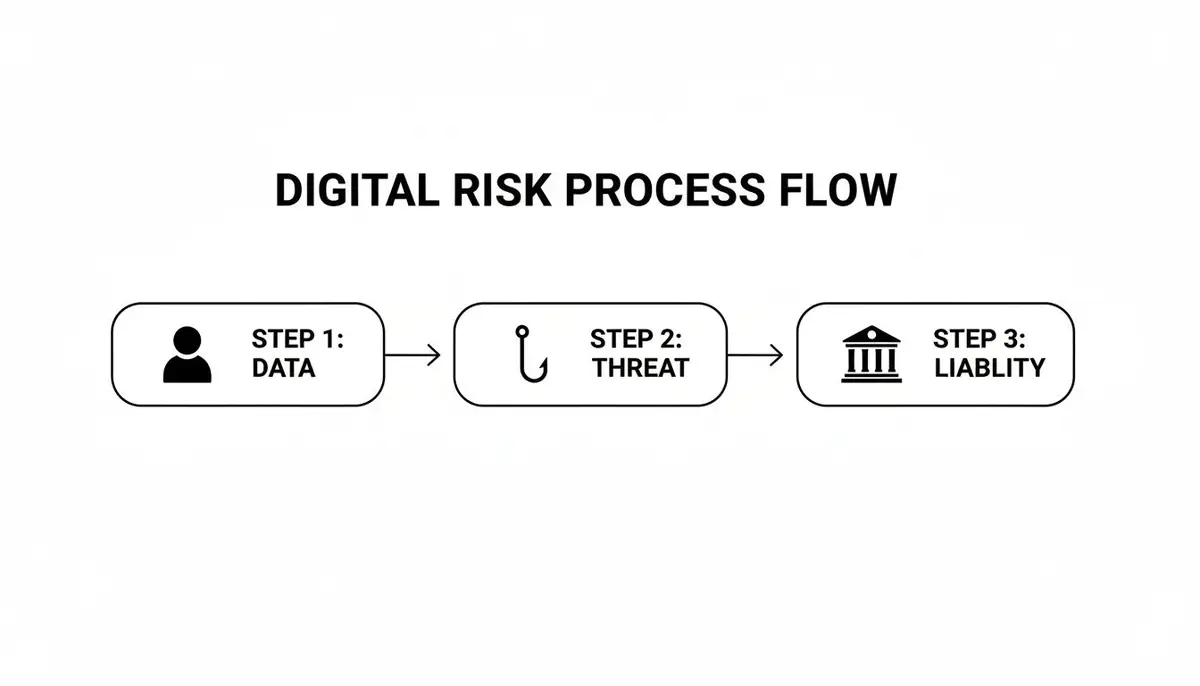
This demonstrates why targeting the source of the data is paramount. Failing to do so means you are merely treating symptoms, not eliminating the cause.
The Battle on the Search Engine Front
A common and dangerous mistake is focusing all efforts on Google, assuming that if content disappears from search results, it is gone permanently. Removing a link from Google’s index is known as de-indexing. While it is a crucial initial step, it only hides the path to the information. The content remains live on the original website, accessible via a direct link or other search engines.
True success is achieved through source removal: the permanent deletion of the information from the host server. This is the only way to ensure the data cannot be re-indexed by Google or discovered through other search engines or direct links.
Achieving source removal is the substantive work. It may involve negotiation with a website administrator, identification of a terms of service violation, or the application of legal pressure based on defamation or privacy statutes. Our guide on how to remove yourself from Google details this dual strategy, as selecting the correct tactic for a given situation is determinative of the outcome.
Tackling Social Media and Platform-Specific Vulnerabilities
Social media platforms are fraught with data leaks, fraudulent accounts, and reputational attacks. Simply adjusting privacy settings is insufficient once damage has occurred. Each platform has its own rules and specific channels for reporting violations; success depends on mastering their distinct procedures.
For instance, removing an impersonation account on Instagram involves a different process than removing stolen intellectual property from a file-sharing site. This is consistently demonstrated in platform-specific engagements, such as various Tiktok information removal projects. A one-size-fits-all approach is never effective. In practice, removing impersonation accounts requires proof of identity and evidence of deceptive intent, directed to the platform’s security team. Removing leaked content often necessitates filing a copyright claim (e.g., a DMCA notice) or demonstrating a severe privacy breach. Addressing harassment depends on meticulously documenting the abuse to build a clear record of behavior that violates the platform’s community standards.
The Futility of Manual War Against Data Brokers
Data brokers represent the most challenging aspect of this effort. These entities exist solely to scrape, package, and sell your personal information. Attempting to manually opt out of their databases is a strategic error. For every record you successfully remove, their automated systems will find and republish your data, often within weeks. This manual approach is akin to bringing a letter opener to a robotic battle.
The only effective countermeasure is persistent, automated monitoring and removal. This requires specialized systems that continuously scan hundreds of these sites, identify your profile, and execute opt-out requests automatically and at scale.
Data validates the scale of this problem. According to recent YouGov data privacy research, while 81% of adults worry about who has their data, a mere 6% have used a service to remove it. A significant knowledge gap exists, as only 42% are even aware that professional data removal services exist.
Applying Legal Leverage to Compel Removal
When initial takedown requests are ignored, escalating to legal pressure is often the only way to compel a website owner or platform to act. This does not necessitate immediate litigation. Instead, it involves the strategic application of legal instruments to force compliance.

Knowing which legal lever to pull, and when, separates a successful removal from a frustrating dead end. These strategies apply pressure methodically, escalating as needed to achieve the desired result.
Using Copyright Law for Tactical Removals
If your original photos, videos, or written works are used without permission, the Digital Millennium Copyright Act (DMCA) is a potent tool. A DMCA takedown notice is not a request; it is a legal directive. A properly drafted notice compels the hosting provider to remove the infringing material or face liability themselves. This approach targets the platform’s self-interest, as companies like GoDaddy, Cloudflare, or Amazon Web Services will almost always choose to remove the content rather than risk a lawsuit over a user’s post.
A well-crafted cease-and-desist letter, citing specific statutes and the sender’s clear intent to litigate, is often sufficient to secure removal without ever filing a lawsuit. It demonstrates that you have the resources and resolve to escalate, forcing a cost-benefit analysis that favors compliance.
For example, a client’s family photos were used across a defamatory blog. Instead of engaging the anonymous blogger, we sent a formal DMCA notice directly to the site’s hosting company. The photos were removed within 48 hours. The process was swift and conclusive.
Defamation and Privacy Torts
When the issue is not stolen content but false and damaging statements, defamation law applies. This is more complex than a copyright claim, generally requiring proof that a statement is false, was published to a third party, and caused reputational harm. Online defamation typically takes the form of libel (written) or, less commonly, slander (spoken).
Another powerful legal tool is the invasion of privacy tort, specifically the “public disclosure of private facts.” This applies when genuinely private, non-newsworthy information, which a reasonable person would find highly offensive, is published. Examples include the non-consensual sharing of private medical records or personal financial statements.
Navigating Data Privacy Regulations
Major privacy laws like Europe’s GDPR and the California Consumer Privacy Act (CCPA) grant individuals significant control over their data. These regulations include a “right to erasure” (or “right to be forgotten”), allowing you to demand that companies delete your personal information under specific conditions. We have previously detailed the process for a successful GDPR content removal campaign.
The legal landscape is shifting in favor of individual privacy. A significant development is California’s Delete Act, effective in 2026. This law will create a streamlined, one-click system for consumers to instruct over 500 data brokers to delete their entire digital footprint. A brief overview of the upcoming Delete Act is available from the California Privacy Protection Agency. These regulations are particularly effective against data brokers and commercial entities, as the penalties for non-compliance are substantial. Leveraging these laws is an essential component of any serious effort to remove personal information from the internet.
To clarify these options, the following table outlines the primary legal strategies for compelling content removal.
Legal Remediation Pathways For Content Removal
| Legal Basis | Primary Application | Key Requirement | Typical Target |
|---|---|---|---|
| Copyright (DMCA) | Unauthorized use of your original photos, videos, or text. | Proof of ownership of the original content. | Hosting providers, social media platforms, search engines. |
| Defamation (Libel) | False statements of fact that harm your reputation. | Proving the statement is false and has caused damage. | The original publisher, website owner, or platform. |
| Invasion of Privacy | Public disclosure of highly offensive, private information. | The information must be genuinely private and not newsworthy. | The publisher, blogs, and forums. |
| Data Privacy Laws (GDPR, CCPA) | Removal of personal data held by organizations. | You must be a resident of the relevant jurisdiction (e.g., EU for GDPR). | Data brokers, businesses, marketing companies. |
Each pathway is designed for a specific type of problem. Selecting the correct one is crucial for achieving fast, effective results.
Defending Against Advanced and AI-Driven Threats
Traditional methods to remove personal information from the internet are becoming obsolete. We now face threats driven by generative AI, deepfakes, and automated tools that exploit the dark web. Every piece of your publicly available data, from old forum posts to social media profiles, is now raw material for these sophisticated systems, creating threats far more complex than a negative review.
Your data is being harvested to train AI models that generate realistic misinformation, fabricate defamatory content, or create non-consensual intimate imagery (NCII). Against an algorithm, conventional removal tactics are insufficient.

The AI Data Harvesting Problem
Generative AI models learn by scraping colossal amounts of data from the public internet, absorbing comments, articles, and professional profiles. Despite developers’ claims of data filtering, a vast amount of personal information is inevitably integrated into the AI’s training data.
This leads to two primary risks. First, the model may directly regurgitate your personal information in response to a query. Second, and more insidiously, malicious actors can use these tools to generate entirely new, false, and damaging content by feeding the AI a few real details to invent a plausible but fabricated narrative.
Once your data is absorbed into an AI model, it is virtually impossible to extract. You cannot send a takedown notice to an algorithm’s memory. The only viable strategy is to aggressively scrub the source data from the public internet before it is scraped and used for training.
The Rise of Malicious AI and Deepfakes
The threat is amplified by deepfakes and other synthetic media. Creating a convincing video of an executive making an inflammatory statement no longer requires a Hollywood budget.
The existence of publicly available photos and videos provides the exact fuel needed to create a high-fidelity deepfake. Each image serves as a training reference point, allowing AI to build a digital puppet that can be manipulated to say or do anything.
This is a present-day reality. Reputation attacks are being automated and scaled in unprecedented ways. It is no surprise that generative AI data leaks have become a top security concern for a growing number of organizations. As these concerns mount, removing source data has become a critical security measure.
Countering Dark Web and Decentralized Threats
When a company you use suffers a data breach, your credentials and other personal identifiers often end up for sale on the dark web. This information is a goldmine for identity thieves, blackmailers, and those planning physical threats. In this environment, takedown notices are useless; you cannot serve a legal letter to an anonymous administrator of an illicit forum.
The only effective defense is proactive, continuous dark web monitoring. This requires specialized tools and human intelligence analysts who constantly scan these marketplaces for your name, email addresses, passwords, and other identifiers. A match serves as an early warning system, allowing you to change compromised passwords, place fraud alerts on your credit files, and formulate a defense. Without this intelligence, you are vulnerable until the damage is done. Stopping these advanced threats requires an aggressive defense that combines source data removal with constant monitoring.
Knowing When to Engage a Specialist Firm
The impulse to handle a digital attack personally is understandable. However, a DIY approach can exacerbate the situation. Attempting to negotiate with anonymous actors or filing an incorrect legal notice can make matters worse by inadvertently confirming your identity, revealing your strategy, or even forfeiting legal rights.
The line is crossed when the problem moves beyond a simple takedown request. If an attack is coordinated, technically sophisticated, or legally complex, it is time to engage expert assistance.
Red Flags That Mandate Expert Intervention
Certain situations are too severe to manage alone. These are not minor privacy leaks but calculated attacks designed for maximum damage, requiring a professional-grade response. Recognizing these red flags early can prevent a manageable issue from escalating into a full-blown crisis.
You must engage specialists for situations involving:
- Coordinated Defamation Campaigns: This is not a single negative review but a multi-front assault involving dozens of fake accounts, purpose-built defamatory websites, and a synchronized effort to suppress positive search results. Attempting to counter this alone is futile.
- Persistent Impersonation: If someone is actively impersonating you online to defraud business partners or systematically destroy your reputation, standard platform reporting is insufficient. Experts possess established relationships with platform administrators that can bypass standard queues and expedite resolution.
- Dark Web Exposure: Discovering your credentials or financial data for sale on dark web marketplaces is a grave threat. This requires specialized monitoring tools and human intelligence analysts who can navigate these hidden environments and provide the necessary early warnings.
These are not problems that can be solved with a few clicks. They demand a level of experience and resources that an individual cannot command.
The Function of a Specialist Firm
A professional content removal firm offers more than just manpower; it provides the right people with the right tools and connections, honed over thousands of real-world cases.
The real value of a professional firm isn’t just getting content removed. It’s the strategy, the speed, and the ability to see three steps ahead of your attackers. You’re investing in peace of mind when the stakes are highest.
This is what that entails in practice.
Proprietary Technology and Automated Systems
Manually removing data from hundreds of data broker sites is a losing battle. Professionals employ proprietary software that operates 24/7, continuously scanning for your information and executing removal requests at a scale no individual can match. This relentless automation is the only way to defeat the bots that constantly repopulate your data.
Established Platform Relationships
Top-tier firms have direct lines to the legal, security, and policy teams at major platforms like Google and Meta. These are not generic email addresses but trusted backchannels that allow for urgent case escalation. This access can reduce resolution time from weeks to hours.
Integrated Legal Expertise
The most effective removal strategies merge technical action with legal force. A reputable firm has an in-house legal team or works in lockstep with one, prepared to deploy everything from cease-and-desist letters to court orders. This integrates legal pressure into the strategy from the outset, compelling action when simple requests are ignored, such as when dealing with old comments posted as a minor that a platform refuses to address without a court order to force their hand.
Continuous Monitoring and Rapid Response
Content removal is only half the task; ensuring it stays down is the objective. Professional firms use sophisticated monitoring systems that constantly scan the web for your name or other keywords. If a threat reappears or a new one emerges, you receive an immediate alert. This defensive shield enables a rapid counter-attack, neutralizing problems before they gain traction and providing long-term protection.
Your Questions, Answered
During a crisis, you require direct answers. Here are responses to the most common questions we receive from clients.
How Long Does It Take to Remove My Information From the Internet?
The timeline depends entirely on the location and nature of the information. De-indexing a link from Google search results can sometimes be accomplished in a few days or weeks, but this only hides the problem.
Lasting success requires source removal: deleting the data from the host website. A comprehensive campaign to scrub your information from hundreds of data brokers and other online archives is a long-term project. We typically initiate action within 24-48 hours, but a deep-level cleanup that provides true protection is an endeavor that takes several months of persistent work.
Is It Possible to Be Completely Anonymous Online?
For any individual with a professional or public life, complete online anonymity is not a realistic goal and can be counterproductive. The objective is not invisibility; it is control.
Our focus is to dramatically reduce your “attack surface” by tracking down and removing non-essential, outdated, and potentially damaging information.
The aim is to make it exceptionally difficult and resource-intensive for any adversary to build an actionable profile on you. This is a continuous process of risk management and threat suppression, not a one-time erasure.
This strategy allows you to maintain your professional presence while hardening your digital footprint against exploitation. It is about controlling your narrative, not erasing it.
What Is the Difference Between De-Indexing and Source Removal?
This is a critical distinction at the core of any effective removal strategy.
- De-indexing instructs Google to hide a page from its search results. The page remains live on the original website, accessible to anyone with a direct link. It is a tactical, temporary measure.
- Source Removal means the information is permanently deleted from the host website. This is the only way to ensure it cannot be found or re-indexed by another search engine.
An intelligent strategy employs both. We often use de-indexing for immediate damage control while pursuing the more complex, permanent solution of source removal.
Can You Remove Negative News Articles or Court Records?
This is among the most difficult challenges in reputation management. Removing factually accurate articles from established news outlets or public court records is exceedingly difficult due to First Amendment protections and the public’s right to access information. Direct removal is rare and typically requires proving a significant factual error or obtaining a legal expungement of the record.
However, this does not leave you without options. While removal is unlikely, suppression is a powerful and effective alternative. By creating and promoting a portfolio of positive, authoritative content, we can systematically push negative items down in search results until they become practically invisible. For most observers, if content is not on the first page of Google, it effectively does not exist.
When you have exhausted DIY efforts or are facing a coordinated attack, you require specialists. The experts at ContentRemoval.com possess the technology, industry relationships, and legal acumen to intervene effectively when the stakes are high. Take the first step toward reclaiming your reputation and schedule a confidential assessment today at ContentRemoval.com.
Frequently asked questions
Why is manually opting out of data brokers a waste of time?
Because their automated systems find and republish your data, often within weeks of a removal. The article’s position is that only persistent, automated monitoring and removal across hundreds of sites keeps pace, and that manual effort is a strategic error for anyone with meaningful exposure.
Can I get my personal information out of an AI model?
No. Once data is absorbed into a model’s training set there is no takedown notice for its memory. The only viable defense is to scrub the source data from the public internet before it is scraped, and to monitor for AI-generated content or deepfakes that use your name or likeness.
What should I do if my details are for sale on the dark web?
Takedown notices are useless against anonymous marketplaces. The response is continuous dark web monitoring that flags your name, emails and passwords, so you can change compromised credentials, place fraud alerts on credit files and prepare a defense before the data is used.