
To remove personal information from Google, build an evidence file of exact URLs and screenshots, then use Google’s Results about you tool for exposed phone numbers and addresses, and the outdated content process for pages already changed. Escalate through doxxing, copyright or legal channels where the facts fit, and pursue source removal, because de-indexing alone leaves the page live.
Key facts
- Results about you launched in November 2022 and reviews specific URLs, not general complaints.
- Google’s doxxing policy requires exposed data paired with explicit or implicit threats of harm.
- Most successful Results about you removals involve phone numbers and physical addresses.
- Source removal decays search visibility naturally and makes future reposts easier to challenge.
Where ContentRemoval.com comes in. ContentRemoval.com is the escalation point when a Google form is not enough: exposure spread across several URLs and platforms, addresses or intimate material creating real-world risk, publishers built to stall, and smear campaigns that spawn new pages after every request, running search, source, legal and monitoring tracks together and reporting progress in writing. Physicians, litigators and executives reach us through an assistant or counsel. A free 15-minute Exposure Scan maps what is removable, and the report is yours to keep. Get a Free, Confidential Exposure Scan or read how our personal data removal work is done.
You search your name, your home address appears in a result snippet, and a second listing ties your phone number to relatives. For executives, founders, physicians, litigators, and public figures, that moment isn’t abstract. It changes how you think about travel, family safety, employee security, and exposure to harassment.
Individuals often make the same mistake next. They treat this as a single-task cleanup problem. It isn’t. If you want to remove personal information from Google, you need a hierarchy of action. First, identify exactly what’s exposed. Second, use Google’s own removal mechanisms where they fit. Third, go after the source. Fourth, escalate through legal and policy channels when the facts justify it. If the situation involves coordinated harassment, repeated reposting, extortion-style sites, or a meaningful reputational threat, stop improvising and move to a managed campaign.
That shift matters. De-indexing, source removal, suppression, monitoring, and legal positioning aren’t interchangeable. They solve different problems. A disciplined response starts with understanding which tool fits which risk.
A strong executive privacy strategy should be built like a control system, not a panic response. If you need a broader operating model for that, this strategic framework for protecting your online identity is a useful companion.
A Framework for Digital Sovereignty
The right way to think about exposed personal data is simple. Google is usually the visibility layer, not the origin layer. That means your strategy must separate appearance from existence. If a page disappears from search but remains live on the open web, your problem is reduced, not solved.
The Three-tier hierarchy
A practical framework has three tiers:
| Tier | Primary objective | Best use case | Limitation |
|---|---|---|---|
| Google tools | Reduce search visibility | PII in search results, outdated cache, eligible policy removals | Usually doesn’t remove the source page |
| Direct source action | Remove content at origin | Data broker pages, directories, forum posts, profile pages | Depends on webmaster or platform cooperation |
| Professional escalation | Force resolution and contain recurrence | Harassment, doxxing, false narratives, repeat uploads, hostile sites | Requires expertise, evidence discipline, and coordinated execution |
This is the hierarchy we use because it reflects how the internet works. Search engines index. Publishers host. Platforms moderate. Hosting providers enforce terms. Lawyers create pressure. Specialists coordinate all of it.
What clients usually misjudge
People often overestimate what a Google form can achieve and underestimate the value of documentation. They also waste time arguing morality with site operators who respond only to influence, policy, or legal exposure. That’s avoidable.
Practical rule: If the information creates a real-world safety, financial, or reputational risk, treat every hour as operationally important. Preserve evidence first. Remove second.
Digital sovereignty means regaining control over where your identity appears, who can associate it with your personal data, and how quickly harmful material can be neutralized when it surfaces. That control rarely comes from one form submission. It comes from sequence, pressure, and follow-through.
The Triage Phase Locating and Documenting Your Digital Footprint
Before you file anything, build an evidence file. If you skip this, you’ll submit weak requests, lose track of URLs, and fail to prove recurrence when content reappears under new pages.
Run a disciplined search audit
Start with Google Search, but don’t stop at a basic name query. Use variations of your name, former names, company affiliations, city-state combinations, phone number formats, home address fragments, and usernames. Search image results as well. Reverse image searches are useful when profile photos, family photos, or conference headshots have been copied into directories or forum posts.
Then review the categories that matter most:
- Direct identifiers: full name, phone numbers, residential addresses, email addresses, personal domains
- Associational data: spouse names, children’s names, LLC filings, board memberships, charitable affiliations
- Professional leakage: speaker bios, archived team pages, old press releases, event pages, PDF brochures
- Visual exposure: property photos, signatures, identification documents, badges, private social images

A proper audit also includes pages that don’t rank on page one. Lower-visibility pages can still be discovered through direct search queries, AI summaries, scraped databases, and people-search ecosystems. If you’re cleaning up a meaningful exposure issue, shallow searching is wasted effort.
For a more complete cleanup workflow, this guide to digital footprint cleanup is worth reviewing.
Build the dossier Google and counsel will need
Your dossier should be secure, timestamped, and structured. At minimum, include:
- Exact URL: Not the domain. The exact page.
- Search query used: What term surfaced the result.
- Screenshot evidence: Capture the result page and the underlying page.
- Date and time: Record when you observed it.
- Risk label: Identity theft, stalking risk, reputational harm, impersonation, doxxing, extortion, or obsolete content.
- Ownership status: Whether you control the page, partially control it, or have no control at all.
A short table helps keep the record usable:
| Field | Example of what to capture |
|---|---|
| URL | Exact page hosting the information |
| Search trigger | Name, phone number, address fragment, company title |
| Data exposed | Email, address, phone, signature, image, document |
| Context | Directory, forum, article, profile, cached page |
| Action path | Google request, webmaster request, legal review |
Why meticulous evidence changes outcomes
Google’s removal systems and legal takedown processes depend on precision. If you can’t identify the exact page, exact search appearance, and exact data exposed, your request becomes harder to evaluate. The same is true if you later need to show a pattern of harassment or repeated reposting.
Preserve the evidence before you contact anyone. Some operators alter the page after receiving a complaint, then claim the issue never existed.
That record also tells you where to spend effort. A stale cached result requires one playbook. A hostile complaint site requires another. A search result tied to a family member’s address requires a different level of urgency entirely.
First-Line Defense Leveraging Google’s Removal Tools
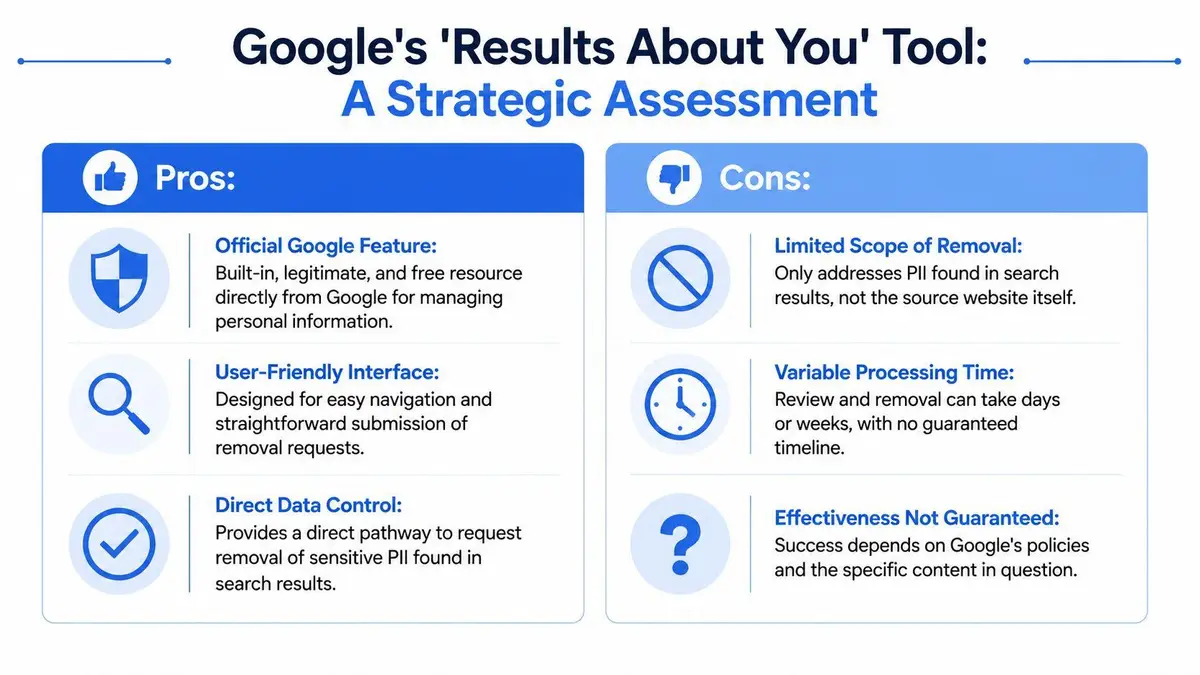
Google’s own tools are the fastest legitimate starting point for many privacy cases. They’re not a complete solution, but they can cut public visibility quickly when the content fits Google’s criteria.
What Google’s tools do well
The strongest first-line option is Results about you. Google formally launched it in November 2022, and by its first major public update in early 2023, Google reported over 1.5 million removal requests, with approximately 78% successfully processed for de-indexing. Google also stated that over 60% of successful removals were related to phone numbers and physical addresses in its Results about you overview.
That tells you something important. Google is relatively responsive when the issue is straightforward PII, especially contact information. If your problem is an exposed mobile number, residential address, or similar identifying detail in search results, use Google’s tool immediately.
What Google’s tools do poorly
Google reviews specific URLs, not your general complaint. That means broad statements like “my information is everywhere” won’t help. You need page-level evidence. It also means partial cleanup is common. One URL may be removed while five adjacent URLs remain live because they weren’t submitted.
Google also de-indexes from Search. In many situations, it doesn’t erase the material from the source website. If that source remains online, the content can still circulate through direct links, other search engines, archives, scrapers, and future reposts.
Here’s the practical assessment:
- Use Google first when the issue is exposed personal identifiers in search results.
- Use the outdated content process when the page has already changed or been removed but Google still shows stale results.
- Don’t expect Google to resolve defamation, context disputes, or reputation attacks unless they fit a specific policy or legal category.
If you need to clear stale search appearances after the source has changed, review this guide to the Google outdated content removal tool.
A useful way to understand why outcomes can vary is to look at how Google’s AI and human review work together in content moderation decisions. It helps explain why some requests are approved quickly while edge cases stall or fail.
This short walkthrough is useful if you want to see the process in action:
The right way to use Google’s tools
Don’t file casually. Submit only after your dossier is complete. Match each URL to the correct removal reason. Keep your explanation factual and restrained. Avoid emotional narratives. Google is evaluating policy fit, not sympathizing with your stress.
A good submission reads like evidence, not outrage.
If Google removes the result, treat that as tactical relief. Then decide whether the source itself also needs to come down. In serious matters, the answer is usually yes.
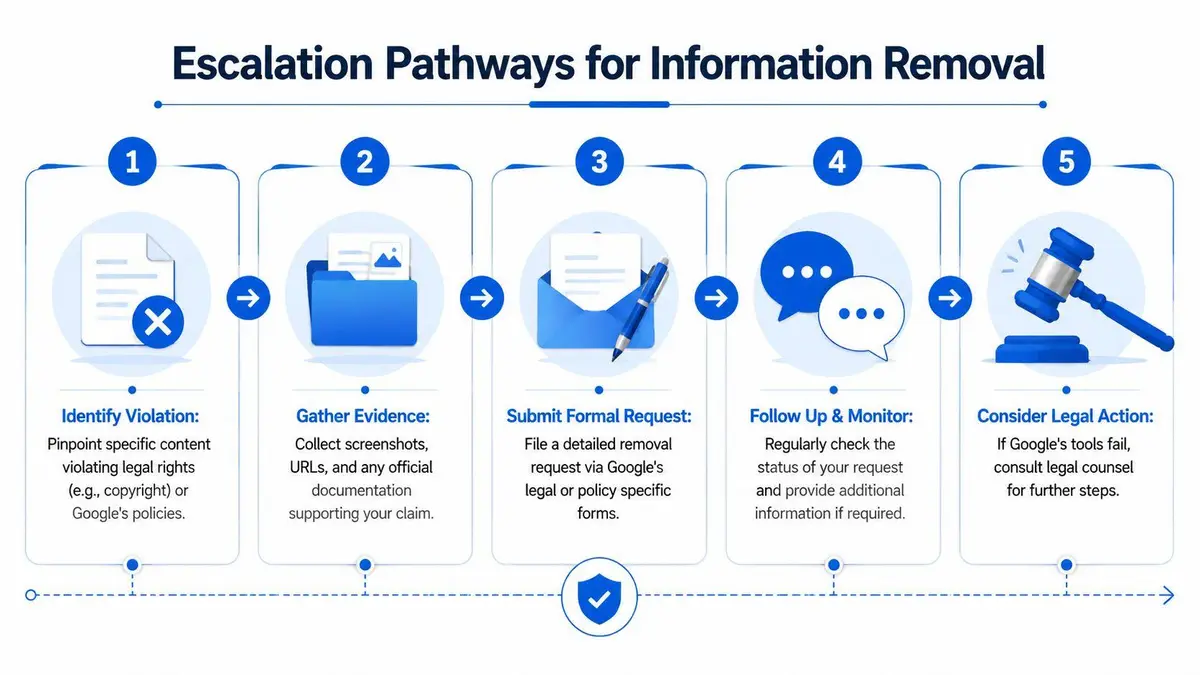
Escalation Pathways Legal and Policy-Based Takedowns
When standard privacy requests fail, the issue usually falls into one of three categories. The content violates a specific legal right, it triggers a defined Google policy, or it sits in a gray area where platform and publisher pressure must be combined.
Doxxing requests require more than exposed data
Google sharpened its doxxing policy in 2023. Under that update, the exposed personal information must be paired with explicit or implicit threats of harm. From mid-2023 through the end of 2024, Google processed over 85,000 doxxing-related removal requests, with 82% successfully removed from Search results, according to Google’s policy guidance on removing personally identifiable information and doxxing content.
That standard matters because many people use the word “doxxing” loosely. Google doesn’t. If a page publishes your address and phone number but there’s no threatening context, you may still have a privacy argument, but not necessarily a doxxing claim under that policy. Precision in categorization determines whether your request lands in the right lane.
Know which pathway matches the violation
Use this decision table:
| Situation | Best pathway | What you need |
|---|---|---|
| Stolen photo, copied article, unauthorized republication | DMCA-style copyright complaint | Proof of ownership and infringing URLs |
| Misuse of protected brand identifiers in a misleading way | Trademark complaint | Registration details or established rights, plus confusing use |
| PII paired with threats or harassment context | Doxxing report | Exact URLs, screenshots, context showing explicit or implicit threat |
| Court-ordered or legally adjudicated content issue | Legal removal channel | Court documentation and matching URLs |
Each route imposes a higher burden than a standard privacy request. That’s appropriate. You’re no longer asking Google to evaluate exposed contact information. You’re asking it to assess rights, policy triggers, or legal process.
Why weak escalation backfires
Poorly framed legal complaints waste time and can undercut credibility. A copyright notice that doesn’t establish ownership gets ignored. A trademark claim used to attack criticism instead of misuse often fails. A doxxing request without a threat component misses the policy threshold.
Use a simple internal checklist before filing:
- Can you tie the claim to a specific rule or right?
- Do you have documentary support, not just a strong objection?
- Are the URLs exact and complete?
- Would a neutral reviewer understand the violation from your evidence alone?
If your exposure touches regulated personal data, data retention, or regional privacy obligations, a broader compliance perspective can help. UTMStack’s GDPR compliance checklist is a practical reference for understanding how organizations think about personal data handling and removal obligations.
The stronger the claim, the less rhetoric you need. Facts, ownership, threat context, and page-level specificity do the work.
For high-profile clients, this is often where amateur cleanup stalls. The issue isn’t lack of concern. It’s lack of legal framing.
Source Removal Engaging Webmasters and Hosting Providers
If you want a durable result, remove the content from the source. Everything else is visibility management.
Why de-indexing alone is incomplete
A de-indexed page can still be shared privately, cited by other publishers, scraped into new databases, or rediscovered if it reappears on another URL. That’s why many “successful” Google removals don’t feel final. The page still exists. The operator still controls it. The risk still survives.
Source removal changes the equation because it attacks the origin. Once the content is gone from the page itself, search visibility usually decays naturally, stale results can be refreshed, and future replication becomes easier to challenge because you’ve established a prior removal history.
How to approach the publisher
Direct outreach works best when it’s brief, precise, and unemotional. Identify the page. Identify the data. State why it should be removed. Give a reasonable deadline. Preserve a record of the request.
A solid outreach sequence usually includes:
- Publisher contact first: site contact form, editorial email, privacy contact, abuse desk
- Domain ownership research: WHOIS records where available, or registrar and hosting clues
- Platform escalation: if the page sits on a forum, marketplace, CMS host, or social platform
- Hosting provider notice: when the publisher is unreachable, anonymous, or plainly abusive
The tone matters. If you sound erratic or threatening, you make resistance more likely. If you sound organized and prepared to escalate, many operators will comply readily.
Where self-help usually breaks down
DIY efforts often fail in three situations.
First, the site is built to monetize removal friction. The operator wants engagement, payment, or attention. Second, the site is offshore or intentionally opaque, with privacy-shielded registrations and no meaningful support path. Third, the material sits inside a broader smear campaign where new pages keep appearing after each request.
Those are not customer service problems. They are pressure-and-process problems.
Here’s the blunt rule. If the publisher is cooperative, you may solve it yourself. If the publisher is evasive, predatory, anonymous, or openly hostile, your approach needs to change. That can mean legal framing, host-level complaints, platform trust-and-safety escalation, search de-indexing in parallel, and monitoring for reposts.
A lot of clients resist this step because they assume contacting the webmaster should be easy. It often isn’t. The internet rewards anonymity and delay. Many high-risk pages remain online not because they are lawful or defensible, but because the target gives up after one unanswered email.
The Endgame Professional Intervention and Proactive Defense
On Monday, your home address appears in Google. By Friday, cached copies, screenshots, and copycat posts have spread far beyond the original page. At that stage, speed matters less than control. You need a removal plan that follows the right order and closes the source of the problem, not another round of isolated requests.
Professional intervention starts when the case stops behaving like a single takedown and starts acting like an active exposure.
Use a clear hierarchy. Start with Google’s free removal tools if the result fits Google policy and the immediate goal is to reduce visibility in search. Move to legal, policy, and platform channels if the facts involve impersonation, intimate content, clear privacy violations, or defamatory framing. Press for source removal when the page itself can continue to rank, get archived, or be reposted. Bring in a specialist when those tracks must run at once, or when the operator is built to stall, ignore, or exploit the process.
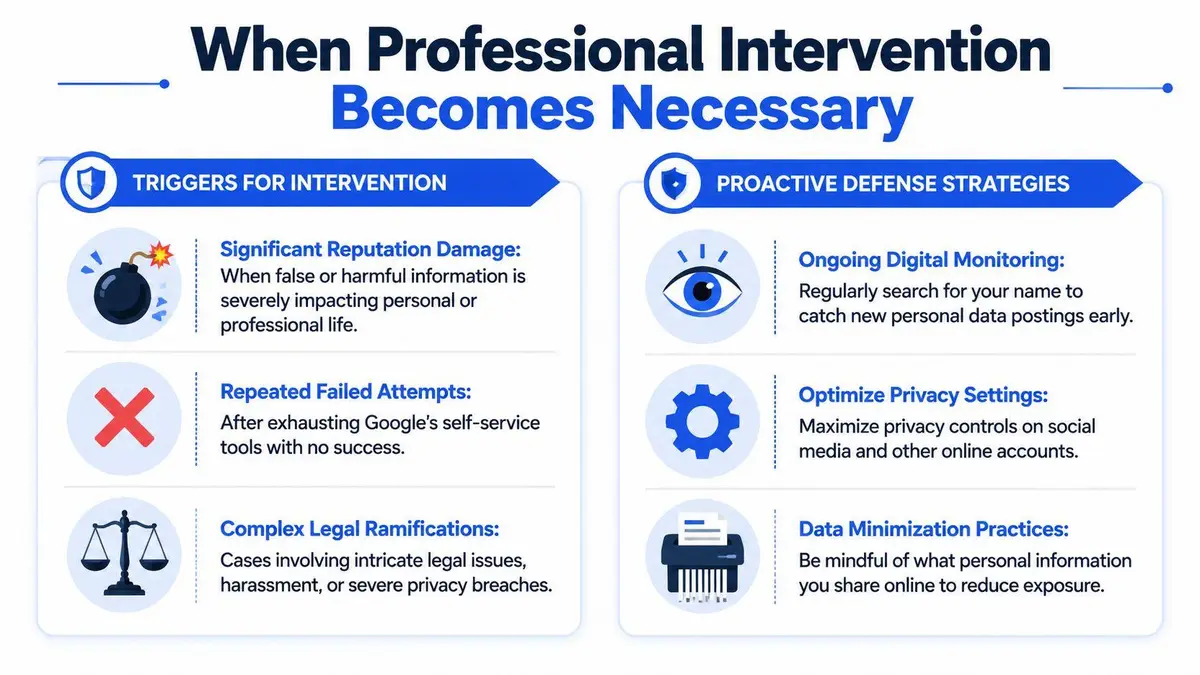
Clear triggers for escalation
Bring in a specialist when any of these conditions applies:
- The exposure is spreading across multiple surfaces: several URLs, several platforms, reposts, mirrors, or search results dominated by the same claim
- The information creates real-world risk: home addresses, private contact details, identity records, intimate material, or data assembled for intimidation
- The issue threatens professional standing: defamatory articles, impersonation, manipulated context, complaint-site attacks, or damage tied to employers, investors, clients, or public visibility
- The response burden is consuming time and judgment: evidence logs, removal requests, platform tickets, legal correspondence, and repeated follow-up with hostile or evasive operators
The mistake is treating every problem as a Google problem. Google can reduce discovery. It cannot force a publisher to remove material from the web. If the source stays live, copies keep appearing, or the content supports a broader harassment or smear effort, the job requires coordinated action across search, source, legal process, and monitoring. Services such as ContentRemoval.com handle those parallel workstreams in a structured way.
Proactive defense is what prevents a repeat
A successful removal is temporary if your own digital footprint still exposes data that can be scraped and reposted.
Audit every public asset you control. Review executive bios, speaker pages, old press releases, event listings, PDFs, image captions, company directories, and domain records. Remove any address, direct phone number, personal email, family reference, or signature block that serves no clear business purpose. Public information gets copied fastest when it is easy to harvest.
Then set up monitoring with enough specificity to catch the next exposure early. Track your name, aliases, common misspellings, image results, and combinations of your name with your city, employer, phone number, or address. Early detection gives you a better chance of stopping a page before it is indexed widely, duplicated, or attached to a broader narrative.
The endgame is sustained control over what can be found, copied, and weaponized about you.
Use that standard. Handle simple cases with Google’s free tools. Escalate to policy, legal, and source-level removal when the facts justify it. Bring in professionals when the issue touches safety, family privacy, coordinated harassment, or a reputation threat that will not be solved by one form and one email.
Frequently asked questions
Does Google’s Results about you tool delete my information from the website?
No. It de-indexes the specific URL from Google Search, and the material usually stays live on the source site, reachable through direct links, other search engines, archives and scrapers. Treat a Google removal as tactical relief, then decide whether the source page also needs to come down.
What counts as doxxing under Google’s policy?
Since Google’s 2023 update, exposed personal information has to be paired with an explicit or implicit threat of harm. A page listing your address and phone number without threatening context may still support a privacy request, but it does not meet the doxxing threshold, so choose the right lane.
What should I include when I ask a website to remove my personal details?
Identify the exact page and the exact data, state plainly why it should be removed, give a reasonable deadline and keep a record. Contact the publisher first, then research the domain owner, then escalate to the platform or hosting provider if the operator is unreachable or abusive. Keep the tone organized rather than threatening.