
Removing personal data from the internet for a high-net-worth individual starts with a confidential exposure map that separates passive broker data from active threat material, then runs a prioritized campaign: source removal first, search de-indexing second, platform enforcement in parallel, selective suppression, and verification. Monitoring covering names, family, emails and the dark web keeps the exposure from rebuilding.
Key facts
- Rank threats by how easily they enable impersonation, extortion or physical approach, not by embarrassment.
- Source removal comes first; de-indexing without removing the source lets material reappear.
- Automated opt-out tools struggle with offshore, evasive sites, leaked PDFs and republished background checks.
- Monitoring should cover name variants, legacy emails, family names, phone numbers and company links.
Where ContentRemoval.com comes in. ContentRemoval.com works with family offices, executives and their counsel on exactly this: the confidential exposure map, prioritized takedowns across brokers, hosts, platforms and search, leaked document and image containment, impersonation complaints and dark web monitoring, reported back in writing. The circle is kept small, usually the principal’s counsel, chief of staff or security advisor. A free 15-minute Exposure Scan maps what is exposed and what is removable, and the report is yours to keep. Get a Free, Confidential Exposure Scan or read how our content removal work is done.
You’re usually not looking for this issue in a calm moment. It tends to surface after something unsettling: an assistant gets a strange invoice email that uses your travel schedule, a family member is named in a phishing message, an old address appears in search, a gossip site republishes stale allegations, or counsel flags that your personal mobile and company entities are now trivially searchable together.
At that point, the question isn’t whether you can remove personal data from internet hnwi exposure on your own. The question is whether you can do it without creating more visibility, wasting time on low-value targets, or leaving the main threat untouched.
My advice is blunt. For a high-net-worth individual, digital privacy is not a cleanup exercise. It’s a risk control function tied to personal safety, family security, negotiation advantage, and reputation. The wrong data in the wrong place does more than embarrass you. It gives criminals, hostile litigants, extortionists, and opportunists a working file on how to approach you.
Your Digital Exposure Profile A Confidential Assessment
A wealthy client’s exposure almost never starts with one bad search result. It starts with linkage. A people-search listing connects to an old property record. That record ties to an LLC filing. The LLC filing links to a business website. The website confirms an executive role. Social posts reveal family names, routines, and travel. A breached email fills in the rest.
That is why a serious assessment doesn’t begin and end with Google. It begins with a confidential exposure map.

Globally, 38% of ultra-high-net-worth families and family businesses lack a cybersecurity plan, and cybercriminals use details from social posts, flight logs, WHOIS records, and reused passwords to build targeted attacks, according to RBC Wealth Management’s guidance for high-net-worth households. That figure matters because it tells you how often wealth exists without a corresponding privacy structure.
What a proper intake actually looks like
We start by separating exposure into distinct classes. That sounds procedural. It is. It also prevents expensive confusion.
Some data is passive exposure. Think Whitepages, Spokeo, BeenVerified, Intelius, old marketing databases, and stale directory copies. This material often fuels nuisance targeting, identity correlation, and convenience-level stalking.
Some data is active threat material. That includes breached credentials, forum mentions, dark web sale references, doxxing chatter, leaked files, impersonation profiles, and pages built to rank your name with defamatory or coercive content.
A professional assessment asks four questions:
- What exists
- Who can access it
- How it can be weaponized
- Which removal path has the greatest impact
That last question is where most DIY efforts fail. People attack what they can see. Professionals attack what creates the most risk.
Practical rule: Don’t rank threats by how offensive they feel. Rank them by how easily they enable impersonation, extortion, physical approach, or business pressure.
The threat matrix matters more than the search results
A proper HNWI review should identify at least these categories:
- Identity linkage points: full name variations, prior addresses, mobile numbers, personal and legacy emails, relatives, shell entities, trusts, and assistant contact details.
- Reputation-sensitive material: old allegations, complaint sites, forum threads, leaked images, cached biographies, and hostile commentary that can be reframed by search engines.
- Operational exposure: geotagged fitness data, travel clues, staff names, property visuals, domain ownership records, and luxury asset references.
- Breach and criminal exposure: credential leaks, dark web references, breach corpus indexing, and impersonation kits built from prior compromises.
The result isn’t a list. It’s a priority order.
Here’s the distinction I want you to keep in mind:
| Exposure type | Typical example | Strategic implication |
|---|---|---|
| Low-grade public data | Old address on a people-search site | Annoying on its own, dangerous when linked with other records |
| Search-amplified content | Gossip page or stale forum result | Shapes first impressions and gives attackers a narrative |
| Breach-linked data | Old email, reused username, leaked password | Enables account targeting and social engineering |
| Adversarial content | Doxxing thread, impersonation page, leaked file | Requires immediate containment and often legal escalation |
This is also where jurisdiction enters the conversation. If your assets, residency, or entities cross borders, the removal strategy has to account for the global data privacy landscape, not just one domestic platform policy. A request that is weak in one country may be strong in another under a different privacy or intermediary-liability framework.
For the public-data side of the problem, a useful starting reference is this people-search removal guide for private data protection. It’s useful because it frames people-search exposure as part of a broader attack surface, not a standalone irritation.
What clients usually miss
Clients often focus on what embarrasses them. Attackers focus on what helps them verify identity and establish trust. Those are not the same thing.
A family office principal may worry about an old article. A criminal may care far more about a child’s school reference in a gala photo caption, a domain registration that confirms a private email pattern, or a property-history site that aligns with a breached phone number.
The first job is not deletion. It’s understanding which pieces of information make the rest of your life easier to attack.
If you skip this assessment and start firing off opt-out forms, you’ll remove fragments while leaving the structure intact. That is wasted motion. A confidential assessment creates the blueprint. Without it, you’re reacting. With it, you’re running a campaign.
The Prioritized Takedown Campaign
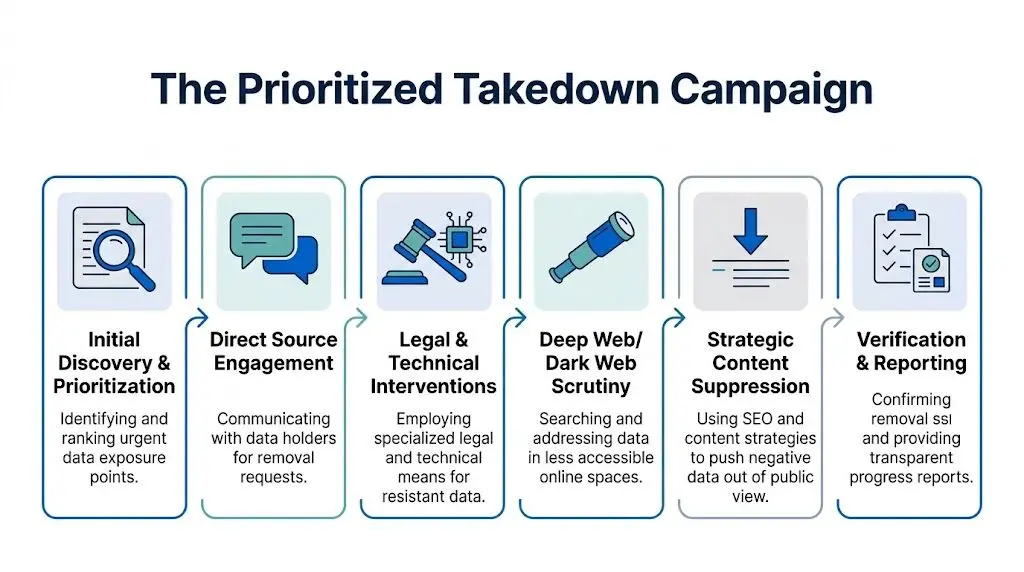
Once exposure is mapped, the work becomes operational. Sequence matters. If you de-index first and ignore source removal, the material often reappears. If you blast automated forms to every broker without checking identity requirements and duplication paths, you create noise and sometimes confirm fresh data to the wrong systems.
A takedown campaign should work like a supply-chain disruption. You cut the source, then remove visibility, then suppress residual references, then verify recurrence.
Why automation is not enough
The market is crowded with automated removal products. They have a role. For HNWI cases, they are rarely sufficient on their own.
A 2025 FTC study indicated that 60% of automated removal requests are ignored, compared to an 85% success rate for custom legal removals in major markets like the US and EU, especially for defamation or news suppression, as cited by AppleInsider’s analysis of internet data removal services. That gap is exactly what discerning clients pay to close.
If you want a useful non-promotional overview of the category itself, review how specialist data deletion services are described in practice. The key point isn’t convenience. It’s deciding which matters can be standardized and which require counsel-grade handling.
The correct order of operations
This isn’t a checklist you hand to an assistant. It’s a sequence designed to reduce reappearance.
- Source removal comes first. We target the original holder where possible: data brokers, directories, archived profile hosts, and databases syndicating your details.
- Search de-indexing follows. Once source action is underway, search engines are approached to remove the pointers that keep the material easy to find.
- Platform enforcement runs in parallel for abusive content. Impersonation, doxxing, leaked media, and policy-violating content often require direct platform reporting with a legal or evidentiary basis.
- Residual suppression is selective. You don’t suppress everything. You suppress what can’t be removed quickly enough and what causes meaningful reputational damage in the interim.
- Verification closes each loop. Every takedown has to be checked at source, in search, and in downstream copies.
The strategic logic is simple. Remove the fuel before you focus on the smoke.
Where manual work still wins
Automated forms can handle a slice of broker removals. They struggle when a site is offshore, non-responsive, lightly compliant, or intentionally evasive. They also struggle when the content category falls outside the normal broker model, such as leaked PDFs, forum reposts, republished background checks, or hybrid pages that mix public records with editorial framing.
That’s where a customized campaign matters.
- Direct broker and webmaster contact works when there is a clear privacy or policy basis and the site has established compliance channels.
- Rights-based requests under frameworks like GDPR and CCPA work when the facts and jurisdiction support them.
- Hosting-level pressure becomes relevant when a site refuses to engage but depends on infrastructure providers that won’t tolerate certain categories of abuse.
- Search-specific submissions are essential where the main harm is discoverability rather than the continued existence of a page.
A concise reference for the broker side is this executive privacy guide to removing yourself from data broker lists. It reflects the fact that broker removals only matter when they are tracked, repeated, and integrated into a broader campaign.
If a service promises one-click privacy for a visible executive, assume it will solve only the easiest part of the problem.
What persistence looks like in practice
The mistake I see most often is assuming a successful submission equals a durable outcome. It doesn’t. Data gets relisted, mirrored, cached, or republished by affiliates. A proper campaign keeps records of URLs, dates, identity variants, response posture, and reappearance patterns.
Here’s the operational difference between amateur and professional handling:
| Approach | What happens | Likely outcome |
|---|---|---|
| One-time opt-out blitz | Mass submissions without prioritization | Partial removals, weak documentation, frequent reappearance |
| Search-only cleanup | Results disappear while source stays live | Visibility drops briefly, then returns |
| Strategic campaign | Source removal, de-indexing, enforcement, verification | Lower attack surface and better long-term control |
The point isn’t to remove every trace of your existence. That is rarely possible. The point is to break the pathways attackers and hostile publishers use to assemble a usable profile. That requires patience, documentation, and the discipline to attack root sources first.
Advanced Remediation for High-Stakes Threats
Standard data scrubbing handles broker profiles and routine directories. It does not solve the difficult problems that keep HNWI clients awake. Those problems are usually adversarial. Someone wants an advantage, attention, revenge, clicks, or money.
That changes the method.

For complex HNWI cases, an advanced protocol is required. It starts with source removal from brokers with 80% success, followed by search engine de-indexing with 88% efficacy under GDPR and CCPA, and then hosting provider DMCA escalation that achieves 70% uptime disruption for non-compliant sites, according to World Protection Group’s framework for anonymous lifestyle protection. Those figures matter because they describe a tiered strategy, not a single magic lever.
Defamation and impersonation require evidence architecture
Most damaging content is not removable because you dislike it. It becomes removable when you can place it within a recognized framework: false statement, impersonation, privacy violation, intellectual-property misuse, platform manipulation, doxxing, or unlawful disclosure.
That means the case file matters as much as the complaint.
A proper defamation or impersonation response usually requires:
- Precise capture of the content before it changes
- Attribution analysis showing who published or amplified it, if available
- Policy mapping to the relevant platform or host rules
- Jurisdiction analysis to determine whether privacy law, intermediary rules, or court process allows for effective action
- Business-impact framing where reputational harm intersects with investor, board, lender, or customer exposure
This is why many wealthy clients waste time with generic PR before legal-tech remediation. PR can help shape narrative. It usually doesn’t remove the underlying material.
Leaked media and confidential documents are containment problems first
When intimate material, confidential board documents, internal emails, legal papers, passports, or family records surface online, speed matters more than elegance.
The first objective is containment. You identify the original post, copies, search indexing, mirrors, and file-hosting pathways. You then act against the highest-propagation nodes first.
That often means triage like this:
| Content type | Immediate objective | Typical response posture |
|---|---|---|
| Leaked images or video | Stop replication and indexing | Platform emergency channels, host notices, search removal |
| Confidential PDFs or contracts | Cut direct download access | Source complaint, host escalation, cache removal |
| Fake profiles or impersonation | Eliminate credibility fast | Platform identity reports, account tracing, linked content review |
| Old articles causing current damage | Reduce prominence or seek removal | Accuracy challenge, privacy arguments, suppression strategy |
A leaked file is rarely dangerous because one site hosts it. It’s dangerous because ten other sites can copy it before the first host replies.
News suppression is a legal and strategic exercise
Clients often ask whether a negative article can be “taken down.” Sometimes yes. Often no. The answer depends on the publisher, the accuracy of the reporting, the age of the content, whether the story remains newsworthy, and what legal hooks exist.
Here’s the direct view. News suppression is not the same as censorship. The legitimate grounds are usually narrower: factual inaccuracy, outdated context, privacy intrusion, unlawful processing, defamatory framing, or disproportionate harm when the public interest has materially faded.
That requires restraint. If you threaten every publication reflexively, you can worsen the problem. If you accept every hostile article as untouchable, you leave reputation exposed.
The right strategy usually combines three tracks:
- direct editorial approach where correction or update is plausible
- legal analysis where privacy, defamation, or data-protection arguments exist
- search-position management where removal is unavailable but prominence can be reduced
This is the only place in the article where I’ll mention a firm by name. ContentRemoval.com handles source removals, de-indexing, leaked image and video takedowns, false review and impersonation complaints, and dark web monitoring. That combination is relevant because high-stakes HNWI cases rarely fit one content category.
Why this work is different from ordinary privacy cleanup
Routine data removal is process-heavy. High-stakes remediation is judgment-heavy.
You are not merely asking websites to respect privacy. You are making a strategic decision about where to apply legal pressure, when to invoke platform policies, when to pursue quiet takedowns, when to avoid escalation, and when suppression is more valuable than confrontation.
That is why executives, family offices, and counsel should treat these matters as a controlled reputation and security operation. Once the issue involves leaked media, defamatory allegations, or impersonation, the cost of a poor response rises sharply.
Continuous Monitoring and Digital Fortification
A one-time cleanup gives many clients a false sense of closure. That is dangerous. The internet republishes. Affiliates scrape. Search indexes update. Dark web traders repackage old breach material with fresh context. If you’re visible and wealthy, exposure behaves like recurrence risk, not a closed file.
The missing piece in most advice is monitoring that can support remediation.

Most guides fail to adequately address dark web monitoring. That gap matters because professional dark web surveillance and remediation can achieve over 90% threat neutralization, and Europol reportedly found a 35% rise in HNWI data sales on dark markets in 2025, as discussed by 360 Privacy’s article on protecting people, assets, and reputation.
What monitoring should actually watch
Basic alerts for your exact legal name are not enough. High-value targets are discussed and traded through variations, fragments, and indirect references.
Monitoring should cover:
- legal name, common misspellings, and name-order variations
- legacy emails, assistant emails, and historical usernames
- family-member names where those names create targeting risk
- phone numbers, prior addresses, and partial address formats
- company names linked to personal identity
- image and document references where leaks are visual rather than textual
A weak monitoring setup tells you when something obvious appears. A serious one catches the precursor signals that indicate someone is building a profile or reselling old material.
The goal of monitoring isn’t awareness for its own sake. It’s enough early warning to interrupt republication, impersonation, or targeting before it hardens into a bigger problem.
Fortification after removal
Removal without behavior change leads to repeat exposure. Once the takedown phase is stable, the client needs a quieter digital operating model.
That doesn’t require paranoia. It requires discipline.
Here is the practical baseline:
- Harden account access: use biometrics where available and stop relying on weak or reused credentials.
- Reduce app permissions: old apps, social logins, and stale third-party connections leak far more context than most clients realize.
- Separate identities: personal, household, and public-facing communications should not share the same discoverable pathways.
- Review public-facing assets: websites, domains, biographies, event pages, and archived press material often expose personal patterns unintentionally.
- Treat family privacy as part of executive security: spouses, children, assistants, and household staff can reveal more than the principal does.
The technical controls matter. So does the human layer. A family office that secures investor communications but leaves household routines searchable has not solved the problem.
International clients need a jurisdiction strategy
Clients with homes, staff, assets, citizenship ties, or business vehicles in multiple countries need a coordinated legal posture. The same result may be obtained through privacy law in one place, intermediary compliance in another, and negotiated editorial removal somewhere else.
That is why digital fortification has to be documented, not improvised. Counsel, chief of staff, family office operations, and security personnel should know:
| Area | What must be decided |
|---|---|
| Identity handling | Which names, emails, and numbers are public-facing |
| Asset visibility | What entities, addresses, and registrations are exposed |
| Family exposure | Which relatives appear in searchable contexts |
| Monitoring response | Who acts when a leak, listing, or mention appears |
| Cross-border escalation | Which jurisdiction provides the strongest removal path |
Why long-term privacy is a posture, not a project
Clients often ask how long they need monitoring. My answer is simple. If your wealth, profile, or litigation posture makes you attractive to opportunists, monitoring should remain active. The form can change. The need doesn’t.
The phrase remove personal data from internet hnwi sounds like a task with an endpoint. In reality, the endpoint is not deletion. It is control. Control over what is visible, what is searchable, what is linkable, and how quickly new threats are contained.
The Engagement Framework For Family Offices and Executives
Most serious clients do not need more internet advice. They need a clean engagement structure, defined confidentiality, clear reporting lines, and realistic expectations about what can be removed, suppressed, or contained.
That starts with an honest premise. DIY privacy work can help at the margins. It does not provide enough control for a visible executive, family office principal, founder, or public-facing investor.
According to VanishID’s guide to deleting yourself from the internet, DIY success rates drop to 40% overall due to re-listing within 6 months, while professional services such as OneRep can reach an 85 to 95% initial removal rate, and advanced plans for complex HNWI matters can yield 75% permanence through legal notices and continuous monitoring. Those numbers align with what discerning clients already suspect. Persistence and follow-through matter more than first-round submissions.
What a proper engagement should include
A serious engagement is not sold as a generic subscription and forgotten. It should have a defined scope tied to risk.
At minimum, the client should expect:
- Confidential intake and exposure mapping across public web, broker networks, search, breach references, and adversarial content.
- Priority-based action plan separating urgent threats from routine privacy cleanup.
- Takedown execution across brokers, websites, search engines, platforms, and hosts where justified.
- Verification and reporting that documents what was removed, what was de-indexed, what remains pending, and what has reappeared.
- Monitoring and recurrence response for names, aliases, family identifiers, and sensitive assets.
For executives evaluating providers, this strategic guide to internet privacy protection services is a useful lens for comparing service models. The key distinction is not branding. It’s whether the provider can handle both routine removals and contentious, reputation-sensitive matters.
How to think about cost without guessing at false precision
Clients always ask about fees. They should. But the right way to assess cost is by complexity, not by searching for a cheap annual tool.
A narrow data-broker cleanup is one category. A multi-jurisdiction campaign involving leaked documents, old articles, impersonation profiles, and family-office exposure is another. The first is process work. The second is specialist work involving law, technical remediation, and strategic communication with platforms and publishers.
What matters in pricing discussions is whether the engagement gives you:
| Engagement factor | Why it matters |
|---|---|
| Scope definition | Prevents vague promises and endless drift |
| Jurisdiction coverage | Determines what legal options are actually available |
| Reporting cadence | Lets counsel and principals track meaningful progress |
| Response speed | Critical for leaks, impersonation, and viral reposts |
| Monitoring inclusion | Reduces the chance of paying twice for the same problem |
Cheap tools often look economical because they price the easy part. Clients then pay again when the difficult part surfaces.
Timelines should be framed by milestones
You should not expect every issue to disappear at once. You should expect a campaign with visible milestones.
The first meaningful benchmark is usually a completed assessment and threat ranking. After that, the early wins often come from broker removals, initial de-indexing, and platform actions against clear policy violations. The slower items are usually offshore sites, editorial content, repost networks, and anything requiring legal escalation.
That’s not a reason to delay. It’s a reason to start with a team that can manage both fast actions and stubborn files.
If your current plan depends on one round of forms and hope, you don’t have a plan. You have an inbox.
Who should be in the room
For family offices and executive households, the most effective engagements usually include a small, controlled group:
- the principal or their counsel
- chief of staff or trusted gatekeeper
- family office operations lead where relevant
- internal security or outside protection advisor if physical risk exists
Keep the circle tight. Privacy projects fail when too many intermediaries create delay, duplicate requests, or disclose the problem more widely than necessary.
The correct first move is a confidential review that identifies what’s exposed, what’s urgent, and which remedies are realistic. Everything after that should be tied to a written action plan, not improvisation.
If your name, family, businesses, or assets are exposed online, act before the next phishing attempt, leak, or reputational hit turns a manageable issue into a wider security problem. ContentRemoval.com works with executives, family offices, legal teams, and high-profile individuals on confidential assessments, takedown strategy, de-indexing, dark web monitoring, and high-stakes reputation threats. Start with a private review and get a clear action plan built around your actual exposure.
Frequently asked questions
What personal data puts a wealthy family most at risk online?
Linkage points rather than single facts: a people-search listing tied to a property record, an LLC filing, a company website, social posts naming family and travel, and a breached email. Attackers care less about an old article than about a child’s school in a gala caption or a domain record confirming a private email pattern.
Why does my information keep reappearing after opt-outs?
Because opt-outs handle the visible fragment, not the structure. Data gets relisted, mirrored, cached and republished by affiliates, and de-indexing without source removal leaves the origin live. A durable campaign records URLs, dates and identity variants and rechecks each removal at source, in search and in downstream copies.
Can a negative news article about a wealthy individual be taken down?
Sometimes. The legitimate grounds are narrow: factual inaccuracy, outdated context, privacy intrusion, unlawful processing, defamatory framing or disproportionate harm once public interest has faded. The usual strategy combines an editorial approach, legal analysis where privacy or defamation arguments exist, and search-position management where removal is unavailable.