
Removing negative online content follows a decision path: assess whether the content breaks a platform’s terms of service, breaks the law, or is protected opinion; file an evidence-backed takedown citing the exact policy; escalate through a cease and desist, DMCA notice, privacy law or court order when platforms refuse; and de-index or suppress what cannot be deleted.
Key facts
- Cease and desist letters typically run 1 to 4 weeks; court orders 6 to 18 months or more.
- DMCA takedowns resolve in 24 hours to 2 weeks; privacy law requests in 1 to 2 months.
- A court order targeting the content itself gives platforms cover to remove it despite Section 230.
- True content can still be removed on copyright, privacy, terms of service or outdated-information grounds.
Where ContentRemoval.com comes in. ContentRemoval.com handles the whole path for executives, founders and family offices: the case file, platform takedowns framed in each platform’s own language, legal escalation with counsel, de-indexing petitions and the monitoring that catches re-uploads within hours. Contact usually comes from the person affected, their chief of staff or their lawyer. A free 15-minute Exposure Scan maps what is removable and what will need suppression, and the report is yours to keep. Get a Free, Confidential Exposure Scan or read how our search result removal work is done.
When damaging online content surfaces (a defamatory article, a fraudulent review, or private information exposed to the public) the immediate impulse is to secure its removal. The path to remove negative online content is not a panicked reaction; it is a calculated, strategic execution. This process begins with a clinical assessment before any action is taken.
A Framework for Strategic Content Removal
The discovery of harmful material online creates intense, immediate pressure. For an executive, a false accusation can disrupt investor confidence overnight. For a family office, a privacy breach exposes critical vulnerabilities to hostile actors.
Reacting emotionally is the most detrimental course of action. Issuing angry emails, engaging in public disputes, or making threats almost always backfires, amplifying the content’s visibility and complicating its eventual removal. It is the equivalent of adding fuel to a fire.
A strategic framework separates a controlled response from a chaotic one. The problem must be diagnosed with precision, much like a surgeon examining an injury before determining the correct procedure. This initial intelligence-gathering phase is the most critical component of the entire engagement.
Assessing the Damage and the Digital Terrain
Before initiating removal, a rigorous analysis of three factors is required: the content itself, its origin, and its potential for dissemination.
Is the content a direct violation of a platform’s Terms of Service, such as policies on harassment or hate speech? Does it present a clear legal issue, such as defamation, copyright infringement, or a breach of privacy? Or is it merely a negative opinion: damaging, certainly, but often protected as free speech?
The answers dictate the primary strategy. Each path (a direct platform takedown, a search suppression campaign, or legal action) carries distinct risks, costs, and timelines. Making the correct initial decision is paramount to avoid wasting resources and triggering the Streisand Effect, where an attempt to hide information inadvertently publicizes it.
This decision tree provides a high-level overview of the strategic pathways we evaluate when developing a removal plan.
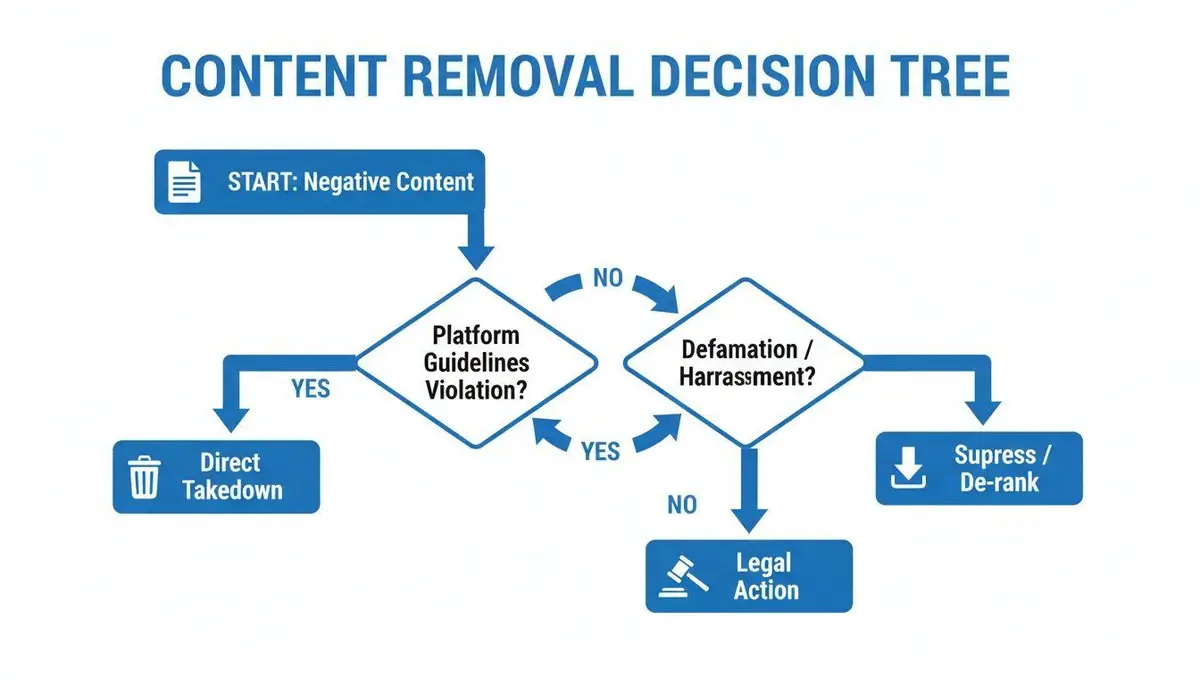
As illustrated, no single solution applies to all situations. The correct strategy must be tailored to the specific content and its digital venue.
The Imperative for Swift, Intelligent Action
The feeling of urgency is not purely emotional; it is tactical. The longer negative content remains online, the more authority it accumulates with search engines, becoming more entrenched and exponentially more difficult to dislodge. Online reputation management is therefore a synthesis of direct removal, search engine optimization (SEO), and public relations. It is about controlling the narrative from every angle.
While many platforms have improved their moderation, only the original publisher or a site administrator can truly delete a post. Firms making unrealistic guarantees should be regarded with extreme caution. To understand the scope of the challenge, one can review online reputation management statistics.
A flawed removal attempt can transform a manageable issue into a permanent digital liability. The objective is not merely to attempt a removal. It is to execute a plan that excises the problem cleanly, quietly, and permanently, without the author or the public detecting the intervention. This requires precision, discretion, and a deep understanding of internet architecture.
Executing Direct Takedowns Across Digital Platforms
Once content is identified as a clear violation of a platform’s policies, the next step is to execute a direct takedown request. This is not a matter of simply clicking a “report” button and hoping for the best. Success depends on constructing an irrefutable case that leaves the moderation team with no alternative but to act.
One must operate like a prosecutor, meticulously documenting the harmful content and framing the request using the precise language of the platform’s Terms of Service. Each platform possesses its own internal culture and enforcement eccentricities. A takedown strategy effective on LinkedIn will fail on Reddit if the approach is not adapted.

Building an Irrefutable Case File
Before contacting any platform, evidence must be compiled. This case file serves as the foundation of the removal request, proving not only the violation but also the real-world harm it is causing.
The file must be organized and comprehensive. It should include:
- High-Resolution Screenshots: Capture the entire page, including the URL, profile information, and comments. The timestamp must be visible.
- Archived Links: Utilize services like Archive.org or Archive.today to create a permanent, unalterable record of the page. This is a crucial defense against any claim that the content was modified or removed post-complaint.
- Direct Policy Citations: Isolate the exact rule being violated within the platform’s Terms of Service or Community Guidelines. Quote it verbatim in the submission.
These steps transform a subjective grievance into an objective report of a policy violation. The burden of proof shifts, compelling the platform to enforce its own stated rules.
Navigating Platform-Specific Takedown Channels
Every online environment has a distinct protocol. Generic templates are ineffective. The strategy must be tailored to each platform’s unique operational reality.
For a defamatory post on LinkedIn, the argument must center on professional misconduct, harassment, and the dissemination of misinformation, as LinkedIn’s brand is predicated on maintaining a trusted professional network. The platform has demonstrated its seriousness by acting on over 204,000 instances of harassment in late 2022.
Conversely, for non-consensual intimate imagery (NCII) on TikTok or Snapchat, the focus must be on minor safety or adult nudity policies. These platforms face immense public pressure to police such content, and framing the request accordingly ensures it is fast-tracked.
The critical mindset shift is this: you are not requesting a favor. You are an auditor identifying a clear breach of contract (the Terms of Service). You are providing the necessary evidence for them to enforce their own regulations. This reframing secures a swift, permanent removal.
The scale of content moderation is immense. In the second quarter of 2023 alone, Meta actioned 18 million pieces of hate speech, while TikTok removed millions of videos for violations ranging from minor safety to illegal acts. These figures, available in this comprehensive report on Statista.com, underscore why a clear, evidence-backed request is the only method to penetrate the noise.
Differentiating Harassment, Copyright, and Impersonation
The type of violation dictates the strategic path, as different offenses trigger distinct internal processes within technology companies.
- Impersonation: A fraudulent profile impersonating an executive can inflict immediate reputational and financial damage. The takedown process requires proof of identity ownership, typically via government-issued ID, which prompts a rapid response.
- Copyright Infringement: If a company’s proprietary report or an influencer’s exclusive photos are stolen, the appropriate tool is a Digital Millennium Copyright Act (DMCA) takedown notice. This is a formal legal instrument with strict requirements that platforms are legally obligated to address.
- Harassment and Hate Speech: These are flagrant violations of community standards. The objective is to demonstrate a pattern of targeted abuse or the use of prohibited language, directly linking it to the platform’s specific rules against such conduct.
When executed with precision, a direct takedown is the most efficient and effective method to remove negative online content at its source.
Controlling Visibility: The Art of De-Indexing and Suppression
Sometimes, direct removal of the source content is not feasible. An uncooperative publisher or forum administrator cannot be forced to delete material. When this door closes, the strategy pivots.
The focus shifts from erasing the content to controlling its audience. If the source cannot be removed, its visibility must be attacked. This means taking control of search engine results.
This is where the sophisticated work of de-indexing and suppression begins. These are not last resorts but strategic counter-moves designed to make damaging material effectively disappear for the 99% of users who discover information via search engines.

Petitioning for Search Engine De-Indexing
De-indexing is the most direct tool for controlling search visibility. It involves petitioning Google, Bing, or another search engine to remove a specific URL from their index. While the page continues to exist on the original website, it becomes invisible to search queries, preventing discovery.
Search engines guard this power carefully. They will not de-index an article simply because it is unflattering or embarrassing. A compelling case must be constructed based on their own policies.
Successful de-indexing petitions almost always fall into specific categories:
- Non-Consensual Intimate Imagery (NCII): Often termed “revenge porn,” search engines maintain a near-zero-tolerance policy for this material and act swiftly when presented with clear evidence.
- Major Privacy Breaches: This includes the publication of bank account numbers, medical records, or images of government identification. The argument rests on the direct and significant threat posed by the exposure.
- Content Subject to a Court Order: A formal court order declaring content defamatory or illegal is the gold standard, providing the legal justification search engines require to act.
- Outdated Information Causing Ongoing Harm: This is the foundation of Europe’s “Right to be Forgotten.” In certain cases, an argument can be made that old, irrelevant information is causing disproportionate harm to an individual’s current life.
Constructing such a petition is a technical legal process. It requires framing a precise legal and policy argument backed by irrefutable proof. We detail this process in our strategic guide to search result removal.
A successful de-indexing petition severs the link between the public and the harmful content. For a founder facing false accusations or a family office dealing with a privacy breach, this can mean the difference between a contained issue and a full-blown reputational crisis.
Advanced Suppression: The Art of Digital Displacement
When de-indexing is not a viable option (often the case with legitimate but negative news articles, critical reviews, or opinion pieces protected by free speech) the strategy shifts to suppression.
Suppression is a proactive, aggressive form of reputation management. The goal is to remove negative online content from the first page of search results by burying it under a flood of positive, authoritative content that you control.
The reality is stark: over 90% of searchers never navigate past the first page. Pushing a negative link to the second, third, or fourth page of Google renders it functionally invisible.
This is not about digital trickery; it is about out-competing negative content by creating a stronger, more dominant digital footprint. We build and promote a portfolio of positive digital assets engineered to rank higher for an individual’s or company’s name.
A typical suppression campaign involves creating and optimizing assets such as:
- New personal or corporate websites with SEO-rich content.
- Polished, active profiles on high-authority platforms like LinkedIn.
- Positive media coverage, interviews, and strategic press releases.
- Guest articles or whitepapers published on respected industry websites.
Suppression is a marathon, not a sprint. It is an ongoing campaign requiring a deep understanding of search engine algorithms and a sustained effort to build the authority of positive content. For any public figure or brand, this is the ultimate defense for controlling the narrative that appears when their name is searched.
Legal Remedies: The Definitive Path to Removal
When direct requests are ignored and suppression tactics are insufficient, legal action becomes necessary. For entrenched cases of defamation, severe privacy breaches, or content theft, legal intervention is not merely an escalation. It is often the only path to a definitive resolution.
This approach transforms the dynamic from polite requests to legal imperatives, compelling a website, publisher, or search engine to act. It is how results are obtained from uncooperative administrators who have ignored all previous communication. This is a different theater of operations, requiring solid evidence and a sophisticated legal strategy.
The Cease and Desist: A Formal Warning
Before initiating a lawsuit, a sharply drafted cease and desist letter is almost always the correct first move. This is not another informal request; it is a formal, legal demand from counsel that puts the opposing party on official notice. It clearly identifies the harmful content, explains the laws it violates, and states the required action: immediate and permanent removal.
A letter from a respected law firm signals that you are prepared to litigate. For many smaller websites or individual bloggers, the threat of legal fees and a potential lawsuit is a powerful motivator to comply. They will quickly assess the risk and conclude that hosting the content is not worth the potential cost.
However, this is a tactical maneuver. A poorly written or overly aggressive letter can backfire, prompting the target to publicize the threat and draw more attention to the content you seek to remove.
A cease and desist letter does more than demand a takedown. It creates a formal record of your complaint and the resulting damages. This documentation becomes invaluable if the matter proceeds to court, proving you attempted to resolve the issue in good faith.
Comparison of Legal Content Removal Strategies
Navigating legal options is complex. Each method has distinct strengths, applications, and timelines. One must select the appropriate tool for the specific task. This table breaks down the primary strategies to clarify which may be suitable for your situation.
| Method | Best For | Key Success Factor | Timeline |
|---|---|---|---|
| Cease & Desist Letter | Initial legal warning for defamation, copyright, or privacy issues with a known publisher. | A strong, fact-based legal argument from a reputable attorney. | 1-4 weeks |
| Court Order | Confirmed defamatory content that a publisher refuses to remove. | Proving the content is verifiably false and has caused material harm. | 6-18+ months |
| DMCA Takedown | Stolen photos, videos, articles, or other copyrighted material. | Clear proof of ownership of the original intellectual property. | 24 hours-2 weeks |
| Privacy Law Invocation | Unauthorized disclosure of private data, especially under GDPR or CCPA. | Content must meet the specific definition of “personal data” under the relevant law. | 1-2 months |
The optimal method depends entirely on the specifics of the case, from the type of content to the identity of the publisher. A court order is the most powerful but also the slowest, while a DMCA notice is exceptionally fast for the right type of infringement.
The Court Order: The Ultimate Takedown Instrument
The single most powerful weapon to remove negative online content is a court order. By proving in a court of law that content is false and damaging, the legal definition of defamation, a judge can issue a declaratory judgment. That court order is the ultimate trump card.
Obtaining one requires filing a lawsuit, presenting evidence that the statements are false assertions of fact (not opinion), and demonstrating the harm caused to your reputation. With that judgment in hand, the dynamic shifts completely:
- It is an order, not a request. A court order creates a non-negotiable legal obligation to act.
- Search engines will comply. Platforms like Google and Bing have clear policies to honor court orders. Presented with a valid order identifying a specific URL, they will de-index it from search results, one of the most reliable ways to make defamatory content disappear.
- It bypasses Section 230. While Section 230 of the Communications Decency Act typically shields platforms from liability for user-generated content, a court order targeting the content itself provides them the legal cover to remove it without issue.
For those dealing with damaging information from old public records, a related legal strategy is pursuing expungement services. This process legally seals or clears official records, stopping them from fueling negative online narratives at the source.
Copyright and Privacy Laws: Precision Instruments
Beyond defamation, two other legal avenues offer precise and often faster paths to force a takedown.
DMCA Takedown Notices
The Digital Millennium Copyright Act (DMCA) is indispensable when intellectual property has been stolen. If your original photos, videos, reports, or website text have been copied without permission, the DMCA is the tool of choice. A formal notice is sent to the website’s hosting provider, which is legally obligated to remove the content quickly to maintain its “safe harbor” status. For clear-cut copyright theft, it is incredibly effective.
Privacy Law Invocations
Modern privacy laws, particularly Europe’s GDPR, have created powerful new removal pathways. If content exposes private personal data without consent, citing specific articles of the GDPR can compel a company to delete it. This is especially useful for individuals with ties to the EU or when the offending company has a global presence and must comply with the regulation.
Knowing which legal tool to deploy is critical. Each is designed for a specific purpose, and success hinges on choosing the correct one. Our guide on navigating online content removal laws offers a deeper analysis of these strategies. A sophisticated legal approach is not about using a sledgehammer for every problem; it is about finding the right key for the right lock.
Proactive Monitoring to Prevent Re-Emergence
Securing the removal of damaging content is a significant achievement. But it is rarely the end of the matter. The internet is designed for permanence, and content thought to be gone has a tendency to reappear.
A determined adversary, a disgruntled former employee, or an anonymous troll can re-upload files, repost defamatory text on a new website, or find an obscure forum to continue an attack. Playing “whack-a-mole” with negative content is a losing strategy.
To truly protect a reputation, the focus must shift from reactive takedowns to proactive, ongoing monitoring. The victory is not just removing the content, but implementing a system that prevents its return. For our clients, this is not an afterthought; it is the core of a durable defense strategy.
Building a Digital Sentry with Modern Technology
Speed is the key to stopping re-uploaded content. If a negative article or video reappears and remains online for weeks, it can quickly regain its search engine ranking, nullifying previous efforts. To prevent this, we employ sophisticated monitoring tools that act as a digital sentry, guarding our clients’ online presence.
These systems operate continuously, scanning not only Google and social media but also the deep and dark web. They are trained to detect the specific digital fingerprints of the removed content: key phrases, images, or video files.
This constant vigilance provides a decisive advantage:
- Early Warning: The moment harmful material is re-uploaded, an alert is generated, often within hours. This occurs before the content can be indexed by search engines or disseminate.
- Rapid Response: With this early warning, our team can act instantly. Possessing the established, successful playbook, we can issue another DMCA notice or report the same defamatory comment for a terms of service violation.
- Strong Deterrent: When adversaries see that every attempt to repost content is shut down almost immediately, they often abandon their efforts. The campaign becomes more trouble than it is worth.
The objective is to reduce the window of opportunity for harmful content to near zero. This transforms reputation management from a series of stressful emergencies into a steady, protective shield, providing the assurance that your digital perimeter is secure.
Who Requires Constant Vigilance?
This level of monitoring is essential for a wide range of our clients. A public figure trying to stop the spread of leaked photos needs it to combat the endless replication across thousands of sites. A company fighting counterfeit products needs it to identify new illegal sellers the moment they appear.
This process is not merely defensive; it gathers valuable intelligence. It can reveal patterns in attack origins, identify the networks being used, and provide concrete evidence for further legal action.
For example, for old legal issues that persist online, an important step is pursuing legal remedies like the expungement of theft crimes. Once completed, monitoring ensures those expunged records are not illegally reposted.
Ultimately, to truly remove negative online content is to ensure it does not return. A takedown followed by a quiet re-emergence is a failure. Sustained vigilance is the only path to a permanent solution. To understand how we construct these protective digital shields, review our reputation monitoring services. This is how we secure a reputation for the long term.
Your Content Removal Questions Answered by Experts

When your reputation is on the line, direct answers are required, not generic advice. We operate in these high-stakes situations daily, guiding executives, public figures, and legal teams through the complexities of removing negative online content.
This section addresses the most pressing questions we receive, providing the same actionable intelligence delivered to our clients. While your case is unique, the strategies for success are built upon a foundation of experience.
How Long Does Content Removal Actually Take?
This is invariably the first question. The only honest answer is: it depends entirely on the strategy employed. There are no fixed timelines.
A straightforward Digital Millennium Copyright Act (DMCA) takedown for stolen intellectual property can often be resolved in 24-48 hours. Hosting providers are legally motivated to act quickly to avoid liability.
Conversely, securing a court order for defamation is a major legal undertaking that can take from six months to over a year. An intermediate action, such as reporting a clear case of harassment on a social media platform, might require a few days to a week for the platform’s review.
The timeline is a direct consequence of the chosen strategy, dictated by the content type, its location, and the legal or procedural path taken. Speed is not an option you select; it is an outcome you engineer.
Can Content Be Removed Even if It’s True?
A common misconception is that if information is true, it is permanent. While factual statements are not defamatory, proving falsity is only one of many removal strategies. Most of our successful removals do not hinge on the truthfulness of the content.
We leverage other angles:
- Copyright Claims: If an attacker used your company photos, proprietary reports, or personal videos, a DMCA claim can be filed based on ownership of that media, forcing a removal. The truth of the narrative becomes irrelevant; the theft of your intellectual property is the actionable offense.
- Privacy Violations: The exposure of private information (financial records, home addresses, or medical details) can be actionable under privacy laws like GDPR or state statutes, regardless of its accuracy.
- Terms of Service (ToS) Violations: Many platform rules extend beyond legality. Content that, while factually true, also constitutes harassment, hate speech, or doxxing violates the platform’s own policies and can be removed on those grounds.
- Outdated Information: For old news articles or posts that are no longer relevant, we can sometimes negotiate a removal or de-indexing with publishers. The argument is that the content no longer serves the public interest and causes disproportionate, ongoing harm.
What if the Attacker Is Anonymous?
Anonymity is a common tactic for online aggressors, but it is not an impenetrable shield. Legal action can be taken to unmask an anonymous poster through a “John Doe” lawsuit.
The process involves filing a lawsuit against the “John Doe” defendant and then serving a subpoena on the website, forum, or social media platform where the content appeared. The platform is then legally compelled to disclose any identifying information it possesses, such as IP addresses, email addresses, and account logs. This is often the first step toward stopping the attacks and holding the individual accountable.
The path to removing negative content has many routes. Reporting direct policy violations to a platform is often the quickest first move, though platform liability shields like Section 230 in the U.S. mean success is never a given. For our higher-profile clients, discreet mediation can sometimes get content removed without drawing more attention to it. A court order, however, remains the most powerful and definitive tool in our arsenal. You can find more detail on these layered strategies and their effectiveness on Search Engine Land.
When your reputation and privacy are at stake, you need a team that moves with precision, discretion, and speed. ContentRemoval.com is a specialized service focused on surgically removing damaging online content and setting up monitoring to make sure it stays down. Contact us for a confidential assessment of your situation.
Frequently asked questions
What is the Streisand Effect and how do I avoid it?
It is when an attempt to hide information ends up publicizing it. Angry emails, public disputes, threats and overly aggressive legal letters can all prompt the publisher to broadcast your attempt. The guide’s answer is to assess first, act quietly and choose the route that removes the content without the author or public noticing.
What evidence do I need before filing a takedown request?
High-resolution full-page screenshots with the URL and timestamp visible, an archived copy of the page on Archive.org or Archive.today, and the exact clause of the platform’s terms of service or community guidelines being violated, quoted word for word. That turns a grievance into an objective report of a breach.
Will Google remove a search result just because it is negative?
No. Search engines de-index for defined reasons: non-consensual intimate imagery, serious privacy breaches such as bank details or ID images, content covered by a court order, and in Europe outdated information causing disproportionate harm. Unflattering but lawful content is handled through suppression instead.