
To remove your information from the internet, work through four fronts: search engine delisting requests for sensitive identifiers and doxxing, individual opt-outs at data brokers such as Whitepages, Spokeo and BeenVerified, full deletion rather than deactivation of social accounts, and legal routes such as GDPR erasure or California’s DROP platform. Public records cannot be deleted, so limit their secondary republication.
Key facts
- Data broker processing times range from 24 to 48 hours at Whitepages to 10 to 14 days at BeenVerified.
- Facebook and Instagram require a 30-day deactivation period before permanent deletion.
- Google expedites doxxing removals when a police report or restraining order accompanies the request.
- People-search profiles commonly reappear within 3 to 6 months, so quarterly re-checks are needed.
Where ContentRemoval.com comes in. ContentRemoval.com is the route when the problem goes beyond broker opt-outs: defamatory articles, explicit imagery, doxxing with a safety dimension, or a professional profile where negative results are costing deals, so we negotiate directly with publishers, apply privacy and copyright grounds, de-index what will not come down and monitor for reappearance. Contact usually comes from the individual, an assistant or a lawyer. A free 15-minute Exposure Scan maps what is removable, and the report is yours to keep. Get a Free, Confidential Exposure Scan or read how our content removal work is done.
The digital landscape of 2026 has made personal privacy a critical concern for individuals, business owners, and public figures alike. Every day, countless pieces of personal information spread across hundreds of websites, data broker databases, and search engine results. Whether you’re dealing with outdated contact details, compromising content, or sensitive data that puts your safety at risk, the need to remove my information from the internet has never been more urgent. This comprehensive guide explores proven strategies, legal frameworks, and practical steps to reclaim control over your digital identity and protect your personal privacy in today’s interconnected world.
Understanding the Digital Privacy Landscape
Personal information proliferates online through multiple channels. Data brokers collect and sell your details to marketers, people search sites compile public records into comprehensive profiles, and social media platforms retain years of activity. The average person has personal data scattered across more than 200 websites without their explicit knowledge or consent.
The types of information typically available online include:
- Full legal names and known aliases
- Current and historical addresses
- Phone numbers and email addresses
- Family member names and relationships
- Property ownership records
- Court records and legal filings
- Social media posts and photos
- Professional affiliations and employment history
- Financial information and income estimates
This data exposure creates significant risks. Identity thieves exploit personal details for fraud, stalkers use address information to locate victims, and malicious actors leverage embarrassing content for blackmail or harassment. For business leaders and entrepreneurs, leaked personal information can damage professional reputations and compromise security protocols.
The Legal Framework for Data Removal
Several legal mechanisms support your right to remove my information from digital platforms. The right to be forgotten originated in European Union law through the General Data Protection Regulation (GDPR), establishing that individuals can request deletion of personal data under specific circumstances.
In the United States, California has led privacy legislation with groundbreaking laws. The California Consumer Privacy Act (CCPA) grants residents the right to know what personal information businesses collect and request its deletion. More recently, California’s Delete Act introduced a streamlined mechanism allowing residents to submit a single deletion request to all registered data brokers simultaneously.
The Delete Request and Opt-out Platform (DROP) launched in 2026 represents a significant milestone in consumer privacy rights. This centralized system enables California residents to remove my information from hundreds of data broker databases through one consolidated request, dramatically simplifying a process that previously required individual submissions to each company.
Manual Removal Strategies
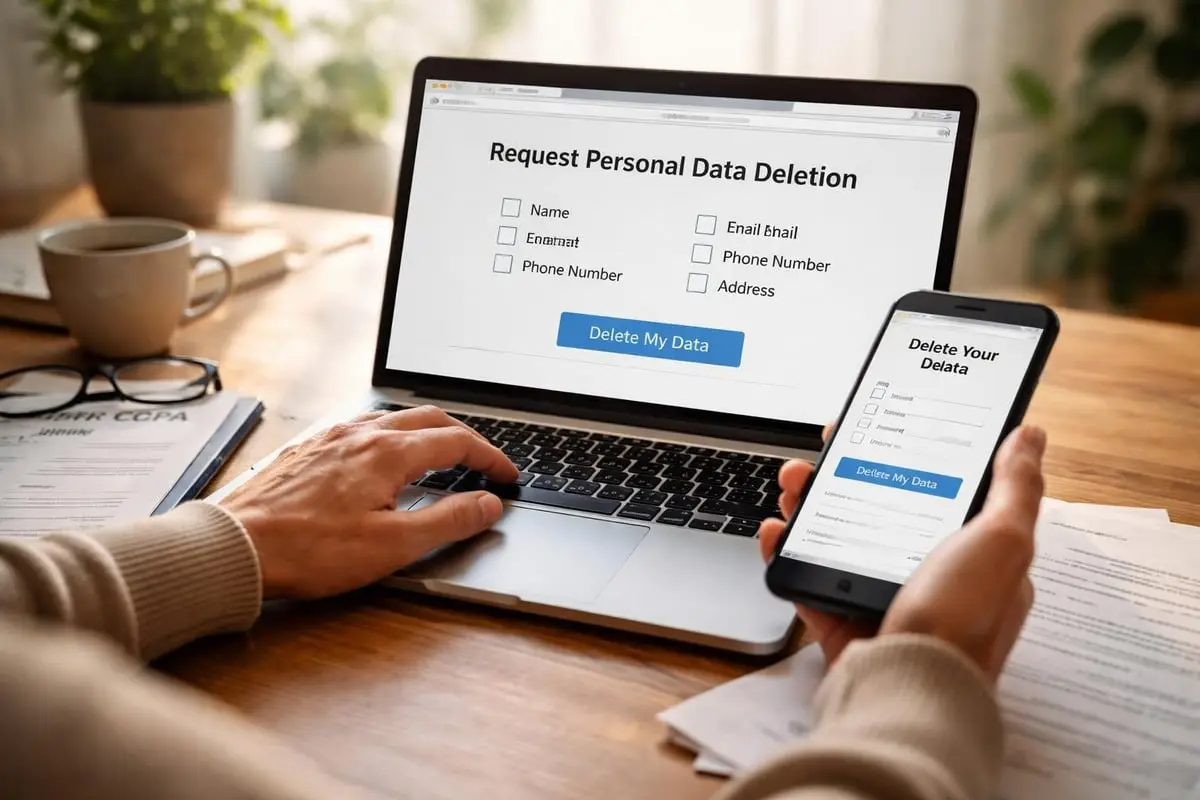
Taking direct action to remove my information requires systematic effort across multiple platforms. Start by identifying where your data appears most prominently through comprehensive searches of your name, phone number, address, and email across major search engines.
Search Engine Delisting Requests
Google, Bing, and other search engines offer removal request tools for specific types of content. Google’s removal dashboard handles requests for:
- Personal information containing sensitive identifiers (Social Security numbers, bank account details)
- Non-consensual explicit imagery
- Doxxing content with intent to harm
- Content about minors
- Court-ordered removals
The process typically requires submitting specific URLs, explaining the removal basis, and providing verification of your identity. Response times vary from 48 hours to several weeks depending on request complexity. When successfully approved, the content disappears from search results but remains on the original website unless separately addressed.
Data Broker Opt-Out Procedures
Data brokers represent one of the most challenging categories when attempting to remove my information. These companies aggregate public records, purchase data from other sources, and compile comprehensive profiles sold to marketers, employers, and background check services.
Major data brokers requiring individual opt-out requests include:
| Data Broker | Primary Data Type | Opt-Out Method | Processing Time |
|---|---|---|---|
| Whitepages | Contact information, addresses | Online form with email verification | 24-48 hours |
| Spokeo | Comprehensive people search | Online form requiring profile URL | 5-7 business days |
| BeenVerified | Background checks, criminal records | Email request with ID verification | 10-14 business days |
| Intelius | Contact details, relatives | Online form with confirmation code | 3-5 business days |
| PeopleFinders | Address history, phone numbers | Phone call or mailed request | 7-10 business days |
Each platform maintains different procedures, verification requirements, and timelines. Some require notarized documentation, while others accept simple email requests. The lack of standardization makes manual removal extraordinarily time-consuming.
Social Media Privacy Controls
Social platforms retain extensive personal information even after account deletion. To thoroughly remove my information from social media requires multiple steps beyond simple profile removal.
Facebook and Instagram:
- Download your complete data archive before deletion
- Remove tagged photos where others posted your image
- Request deletion of facial recognition data
- Deactivate before permanent deletion (30-day waiting period)
- Contact Meta directly for post-deletion data confirmation
LinkedIn:
- Close your account through settings (not just deactivation)
- Request removal from cached search engine results
- Contact former connections who may have downloaded your profile
- Remove professional recommendations and endorsements
Twitter/X:
- Delete individual tweets before account closure (permanent tweets remain in archives)
- Remove from third-party Twitter analytics platforms
- Request archive deletion after account closure
Professional platforms often retain certain data for legal compliance even after account deletion. Understanding these retention policies helps set realistic expectations when attempting to remove my information completely.
Automated Removal Services
The complexity and time investment required for manual removal has spawned an industry of specialized privacy services. These platforms automate the process of identifying data broker listings, submitting removal requests, and monitoring for re-appearances.
Comparing Privacy Service Options
Several privacy services offer varying levels of coverage and automation. Services like DeleteMe pioneered the subscription-based model where privacy experts manually submit removal requests on behalf of clients, then continuously monitor for new listings.
Key features to evaluate when selecting a removal service:
- Data broker coverage: The number of sites monitored and targeted for removal
- Removal frequency: How often new scans and removal requests occur (monthly, quarterly)
- Verification methods: How the service confirms successful removals
- Monitoring duration: Ongoing surveillance for data reappearance
- Customer support: Access to privacy specialists for questions and custom requests
- Family plans: Options to protect multiple family members under one subscription
Pricing typically ranges from $100 to $300 annually for individual plans, with family packages covering 2-4 people costing $200 to $500 per year. While automated services significantly reduce the burden of trying to remove my information manually, they cannot guarantee complete removal from all platforms.

Limitations of Automated Approaches
Even the most comprehensive privacy services face inherent limitations. New data brokers emerge constantly, requiring services to update their coverage lists continuously. Some sites deliberately make opt-out procedures difficult, requiring phone calls, notarized documents, or physical mail submissions that complicate automation.
Public records present another challenge. Information contained in government databases, court filings, property records, and professional licenses remains accessible regardless of removal requests to third-party aggregators. These sources continually repopulate data broker databases, necessitating ongoing removal efforts rather than one-time fixes.
For individuals facing serious privacy threats or dealing with harmful content beyond simple data broker listings, professional reputation management firms offer more comprehensive solutions. Services like Content Removal specialize in directly negotiating with publishers, leveraging legal frameworks, and employing technical de-indexing strategies to remove problematic content that automated services cannot address.
Strategic Approaches for Different Scenarios
Different privacy challenges require tailored strategies. The approach to remove my information varies significantly based on the specific threat, content type, and urgency level.
Personal Safety and Doxxing Situations
Victims of doxxing, stalking, or domestic violence face unique urgency when attempting to remove my information. Immediate steps include:
- Document everything: Screenshot all instances of exposed information with timestamps
- Report to platforms: Use emergency removal procedures for imminent safety threats
- Contact law enforcement: File reports establishing legal documentation of threats
- Engage specialized services: Work with privacy experts experienced in high-risk removals
- Implement ongoing monitoring: Establish alerts for your name, address, and identifying information
Many platforms prioritize removal requests involving documented safety threats. Google expedites removal of doxxing content when accompanied by police reports or restraining orders. Law enforcement involvement creates legal leverage that accelerates removal timelines.
Professional Reputation Management
Business leaders, executives, and public figures often need to remove my information that damages professional credibility. This includes negative press coverage, defamatory reviews, outdated content, or personal information that compromises security.
Professional reputation cleanup strategies:
- Assess all potentially harmful content through comprehensive audits
- Prioritize removals based on search visibility and damage potential
- Leverage legal grounds including defamation, copyright, or privacy violations
- Suppress non-removable content through strategic content creation and SEO
- Monitor brand mentions and personal name searches continuously
The digital footprint cleanup process for professionals extends beyond simple data broker removal to encompass strategic reputation repair. This holistic approach addresses not only privacy concerns but also professional image management.
Explicit Content and Revenge Porn
Non-consensual intimate imagery represents one of the most distressing privacy violations. Federal law through the SHIELD Act and state-level revenge porn statutes provide legal mechanisms to remove my information of this nature from mainstream platforms.
Major search engines and social platforms maintain dedicated reporting channels for non-consensual intimate imagery. These reports typically receive expedited processing, with many platforms removing content within 24-48 hours of verified reports.
However, removal from mainstream platforms doesn’t address content hosted on foreign servers or dedicated explicit content sites. These situations require more aggressive legal strategies, including DMCA copyright claims (if you created the content), international takedown requests, and in severe cases, litigation against perpetrators and hosting providers.
Technical Methods for Privacy Protection
Beyond removing existing information, implementing technical safeguards prevents future data exposure. These proactive measures reduce the volume of personal information requiring removal efforts.
Privacy-Enhancing Technologies
Several technical tools help minimize your digital footprint:
- Virtual private networks (VPNs): Mask your IP address and location data during browsing
- Encrypted email services: Protect communication content from data mining
- Privacy-focused browsers: Block tracking cookies and fingerprinting techniques
- Temporary email addresses: Avoid linking your real email to account registrations
- Virtual phone numbers: Prevent your actual phone number from appearing in databases
These tools work best when implemented before privacy problems emerge. Once information enters data broker databases or appears in search results, technical prevention measures cannot retroactively remove my information already in circulation.
Data Minimization Practices
The most effective long-term privacy strategy involves sharing less information initially. Adopt these data minimization principles:
Online forms and registrations:
- Provide only required fields (marked with asterisks)
- Use alternative contact methods for non-essential communications
- Review privacy policies before submitting personal information
- Opt out of marketing communications and data sharing
Social media sharing:
- Limit profile visibility to confirmed connections only
- Disable location tagging on posts and photos
- Review and delete old posts containing personal information
- Adjust privacy settings quarterly as platforms update policies
Public records considerations:
- Use business entities for property purchases when possible
- Request confidential voter registration in states offering this option
- Seal court records when legal options exist
- Limit participation in public directories and membership lists

Addressing Specific Platform Challenges
Certain platforms present unique obstacles when attempting to remove my information due to their policies, technical architectures, or business models.
People Search Engines
Sites like Whitepages, Spokeo, and BeenVerified specifically aggregate personal information for profit. Their business model depends on comprehensive data availability, creating misaligned incentives with privacy requests.
These platforms typically require:
- Locating your specific profile URL from search results
- Completing multi-step verification proving your identity
- Waiting through processing periods (often 7-14 days)
- Monitoring for profile reappearance (common within 3-6 months)
The cyclical nature of people search removals necessitates ongoing vigilance. As public records update and data brokers share information, removed profiles frequently reappear. Quarterly monitoring and re-submission of removal requests becomes essential for maintaining privacy.
Government Databases and Public Records
Certain information remains permanently accessible through government transparency requirements. Property ownership, professional licenses, business registrations, and court records serve legitimate public interest functions that supersede individual privacy preferences.
However, even when you cannot remove my information from government sources directly, you can limit secondary distribution through:
- Requesting removal from third-party aggregators who republish public records
- Sealing or expunging eligible court records through legal petitions
- Using business entities or trusts for property ownership to separate personal names from public records
- Registering for confidential programs offered to victims of violence or protected professions (judges, law enforcement)
Understanding the distinction between primary government sources and secondary commercial republication helps focus removal efforts where success is achievable.
International Data Removal Challenges
Cross-border data flows complicate removal efforts when information appears on foreign websites or servers. European privacy protections under GDPR are stronger than most American frameworks, but enforcement against non-European entities remains challenging.
When attempting to remove my information from international sites:
European Union sites (for EU residents or data subjects):
- Submit GDPR Article 17 deletion requests directly to data controllers
- Escalate to national data protection authorities if ignored
- Reference specific lawful basis for processing (usually consent or legitimate interest)
- Document all requests and responses for potential enforcement actions
Asian, African, or South American sites:
- Research local privacy laws that may support removal requests
- Engage local legal counsel for sites hosted in specific jurisdictions
- Utilize platform-specific reporting tools when available
- Consider technical suppression strategies when legal removal proves impossible
Global reputation management requires understanding diverse legal frameworks and cultural approaches to privacy across jurisdictions.
Measuring Success and Ongoing Maintenance
Privacy protection represents an ongoing process rather than a one-time achievement. Measuring progress and implementing maintenance protocols ensures sustained results.
Key Performance Indicators for Privacy
Track these metrics to evaluate whether efforts to remove my information are succeeding:
| Metric | Measurement Method | Target Benchmark |
|---|---|---|
| Search result appearances | Monthly searches of name + variations | Less than 3 results on first page |
| Data broker listings | Quarterly scans of major sites | Zero active profiles |
| Social media mentions | Social listening tools | No unauthorized tagged content |
| Image search results | Reverse image searches | No identifiable personal photos |
| Address exposure | Property record checks | No current address publicly linked |
Regular monitoring through these metrics reveals when previously removed information reappears or new privacy threats emerge.
Establishing Monitoring Systems
Automated monitoring systems alert you to new appearances of personal information before they proliferate widely. Set up:
Google Alerts for:
- Your full name in quotes
- Name variations and nicknames
- Phone number and email address
- Current and former addresses
- Family member names if relevant
Specialized monitoring services:
- Reputation monitoring platforms tracking brand mentions
- Dark web monitoring for compromised credentials
- Image recognition services for unauthorized photo usage
- Social media listening tools for tagged content
These systems create early warning mechanisms, allowing rapid response when attempts to remove my information require renewal or expansion to new platforms.
Financial and Time Investment Considerations
Understanding the costs and time commitments involved in privacy protection helps set realistic expectations and budgets.
Cost Breakdown by Approach
Do-it-yourself manual removal:
- Time investment: 20-40 hours initially, 2-5 hours monthly ongoing
- Direct costs: $0 (unless purchasing privacy tools)
- Learning curve: Moderate to high
- Effectiveness: 60-75% coverage of common data brokers
Automated privacy services:
- Annual subscription: $100-$300 for individuals
- Time investment: 1-2 hours setup, minimal ongoing
- Learning curve: Low
- Effectiveness: 70-85% coverage of monitored sites
Professional reputation management:
- Project-based pricing: $3,000-$15,000+ depending on scope
- Time investment: Consultative (primarily firm’s work)
- Learning curve: Low (experts handle implementation)
- Effectiveness: 85-95% coverage including complex removals
The appropriate investment level depends on threat severity, public profile, and financial resources. High-profile individuals facing serious privacy threats justify professional intervention, while average consumers may find automated services provide adequate protection.
Return on Investment Analysis
Quantifying the value of privacy protection helps justify the investment. Consider these potential costs of inadequate privacy:
- Identity theft remediation averages $1,400 and 200 hours of time
- Data breaches affecting executives average $287,000 in direct damages to organizations
- Reputation damage to business owners can reduce revenue by 15-30% annually
- Personal safety threats necessitate security measures costing $5,000-$50,000+ annually
When viewed through risk mitigation, spending $200-$500 annually on privacy protection represents cost-effective insurance against substantially larger potential damages.
Emerging Trends in 2026
The privacy landscape continues evolving with new technologies, regulations, and threats emerging throughout 2026.
Artificial Intelligence and Privacy
AI systems trained on vast internet datasets incorporate personal information scraped from websites, social media, and public databases. These models can generate detailed profiles, predict behaviors, and even create synthetic content (deepfakes) using your likeness.
Efforts to remove my information now must extend to:
- Requesting exclusion from AI training datasets where possible
- Monitoring for AI-generated content using your name or likeness
- Understanding how large language models reference your information in responses
- Advocating for “right to be forgotten” application to AI systems
The European Union’s AI Act and emerging American legislation begin addressing these concerns, but practical implementation remains in early stages.
Blockchain and Permanent Records
Blockchain technologies create immutable records that fundamentally conflict with privacy rights. Information recorded on public blockchains cannot be deleted or modified, creating permanent digital traces.
Individuals concerned about blockchain privacy should:
- Avoid associating real identity with cryptocurrency wallet addresses
- Use privacy-focused blockchain networks when transactions are necessary
- Understand that blockchain transactions provide permanent public records
- Consider the privacy implications before engaging with blockchain-based systems
This tension between blockchain immutability and privacy rights will shape future privacy frameworks as adoption expands.
Legislative Developments
Privacy legislation continues expanding beyond California’s pioneering efforts. Multiple states enacted comprehensive privacy laws taking effect in 2026, including:
- Virginia Consumer Data Protection Act
- Colorado Privacy Act
- Connecticut Data Privacy Act
- Utah Consumer Privacy Act
- Additional states with pending legislation
These laws create a patchwork of requirements, with some offering stronger protections than others. Federal privacy legislation remains under discussion but faces political obstacles. Understanding which laws apply to your situation helps leverage appropriate legal mechanisms when seeking to remove my information from various platforms.
Protecting your digital privacy requires combining legal knowledge, technical tools, persistent effort, and realistic expectations about achievable outcomes. The strategies outlined above provide comprehensive frameworks for removing personal information across data brokers, search engines, social platforms, and public records while implementing safeguards against future exposure. When you face complex removals involving defamatory content, explicit imagery, or high-stakes reputation challenges, specialized expertise becomes essential. Content Removal delivers strategic, case-managed solutions for individuals and businesses needing direct takedown services and comprehensive reputation protection across global digital platforms.
Frequently asked questions
Is deactivating my social media account enough to remove my information?
No. Deactivation hides the profile but keeps your data on the company’s servers. Choose permanent deletion, download your archive first, remove tags in other people’s posts and, on Facebook and Instagram, allow for the 30-day waiting period before deletion completes.
Can I remove my information from government or court records?
Usually not at the source, since property, licensing, business and court records serve a public function. You can limit secondary spread by asking aggregators that republish them to remove your listing, sealing or expunging eligible court records and holding property through a business entity or trust.
How do I get doxxing content about me taken down faster?
Screenshot every instance with timestamps, use the platform’s emergency or safety reporting route, and file a police report. Google and major platforms prioritize doxxing removals when a police report or restraining order accompanies the request, and law enforcement involvement shortens timelines.