
To remove content about you professionally, preserve the material first, classify it as defamation, privacy violation, copyright misuse, outdated information or impersonation, then choose the pathway that fits: a direct platform request, legal intervention or a specialized removal service. Search de-indexing lowers visibility but leaves the source online, so serious matters need a layered response and continued monitoring.
Key facts
- Direct platform requests work best for impersonation, intimate image abuse, doxxing, fake profiles and clear copyright misuse.
- Legal takedowns through defamation suits or right to be forgotten requests can take 6 to 12 months.
- Google de-indexing leaves the source live, and Bing and DuckDuckGo may still surface it.
- Escalation moves in layers: publisher, then trust and safety, then hosts and registrars, then legal proceedings.
Where ContentRemoval.com comes in. ContentRemoval.com runs source removal, de-indexing and monitoring as one coordinated case for executives, public figures and high-risk clients, so platform reports, legal notices and search work move in parallel rather than one failed form at a time. Contact often comes through a chief of staff, a lawyer or a family office. A free 15-minute Exposure Scan maps what is removable and by which route, and the report is yours to keep. Get a Free, Confidential Exposure Scan or read how our content removal work is done.
A board member sends you a screenshot at 6:20 a.m. Your name is attached to a false allegation, an old legal issue, leaked personal media, or a hostile forum thread that now ranks for branded search. You open Google. It is there. So is the secondary damage. Autocomplete shifts. A LinkedIn query starts surfacing the same material. Colleagues will see it before lunch.
Your first mistake is speed without control. People email the publisher in anger, post a denial, threaten litigation they are not prepared to file, or click every reporting tool they can find. That feels active. This move often makes removal harder.
If you want to remove content about me professionally, stop thinking like a person defending pride. Start thinking like a party preserving an advantage. The difference determines whether the content disappears, lingers, or spreads.
A Framework for Immediate Action
The first hour matters because it shapes every option that follows. I have seen skilled executives damage their position by alerting a hostile site owner too early. The publisher updates timestamps, changes wording, republishes on mirror domains, or claims your contact proves public interest. Once that happens, your clean removal path narrows.

Follow the do not engage rule
Do not comment publicly. Do not argue in the thread. Do not message the poster from your personal account. Do not ask assistants or staff to “clean this up”. Every uncontrolled contact creates evidence for the other side and weakens later legal or platform arguments.
The disciplined move is containment.
Start by capturing the content as it appears. Take full-page screenshots. Save the URL. Copy the headline, body text, image file names, visible usernames, post date, and any comments that repeat the claim. Record where the content appears in search results, not just that it exists. Search placement affects urgency.
Practical rule: Preserve first, challenge second. If you cannot prove what was published, when it was published, and how it was presented, you are already negotiating from weakness.
Document the attack surface
The content itself is one asset in the problem. The underlying issue is distribution. Harmful material moves across three layers:
- The source page where the content lives
- Search visibility where Google and other engines amplify discovery
- Platform circulation where screenshots, reposts, and commentary multiply exposure
That is why volume matters. Since 2020, Google has received nearly 330,000 content removal requests from courts and government agencies worldwide, with an annual average growth rate of 34%, and the majority targeted YouTube at 54% and Google Web Search at 31% according to Surfshark’s analysis of Google content removal attempts. Harmful content disputes are no longer unusual edge cases. They are routine, crowded, and competitive.
Establish command quickly
Within that first hour, assign one decision-maker. Not five. One. If legal, communications, executive staff, and family office representatives all start contacting platforms independently, you create contradictions and duplicate submissions.
Use a simple triage list:
- What is live right now
- Where it ranks
- Whether it violates law, platform policy, or both
- Who must be informed internally
- What must not be said yet
If the matter threatens your name, employer, investment relationships, or personal safety, move straight to a structured removal plan rather than improvising. A professional starting point is a confidential review of the offending material and distribution channels through a service built for removing online content.
Assess the Digital Damage and Business Impact
Not all harmful content deserves the same response. Executives lose time and money when they treat every bad result as equally dangerous. A stale directory listing, a defamatory blog post, a leaked image set, and a small news item about an old dispute require different tools and different levels of force.
Identify the content class
The first question is legal and procedural. What exactly is this?
A useful working classification looks like this:
| Content type | Core issue | Usual removal angle |
|---|---|---|
| Defamation | False factual claim harming reputation | Factual rebuttal, legal notice, host escalation |
| Privacy violation | Personal data, intimate material, address, family details | Platform privacy policy, data protection rights, emergency safety framing |
| Copyright infringement | Unauthorized use of your original image, video, text, or audio | Formal takedown notice and host escalation |
| Outdated professional information | Old role, resolved allegation, obsolete case, prior dispute | Publisher correction request, search deindexing, context update |
| Impersonation or fabricated profile | Fake identity, false endorsement, cloned account | Platform identity verification and trust and safety escalation |
That classification controls your path. If a claim is false and hosted on a small independent blog, this is not the same case as a people-search listing or a social media impersonation account.
Measure authority and visibility
A damaging statement on a weak forum may feel personal, but a false accusation on a site with strong search authority can have greater commercial impact. You need to assess two things at once.
First, how credible the source appears to outsiders. A niche blog with a professional design, indexed pages, and branded social accounts can influence journalists, recruiters, and investors even if the reporting is poor.
Second, how visible the content is in search. Is it ranking for your name alone, your name plus company, your name plus title, or industry queries that matter commercially? If it surfaces on branded search, it becomes a business problem, not just a personal nuisance.
Key judgment: The same sentence can be low risk on an obscure page and high risk when indexed under your name. Search context determines commercial damage.
Prioritize by consequence, not emotion
Many clients focus first on the content they find most insulting. That is understandable and often wrong. Start with the material most likely to alter a real-world decision. Ask:
- Would a board, investor, or journalist find this with a branded search?
- Does it imply criminality, dishonesty, harassment, or professional incompetence?
- Is it current enough to look unresolved?
- Can a screenshot circulate even if the page later disappears?
Delay becomes expensive in such situations. Professional removal services use phased methodologies because spread and persistence change over time. In data broker removals, professional services have shown 65% to 68% removal rates at the four-month mark, and the hidden cost of delay can include lost opportunities and brand value erosion, as noted by My Data Removal’s review of what people want removed from Google search. The broader lesson is not limited to data brokers. Waiting rarely improves the case.
Distinguish nuisance from strategic threat
A strategic threat has one or more of the following traits:
- It ranks for your name
- It sits on a site that looks legitimate
- It can be copied easily
- It touches regulated, financial, or professional trust issues
- It creates a trail that others can cite later
A nuisance is irritating. A strategic threat changes behavior around you. It influences who calls back, who requests diligence, who invites you to speak, and who hesitates before closing.
If the content affects hiring, governance, fundraising, media exposure, or family privacy, treat it as an active risk file. That framing improves decisions immediately. You stop asking, “Can I report this?” and start asking, “What is the fastest lawful path to source removal, search suppression, and repeat-appearance prevention?”
Selecting Your Removal Pathway
Many failed campaigns collapse at the choice stage. The person affected picks the wrong instrument, pursues it too long, and gives the content time to harden. A platform form is not a legal strategy. A court filing is not a search strategy. Google deindexing is not removal.
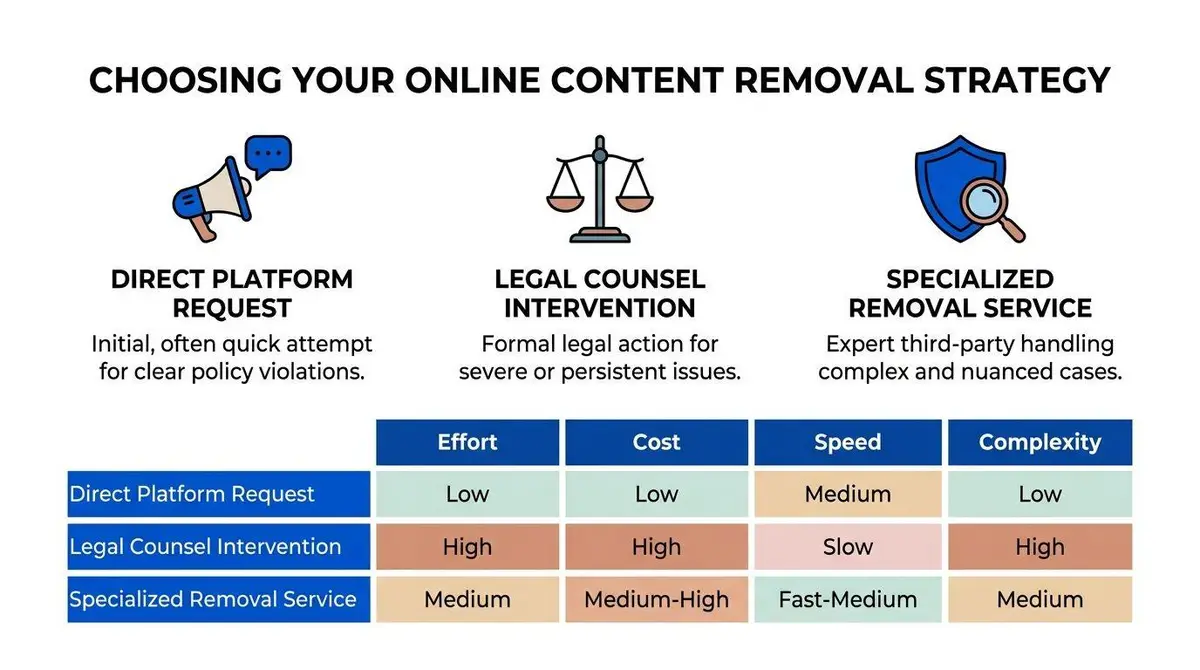
Three pathways with very different outcomes
Use this comparison before you take action:
| Pathway | Best use case | Main advantage | Main weakness |
|---|---|---|---|
| Direct platform request | Clear policy violation on a major platform | Fastest first move | Enforcement is discretionary |
| Legal counsel intervention | Defamation, privacy harm, repeat refusal, serious commercial injury | Strongest influence for source removal | Slower and more resource-intensive |
| Specialized removal service | Multi-platform, multi-jurisdiction, nuanced or persistent attacks | Coordinates legal, technical, and platform actions | Requires careful provider selection |
The mistake is treating these as substitutes. In serious matters, they work in sequence or in parallel.
Direct platform request
This is the right opening move when the violation is obvious. Impersonation, intimate image abuse, doxxing, account compromise, fake profiles, and straightforward copyright misuse belong here first.
The benefit is speed. You can get a quick decision when the facts match a published policy and the evidence is clean. The weakness is that many high-damage cases do not fit platform templates neatly. A defamatory post on a “legitimate” blog, a misleading article on a small publisher, or an outdated but technically accurate page falls outside simple reporting tools.
Use a direct platform request when the facts are simple and the policy fit is strong. Do not keep repeating the same failed request if the first denial shows the platform views the issue as contextual.
Legal action and formal influence
Formal legal intervention becomes necessary when the publisher is hostile, the host is uncooperative, or the content lives on a site that looks lawful enough to survive casual complaints. This is common with blogs, forums, small news outlets, and adversarial operators who know how to sit just inside platform rules.
Legal pressure works best when your evidence is complete and your theory is precise. Vague allegations do not move legal departments. Specific false statements, privacy harms, documented infringement, and provable impersonation do.
There is a practical timing problem. Legal takedowns through defamation suits or right to be forgotten requests succeed in approximately 40% to 60% of cases in major markets like the EU and US, with the EDPB noting a 52% global approval rate for RTBF, but those matters can take 6 to 12 months according to Google’s guidance page referenced in the verified data set. That timeline is often unacceptable in a live executive crisis.
So use legal action for permanence and influence, not as your only time-sensitive tactic.
Search deindexing
Search deindexing is useful. It is also routinely misunderstood.
If Google removes a result, many clients feel the problem is solved. It is not. The source remains online. Direct links still work. Other engines may still index it. Screenshots can still circulate, and anyone motivated enough can still find it.
Real-world testing of Google’s Results About You feature found only a 25% to 50% delisting success rate, and even successful delisting leaves the source content online while Bing, DuckDuckGo, and other engines continue to surface it, according to Cloaked’s analysis of Google’s Results About You versus professional data removal.
Do not confuse lower visibility with actual removal. If the source still exists, the problem still exists.
Search deindexing is best used as one layer in a broader campaign. It buys time. It reduces casual discovery. It does not deliver finality.
When a specialized service is the correct choice
Many high-profile clients should start here, not finish. If the matter involves multiple URLs, several platforms, old copies, mirrors, search indexing, legal nuances, and cross-border issues, coordination matters more than any single request form.
A specialized service can run platform reports, draft legal notices, pursue source-level takedowns, monitor reuploads, and manage search visibility together. Some firms focus narrowly on data brokers. Others handle reputational attacks, publisher disputes, impersonation, leaks, and search suppression in one workflow. ContentRemoval.com is one such option. It handles source removal, deindexing, and monitoring across search engines, websites, and social platforms.
The decision standard I recommend
Choose the pathway by asking one blunt question. What gets this content offline, hidden, or neutralized fastest without sacrificing the chance of a stronger remedy later?
For a fake profile, start with the platform. For a hostile publisher making false factual claims, prepare legal and hosting escalation early. For personal information or widespread search contamination, combine deindexing with source pursuit. For anything affecting your office, board position, investors, or family, assume a single tactic will fail and build a layered response from day one.
Building Your Case for Removal
Weak submissions fail for predictable reasons. They are emotional, incomplete, and vague about the rule being violated. Platforms ignore them. Site owners exploit them. Legal departments archive them.
Your case file should read like a concise litigation bundle, even if you never file suit.

Build an evidence record before you write a word
Gather proof in layers. Do not rely on one screenshot. Capture the page header, full text, comments, profile name, account URL, publication date, and visible ads or monetization if relevant. If the content appears in search, capture that result too. If it appears on mobile and desktop differently, preserve both.
Your file should usually include:
- Full-page screenshots showing the page in context
- Direct URLs for the post, profile, image, or video
- Search result screenshots for your name and key variations
- Identity evidence proving you are the affected party
- Supporting records that disprove false claims or prove ownership
- A chronology of when the content appeared and how it spread
A 2024 survey found that only 6% of Americans use online data removal services, while manual opt-outs removed 70% of data in one week compared with 35% over four months for the services tested, according to the Turn to 10 report on online data removal services. The useful lesson is not that automation is worthless. It is that targeted submissions outperform generic ones.
Match the evidence to the theory
Do not submit a privacy complaint when the stronger claim is impersonation. Do not frame copyright as “harassment.” Platforms reject accurate facts that are placed in the wrong policy bucket.
Use this alignment test:
| If the problem is | Your evidence must prove |
|---|---|
| Defamation | The statement is factual, false, and damaging |
| Privacy invasion | The material exposes protected personal information or intimate content |
| Copyright infringement | You own or control the original work being used without permission |
| Impersonation | The account or content falsely represents your identity |
| Outdated or misleading professional information | The material is materially incomplete, stale, or creates a false present-tense impression |
Write for the reviewer, not for yourself
The reviewer is often overworked and skeptical. Give them a short, clean path to yes.
A strong request does three things quickly:
- Identifies the exact URL or account
- States the precise violation
- Attaches evidence that proves it
Do not tell your life story. Do not speculate about motive unless it matters legally. Do not insult the publisher. Do not threaten criminal consequences you are not pursuing.
Submission standard: Calm tone, exact rule, attached proof, requested remedy. Nothing else is essential.
A good opening sentence is plain: “This URL publishes a false factual allegation that I was terminated for fraud. The statement is untrue, damaging, and contradicted by the attached employment records.” That gets attention. “This disgusting liar is ruining my life” does not.
For copyright-based removals, structure matters even more. If unauthorized use of your image, video, or written work is involved, a formal notice may be the best opening move. This guide on how to write and file a DMCA takedown notice is a useful procedural reference.
Keep the file ready for escalation
Your first submission may fail. Prepare for that before you send it. Every request should be reusable for host escalation, legal review, search deindexing support, and repeat reports if mirrored copies appear.
A practical way to organize the file is by folders:
- Folder one contains the original content and screenshots
- Folder two contains identity and ownership proof
- Folder three contains correspondence and ticket numbers
- Folder four contains rebuttal records, declarations, or legal drafts
Later in the process, this video gives a useful visual overview of online content takedown mechanics and why structured submissions outperform reactive complaints.
Avoid the three errors that destroy your advantage
First, never send conflicting explanations to different parties. If your platform report says privacy violation and your lawyer later argues falsity, you create credibility problems.
Second, do not overclaim. If one paragraph is false and another is opinion, separate them. Overreaching weakens the entire request.
Third, never assume a rejected request means the content is protected forever. It often means you chose the wrong reviewer, the wrong theory, or the wrong sequence.
Escalation Paths and Jurisdictional advantage
A denial is frequently procedural, not final. Frontline support teams reject edge cases because they are trained to process obvious violations, not nuanced reputational harm. That is why complex removal work depends on escalation discipline.
Escalate in layers, not in anger
When a platform or publisher refuses removal, your next move should be narrower and stronger. Not louder.
Start by separating who controls what. The site owner controls the page. The host controls infrastructure access. The search engine controls discoverability. The ad network may control monetization. Each party responds to a different kind of pressure.
A smart escalation sequence looks like this:
- First layer targets the original publisher with a concise notice and evidence pack
- Second layer moves to platform trust and safety or internal legal if frontline support failed
- Third layer targets hosting providers, registrars, or payment and ad relationships where appropriate
- Fourth layer uses jurisdiction-specific legal rights and formal proceedings. Most self-managed efforts stall at this point. People keep emailing the same generic inbox that previously said no.

Use the law of the place that helps you
Jurisdiction is not academic. It changes your position of advantage.
In the United States, platform immunity rules and speech protections often make direct removal harder, especially for content framed as opinion or hosted by intermediaries. In the European Union, privacy rights and right to be forgotten principles can create stronger arguments around outdated, excessive, or irrelevant personal information. The same content may be difficult in one jurisdiction and removable in another.
That is why the governing question is not “where do I live?” It is “which party is subject to which rules?” A site may serve US users, host in another country, process data in the EU, and rank through a search engine that responds to regional privacy law. Complex cases become solvable when you stop treating them as single-country disputes.
Legal takedowns through defamation suits or right to be forgotten requests succeed in approximately 40% to 60% of cases in major EU and US markets, with the EDPB noting a 52% global approval rate for RTBF, but these matters can take 6 to 12 months according to Google’s removal guidance cited in the verified data. That delay is exactly why urgent matters need a dual track. Press the legal route for permanence while pursuing technical and platform remedies for speed.
Strategic takeaway: Use immediate pressure to reduce visibility now, and slower legal pressure to eliminate the source later.
Target legitimate third-party sites differently
The most difficult cases are not revenge sites or obvious scams. They are legitimate-looking third-party sites with professionally damaging content that falls outside simple platform abuse categories. Small publishers, independent blogs, local outlets, and industry forums sit in this category.
They may not violate a platform’s exploitative removal rules. They may refuse edits. They may argue public interest. DIY requests frequently fail because the operator feels no immediate obligation to cooperate.
In those cases, influence comes from precision. You isolate false factual statements, privacy overreach, misuse of copyrighted material, procedural defects, stale information presented as current, or noncompliance with local data rights. Then you direct the argument to the party most exposed by ignoring it.
Keep your escalation file litigation-ready
Every denial should improve your next submission. Save ticket numbers, names, dates, and copies of the exact complaint language. Track what each reviewer rejected and why.
That record does two things. It sharpens the next round, and it demonstrates seriousness if outside counsel or a specialist takes over. A clean chronology tells the next decision-maker that you are organized, credible, and prepared to continue.
Escalation is not about theatrics. It is about moving the case from a low-authority reviewer to the person or entity with actual power to remove, delist, disable, or settle.
Sustaining a Clean Slate Through Monitoring
Removal is an event. Protection is a system.
Clients relax too early. A result disappears from Google. A fake profile is taken down. A blog post vanishes. Then the copied version shows up elsewhere, someone posts a screenshot on LinkedIn, or a data broker republishes the same record from an older source file. You are back where you started, except now the story has a second life.
Why one-off removals fail
The internet rewards duplication. If a hostile actor, aggregator, forum user, or low-grade publisher has copied the material, one successful request solves only one node of the problem.
Even when suppression appears to work, it can reverse. Negative results pushed to page two of Google re-emerge within six months 40% of the time without active monitoring, and manual requests to remove professional defamation on LinkedIn succeed only 35% of the time without legal backing, according to Super Lawyers’ discussion of removing negative content from the internet. That should end the fantasy that a single takedown equals safety.
Monitor the places that matter professionally
Many individuals rely on Google Alerts. That is insufficient for high-profile clients.
You need monitoring that watches for:
- Branded search changes involving your name, company, and title
- Professional network misuse such as fake endorsements, cloned profiles, and defamatory posts
- Image and video reuse across social platforms and adult or piracy ecosystems
- Data broker resurfacing after prior removals
- Forum and blog reposts that use screenshots rather than original links
A proper monitoring program also separates noise from risk. You do not need a fire drill every time someone mentions your name. You need immediate flags when a harmful asset is indexable, shareable, or likely to influence hiring, governance, investment, media, or family security.
Build a defensive posture, not just a cleanup habit
A resilient reputation defense has three parts.
The first is continuous detection. Harmful content should be identified early, before it ranks, spreads, or gets copied into professional ecosystems.
The second is rapid response playbooks. Different threats need pre-decided pathways. Impersonation is not handled like a stale article. A leak is not handled like a review dispute. Delay usually comes from indecision, not impossibility.
The third is surface reduction. Reduce the amount of unnecessary personal and professional data available online in the first place. The less exposed material that exists, the fewer handles hostile actors have to work with.
My advice to every high-profile client: Treat your digital footprint like a legal exposure map, not a branding exercise.
Make monitoring part of executive risk management
This is not a vanity service. It belongs alongside legal, cyber, and communications functions. If a false allegation, private image, impersonation account, or stale legal reference can affect diligence, recruiting, deal flow, or family safety, then monitoring is part of governance.
That is why a structured monitoring service matters more than occasional checks. If you need ongoing detection across search, platforms, and repeat-appearance risks, use a system designed for reputation monitoring.
When clients ask me when they can stop watching, the answer is simple. You can reduce intensity after the risk drops. You should not go blind again. High-visibility names do not get a permanent exemption from reposting, scraping, impersonation, or search resurfacing. They get safer when someone is actively looking.
If harmful material is affecting your name, your office, or your family, act before it hardens into the permanent record others assume is true. ContentRemoval.com provides confidential assessments and strategic removal planning for executives, public figures, and high-risk clients who need discreet action, not generic advice.
Frequently asked questions
Should I contact the website owner myself to get content taken down?
Not from a personal account and not in anger. Alerting a hostile publisher too early can prompt them to change timestamps, republish on mirror domains or claim your contact proves public interest, which narrows your clean removal path. Preserve everything first, then send a concise notice with evidence.
Is getting a result removed from Google the same as removing the content?
No. If Google delists a result the source page stays online, direct links still work, other search engines may still index it and screenshots can still circulate. De-indexing buys time and reduces casual discovery, but it does not deliver finality.
What evidence do I need for a content removal request?
Full-page screenshots in context, direct URLs, search result screenshots for your name, proof that you are the affected party, records that disprove the false claims or prove ownership, and a chronology of when the content appeared and spread. Match that evidence to the exact policy or legal theory you are invoking.