
Removing competitor attacks online means containing the incident, preserving evidence, diagnosing the attack vector, then applying platform and legal pressure in the jurisdiction where it works. Fake reviews, impersonation accounts, negative SEO and leaked material each need a different route. The disciplined response preserves records, centralizes decisions and runs source removal and de-indexing together.
Key facts
- Platform takedowns are framed around the platform’s own policy categories, not your preferred legal narrative.
- In the US, intermediary protections shift pressure toward identifying the poster through a John Doe action.
- EU privacy rights can support source removal and de-indexing in ways that do not exist in the US.
- Negative SEO is countered by a careful disavow file, a webspam report and stronger owned assets.
Where ContentRemoval.com comes in. ContentRemoval.com handles coordinated competitor attacks as one workflow: source takedowns, search de-indexing, impersonation and defamation removal, and ongoing monitoring, so the hostile material is worked at every layer at once. Contact usually comes from the executive, their general counsel or their chief of staff. A free 15-minute Exposure Scan maps which items are removable and by which route, and the report is yours to keep. Get a Free, Confidential Exposure Scan or read how our content removal work is done.
A competitor has launched something ugly against you. Search results have turned hostile, reviews don’t look organic, a fake profile is contacting customers, or internal material has surfaced where it shouldn’t. You’re not dealing with a brand problem. You’re dealing with an adversarial campaign.
The worst response is the one executives instinctively reach for. A public denial, a legal threat fired too early, an angry message to the account behind the posts, or a rushed internal memo that leaks by lunchtime. Those moves often validate the attack, widen distribution, and destroy evidence.
What works is discipline. You contain the incident, preserve the record, diagnose the actual vector, and remove the attack through the most effective channel in that jurisdiction. That last point is where most advice fails. Generic reputation posts treat every attack like a social media nuisance or an SEO issue. Real cases are harder. A defamatory review hosted in the US, copied onto a European domain, indexed globally, and amplified through impersonation accounts requires a different response at each layer.
If you need to remove competitor attacks online, think like litigation counsel and incident response at the same time. You need platform pressure, search strategy, evidence control, and legal accountability working in parallel.
For executives trying to separate signal from noise, a structured market view can help identify whether the attacker is trying to damage trust, divert demand, or force a pricing or deal advantage. A useful reference point is this winning competitive analysis framework, not for marketing theory but for understanding motive and likely escalation paths. Once the campaign is active, your attention shifts from analysis to removal. The practical starting point is a confidential assessment of the hostile material, its hosts, and the fastest path to remove online content.
Introduction A Strategic Briefing on Competitor Attacks
Most complex competitor attacks don’t begin with one obvious event. They arrive as fragments. A review spike. A complaint thread. A search result that wasn’t there yesterday. An impersonation profile that knows too much. A leaked document sent to a journalist with selective edits.
That fragmentation is deliberate. It creates uncertainty inside your own team. Marketing thinks it’s review abuse. Legal thinks it’s defamation. IT thinks it’s phishing. The attacker benefits while your departments debate ownership.
What the attack is usually trying to achieve
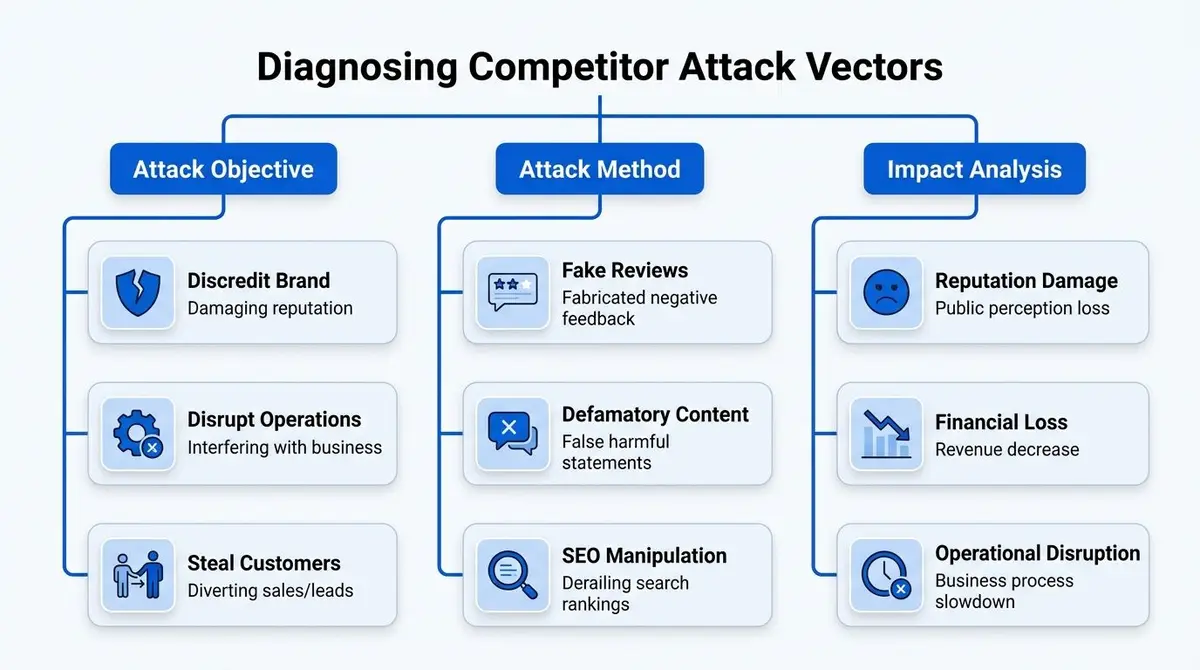
Competitor-led online attacks usually pursue one of three outcomes:
- Damage trust: Push prospects, investors, regulators, or counterparties to hesitate.
- Interrupt revenue: Divert leads, poison branded search, or create friction in sales cycles.
- Extract information: Use public data, impersonation, or phishing to pull staff into mistakes.
The right response starts with accepting that these campaigns are operational attacks with legal consequences. They aren’t PR annoyances.
Practical rule: Treat hostile online content the way you’d treat a breach allegation or whistleblower complaint. Restrict access, preserve records, and assign one decision-maker.
Why jurisdiction decides the outcome
C-suite teams often lose time at this point. They focus on what the content says and ignore where the content sits. That’s a mistake.
A review platform’s internal policy may give you a fast route to removal. A host may respond only to a tightly drafted abuse notice. A search engine may need a court order, a policy violation, or a de-indexing pathway tied to the source status. In Europe, privacy and data rights can provide an advantage that doesn’t exist the same way in the US. In the US, intermediary protections can make source removal harder, which means your strategy may shift toward identifying the poster, preserving claims, and targeting the weakest link in distribution.
If you misread jurisdiction, you burn your best arguments early and educate the attacker about your next move.
First 48 Hours The Containment and Evidence Protocol
The first two days decide whether this becomes a manageable removal matter or a sprawling reputational event. Act like a crisis operator, not a commentator.

According to AAG’s cyber crime statistics summary, 50% of UK businesses faced cyber attacks in 2023, and the global average cost of a data breach reached $4.88 million in 2024. For an executive under attack, that matters because delay turns a contained reputational event into a business systems problem, a customer trust problem, and sometimes a regulatory problem.
Lock down communications
Your first job is to stop unforced errors.
Set a temporary rule of silence. No employee responds publicly. No one contacts the poster. No one speculates in writing about who’s behind it. Internal chatter creates discoverable material and gives rumor the same status as evidence.
Create a small response cell. It should usually include legal, security, one executive sponsor, and one operator responsible for evidence control. If your team already uses a dashboard for reputation monitoring, route all incoming findings there so you have one record, not ten contradictory screenshots in group chats.
Preserve evidence before it disappears
Attackers delete, edit, and repost. Platforms also change display states without warning. Preserve everything immediately.
Use a disciplined capture process:
- Record the live URL: Save every page, profile, post, image, and review URL.
- Capture screenshots with visible timestamps: Include the browser window, date, and surrounding context.
- Save page source or exports where possible: Don’t rely on screenshots alone if the platform allows downloads.
- Preserve email headers and message metadata: If impersonation or phishing is involved, keep the full message data.
- Log chronology: Note when the content first appeared, when it was discovered, and who accessed it.
What not to do
A short list of bad moves saves clients from expensive cleanup later.
- Don’t argue in public: You give the attacker attention and often trigger copies.
- Don’t threaten legal action from a personal account: That can be screenshotted and reframed.
- Don’t ask junior staff to investigate: They often alert the attacker.
- Don’t delete your own internal records: Even embarrassing material may become necessary evidence.
The executive who speaks first often becomes the story. The executive who preserves evidence usually wins the case.
Separate incident types early
Not every hostile event belongs in the same workflow. Put each item into one of these buckets immediately:
| Incident type | Immediate owner | Primary risk |
|---|---|---|
| Fake reviews or defamatory posts | Legal and reputation lead | Customer trust damage |
| Impersonation or phishing | Security and legal | Fraud and account compromise |
| Search ranking collapse or toxic backlinks | SEO and legal | Lead loss and discoverability harm |
| Leaked material or private data exposure | Legal, security, exec sponsor | Escalation across jurisdictions |
This triage matters because each category has a different evidence standard and a different removal path.
Control the internal narrative
Your staff will talk. Give them a disciplined holding line.
Tell them the company is reviewing unauthorized online activity, all media and platform inquiries must go to one contact, and nobody should respond independently. Keep it short. The point isn’t morale. The point is containment.
Diagnosing the Attack Vector Beyond Surface-Level Symptoms
Most executives misdiagnose competitor attacks because they look at the visible content rather than the attack architecture. A fake review campaign, a ranking collapse, and a spoofed social account may be one coordinated operation, not three separate headaches.
Review bombing and testimonial fraud
Review attacks are usually the easiest to spot and the easiest to underestimate. The obvious sign is a sudden cluster of low-quality reviews. The more useful signs are repetition in language, policy-trigger terms, geographic mismatch, and reviews that describe an experience no real customer would describe that way.
This category isn’t just about ratings. It’s often designed to create searchable allegations that sales prospects will repeat back to your team.
Defamation disguised as opinion
Competitors rarely publish clean, actionable defamation. They mix fact claims with rhetorical opinion to make removal harder. A post that says your company is “dishonest” may be noise. A post that states false specifics about fraud, safety, misconduct, or contract performance is a different matter.
Your team should isolate the verifiable statements from the insults. Platforms and courts respond to different arguments. Policy enforcement often hinges on abuse, impersonation, or manipulated behavior. Legal enforcement depends on falsity, harm, and identification.
Negative SEO and search suppression
This category feels abstract to non-technical executives because the damage shows up as declining inbound leads, not a visible attack. In practice, it often looks like toxic backlinks, copied pages, spam anchors, or coordinated attempts to raise hostile pages above your owned assets.
The key diagnostic question is simple. Did your search visibility fall because your market changed, or because someone manufactured bad signals around your name, domain, or key pages?
Impersonation and social engineering
If an attacker knows executive names, assistant details, old contact data, or partner relationships, they may not be trying to embarrass you first. They may be trying to harvest payment approvals, customer credentials, or sensitive internal information.
That’s why reputational attacks and security incidents often overlap. A fake account aimed at customers can quickly become a fraud problem. A smear campaign aimed at staff can become a credential-theft problem.
A hostile review is public theater. An impersonation campaign is often prelude to theft.
Leaks and selective disclosures
Leaked documents, screenshots, or edited recordings deserve special handling because they create emotional pressure inside the company. Teams become obsessed with proving context. That’s understandable and often counterproductive.
The first question isn’t whether the material is embarrassing. It’s whether it’s authentic, altered, unlawfully obtained, contractually restricted, or posted with personal data that provides grounds for privacy action in one or more jurisdictions.
A better diagnosis model
Use this sequence before you authorize any takedown language:
- What is the attacker trying to make happen commercially
- Which platform or host is distributing the harm
- Which jurisdiction governs the host, the victim, and the likely attacker
- Which pressure point is strongest first, policy, privacy, copyright, defamation, fraud, or court order
Executives who answer those four questions early stop wasting days on the wrong remedy.
Executing Takedowns via Platform and Legal Channels
Removal succeeds when you run two tracks at once. One is platform enforcement. The other is legal pressure. If you rely on only one, you give the attacker room to repost, relocate, or wait you out.

For review-site defamation, Vorys reports that direct platform takedowns succeed in 70-80% of cases when there is a clear policy violation. For anonymous attackers, a John Doe lawsuit has a 60-90% success rate in unmasking perpetrators, and full legal processes can achieve over 90% resolution. Those figures tell you something important. Speed matters, but strategic advantage matters more.
Start with the platform when policy is your strongest argument
Platforms don’t remove content because your executive team is upset. They remove content when you fit their internal rule set cleanly.
That means your submission should be framed around the platform’s own categories, not your preferred legal narrative. On review sites, the winning argument may be fabricated experience or coordinated manipulation. On social platforms, it may be impersonation, harassment, or fraudulent behavior. On websites and hosts, it may be abuse, privacy exposure, or copyright infringement.
A weak takedown request reads like a complaint. A strong one reads like a policy memo with exhibits.
Platform-first cases usually include
- Fabricated reviews: No genuine customer relationship, repeated language, impossible timelines.
- Impersonation accounts: Fake executive or brand profiles contacting customers or staff.
- Unauthorized images or copied content: Material that supports a DMCA route where applicable.
- Harassment and doxxing: Posts exposing private details or coordinating abuse.
Escalate legally when anonymity or persistence changes the game
If the attacker is hiding behind throwaway accounts, reposting after removal, or operating across multiple hosts, you need legal escalation fast. Executives often hesitate at this stage because they don’t want to “make it bigger.” In reality, delay gives an anonymous attacker time to destroy platform records.
A properly timed preservation demand and John Doe action can force platforms to retain logs and identifying information before routine deletion cycles wipe them out.
Board-level view: If the attacker is anonymous and commercially motivated, assume evidence is perishable and act accordingly.
Jurisdiction is not a footnote
Cross-border attacks require jurisdiction-specific sequencing.
In the EU, privacy rights can provide a strong basis for source removal, de-indexing, and objections to personal data processing. In the US, intermediary protections often mean the host may resist liability even when the content is ugly, which shifts pressure toward the user, the account identity, the advertiser, or the upstream source of the material. In other markets, criminal complaint pathways or local court orders may be more practical than a long civil strategy.
A CEO with operations in multiple countries shouldn’t ask, “Can this be removed?” Ask, “Where is the fastest enforceable point of control?”
Here’s the strategic difference:
| Scenario | First move | Why |
|---|---|---|
| Fake reviews on a major platform | Platform policy submission with evidence pack | Fastest route if behavior clearly violates platform rules |
| Anonymous smear on a niche site | Preservation demand and John Doe preparation | Identity and logs may disappear |
| Impersonation with customer contact | Platform fraud report plus legal notice | Stops immediate harm while building record |
| Cross-border privacy exposure | Jurisdiction-specific privacy request | Rights and remedies differ by location |
A short explainer may help your internal team align on takedown mechanics before outside counsel finalizes filings:
Run removal and de-indexing together
Executives often treat source removal and search cleanup as separate projects. That’s inefficient. If a page is removable, pursue source takedown. If a page won’t come down immediately, work the search layer in parallel where lawful grounds exist. One without the other leaves residual harm in branded search, media monitoring systems, and customer due diligence.
Where external support is needed, firms such as ContentRemoval.com handle source removal, search de-indexing, and ongoing monitoring as one coordinated workflow rather than isolated tickets.
Dismantling Negative SEO and Search Manipulation Campaigns
Negative SEO is the attack many leadership teams notice last and feel most helpless about. Revenue slips first. Branded search weakens next. Then someone says the usual line, “Maybe the algorithm changed.” Sometimes it did. Sometimes a competitor pointed toxic signals at your site and counted on you to dismiss the evidence.
The business issue is straightforward. Search manipulation reduces discoverability at the exact moment buyers are validating your credibility.
What to look for first
Negative SEO usually leaves a pattern. You’ll often see sudden backlink spikes from irrelevant domains, anchors that don’t match your brand language, copied pages appearing elsewhere, or a drop in rankings tied to pages that previously held steady.
The first pass should be forensic, not interpretive. Pull data from Google Search Console, Ahrefs, or SEMrush and compare the timing of ranking loss with the appearance of suspicious links or duplicate content.
According to Negative SEO Expert, alerts from tools like Google Search Console can detect 80% of spam profiles within 48 hours, and a combination of disavowing toxic links and submitting detailed webspam reports yields a 65-85% ranking recovery rate. That means the teams who monitor continuously usually get a very different outcome from the teams who investigate after a quarterly traffic review.
The response sequence
Don’t overcomplicate this. Run an ordered process.
- Confirm the anomaly: Establish whether the ranking loss aligns with hostile link growth, content scraping, or manipulative anchor patterns.
- Classify suspect links: Separate obvious spam from links that are merely low authority. Overreaction creates new problems.
- Prepare a disavow file carefully: Include domains or URLs that are clearly toxic and irrelevant.
- Submit a webspam report: Keep it factual and specific.
- Strengthen your own assets: Improve authoritative pages, branded entities, and trusted references so hostile noise has less room to rank.
- Track recovery weekly: You’re looking for stabilization, then improvement.
Two mistakes that prolong damage
The first mistake is over-disavowing. If your team dumps legitimate links into a disavow file because they’re nervous, you can weaken your own authority.
The second mistake is treating negative SEO as a purely technical clean-up. If the same attacker is also pushing false pages, copied content, or hostile results, you need a search removal strategy as well. That’s where a clear understanding of what de-indexing is and how search result removal works becomes operationally useful, not theoretical.
Search attacks rarely end because you submitted one file. They end when the hostile signals are neutralized and your trusted assets regain control of the page.
Resilience matters as much as remediation
A vulnerable search profile is one where your branded results are thin, fragmented, or overly dependent on one domain. Build redundancy. Publish stronger executive bios, maintain controlled properties, improve factual third-party profiles, and keep your core pages current.
That doesn’t mean flooding the internet with fluff. It means building enough legitimate authority around your brand that manipulation has a harder time taking hold.
Building a Proactive Digital Defense System
If you only respond after the attack is visible, you’re already operating from a weaker position. Executives who face recurring harassment, aggressive competitors, or cross-border exposure need a standing defense system, not a sequence of emergency fixes.
The strongest programs do three things at once. They reduce available attack surface, increase early detection, and make your legitimate assets harder to displace.

One defensive layer matters more than most executives realize. According to Cloaked’s analysis of data broker removals, analysis of over 170 million removed records in 2025 showed a 70%+ decrease in targeted phishing attempts for individuals who underwent thorough data broker removal. For a founder, CEO, or family office principal, that’s not a privacy side issue. It directly shrinks the information competitors and hostile actors can weaponize.
Remove the raw material attackers use
Competitor attacks often rely on public scraps that should never have been easy to assemble in the first place. Executive email patterns, family names, old addresses, direct mobile numbers, corporate affiliations, shell entities, and historical contact data all make phishing, impersonation, and intimidation easier.
Data broker removal reduces the attacker’s intelligence base. It doesn’t make you invisible. It makes targeting you slower, costlier, and less precise.
That’s why I treat data exposure reduction as a board-level control for public-facing leadership teams.
Build a monitoring stack that sees the campaign early
Reactive discovery is expensive. You want alerts before a post starts ranking or a fake profile contacts customers.
A practical monitoring stack usually includes:
- Brand mention monitoring: For executive names, company names, product names, and key allegations.
- Review platform surveillance: Especially where buying decisions are influenced quickly.
- Dark web and credential monitoring: To catch compromised accounts or leaked credentials.
- New domain and impersonation tracking: To identify lookalike domains and spoofed profiles.
- Search result watchlists: For branded queries tied to executive and company reputation.
This isn’t glamour work. It’s what turns a reputational ambush into an administratively manageable incident.
Control the first page before someone else does
Most companies leave branded search undefended. They assume the market will naturally surface the right assets. That assumption fails the moment someone invests in suppressing, attacking, or reframing your name.
You need a deliberate portfolio of assets that can hold top positions: company pages, executive bios, verified profiles, trusted interviews, factual thought leadership, and controlled reference pages that answer the questions buyers and journalists search.
A resilient search profile doesn’t look promotional. It looks authoritative, current, and difficult to dislodge.
If you don’t build your own search perimeter, an attacker will build one around you.
PR is useful, but only inside a legal and search strategy
Many executives call PR first because they want narrative correction. Sometimes that’s right. Often it’s incomplete.
Public relations can help after removal pathways are underway and factual assets are ready to rank. If you’re considering external communications support, understand what a specialist engagement involves before you hire a boutique PR company.com/boutique-pr-company/). PR can reinforce credibility. It can’t subpoena an anonymous reviewer, preserve platform logs, or force source removal.
Treat PR as one layer in the defense system, not the defense system itself.
Establish executive-grade governance
A proactive defense system fails when it has no owner. Give it one.
For most organizations under meaningful exposure, governance should include:
| Control area | Executive question | Operational answer |
|---|---|---|
| Monitoring | Who sees attacks first | Named owner with escalation protocol |
| Evidence | Where records are stored | Centralized, access-restricted archive |
| Legal routing | Which counsel acts where | Jurisdiction-specific response map |
| Search control | Which assets defend our name | Maintained portfolio of authoritative pages |
| Data exposure | What’s publicly available about leadership | Ongoing broker removal and privacy review |
The strategic shift that matters
The companies and principals who recover fastest don’t just remove hostile material. They become harder to attack well.
That means fewer exposed data points, better search control, faster evidence preservation, cleaner internal escalation, and legal pathways already mapped before the next incident appears. Once you build that system, the next attack is still unwelcome. It’s no longer destabilizing.
Conclusion From Reactive Crisis to Proactive Control
A competitor attack feels chaotic because it’s designed to break your sequencing. The attacker wants you emotional, public, and late. The disciplined response does the opposite. You preserve evidence, centralize decisions, diagnose the actual vector, and apply the right removal pressure in the right jurisdiction.
That is the difference between noise and control.
The deeper lesson is this. Removing content is only one part of the work. The stronger objective is to deny hostile actors distribution, credibility, and usable intelligence. That requires more than a takedown form and more than a lawyer threatening action on firm letterhead. It requires coordinated execution across platform policy, search strategy, evidentiary preservation, privacy protections, and jurisdiction-specific legal tools.
Cross-border matters are where that discipline becomes decisive. A US-hosted review, an EU privacy angle, a social platform headquartered elsewhere, and a search result visible everywhere can’t be handled with one generic script. Each layer has its own point of strategic advantage. Your job as an executive is not to master every rule. It’s to make sure your response team does not confuse speed with recklessness.
If your business is under active attack, keep your internal circle small. Preserve everything. Don’t negotiate with anonymous accounts. Don’t let marketing improvise legal language. Don’t let legal ignore search distribution, and don’t assume that because content is visible, it is untouchable.
Complex attacks are removable. Persistent attackers are identifiable more often than they expect. Search damage is repairable. But only if the response is methodical from the start.
The firms that handle these matters well don’t just clean up a mess. They restore decision-making authority to the client. That’s what you need when reputation, revenue, and personal exposure are all on the line.
If you need discreet help to remove competitor attacks online, ContentRemoval.com handles confidential assessments, source takedowns, de-indexing strategy, impersonation and defamation removal, and ongoing monitoring for executives, brands, and high-profile clients dealing with coordinated attacks.
Frequently asked questions
What should I do first when a competitor attacks my business online?
Preserve everything before anyone responds: live URLs, timestamped screenshots, page source, message headers and a chronology. Set a rule of silence so no employee replies publicly or contacts the poster, and assign one decision-maker with a small response cell of legal, security and an executive sponsor.
Can I sue a competitor for fake reviews and anonymous posts?
You can, and the article notes that a John Doe action combined with a preservation demand can force platforms to retain logs before routine deletion wipes them. Legal escalation is most useful when the attacker hides behind throwaway accounts, reposts after removal or operates across several hosts.
How do I know if negative SEO is behind my ranking drop?
Look for sudden backlink spikes from irrelevant domains, anchors that do not match your brand language, copied pages elsewhere and ranking losses on pages that previously held steady. Pull data from Google Search Console or a backlink tool and compare the timing of ranking loss with the appearance of suspicious links.