
To remove a bar complaint from the internet, classify what is ranking first: an official bar page, a news article, a complaint site or a scraper each needs a different approach. Contain visibility through host requests and de-indexing, petition the bar authority if the complaint was dismissed or erroneous, suppress durable results with authoritative assets, and monitor because copies reappear.
Key facts
- Use a different theory per audience: record integrity for the bar, policy categories for search engines, terms for hosts.
- Ask a host for one action only: deletion, correction, redaction or a noindex tag.
- Scraper and duplicate copies are often easier to remove or de-index than the original source.
- Frame bar petitions as record correction or status accuracy, never as embarrassment or lost business.
Where ContentRemoval.com comes in. ContentRemoval.com works with attorneys, partners and general counsel whose bar complaint or disciplinary listing is ranking beside their firm bio, has been copied to complaint sites, or is surfacing during lateral moves or client pitches. The lawyer usually calls directly, sometimes through the firm’s marketing or risk team. A free, confidential 15-minute Exposure Scan maps every ranking copy and which can be removed, de-indexed or corrected, and the report is yours to keep. Get a Free, Confidential Exposure Scan or read how our content removal work is done.
The call usually comes after midnight. A partner, GC, or founder searches their own name because a colleague hinted at “something online,” then finds a bar complaint sitting in search results beside their firm bio, board appointment, and media coverage. They don’t need a lecture on internet hygiene. They need a plan that protects clients, referrals, deal flow, and licensing risk before the result starts circulating internally.
If you’re trying to remove bar complaint from internet search results, treat it as a legal crisis with search-engine consequences, not a generic reputation problem. The wrong first move makes the matter louder. A sloppy demand letter gets reposted. An emotional email to a webmaster becomes an exhibit. A premature lawsuit turns a low-visibility complaint into a searchable news item.
The right approach is layered. First, classify the source and the exposure. Then contain visibility fast through takedowns and de-indexing where available. If the complaint itself is erroneous, dismissed, outdated, or non-adjudicated, pressure the record owner and related publishers with a disciplined legal record. If the source won’t come down, suppress it with stronger assets and keep monitoring because reappearance is common.
The Initial Assessment A Strategic Triage
The first hour matters because panic creates bad strategy. I’ve seen lawyers fixate on the complaint text when the actual issue was the search result title. I’ve also seen professionals waste a week fighting a scraper site while an official disciplinary listing sat untouched on page one under their name.

A proper triage starts with one question. What exactly is ranking? Not all bar complaint exposure is the same. An official bar page, a legal news article, a forum thread, a complaint aggregator, and a scraped archive each require a different response path.
Classify the source before you touch it
Use a simple source map:
| Source type | Typical leverage | Primary objective |
|---|---|---|
| Official bar or regulator page | Record correction, sealing, amendment, privacy argument | Change or limit the underlying record |
| News article | Accuracy challenge, update request, negotiated noindex | Reduce visibility, preserve newsroom relationship |
| Complaint or forum site | Terms of service report, admin outreach, noindex negotiation | Source removal or de-indexing |
| Scraper or mirror | Host complaint, search de-indexing, repeat enforcement | Fast containment and recurrence control |
This sounds basic. It isn’t. Most failed campaigns collapse because the attorney treats all publishers the same. A bar authority cares about procedural status and record integrity. A search engine cares about policy categories. A forum moderator cares about terms of service and administrative burden.
Practical rule: Never send the same narrative to the bar, the host, and the search engine. Each audience needs a different theory.
Measure visibility, not just existence
A complaint online is a problem. A complaint ranking on a name search is a commercial threat. Search your full name, common variations, firm name plus your name, and practice-specific combinations. Then check whether the result appears with sitelinks, snippets, cached copies, image results, or reposts on secondary domains.
Your risk profile usually falls into one of three buckets:
- Contained exposure: the item exists but doesn’t rank prominently for your name.
- Active exposure: the item appears on page one or page two for direct name searches.
- Expanding exposure: the item is being copied, discussed, or attached to other narratives like firm reviews or litigation coverage.
That classification decides pace. Contained exposure gives you room to work discreetly. Active exposure requires immediate de-indexing and contact strategy. Expanding exposure means you need parallel tracks at once, because the internet punishes delay.
Separate removable content from suppressible content
A high-profile professional often asks the wrong question first: “Can this be deleted?” Sometimes yes. Often no. Instead, the strategic question is narrower and more useful: Can this specific publication be challenged, de-indexed, amended, noindexed, or outranked?
Think in two categories:
- Directly challengeable content includes erroneous filings, duplicate pages, privacy-violating reposts, outdated references after expungement, and pages violating platform terms.
- Legally durable content includes accurate public reporting and official records that remain lawfully published.
If you misclassify durable content as removable, you burn time and create more records. If you misclassify challengeable content as permanent, you surrender an advantage you have.
The complaint itself may be the least important issue. The ranking page, the snippet, and the copy sites often do more immediate damage than the original record.
At this stage, don’t threaten. Preserve screenshots, URLs, indexed search queries, publication dates, and any discrepancies between the original record and what’s ranking. Build a clean file. The lawyer who documents precisely usually has options. The lawyer who reacts emotionally usually creates new problems.
Immediate Takedowns and De-indexing Tactics
At 7:15 a.m., a managing partner searches her name before a client pitch and sees a bar complaint result on page one. By 9:00, colleagues have seen it, the client has likely seen it, and delay has become part of the problem. In that moment, the job is containment. Reduce visibility first. Then decide which path gets you to a permanent fix.
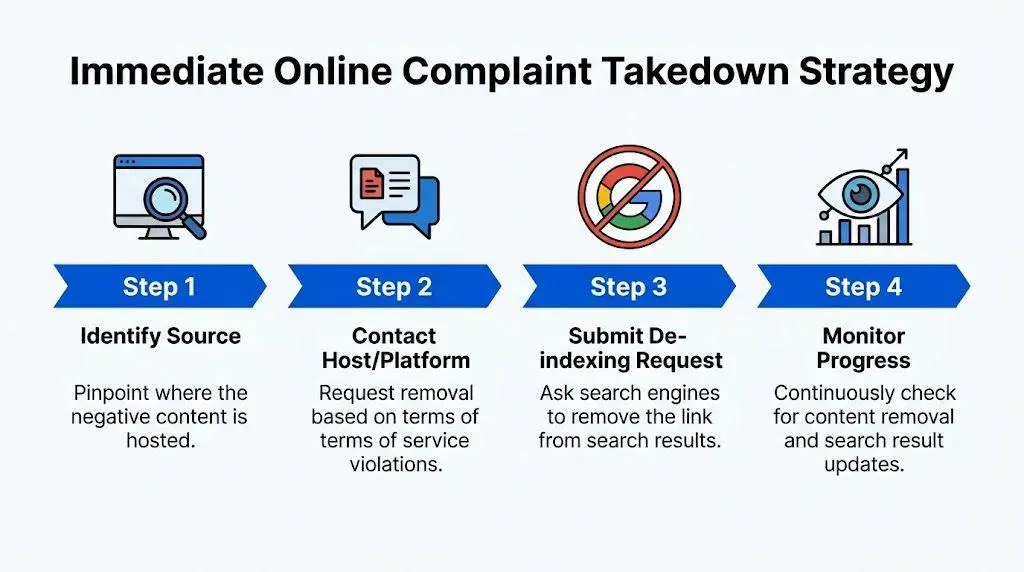
Platforms and search engines do not respond to indignation. They respond to category match, documentation, and a clean request. Send dates, screenshots, status records, direct URLs, and a short explanation written like an operations memo. High-stakes reputation work is won by precision.
Go to the host first when there is a credible removal path
If a site owner, editor, or platform moderator can act, contact them immediately. Keep the request narrow. Ask for deletion, correction, redaction, or a noindex tag. Do not ask for all four.
Your message should include:
- The exact URL and page title.
- The defect. Dismissed, inaccurate, outdated, duplicate, privacy-invasive, or posted without context.
- The requested action. One action only.
- Proof that supports the request. Nothing extra.
Tone matters. A concise administrative request gets read. A wounded essay gets ignored. If you plan to escalate later, start with a record that makes you look disciplined and reasonable.
Use de-indexing to cut visibility while the larger case develops
Search removal and source removal are different remedies. Treat them that way. If the page qualifies for de-indexing under platform or search policies, file that request at once. Waiting for the publisher to cooperate wastes time you do not have.
The California Attorney General cyber exploitation practices page outlines forms of search removal and noindex-based containment for qualifying content. For practical execution, this strategic guide to de-indexing explains the operational difference between removing a result from search and removing the underlying page.
That distinction matters because reputation harm usually happens at the search layer first. The ranking URL, the title tag, and the snippet often do more damage than the source record itself.
Use three tracks where the facts support them:
- Search engine removal requests tied to privacy, policy, or other qualifying violations.
- Publisher noindex requests when deletion is unlikely but search suppression is possible.
- Interim containment measures while correction, amendment, or formal record challenge is underway.
Search visibility is a distribution problem. If you cut distribution fast, you buy time to solve the underlying record properly.
Match the tactic to the publishing environment
A forum post, a complaint aggregator, a news archive, and an official database do not respond to the same pressure. Handle each one according to its rules and incentives.
- Anonymous forums and complaint sites: Focus on impersonation, harassment, privacy exposure, spam signals, and inconsistencies with the underlying record.
- Social and user-generated platforms: Use terms-of-service reporting first. It is often faster than lawyer-to-lawyer correspondence.
- Legitimate publishers: Request a correction when the content is materially wrong. Request noindex when the publisher will keep the page live but has no strong editorial reason to keep it prominently searchable.
- Scraper and duplicate sites: Attack the copied version first. These sites are often easier to remove or de-index than the original source.
An integrated strategy beats generic takedown advice. You are not chasing a single delete button. You are building pressure across the host, the search layer, and the legal record at the same time, with the goal of permanent resolution rather than temporary relief.
Run the workstreams in parallel
Sequential response is too slow for a high-profile lawyer. Start host outreach, platform reporting, and search requests together if the facts support each one. A rejection in one lane often gives you language or evidence that strengthens another lane.
Use a disciplined first-response checklist:
- Capture evidence immediately: Live URL, search result, snippet, cache, and timestamp.
- Confirm the status of the matter: Pending, dismissed, erroneous, expunged, resolved, or never adjudicated.
- Send one clean administrative request: Short, factual, documented.
- File search requests without delay: If the result independently qualifies, do not wait for the host.
- Log every response: Rejection language often reveals the next viable argument.
Lawyers who improvise usually create a mess of inconsistent requests and weak records. Lawyers who treat this as a coordinated legal-tech operation usually get better outcomes, faster.
Engaging Bar Authorities and Legal Remedies
At some point, visibility control isn’t enough. If the underlying record is wrong, stale, incomplete, or unfairly exposed, you need to engage the institution that created or maintains it. That is where many lawyers hesitate, usually because they assume a bar authority is immovable. Sometimes it is. Sometimes it isn’t.

The core question here is not whether a complaint once existed. The question is whether the current public presentation is accurate, proportionate, and procedurally justified.
When the record itself should be challenged
In the U.S., public records from bar complaints can remain online indefinitely. But there are formal channels for recourse. The Justia discussion of dismissed court-case and record removal issues states that erroneous filings can represent 15-20% of the total, and legal teams can pursue retraction with an 80% success rate in suppressing them from search results. The same source notes that dismissed cases make up 30-40% of filings and often remain visible, while Google’s de-indexing tools were used to remove 2.5 million URLs in 2023 under privacy policies for outdated content such as expunged bar complaints.
Those figures matter because they support a direct, non-apologetic position: if the filing is erroneous or the matter was dismissed, you should not treat the current online footprint as untouchable.
Build the argument like a record lawyer
Bar authorities respond to procedure and documentation. A vague plea for fairness is weak. A disciplined record package is much stronger.
Include a chronology that shows:
| Record issue | What to submit |
|---|---|
| Erroneous filing | Proof of inaccuracy, correspondence, docket or bar status materials |
| Dismissed complaint | Dismissal documentation, final disposition, current harm from continued indexing |
| Outdated publication | Passage of time, completed sanctions if any, rehabilitation evidence, current professional standing |
| Misleading third-party summary | Source record compared against the inaccurate repost |
The strongest petitions don’t argue abstract reputation harm alone. They show mismatch. The online publication says one thing. The actual status says another. Institutions take that seriously because it is a record-integrity problem, not a vanity complaint.
A bar authority is far more likely to consider a request framed as record correction, privacy update, or status accuracy than a request framed as embarrassment.
After you establish the official position, extend that paper trail outward. Any news outlet, scraper, directory, or complaint site summarizing the matter now has less room to resist correction or noindex requests.
Here is a useful legal-strategy reference on high-stakes internet defamation and content removal if the matter also involves false amplification beyond the original bar record.
When court action is justified
Litigation is a tool, not a reflex. Use it when the publication is false, materially misleading, maliciously amplified, or repeated after clear notice. Don’t use it solely because a result offends you.
The practical threshold is high. You need a provable false statement of fact, measurable harm, and a forum that won’t convert your filing into a larger searchable event. If a complaint site has repackaged a dismissed or erroneous bar matter into a defamatory accusation, then a court order may become the cleanest path to source removal and stronger search requests.
A short briefing often helps clients understand the terrain before formal escalation:
What not to do with a regulator
Don’t accuse the bar of causing your business losses in the opening letter. Don’t overstate constitutional claims. Don’t threaten media exposure. Those moves usually harden resistance.
Use a restrained ask. Ask for amendment, sealing where available, correction of procedural status, privacy review, or limitation of public indexing where the rules permit. If the institution declines, that answer still helps. It sharpens the next phase, because your takedown and suppression strategy can now distinguish between the official record and the unauthorized ecosystem that copied it.
Strategic Suppression for Unremovable Content
Some content won’t come down because it is legally hosted, factually grounded, or sheltered by public-interest arguments. You still have a serious problem if it ranks well. That is where many lawyers make a second mistake. They confuse “can’t delete” with “must accept.”
You do not need to erase every negative page to control what clients, referral sources, reporters, and opposing counsel see first. You need to change the search environment around your name.
Suppression is not cosmetic
Suppression gets dismissed as vanity work by people who’ve never had a client walk into a pitch meeting after reading page one of Google. Search rankings create first impressions long before anyone reads the full underlying record.
The precedent from the Google Spain ruling established the right to be forgotten in the EU, and by 2023 Google had processed over 1.65 million such requests, according to Super Lawyers’ discussion of online content removal and RTBF. That same source says these strategies have been used to reduce visibility of bar complaints and regulatory issues by up to 90% in name-based searches after successful de-indexing or suppression campaigns.
The U.S. doesn’t offer the same legal framework. The search logic still applies. If stronger, relevant, high-authority pages occupy the first results for your name, the complaint loses practical reach.
Build assets that deserve to rank
Weak suppression fails because the assets are thin, duplicated, or obviously manufactured. If your response consists of three empty profile pages and a low-quality press release, you’re wasting time.
A strong suppression portfolio usually includes:
- Your controlled professional assets: firm bio, attorney directory profiles, speaking pages, and board or academic affiliations.
- Credible third-party authority pages: podcast appearances, authored commentary, conference features, and professional association contributions.
- Topical thought leadership: material tied to the exact practice areas people search with your name.
What ranks best is what search engines see as relevant, authoritative, and consistent. If the complaint targets ethics or trust, your counterweight should not be fluffy branding. It should be serious legal analysis, published under your name, on reputable sites, connected to your real body of work.
Use relevance, not volume, to push results down
A search result tied to your name usually holds position because of one of three things. It has strong domain authority. It matches the search query exactly. It has engagement history. Your replacement strategy must attack at least two of those advantages.
For a lawyer, that often means this sequence:
- Clean up and unify every controlled profile under one naming convention.
- Publish authoritative pieces on subjects your clients and peers already associate with you.
- Strengthen third-party citations so your best pages reinforce each other.
- Update stale bios and profiles so search engines recrawl fresh, coherent material.
If the negative page is about your name, your response pages must also be about your name. Generic firm marketing won’t dislodge a personalized complaint result.
Suppression is especially effective when paired with earlier de-indexing attempts. If one or two negative URLs can be pushed lower while stronger assets rise, the combined effect is often more durable than either tactic alone.
The strategic mindset that works
Lawyers often resist suppression because it feels indirect. That’s a mistake. In high-stakes matters, suppression is often the most realistic route to commercial protection when formal removal rights are limited.
Think like trial strategy, not housekeeping. You are shaping the record that the public sees. If the complaint cannot be erased, you can still make it less accessible, less central, and less defining.
Long-Term Monitoring and Proactive Defense
A partner resolves a bar complaint issue, sees the result drop, and assumes the matter is closed. Three months later, a copied version appears on a scraper site, an old URL slips back into the index, and a client finds it before the firm does. That is how reputational damage returns. Initially unnoticed, then all at once.

Reappearance is part of the threat model
If your strategy ends with one successful takedown request or one round of suppression, you do not have a resolution plan. You have a temporary win.
Removed pages get republished. Old links get recrawled. Complaint text gets copied into forums, people-search pages, low-grade blogs, and AI-generated directory sites. High-profile legal professionals attract this kind of repetition because their names carry search demand. Once a complaint has circulated, you should assume some form of recurrence and build around it.
That changes the objective. The goal is not just removal. The goal is permanent control through detection, fast response, and repeatable process.
What a defense system should cover
A serious program tracks more than a few Google Alerts. It watches the places where recurrence starts and separates minor noise from material risk.
Your monitoring should cover:
- Name variations: full name, shortened versions, misspellings, firm-name combinations, and practice-area modifiers
- Known risk sources: complaint boards, scraper networks, legal gossip sites, people-search domains, and cached or archived copies
- Search movement: changes in ranking, reindexing of old URLs, and new pages that begin associating your name with the complaint
- Response workflow: evidence capture, platform reporting, counsel review, and decision rules for escalation
That last point matters. A reposted copy, a commentary article, and a resurfaced indexed page are three different problems. Treating them the same slows response and increases exposure.
Speed decides whether recurrence becomes a problem
The right time to act is before the page gains traction, gets screenshotted, or gets copied again. Delay gives the content more authority, more links, and more staying power.
Set fixed review intervals. Preserve evidence immediately. Route each incident through a clear decision tree. Reuse the arguments, documentation, and platform contacts that worked before. Senior professionals should not be drafting fresh responses every time a low-value site republishes the same allegation.
This is the difference between reactive cleanup and a managed defense program. Our executive clients do not rely on one tactic. They use a layered model. Remove what can be removed. Suppress what cannot. Escalate legally where the facts support it. Then monitor the entire search environment so the issue does not rebuild itself in the background.
For matters with recurring visibility risk, dedicated reputation monitoring systems give you earlier detection and cleaner escalation. That is how you keep a resolved complaint from becoming a quarterly emergency.
If you want to remove bar complaint from internet results and keep it out, treat monitoring as standing infrastructure. Anything less leaves your name exposed to the next repost.
Engaging a Professional Firm A Decision Framework
Some matters are manageable in-house. Many aren’t. The dividing line isn’t your intelligence or your willingness to work. It’s complexity, visibility, and the cost of getting the sequence wrong.
If the complaint appears on an obscure page, the facts are clean, and the source is cooperative, a limited direct-response effort may be enough. But if the result sits on page one for your name, has been copied across sites, or intersects with licensing, investor, board, or client concerns, the matter has outgrown DIY.
The situations that usually require outside intervention
A professional firm becomes the rational choice when one or more of these conditions exist:
| Situation | Why it changes the equation |
|---|---|
| The complaint appears on a major publication or official record site | Poor outreach can entrench the result or trigger wider attention |
| Multiple negative results cluster around your name | You no longer have a single-URL problem. You have a search-ecosystem problem |
| The complaint is being republished or mirrored | Source removal alone won’t solve recurrence |
| The matter mixes truth, error, and commentary | You need legal, technical, and editorial strategy at the same time |
| Your time horizon is short | Delay increases circulation and screenshot risk |
Strategic integration matters significantly. A lawyer alone may draft a strong letter but miss the search-side opportunity. A PR team may write favorable content but have no influence with hosts and platforms. A pure SEO vendor may suppress clumsily and create obvious footprint manipulation. High-stakes matters need all three disciplines working in sequence.
Litigation is often the wrong default
Many lawyers instinctively reach for litigation because it feels formal and familiar. That instinct is understandable and often counterproductive.
According to the Cato policy analysis discussing Section 230-related litigation pressures and adjacent online speech issues, litigation in this area can average $10K-$50K with no guaranteed outcome. The same source notes a more nuanced alternative: expert negotiation with bar associations can yield a 60% removal rate for non-adjudicated complaints. It also flags emerging threats such as dark web mirrors and AI-generated deepfake complaints, problems ordinary legal tactics don’t handle well, while professional firms use continuous AI monitoring to prevent 95% of recurrences that automated systems can catch.
That should reset your assumptions. Court may be necessary, but it is rarely the first efficient move. A disciplined firm will usually test administrative correction, host pressure, policy-based de-indexing, suppression architecture, and recurrence controls before recommending a suit.
What you’re actually buying
When a discerning client hires a specialist, they are not buying “reputation management” in the vague sense. They are buying judgment under pressure.
That includes:
- Triage discipline: identifying what can be removed, what can be corrected, and what must be suppressed.
- Message control: one set of facts, adapted correctly for regulators, publishers, hosts, and search engines.
- Operational speed: action within a narrow window before the issue spreads.
- Discretion: avoiding the kind of blunt-force tactics that turn a complaint into a larger story.
- Persistence: staying with the matter until recurrence risk is reduced, not just until one URL disappears.
A high-profile legal professional should care about discretion as much as success rate. The loudest vendors often do the most damage. Good operators don’t send inflammatory templates to everyone in the chain. They build a record, utilize the simplest advantages first, and escalate only when it improves the outcome.
A blunt framework for deciding now
Ask yourself four questions.
First, is this result already affecting how discerning people evaluate you? If yes, act immediately.
Second, is the complaint the only problem, or has it created a cluster of linked pages, snippets, reposts, and commentary? If it’s a cluster, you need coordination.
Third, can you personally manage a process that may require repeated admin outreach, platform filings, evidence packaging, suppression planning, and monitoring without making an avoidable mistake? Most busy partners and executives can’t, and they shouldn’t pretend otherwise.
Fourth, what is the cost of delay? Not emotionally. Professionally. Lost clients, reduced trust inside a boardroom, questions from compliance, awkward explanations during lateral discussions. Those costs usually exceed the price of getting expert help early.
The professionals who handle this best are not the most aggressive. They are the most methodical. They know when to push a platform, when to negotiate a noindex, when to petition the underlying authority, when to bury a result, and when to leave no public footprint while doing any of it.
If you are serious about removing or neutralizing a bar complaint online, stop treating it as a single takedown problem. It is a record problem, a search problem, and a recurrence problem. Solve all three or expect it to return.
If a bar complaint, disciplinary listing, or complaint-site result is threatening your name, your practice, or your firm, get a confidential assessment from ContentRemoval.com. Their team handles high-stakes online content removal, de-indexing, suppression, and monitoring for executives, public figures, and legal professionals who need speed, discretion, and a strategy built for permanent risk reduction.
Frequently asked questions
Can a dismissed bar complaint be removed from Google?
Often the visibility can be reduced even where the record persists. Dismissal documentation supports host correction requests, search de-indexing where policies allow, and a petition to the bar authority for amendment or limited indexing. Scraper copies that repackage a dismissed matter are frequently removable outright.
Should I sue a website that posted my bar complaint?
Only when the publication is false, materially misleading, maliciously amplified or repeated after notice, and when a filing will not turn a low-visibility complaint into a searchable news item. Administrative correction, host pressure, de-indexing and suppression usually come first.
How do I push a bar complaint down in search results?
Build assets that deserve to rank for your name: a unified firm bio and directory profiles, authored legal analysis on reputable sites, speaking and association pages. Relevance and authority move results, not volume, and pairing suppression with earlier de-indexing makes the effect more durable.