

To remove background check results online, treat the problem as a syndicated data network rather than one listing. Audit every name variant across search and broker sites, then match the pathway to the data: broker opt-outs for simple listings, status documents for dismissed or expunged matters, privacy rights for stubborn brokers, de-indexing for residual visibility, and monitoring because records reappear.
Key facts
- Advanced Background Checks opt-out verification links expire in 24 to 48 hours; suppression can start within 10 minutes.
- Around 40 to 60% of removed broker records reappear within 3 to 6 months through resyndication.
- Expungement changes the court record but brokers often keep displaying older cached copies.
- EU and UK data protection law can give stronger grounds when data is outdated or excessive.
Where ContentRemoval.com comes in. ContentRemoval.com handles background check exposure for executives and public figures when the same record has spread across brokers, involves a sealed or expunged matter, or is surfacing during investor diligence, board vetting or licensing. Counsel, a chief of staff or a family office usually initiates contact. A free, confidential 15-minute Exposure Scan maps every instance of the record and which levers apply to each, and the report is yours to keep. Get a Free, Confidential Exposure Scan or read how our content removal work is done.
A sensitive background check result rarely appears at a convenient moment. It shows up during investor diligence, board vetting, a lender review, a family office transaction, a licensing application, or a journalist’s search before publication. By the time you see it, someone else already has.
The instinct is to search your name, submit a few opt-outs, and hope the issue fades. That approach is too weak for a serious matter. If you need to remove background check results online, you need to treat the problem as a distributed data system with legal, technical, and jurisdictional moving parts. The visible profile is only the surface. The core issue is the network underneath it.
The Anatomy of an Online Background Check Crisis
For an executive or public figure, a background check result online is rarely just “an old record.” It becomes a credibility problem. A stale court entry, a dismissed matter, an expunged issue that should have disappeared, or even a low-level citation can be misread by someone scanning fast and judging faster. If you’re under pressure right now, that pressure is rational.
What most people misunderstand
There are two different worlds here. One is the regulated background screening environment tied to employment or tenant screening rules. The other is the sprawling broker ecosystem made up of people-search platforms, public-record aggregators, reseller feeds, and search-indexed profile pages. Most reputational damage happens in the second world.
That distinction matters because online background check sites don’t operate like a single database you can “fix” once. They ingest, republish, refresh, and copy from one another. One profile page gets removed, another appears. One search result drops, an older cached copy resurfaces elsewhere.
Practical rule: If the data exists on more than one broker, you do not have a listing problem. You have a syndication problem.
Typical advice online is too narrow. It assumes a U.S. resident, a U.S. broker, and a U.S. legal path. That leaves international clients exposed. Existing content on this issue remains heavily U.S.-centric, while a 2025 Eurobarometer survey found 68% of EU citizens are concerned about personal data appearing in background checks and only 22% are aware of effective removal mechanisms. The same analysis notes a 52% failure rate in self-service removals outside the U.S. when international jurisdiction becomes part of the problem, as discussed by Reputation Lawyers on background check removal.
Why high-value clients face a different risk profile
Executives, founders, and HNWIs don’t have the luxury of treating this as an annoyance. Their names are searched more aggressively, by more discerning parties, in more jurisdictions. They also trigger more secondary scrutiny. If a reviewer sees a stray entry, they often search adjacent issues. That’s why even seemingly minor topics, including whether traffic tickets can show up on background checks, can matter in a high-stakes review.
Three factors usually make the situation worse:
- Outdated data persists: a platform may display information long after the underlying matter changed.
- Search visibility amplifies everything: a result doesn’t need to be legally actionable to be commercially damaging.
- Cross-border enforcement gets messy: GDPR rights are stronger on paper in many cases, but enforcement and broker compliance can become fragmented once data crosses borders.
The correct response isn’t panic and it isn’t passivity. It’s controlled escalation based on audit, removal power, and monitoring.
Phase One Auditing Your Digital Footprint
Before you remove anything, build a precise map of what exists. Most clients skip this because they want immediate action. That mistake costs time. A rushed removal effort creates blind spots, and blind spots are where stale records survive.
Search like an investigator, not a consumer
Start with your exact legal name, then your common variations, prior names, initials, and any shortened public-facing version. Run those searches in standard web search, image search, and news search. Then combine the name with terms that often trigger broker or court-related results.
Use combinations such as:
- Name plus geography: city, state, ZIP, prior residence, or office location
- Name plus record terms: arrest, case, court, citation, lawsuit, mugshot, criminal, address
- Name plus role markers: CEO, founder, board member, physician, attorney, investor
- Name plus aliases: maiden name, former married name, alternate spellings
This is not about curiosity. It is about evidence collection.
Build a live evidence file
Create a master document or spreadsheet with every discovered instance logged individually. Each entry should include the URL, page title, the platform name, the kind of information shown, whether the page appears indexed by search engines, and a screenshot with a date stamp. If the page includes your address, relatives, prior employers, or case language, note that specifically.
The objective is to separate four categories that require different responses:
| Category | What it usually means | Immediate implication |
|---|---|---|
| Inaccurate identity match | Wrong person or merged profile | Fast dispute route may work |
| Accurate but outdated record | Underlying matter changed | Needs documentation and targeted removal |
| Expunged or sealed issue still online | Broker retained older copy | Likely requires escalation |
| Multi-site replication | Same data on many brokers | Single-site effort won’t hold |
Audit beyond Google
Google is only the front door. Many damaging entries sit on broker pages that don’t rank well until someone adds a city, age range, or former address. Manually inspect major people-search and background check platforms, then note where identical wording appears across multiple sites. Matching phrasing often reveals syndication.
If you need a deeper cleanup framework after the audit, a useful reference point is this guide to digital footprint cleanup for executives. Use that mindset here: document first, act second.
A weak audit creates a false sense of progress. A strong audit tells you which pages matter, which levers apply, and which removals will fail if handled in isolation.
Preserve proof before pages change
Many platforms alter titles, snippets, or profile structures after receiving complaints. Take full-page screenshots before outreach. Save confirmation emails. Record the date a listing was visible. If a site later denies publication, your own documentation becomes important.
Use a simple priority stack:
- Pages ranking on page one for your name
- Profiles showing criminal or court-adjacent language
- Listings exposing home address or relatives
- Pages on brokers known to feed others
- Secondary copies and lower-ranking duplicates
That last point matters. Secondary copies may not look urgent, but they often become the source of reappearance later. Your audit is not finished when you’ve found the obvious results. It’s finished when you can explain how the data is traveling.
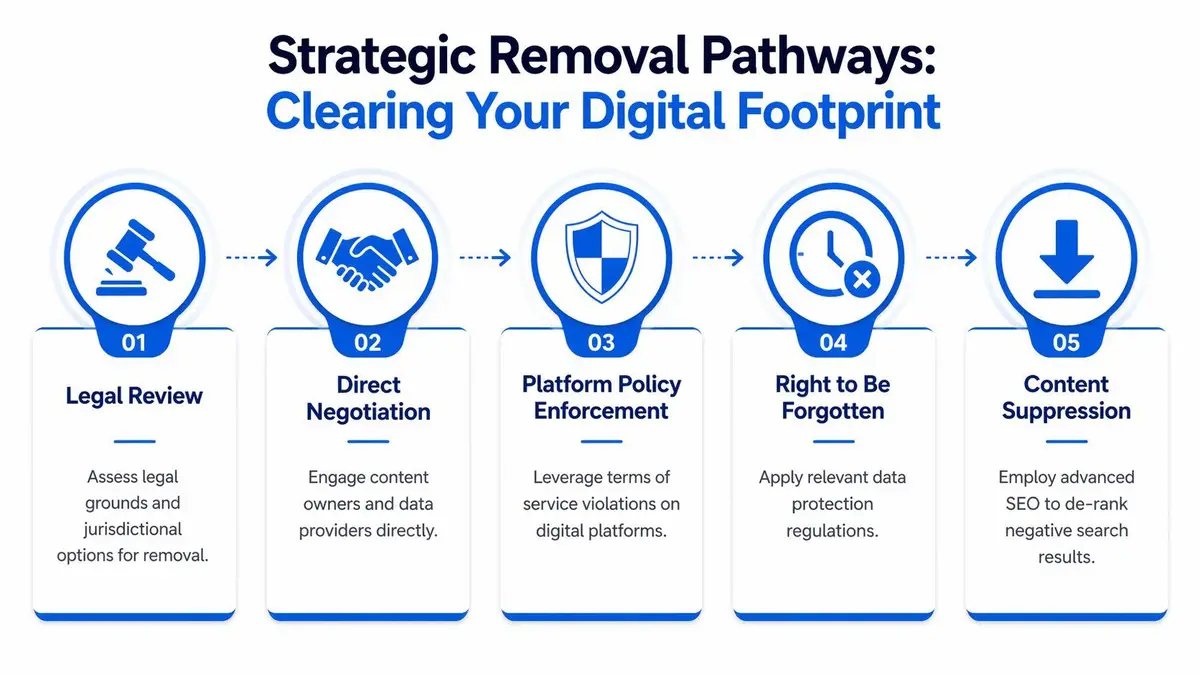
Phase Two Strategic Removal Pathways
Once the footprint is mapped, you choose the pathway based on what type of data you’re dealing with and where it sits. Frequently, DIY efforts collapse at this stage. People treat every site as if it accepts the same request and responds to the same approach. It doesn’t.
Direct broker opt-outs
Sometimes the fastest first move is a broker opt-out. But don’t confuse “available” with “effective.” Advanced Background Checks is a clean example of why this route looks simpler than it is.
The process begins at the removal page. You enter a masked or throwaway email, complete CAPTCHA verification, search using full name plus city, state, or ZIP, identify the exact profile, select “Remove My Record,” and then confirm through the emailed verification link. The link relies on token authentication and typically expires within 24 to 48 hours, with initial suppression often occurring in 10 minutes for a correct match, according to the walkthrough published by Incogni on Advanced Background Checks opt-out.
That sounds manageable until reality intervenes. The same source notes a 15% CAPTCHA failure rate, rising for mobile users, and a 20% rejection rate from incomplete data. Of greater concern, 40% to 60% of records reappear within 3 to 6 months due to data resyndication. That’s why one-off manual removal is unreliable as a lasting privacy strategy.
The practical takeaway is blunt. If you are dealing with a single, low-stakes listing, an opt-out is reasonable. If you are dealing with a name under scrutiny, the opt-out is only a first touch. It is not the strategy.
Record status and legal reality
If the issue involves criminal data, dismissal, sealing, or expungement status determines what recourse you possess. Many people assume expungement solves the online side automatically. It doesn’t. Courts can change the record status while brokers continue displaying older cached or copied versions.
If you’re assessing what can be cleared at the source level, jurisdiction-specific expungement analysis matters. For Texas matters, this explanation of what crimes can be expunged in Texas gives a practical overview of the threshold issue. You need that threshold determined before you start sending aggressive demands based on a status you can’t prove.
Statutory rights are stronger than polite requests
A voluntary opt-out asks. A rights-based notice compels. That difference becomes decisive in serious matters.
For U.S. residents, state privacy laws can provide a stronger path against certain brokers. For EU and UK-connected matters, data protection law can create a much more forceful basis for removal or de-indexing, especially when the data is outdated, excessive, or no longer justified in context. The legal path must match the subject’s residence, the broker’s operations, the source of the data, and the search engine exposure.
Use the pathways this way:
- Simple broker listing with no legal complexity: start with direct opt-out.
- Outdated criminal or court-related result: pair removal requests with official status documents.
- Expunged, sealed, or wrongly retained data: escalate early. Don’t waste time repeating the same form submission.
- Cross-border exposure: move immediately to jurisdiction-aware notices rather than U.S.-only templates.
- Search visibility after source changes: prepare for de-indexing and suppression instead of waiting for search engines to update on their own.
A useful privacy-specific reference on this category of work is this guide on removing content from people search sites for executives.
If the broker profits from indexing your identity, assume convenience for them and friction for you. Your job is to choose the route that changes the cost of noncompliance.
Removal is a layered operation
No serious file gets solved with one lever. The durable pathway usually combines source removal, legal status documentation, search de-indexing where appropriate, and later suppression if residual results remain. High-value clients should expect that sequence. They should not expect a single form to fix a system built to republish them.
Deciding Your Approach DIY vs Professional Intervention
Some matters can be handled personally. Most cannot. The question isn’t whether you are capable of filling out forms. It’s whether the stakes allow experimentation.
A do-it-yourself approach works only when the problem is narrow, the data is clearly wrong, the platform is cooperative, and the reputational downside of delay is modest. That is a small subset of cases.
When DIY is realistic
DIY can make sense if one broker profile contains a straightforward factual error, there is no sign of replication, and no deal, appointment, or media event depends on speed. In that scenario, a disciplined individual can gather proof, submit the request correctly, and track the response.
It becomes a poor decision when any of the following are true:
- Multiple brokers carry the same record
- The issue involves a sealed or expunged matter
- Your name is actively being searched by investors, counterparties, or reporters
- The data crosses U.S. and non-U.S. jurisdictions
- You need durable removal rather than short-term suppression
Comparison of DIY vs. Professional Removal Strategy
| Factor | DIY Approach | Professional Firm (e.g., ContentRemoval.com) |
|---|---|---|
| Scope control | Usually limited to what you can find manually | Broader discovery across visible and secondary locations |
| Time burden | High. You handle search, documentation, outreach, and follow-up | Lower client burden once facts and authority are provided |
| Legal positioning | Often generic and inconsistent | Tailored to record status, platform type, and jurisdiction |
| Handling expunged or sealed issues | Often weak unless you know how to escalate | Structured escalation is built into the process |
| International complexity | Difficult to navigate consistently | Better suited to cross-border enforcement and de-indexing |
| Reappearance management | Usually reactive | Ongoing monitoring and repeat action are possible |
| Privacy exposure | You communicate directly with brokers | Buffered process can reduce personal exposure |
| Suitability for executives and HNWIs | Poor fit for urgent, high-risk situations | Better fit where speed, discretion, and certainty matter |
The deciding issue is risk, not pride
Clients who are confident in their abilities sometimes resist professional help because they believe they should be able to manage their own record. That instinct is understandable and often costly. A fragmented response burns time and can create contradictory submissions across sites.
The more visible your name is, the less sense it makes to run a trial-and-error cleanup under your own identity.
If the matter is minor, handle it yourself carefully. If the matter affects financing, employment, board candidacy, licensing, M&A activity, family privacy, or cross-border reputation, delegate it. The opportunity cost of getting this wrong is higher than the cost of doing it properly.
Phase Three Advanced Suppression and Escalation
When a broker ignores a request, when a lawful removal route stalls, or when the listing is legally vulnerable but technically persistent, the playbook changes. At that point you stop asking casually and start applying pressure in the channels that matter.

Search de-indexing and platform enforcement
A source page and a search result are related, but they’re not the same problem. Even if the website drags its feet, search engines may reduce visibility under certain privacy or outdated-content pathways. That won’t always remove the page from the web, but it can materially reduce discovery during name-based searches.
This is also where platform policy analysis matters. Some pages violate their own stated rules, especially when they display excessive personal data, stale information, or identity-mismatched records. A site may ignore a generic plea and respond to a properly framed policy violation.
Legal-tech is what works on stubborn records
For expunged or sealed matters that still appear online, standard outreach is often a waste of time. According to the verified legal-tech methodology in the referenced video analysis, 70% of expunged records persist online because of pre-seal caching, and specialized firms achieve a 95% removal rate from targeted sites within 45 days by filing automated takedown notices and using AI-driven monitoring to prevent re-uploads. By contrast, manual single-site efforts deliver only a 40% long-term success rate, as described in the RecordGone legal-tech discussion on YouTube.
That result makes sense. These cases aren’t just legal. They’re logistical. The record has usually spread across many endpoints, often through old ingestion pipelines and reseller feeds. You need parallel action, not a string of isolated emails.
Escalation needs a hierarchy
Not every problem requires litigation posture, but every serious matter needs an escalation ladder. In practice, that often looks like this:
- Source-level demand tied to documented record status or factual inaccuracy
- Platform policy enforcement where a site breaches its own rules
- Search de-indexing request for residual visibility
- Counsel-driven notice when the site remains noncompliant
- Technical monitoring and repeat takedown if the content reappears
For persistent search reputation issues after removals, strategic suppression becomes part of the answer. This framework on methods to suppress negative content and restore digital authority aligns with what high-pressure cases usually require after the initial cleanup.
A page that survives the first request isn’t telling you to quit. It’s telling you the first lever was too weak.
False, misleading, and context-stripped content
If the listing is inaccurate, merged with another person, or framed in a way that creates a false implication, legal escalation becomes stronger. Defamation, false light, privacy invasion, and policy-based complaint routes depend heavily on wording and jurisdiction, so they must be handled with precision. Sloppy accusations often backfire. Precise claims, backed by documentation, move faster.
For high-value clients, the right standard is not “good enough.” It is whether the result is removed, de-indexed, or displaced quickly enough to protect the transaction, appointment, or family concern in front of you.
Phase Four Monitoring and Long-Term Prevention
Removal is often treated as an event. It isn’t. It is maintenance.
Once a record has circulated through the broker ecosystem, you should assume copies, cached references, and derivative listings remain in play. If nobody watches for reappearance, the issue often returns unnoticed and then gets rediscovered at the worst time.

Why manual checks fail over time
A manual approach usually means periodic self-searching, occasional broker checks, and hoping someone on your team notices a problem. That is too sporadic for a reputation asset that matters. It also creates lag. By the time a result is rediscovered, it may already have been seen by the person you needed to impress.
Long-term protection requires three things:
- Detection: alerts when a removed profile or similar copy reappears
- Verification: confirmation that the result concerns you and not a namesake
- Response: a repeat removal or suppression action without rebuilding the case from scratch
Prevention is partly technical and partly strategic
Monitoring should include your core name variants, known problematic URLs, and the brokers or public-record platforms most likely to republish older material. Keep a clean archive of prior takedowns, screenshots, and status documents so new requests can be sent immediately with evidence attached.
You should also maintain a strong set of accurate, current web assets under your name. That doesn’t replace removal, but it improves resilience. If a residual result survives somewhere, current professional profiles, leadership bios, speaking pages, and controlled publications help search engines understand what should rank first.
The best time to prepare your defense is after the first successful cleanup, not after the second exposure.
What disciplined clients do differently
They don’t wait for a crisis to restart the process. They treat online reputation like legal compliance or executive security. It is reviewed, updated, and documented. The people who come through these situations best are not the ones with perfect histories. They are the ones with a repeatable protection system.
If you’re serious about removing background check results online, think in cycles: audit, remove, suppress, monitor, repeat as needed. Anything less is temporary.
Frequently Asked Questions for Executives
Can accurate background check information still be removed?
Sometimes, yes. Accuracy alone doesn’t end the analysis. The important questions are whether the information is outdated, excessive, improperly contextualized, legally restricted, or processed in a way that violates privacy rights or platform policies. In cross-border matters, the answer changes significantly by jurisdiction.
If a record was expunged or sealed, shouldn’t it disappear automatically?
No. Court status and internet visibility are different systems. A record can be cleared at the court level while old copies remain on brokers, reseller sites, or search indexes. That’s why post-expungement enforcement is often harder than clients expect.
Is Google removal enough?
Usually not. Google de-indexing can reduce visibility, but it doesn’t necessarily remove the source page itself. If the page remains live, it can still be found directly, copied elsewhere, or re-indexed later under the wrong conditions.
How long does this kind of cleanup take?
It depends on the platform mix, the legal status of the record, and whether the issue is local or syndicated. Straightforward broker removals can move quickly. Distributed or contested cases take longer because they require coordinated action across multiple entities.
Should I contact every site myself?
Only if the matter is minor and low risk. Direct outreach under your own identity can expose more information, create inconsistent records, and weaken later escalation if done carelessly. In high-stakes matters, coordination matters as much as the legal basis.
If a background check result is threatening a deal, appointment, licensing process, or family privacy, handle it like the high-consequence problem it is. ContentRemoval.com works with executives, public figures, and high-net-worth clients who need a discreet, jurisdiction-aware plan to remove harmful content, suppress what can’t be removed immediately, and monitor for reappearance before it causes another crisis.