
To remove address history from the internet, work in layers: use Google’s Results About You tool for visible search exposures, strip stale details from profiles and PDFs you control, submit individual opt-outs to people-search brokers like Whitepages, then address public records through trusts, LLCs or address confidentiality programs. Expect a latency gap where search results outlive the source removal.
Key facts
- Google’s Results About You typically resolves in 3 to 5 days, with about 70% approval for unverified address results.
- Requests often fail when the address appears in business registries, public filings or news coverage.
- Each broker needs its own opt-out; some honor requests in days, others take weeks or months or need resubmission.
- Address history is not a FICO scoring factor, so credit-report removal does not improve scores.
Where ContentRemoval.com comes in. ContentRemoval.com handles address exposure for executives, founders and family principals when the listing has spread across brokers, sits beside a negative search result, or stems from a public record that a simple opt-out cannot touch. A chief of staff or security adviser usually raises it after a board dispute, press mention or security review. A free, confidential 15-minute Exposure Scan maps every source and search result showing your address and what is removable, and the report is yours to keep. Get a Free, Confidential Exposure Scan or read how our content removal work is done.
You search your name after a board dispute, a press mention, or a routine security review. The first page doesn’t just show commentary. It shows your home address, prior residences, family associations, and a map pin on a people-search site you’ve never heard of. That isn’t a privacy annoyance. It’s an exposure event.
If you’re an executive, founder, investor, or public-facing professional, your address history functions as targeting intelligence. It helps a hostile former employee identify where you live now. It gives a litigant an advantage. It gives a scammer enough context to sound credible on the phone, and it gives the market one more signal that you are accessible in ways you should not be.
Individuals often approach this backwards. They ask how to remove address history as if they were deleting an old social profile. That mindset is expensive. The critical question is how much liability you’re carrying while that information remains searchable, cached, copied, and redistributed.
The Exposure You Cannot Afford
A client usually arrives after the first shock has already passed. They found a listing on Whitepages, Addresses.com, or a smaller broker, then discovered the same address propagated across other sites, old filings, and search results. By that point, the data has already moved beyond one domain. It has become part of a searchable profile built from public records and commercial aggregation.

For high-net-worth individuals, this isn’t hypothetical reputational damage. A single negative search result can lead to a 22% reduction in business opportunities for HNWIs, according to ContentRemoval.com’s analysis of the cost of unremoved online content. Address exposure often sits beside that negative result, making the problem operational, not just cosmetic.
What address exposure actually enables
An exposed address history gives an adversary a timeline. They can connect property ownership, family relationships, shell entities that aren’t as private as you assumed, and routine movement patterns. If your household staff, children, or elderly relatives have weak digital hygiene, the risk multiplies.
This is why privacy work has to extend beyond takedowns. Secure storage habits matter. If you need a practical primer on how to secure family records online, review that before another insurance document, passport scan, or school form ends up in the wrong system.
Practical rule: Treat your address like a controlled asset. If the public can map it, archive it, and cross-reference it, you’ve already lost too much ground.
The liability is broader than one listing
Executives often focus on the site they can see. That’s a mistake. One listing creates at least three categories of risk:
| Risk area | What it looks like | Why it matters |
|---|---|---|
| Physical security | Home address, prior residence, household names | Raises the odds of stalking, harassment, and targeted intrusion |
| Commercial leverage | Search results tying identity to personal details | Damages negotiations, board confidence, and counterpart perception |
| Fraud enablement | Address, phone, purchase or location data combined elsewhere | Makes impersonation and social engineering more credible |
If you want to remove address history, start by recognizing the problem accurately. You are not cleaning up clutter. You are containing a live intelligence leak.
Immediate Takedowns You Must Execute Now
Start with what you control. Don’t begin with a sprawling broker campaign if Google is still surfacing the most visible versions of your address and your own profiles still expose stale details.
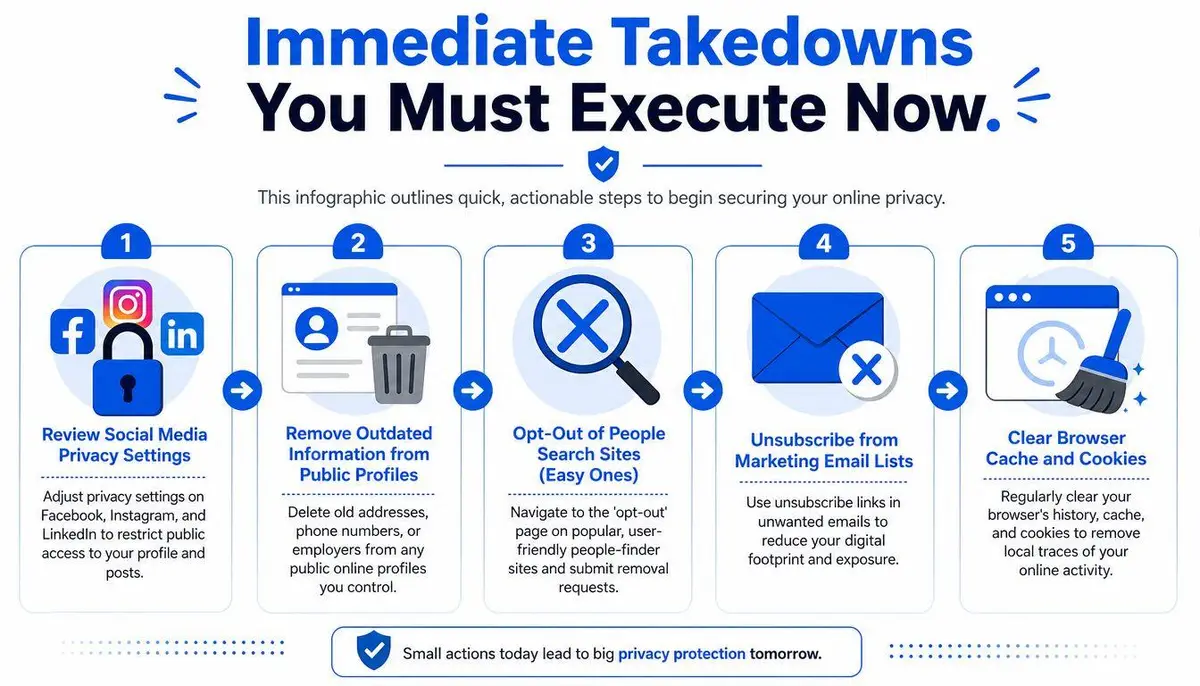
Use Google’s Results About You correctly
Google’s Results About You tool is the fastest first move for visible exposures. Go through your Google account to Data & Privacy, then My Activity, then Other activity, then Results about you, then Manage results about you. Add your name and address variations, review matches, and choose “Request to remove” where eligible.
Use quotation marks around your name when searching. That matters. The cited benchmark on this tool notes that the process typically resolves within 3 to 5 days and sees a 70% approval rate for unverified address results, while 30% are rejected when the address appears in business registries or public records. It also notes that searching without quotation marks reduces match accuracy by 45%. Those figures come from a walkthrough of Google’s tool and removal behavior in this video analysis of Results About You.
Google removes some search visibility. It does not erase the underlying source, and it won’t rescue you from public-record exposure.
That distinction matters. Search suppression and source removal are separate tasks. If you need a more focused process for one of the largest people-search sites, review this strategic guide to removing your home address from Whitepages.
Fix the assets you own
Your own platforms often leak more than the brokers. Audit LinkedIn, executive bios, speaker pages, old campaign sites, alumni directories, and domain registrations under your control. Remove old city-level references, personal contact details, archived team pages, and downloadable PDFs with headers that still contain an address block.
Use this short strike list:
- Lock profile visibility: Restrict public access on LinkedIn, Facebook, and Instagram where that aligns with your role.
- Delete stale identifiers: Remove old phone numbers, former office locations, personal emails, and any “contact me directly” language that routes attention to you.
- Purge file metadata where practical: PDFs, resumes, and uploaded forms often preserve more than the page displays.
- Turn on alerts: Google’s monitoring is useful only if you review the notices and act on them.
A narrow point about deletion matters here. Many clients assume that if a file or record is overwritten somewhere, it is simple to recover. In ordinary environments, that assumption is often wrong. If you want a technical explanation of why overwritten data behaves differently, this overview of recovering data from overwritten drives is useful context. The lesson is straightforward. Don’t rely on myths about what disappears and what persists. Verify.
The basic workflow below is worth following immediately.
Manage expectations from the start
Some removals will go through quickly. Some won’t qualify. If your address appears because of a public filing, a business registration, or news coverage, a standard Google request may fail even when the exposure is plainly harmful. That is not a reason to stop. It’s a reason to separate fast tactical wins from the larger structural problem.
The Manual Grind of Data Broker Removal
Once you move past Google and your own properties, the work gets slower and far less predictable. At this stage, most DIY campaigns stall. People underestimate the repetition, the identity verification burden, and the persistence required to keep the data from resurfacing.
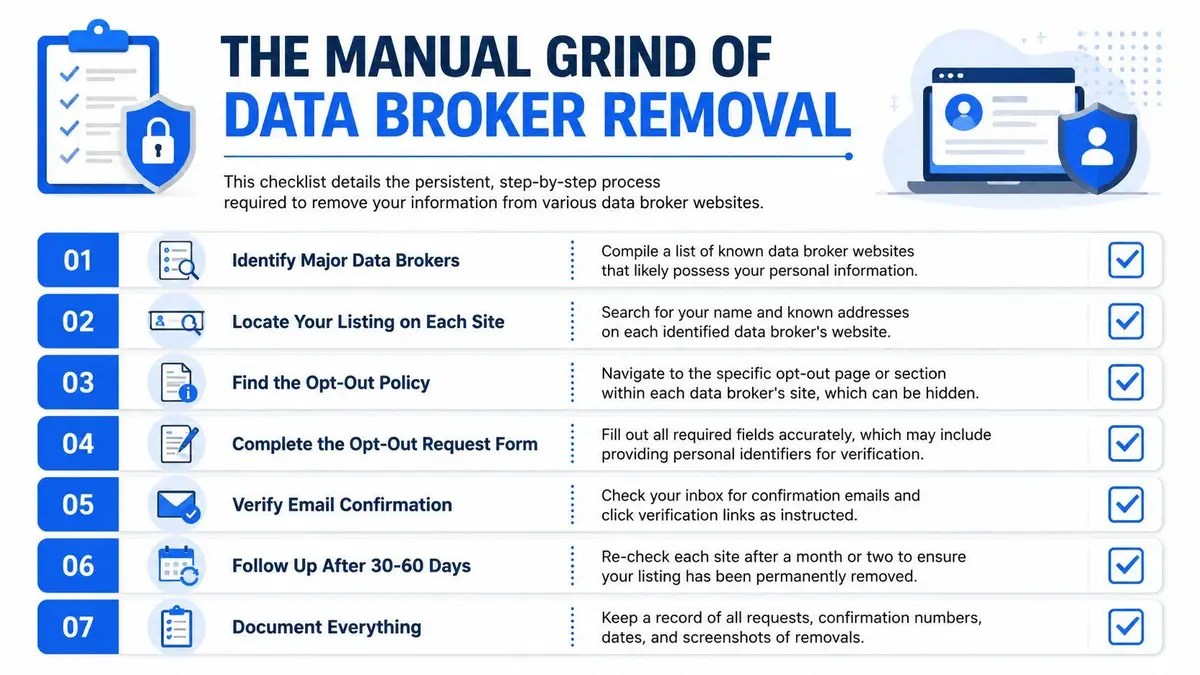
Address and personal information on sites such as Whitepages, Addresses.com, and CoreLogic is often sourced from public real estate records and background databases, and each site usually requires a direct opt-out submission. Some honor requests within days. Others take weeks or months. Some won’t respond at all without repeated submissions, as outlined in Security.org’s review of address removal procedures.
Why the process breaks down
Each broker has its own procedure. You search for your record, identify the precise listing, find the privacy or opt-out page, submit the form, confirm through email, and then check later to see whether the entry is gone. Then you repeat the process on another site, and another, and another.
There is no standard timeline. There is no universal portal. There is no central authority that compels synchronized deletion across the broker ecosystem.
You’re not dealing with one database. You’re dealing with a distribution chain.
That is the critical point. Many people-search sites are resellers, mirrors, or downstream consumers of the same underlying data. You remove one listing, and a similar one appears elsewhere because another broker refreshed its feed from a different source.
What the manual campaign requires
A proper manual campaign is administrative work, not strategy. It demands documentation, patience, and repeated follow-up.
- Search thoroughly. Use name variants, city combinations, and prior addresses.
- Capture exact URLs. Without them, requests are often delayed or rejected.
- Submit one by one. Each platform asks for different information and uses different verification methods.
- Track dates and confirmations. Without records, you can’t escalate effectively.
- Recheck the same listings. Removal today doesn’t guarantee absence next quarter.
For a broader framework on broker-targeted takedowns, this executive privacy guide to removing yourself from data broker lists is a useful reference.
The hidden cost of DIY
The actual cost isn’t only time. It’s attention diversion. If you’re billing by the hour, running a company, managing a family office, or preparing for litigation, a repetitive takedown campaign is the wrong use of your time. It also produces a false sense of completion. You remove the visible records and assume the issue is contained. In many cases, it isn’t.
Manual removal has a role. It is sensible for low-risk individuals with patience and no active threat profile. It is not a complete answer for someone whose name already carries commercial value, legal visibility, or personal security concerns.
Addressing Public Records and Archival Data
Many clients become frustrated at this point, because the rules change. A people-search site may honor an opt-out under its own policy. A county recorder, court archive, business filing database, or voter-related source isn’t operating on the same basis. You’re no longer arguing with a private website’s preferences. You’re dealing with law, procedure, and recordkeeping mandates.
Public records are the source layer
Property deeds, corporate filings, court documents, licensing records, and similar repositories often function as the seed layer for downstream exposure. Even when an aggregator removes your listing, the underlying source may remain public, searchable, and available for republication.
That’s why simple takedown language often fails here. “Please remove my address” has little force when the publication reflects an official filing. The analysis has to shift from removal to lawful shielding, minimization, and eligibility for restricted access.
What can actually be done
Some interventions are structural, not editorial. If you are acquiring real estate, entity planning matters. Buying through a trust or LLC may reduce direct name-level discoverability, though the effectiveness depends on jurisdiction, filing practice, and how carefully the structure is maintained. If the entity then appears in other publicly linked records, the privacy benefit can collapse.
For individuals facing documented threats or court-recognized risks, state Address Confidentiality Programs may offer protection in some jurisdictions. Access is limited and depends on eligibility. The key point is that these programs are not broad convenience tools for affluent households seeking discretion. They are targeted legal mechanisms.
A practical distinction helps:
| Source type | Typical removal path | Realistic expectation |
|---|---|---|
| Commercial people-search site | Site opt-out form | Partial success, requires monitoring |
| Search engine result | Platform removal request | Visibility may decline, source remains |
| Public filing or government record | Legal or procedural route | Depends on jurisdiction and eligibility |
| Archived copies or mirrors | Case-by-case intervention | Often slow and fragmented |
If the address sits in a public record, this becomes a legal architecture problem, not a customer-service problem.
A separate myth that wastes time
Many clients also ask whether removing old addresses from credit files will improve their scores. It won’t. Consumer education on this issue makes clear that address history is not a scoring factor in FICO models, yet a 2025 Consumer Financial Protection Bureau report noted that 34% of consumers incorrectly believe address removal affects scores, according to The Credit People’s discussion of old addresses on credit reports. The risk isn’t score damage. The risk is misidentification, fraud alerts, and unnecessary disputes that complicate lending.
For executives, that distinction matters. Don’t waste effort chasing a fictional score benefit while leaving actual public-record exposure untouched.
The Latency Gap Where Your Data Lives On
Even after a successful source removal, your address can remain visible where people often look. Search engines index, cache, and recrawl on their own schedule. That delay is the latency gap. It is the period when the source is altered or deleted, but search visibility hasn’t caught up.
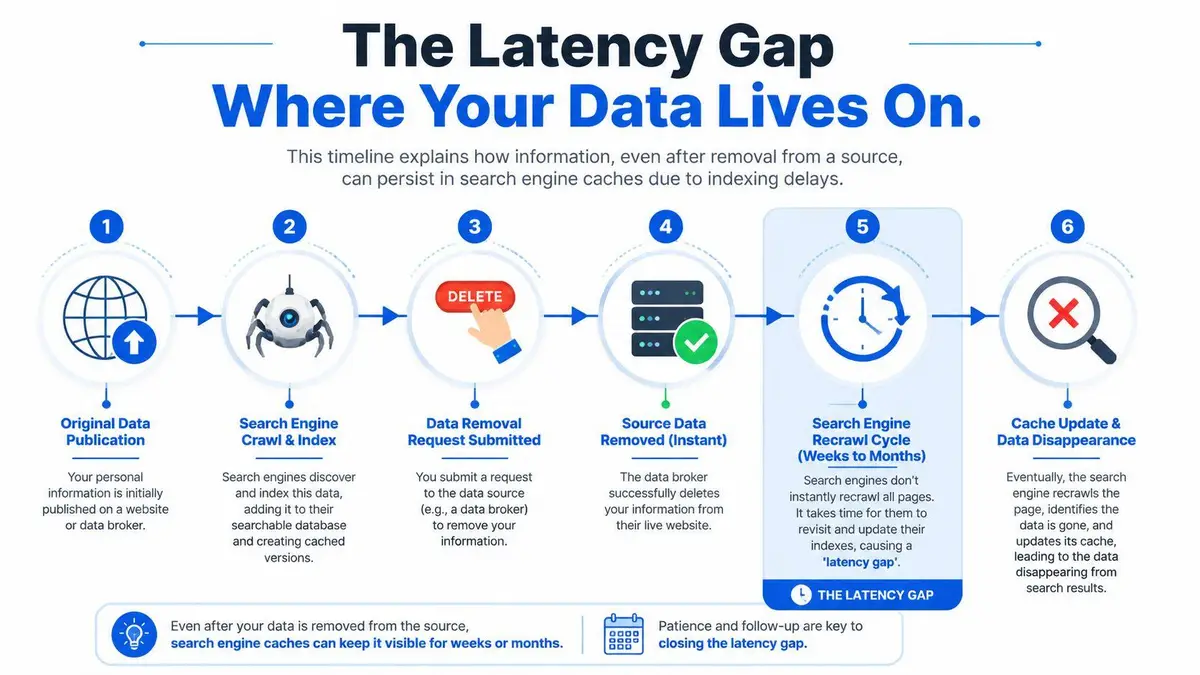
Most non-specialists misread this delay. They submit a removal request, receive confirmation from the source site, search their name the next day, and conclude that nothing happened. Sometimes the source did comply. The index has not updated.
Why delay still creates active risk
Searchers don’t care whether a record is technically gone from the live page if Google still presents the title, snippet, or cached impression. Recruiters, journalists, litigants, activists, and hostile counterparties act on what they can see immediately.
This is not a trivial lag. Google’s own removal tool data reveals that 70% of outdated LinkedIn profiles remain indexed for 6 to 12 months post-deletion, according to ContentRemoval.com’s reporting on removal latency and indexed remnants. That statistic concerns LinkedIn, but the principle extends to address-related content. Search persistence can outlast source deletion by months.
DIY removal fails here for a simple reason
The do-it-yourself mindset focuses on the source because that is where the user has direct access. The search layer is harder. It requires understanding what was removed, what is still cached, what qualifies for accelerated update requests, and when the issue is a republication problem rather than a de-indexing problem.
A useful distinction:
- Source removed, search result remains: likely latency, cache, or recrawl delay.
- Source still live elsewhere: likely duplication or syndication.
- Search result leads to a dead page but still harms you: still a reputational problem, because the result itself is visible.
A successful takedown that remains indexed is not a complete fix. It is an incomplete containment measure.
If you’re trying to remove address history and you stop at “the page is down,” you are accepting a long window of continuing exposure. For a high-value client, that is not an acceptable endpoint.
When to Escalate to Professional Removal Services
Not every address exposure requires outside intervention. Some do. The decision should be clinical.
If you are a private individual with no active threat, no public-facing role, and time to spend on repetitive forms, a manual campaign can be reasonable. If your issue sits mostly on mainstream people-search sites and you can tolerate follow-up work, automated services may also help. Data brokers collect and distribute address, phone number, purchase history, and location data from public records, apps, and third-party sources. Services such as Optery, DeleteMe, and Hello Privacy can automate common removal requests, but they still require you to provide personal information so they can scan and submit on your behalf, as explained in this overview of data broker collection and removal tools.
Professional intervention is non-negotiable when these conditions exist
The matter should be escalated if any of the following are true:
- Your name carries economic value. Investors, founders, public company executives, litigators, and visible family office principals should assume that personal data exposure has commercial consequences.
- There is a credible security concern. Harassment, stalking, extortion attempts, domestic risk, or politically charged visibility changes the equation immediately.
- The source layer includes public records or archives. At that point, tactics must align with law, not ordinary website policies.
- Search persistence continues after source changes. If the latency gap keeps the exposure visible, the work is no longer basic opt-out administration.
- Your time is worth more than the process. Senior operators should not spend strategic hours hunting footer links and confirmation emails.
What a serious engagement should include
A proper engagement is not just a subscription dashboard. It should include source mapping, risk prioritization, removal sequencing, search-result intervention, reappearance monitoring, and escalation paths when policy routes fail. If a firm can’t explain how it handles public-record adjacency, cache persistence, and recurring syndication, it is not equipped for high-stakes matters.
One option in that category is professional digital footprint cleanup for executives, which addresses source removal and search-layer exposure as separate but related problems. That is the correct model.
The wrong model is hoping a low-touch subscription or a handful of DIY forms will protect a household, a board member, or a founder in an active visibility event.
If your address history is exposed online, a confidential assessment through ContentRemoval.com is the rational next step. We evaluate the source of the exposure, the search-layer persistence, the public-record complications, and the security implications, then define whether this is a manageable cleanup or a matter that requires immediate intervention.
Frequently asked questions
How do I remove my home address from Google search results?
Go through your Google account to Data and Privacy, My Activity, Other activity, Results about you, then Manage results about you. Add your name and address variations, review matches and request removal where eligible. Search with your name in quotation marks to improve match accuracy, and remember this hides the result rather than deleting the source.
Why does my address still show in search after the website removed it?
Search engines index, cache and recrawl on their own schedule, so a title or snippet can persist for months after the source changes. That delay is the latency gap, and it still creates risk because recruiters, journalists and litigants act on what they can see.
Can I remove my address from public property records?
Rarely through a takedown request, because the publication reflects an official filing. Options are structural: acquiring property through a trust or LLC, maintaining record discipline, or qualifying for a state address confidentiality program where a documented threat exists. Downstream brokers can still be addressed separately.