

To protect a personal brand online, an executive needs a structured defense: lock down profile privacy beyond the defaults, audit old posts and data broker listings, build a content moat of owned assets on the first page of Google, monitor the clear, deep and dark web with a four-level triage framework, and neutralize threats through takedowns, de-indexing or legal action.
Key facts
- Reputation risk is the top concern for 87% of executives worldwide.
- A platform impersonation report needs side-by-side screenshots, timestamps and direct links to succeed.
- Clear policy violations like intimate imagery can often be de-indexed within 24 to 72 hours; defamation takes weeks or months.
- Legitimate news articles and public court records are rarely deleted at source; suppression and de-indexing are the route.
Where ContentRemoval.com comes in. ContentRemoval.com does the removal work that sits behind an executive’s brand defense: taking down impersonation accounts, de-indexing defamatory posts and revenge blogs, and clearing exposed personal data from broker sites. Executives, their chiefs of staff and their agencies usually make contact once a monitoring alert becomes a live problem. A free, confidential 15-minute Exposure Scan maps what is removable and what needs suppression, and the report is yours to keep. Get a Free, Confidential Exposure Scan or read how our content removal work is done.
For high-profile individuals, learning to protect your personal brand online is not an exercise in vanity. It is a critical risk management function, a proactive defense against digital threats that can dismantle a career, derail a transaction, or inflict staggering financial damage.
When your name is your most valuable asset, its defense is non-negotiable.
The Executive Imperative For Online Brand Protection
Your digital brand is a permanent, public ledger of your career and character. For executives, founders, and public figures, this ledger has become a primary vulnerability. A single adverse search result, a fraudulent review, or a coordinated impersonation campaign can dismantle decades of earned trust in an instant.

The stakes transcend public perception. Your online reputation is now a material factor in enterprise valuation, investor confidence, hiring decisions, and career longevity. Neglecting these digital risks is analogous to leaving a financial portfolio entirely unguarded.
The Digital Threat Matrix For High-Profile Individuals
Threats targeting executives are distinct. They are more sophisticated, malicious, and frequently coordinated, extending far beyond a simple social media misstep. Understanding the adversary is the first step toward mounting a credible defense.
Digital Threat Matrix For High-Profile Individuals
| Threat Vector | Potential Impact | Recommended Response Level |
|---|---|---|
| Defamatory Content (fake news, smear articles) | Severe damage to credibility and trust; loss of business opportunities. | High: Requires immediate suppression and removal efforts. |
| Sophisticated Impersonation (fake profiles/websites) | Fraud, misinformation spread in your name, network compromise. | Critical: Demands urgent takedown and public clarification. |
| Data Broker Exposure (address, phone, family info) | Physical safety risks (doxxing, stalking); phishing and identity theft. | High: Needs continuous monitoring and systematic data removal. |
| Negative Media & Leaks (weaponized news, leaked docs) | Catastrophic reputational harm, legal entanglements, stock devaluation. | Critical: Involves crisis communications and strategic legal action. |
These are not hypotheticals; they are daily realities for leaders across industries. The velocity at which negative information propagates renders a reactive, “wait-and-see” approach obsolete.
In this environment, brand defense must be treated as a core component of modern risk management, on par with expert financial and legal counsel. It’s about establishing control before a crisis forces your hand.
From Vulnerability To Fortification
The anxiety surrounding online reputation is justified. Analysis confirms that reputation risk is the top concern for 87% of executives worldwide, who view it as more critical than other business threats. This concern is well-founded, particularly when 44% of employers use personal brand strength to make hiring decisions. A compromised search result can lead to rejection before an interview is granted.
This new reality demands a paradigm shift, from passive hope to active defense. Protecting a personal brand online requires a structured, strategic framework, beginning with an unflinching audit of your digital footprint to map every vulnerability.
This audit involves examining all digital assets: old forum posts, forgotten social media profiles, and the sprawling network of data brokers that traffic in your private information. Each represents a potential vector for attack.
With a complete map, you can begin the systematic process of removal, suppression, and fortification. The ultimate goal is to build a “reputational moat”, a dominant and controlled online narrative that insulates you from future threats. This guide provides the playbook to achieve that, from neutralizing negatives to building a portfolio of positive, authoritative assets under your control.
Building Your Digital Fortress: Proactive Brand Protection
Waiting for a reputation crisis to act is a losing strategy. Effective protection for your personal brand is not about scrambling to clean up a mess. It is about constructing a digital fortress before an attack materializes. The objective is to make yourself a hard target. By shrinking your digital attack surface, you make it exceptionally difficult for negative content, misinformation, or malicious actors to gain traction.
Locking Down Your Digital Perimeter
Default privacy settings are insufficient. They are designed for the average user, not for an individual with a high-value reputation to protect. You must operate under the assumption that every public-facing piece of data will be scraped, compiled, and potentially weaponized.
Consider a platform like LinkedIn. True security goes beyond the basics:
- Hiding Your Public Profile: Restricting non-connections from viewing your full profile and activity log drastically reduces what data scrapers and casual reconnaissance can gather.
- Securing Your Connections: Your network is a valuable asset. Hiding your connection list from public view prevents adversaries from mapping your professional relationships for targeting.
- Isolating Your Email: Your primary email address must never be public. For public-facing profiles, use a separate, dedicated email address.
This logic applies universally. On X (formerly Twitter), control who can tag you in photos and disable direct messages from anyone you do not follow. Every platform has these deeper settings; your first task is to locate and leverage them.
Auditing Your Digital Footprint
Next, you must conduct forensic analysis on yourself. This is not a simple Google search; it is a deep-dive investigation to uncover every forgotten element of your online history that could become a liability. A thorough audit searches for: old forum posts from a decade ago, forgotten social media profiles, passing mentions in obscure online articles, and your personal information listed on data broker sites.
Data broker sites represent a significant vulnerability. They aggregate public records and online data to create alarmingly detailed profiles (including phone numbers, past addresses, and relatives) and sell them to anyone. Removing your information from these sites is not a one-time task but an ongoing battle. For a detailed protocol, particularly for executives, our guide on how to remove yourself from data broker lists is essential reading.
Think like an attacker. Every unsecured comment, old profile, or public connection is a potential way in. You have to find these weaknesses before they do.
Constructing Your Content Moat
After tightening security and cleaning up vulnerabilities, the next phase is offensive. You must build a “content moat” around your brand by creating a portfolio of positive, authoritative content that you completely control. The strategy is to dominate the first page of Google for your name. When you are searched, you want the results to show your official website, your polished LinkedIn profile, articles you have authored, and positive interviews. This makes it exponentially harder for a random negative post to penetrate the first page and inflict real damage.
This is a deliberate campaign to establish your expertise and own your narrative. A crucial component of this is protecting your intellectual property. The content you create, from articles to entire books, is an asset. Securing formal copyright for your original works is not merely a legal formality; it is a strategic maneuver that builds a legal fortress around your expertise, granting you control over its use and reinforcing your entire digital defense system.
Continuous Vigilance: The Threat Monitoring Playbook
Locking down accounts is a necessary first step, but a purely defensive strategy is untenable. To truly safeguard your personal brand, you must operate on the assumption that new threats are constantly emerging. The only way to preempt them is through continuous, intelligent monitoring that detects anomalies the moment they appear. This requires building a dedicated intelligence operation focused solely on you.
Why Consumer Tools Are Inadequate
Consumer-grade tools like Google Alerts are wholly insufficient for any individual whose reputation is a material asset. They are slow, miss a staggering volume of online mentions, and offer zero visibility into the deep and dark web, the very places where leaked credentials and doxxing information are trafficked. For any executive or public figure, relying on such basic tools is a critical error.
The professional standard is a different class of system entirely. It involves sophisticated, AI-powered platforms that scan millions of sources in real-time. These systems are engineered to penetrate every corner of the web, including:
- The Clear Web: Public news sites, blogs, forums, and major social media platforms.
- The Deep Web: Private groups, password-protected forums, and other content not indexed by standard search engines.
- The Dark Web: Illicit marketplaces and hacker forums where stolen data is bought and sold.
This comprehensive sweep seeks specific red flags: your name appearing in unsanctioned locations, new websites registered to impersonate you, fraudulent social media profiles, or your personal information surfacing in a data breach. It ensures you are the first to know, not the last to find out.
The Triage Framework: Plan, Don’t Panic
Identifying a threat is one thing; executing the correct response is another. When an alert arrives, a disorganized, panicked scramble can be almost as damaging as the threat itself. A structured triage framework is essential. It allows for the immediate classification of threats by severity and the activation of the appropriate response protocol.
Not every negative mention constitutes a crisis. The essential skill is distinguishing between background noise and a five-alarm fire. A single hostile tweet may be a minor issue, but a credible threat of violence or a coordinated smear campaign demands an immediate, full-scale response.
Your triage framework should take the emotion and guesswork out of the equation. It’s a clear, logical roadmap that guides you from detection to resolution, making sure every move is measured, proportional, and smart.
This decision tree outlines the fundamental logic: If the asset is not public, secure it. If it is public, monitor it relentlessly.
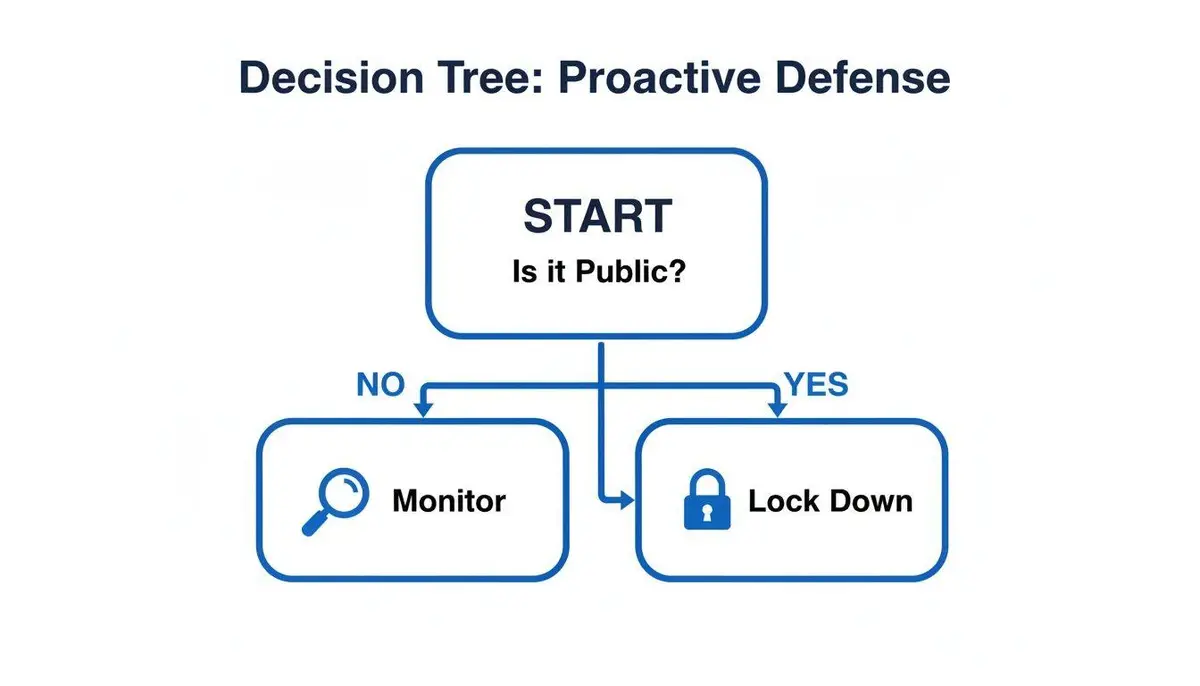
The principle is to shrink your attack surface. Anything that does not have a compelling reason to be public should be private and secured. Everything else requires constant vigilance.
Classifying and Responding to Alerts
An effective triage system sorts threats into clear categories, each with a pre-defined playbook. This enterprise-level approach to risk management ensures that resources are focused where they are most needed.
Level 1: Low Severity
- Indicators: Isolated negative comments, minor brand misrepresentation, spammy social media mentions.
- Action: Monitor and Document. Immediate action is unnecessary, but logging these incidents is critical for trend analysis. Ignoring them can allow a small problem to escalate.
Level 2: Moderate Severity
- Indicators: A sudden cluster of negative reviews, a news article with factual errors, a low-follower impersonation account.
- Action: Assess and Contain. This may involve reporting the fraudulent account through official platform channels or engaging a reviewer to resolve their issue. The goal is to prevent further escalation.
Level 3: High Severity
- Indicators: A defamatory article on a major news or gossip site, a coordinated harassment campaign, a sophisticated phishing scam using your name.
- Action: Mitigate and Suppress, Immediately. This is the point to engage professionals for takedown procedures, Google de-indexing, or launching a counter-campaign to demote the content in search results.
Level 4: Critical Severity
- Indicators: Credible threats of physical harm, doxxing (publication of private information), a major data breach involving sensitive files, or extortion.
- Action: Escalate to Legal and Security Teams Immediately. This is a red alert requiring a multi-faceted response, potentially involving law enforcement, cybersecurity firms, and legal counsel.
By implementing this framework, you transition from a passive posture to one of active, strategic defense. To understand the tools used in this process, learn more about professional reputation monitoring systems. This structured methodology is the cornerstone of protecting a personal brand in a high-risk digital environment.
Taking Action: How to Mitigate and Neutralize Online Threats
When an online threat transitions from a monitoring alert to a tangible problem, the time for observation is over. Action must be swift and decisive. The strategy you deploy can determine the difference between a quickly resolved issue and a full-blown reputational crisis. Different threats demand different tools. Knowing which tactic to use, and when, is what separates amateurs from professionals.
The First Line of Defense: Platform-Based Takedowns
In many instances, the most expedient path to resolution is working directly with the platforms hosting the offending content. Social media networks, review platforms, and web hosts have terms of service and established procedures for reporting violations. This should always be the initial step for clear-cut violations, such as:
- Impersonation: An account on X or Instagram using your name and photo to deceive your network.
- Harassment: A targeted campaign of abusive comments or direct messages.
- Copyright Infringement: Unauthorized use of your photos, videos, or written work.
To secure a fast response, you must make it easy for the platform’s review team to approve the takedown. A simple report of “this account is fake” is insufficient. You must build a case file. A proper report includes side-by-side screenshots of the fraudulent profile next to your authentic one, timestamps, and direct links to the violating content.
You are interfacing with a busy trust and safety team. Your task is to provide them with a perfectly documented case file that justifies immediate action. A poorly constructed report is a waste of critical time.
However, platform takedowns have limitations. They are often ineffective against nuanced attacks like negative opinions, veiled defamation, or content hosted on uncooperative offshore servers. When a simple report fails, you must escalate.
Advanced Removal: Legal and Technical Intervention
When content is actively harmful but does not technically violate a platform’s terms, you must engage specialists who can leverage legal pressure and technical expertise to compel a removal. These strategies are more complex and often depend on established relationships with registrars, hosting companies, and search engine teams.
Search Engine De-indexing
De-indexing is the process of removing a specific URL from search engine results. While the page may continue to exist on its host website, its capacity for harm is crippled if it cannot be found via search. This is an exceptionally powerful tool against defamatory articles, outdated court records, or “revenge-for-hire” blog posts.
Source-Level Removal
This is the optimal outcome: compelling the website owner to delete the content entirely. It is the most permanent solution but also the most difficult to achieve. This process typically involves direct negotiation, a cease-and-desist letter from legal counsel, or identifying a violation of the website’s hosting agreement.
In 2026, your online reputation is a core component of your professional security. With 98% of employers researching candidates online and 54% admitting they’ve rejected someone based on search results, a negative digital footprint is a direct threat. This is precisely why firms like ContentRemoval.com exist. They utilize specialized legal and technical channels to de-index harmful search results, often in as little as 24-48 hours. A clear understanding of the stakes can be found in this personal branding statistics overview.
Invoking Legal Frameworks
Depending on your jurisdiction, powerful legal instruments may be available. In Europe, the ‘Right to be Forgotten’ (RTBF) under GDPR allows individuals to request the removal of outdated or irrelevant personal data from search results. Similar privacy laws, such as those in California, provide other avenues to combat data brokers and sites that disseminate personal information.
Choosing the Right Strategy
There is no “best” strategy, only the right strategy for a specific situation. Deploying the wrong tactic can be ineffective at best and counterproductive at worst.
| Scenario | What Not to Do | The Optimal Strategy |
|---|---|---|
| A defamatory post on an anonymous blog | Reporting the author’s social media for “harassment.” | Engage a specialist to identify the web host and registrar. Pursue source removal with legal pressure while simultaneously filing for de-indexing with Google. |
| An impersonation account on LinkedIn | Sending angry DMs to the fake account. | Immediately use LinkedIn’s official impersonation reporting tool with clear, documented proof. Proactively warn key contacts about the fraudulent profile. |
| A negative but factually-based news article | Demanding the newspaper retract the story. | Launch a proactive content campaign. Publish a wave of positive, authoritative content (new interviews, guest articles, press releases) to systematically push the negative article off the first page of search results. |
Every action must be deliberate. The objective is not merely to react to a problem, but to solve it permanently and prevent recurrence. When under attack, impulsive action is the greatest risk. Engaging an attacker publicly or issuing a poorly worded legal threat can amplify the crisis. The correct course is to pause, assess, and seek expert counsel before taking any irreversible step.
Playing the Long Game: From Defense to Dominance
A successful takedown request is a single battle won. The war is for control of your digital narrative, and playing “whack-a-mole” with negative content is a reactive, losing strategy. True online resilience is not about being a firefighter; it is about being an architect, constructing a reputational fortress so formidable that most attacks are rendered ineffective.

This requires a shift from defense to proactive curation of your digital legacy. You must deliberately build the body of information that will define you for years to come.
Architecting Your Reputational Moat
The most powerful defense is a “reputational moat”, an ecosystem of positive, high-ranking digital assets that you own and control. When this moat is sufficiently deep and wide, it becomes incredibly difficult for any negative content to breach the first page of Google, where 95% of all user clicks occur.
Building this moat is a disciplined campaign, not a short-term project. It is a calculated effort focused on:
- Expert Content: Publishing insightful articles on respected industry platforms and your own professional blog to establish authority.
- Strategic Media: Securing interviews, expert quotes, and podcast appearances on channels trusted by your target audience.
- Owned Properties: Creating and actively managing a portfolio of channels you control, including a personal website and a polished LinkedIn profile.
Your expertise is your best defense. Employee advocacy on social media generates 561% more reach when a message comes from an individual versus a corporate account. Executive content receives 8 times more engagement on average, and 92% of people trust recommendations from individuals over brands. This is not about vanity; it is about credibility and revenue. The specific ROI is detailed in data on the value of a strong personal brand.
The goal is to bury negative content under an avalanche of credible, positive information. You are not just cleaning up the past; you are engineering the future of your search results.
Maintaining a Crisis Response Playbook
Even with the strongest moat, a crisis can occur. A coordinated smear campaign, a data leak, or a viral piece of fake news can detonate without warning. In these moments, hesitation is your enemy. A documented crisis response playbook is non-negotiable.
This is not a vague plan. It is a specific protocol your team can execute the moment a major threat is confirmed. A robust playbook includes three core components:
- Ready-to-Go Communications: Pre-drafted statements for different stakeholders (employees, investors, the public) that can be adapted in minutes.
- Clear Notification Chains: A contact list and flow chart detailing who is called, in what order, and with what information.
- Firm Escalation Triggers: Concrete criteria that automatically engage legal counsel, a cybersecurity firm, or a reputation management specialist.
This plan removes emotion and guesswork from a high-stakes situation, ensuring a measured and rapid response that prevents the panicked reactions that often exacerbate a crisis. Mastering the fundamentals of social media and reputation management is foundational to both building the moat and reacting to a crisis.
By combining a durable reputational moat with a detailed crisis playbook, you shift from a position of vulnerability to one of strategic control. You will be prepared to both build and defend your most valuable professional asset: your name.
Your Questions, Answered
When your online reputation is under attack, you require clear answers from specialists. Here are the responses we provide to the executives, founders, and public figures we represent.
How Quickly Can Negative Content Be Removed From Google?
The timeline for removal depends entirely on the nature of the content. For clear-cut policy violations, such as the posting of non-consensual intimate imagery (NCII) or content falling under specific legal removal frameworks, de-indexing from Google can often be achieved within 24 to 72 hours. Once a properly documented case is filed, the process can be swift.
However, for more entrenched issues like defamatory articles or negative press, there is no immediate solution. These situations require a strategic campaign that can take weeks or months. Success is not achieved through a single takedown request but through consistent, targeted pressure until the objective is met.
What About Old News Articles or Court Records? Can They Be Removed?
Rarely through direct request. Legitimate news organizations are protected by freedom of the press and almost never delete published articles. Publicly filed court records are, by design, part of the public domain. Compelling the source to remove them is highly improbable.
Therefore, we change the strategic objective. The most effective approach is a combination of suppression and de-indexing. First, we can often secure legal de-indexing, which removes the content from search results for your name. Concurrently, we execute a proactive campaign, creating and ranking positive, high-authority content to push the negative link so far down in search results that it becomes functionally invisible.
Key Takeaway: If you can’t remove it from the web, you can remove it from public view. That’s the power of suppression.
What Is the Difference Between Suppression and Removal?
Understanding this distinction is fundamental. The terms are often used interchangeably, but they represent distinct outcomes.
- Removal is the complete deletion of the content from the host website. The page itself ceases to exist. This is the ideal but not always possible outcome.
- Suppression (or de-indexing) is the removal of the content from search engine results. While the content may technically still exist at its direct URL, it is rendered undiscoverable to the public.
While removal is always the primary goal, suppression is what neutralizes the immediate threat. It cuts off the content’s visibility, making it impossible for the public to find it.
I Am Facing a Coordinated Online Attack. What Is the Protocol?
If you are targeted by a flood of fraudulent negative reviews or a harassment campaign, the first rule is: do not engage. Responding directly almost invariably amplifies the attack.
This is a crisis and must be managed as such. Immediately begin executing a pre-planned response protocol. This includes documenting everything (screenshots, links, user profiles) while your team initiates takedown requests for every post that violates platform terms.
Simultaneously, your reputation and legal counsel must confer. Is a public statement warranted, or is silence the better strategy? Is there a viable legal path against the perpetrators? The key is a swift, controlled, and strategic response, not a panicked, emotional reaction.
When facing a digital threat, you need a solution, not just advice. ContentRemoval.com possesses the expertise to remove damaging content, neutralize attacks, and restore your control.
Begin with a confidential assessment to protect your most valuable asset: ContentRemoval.com.
Frequently asked questions
How do I respond to a coordinated attack of fake reviews or harassment?
Do not engage, because a direct response almost always amplifies it. Document every post, link and profile, initiate takedown requests for each item that violates platform terms, and have reputation and legal counsel decide together whether a statement or silence serves you better.
Can an old news article about me be removed from Google?
Rarely through direct request, since news organizations almost never delete published articles. The effective approach combines legal de-indexing where grounds exist with a suppression campaign that ranks positive, authoritative content until the article drops out of practical view.
What LinkedIn privacy settings should an executive change?
Restrict non-connections from viewing your full profile and activity, hide your connection list so adversaries cannot map your relationships, and never expose your primary email. Use a separate dedicated address for any public-facing profile.