
To protect a child’s reputation online, treat it as a privacy and escalation problem rather than a parenting problem. Inventory every account, set household posting rules, monitor names, usernames and images for early signals, and when harmful content appears, preserve evidence first, report under the platform’s own category, use the narrowest valid legal claim and follow removal with de-indexing.
Key facts
- In 2022 about 1.7 million children had personal information exposed in data breaches, roughly 1 in 43.
- Copyright claims work when a parent owns the reposted photo; privacy and child protection routes are often stronger than defamation.
- Request de-indexing only after the source page is removed; search results lag behind takedowns.
- Intimate imagery involving minors goes straight to NCII and child safety reporting; never negotiate with uploaders.
Where ContentRemoval.com comes in. ContentRemoval.com works with families whose child has become the subject of shared images, fake accounts or a circulating screenshot, running the matter as a case: coordinated takedowns, de-indexing, image tracking and monitoring for reposts. A parent, family office or the family’s lawyer usually makes the call once content has crossed more than one platform. A free, confidential 15-minute Exposure Scan maps what exists and what is removable, and the report is yours to keep. Get a Free, Confidential Exposure Scan or read how our reputation management work is done.
This is the point where most families make their first serious mistake. They treat the incident as a parenting problem when it is a reputation, privacy, and escalation problem. The right response is not panic, punishment, or a loosely worded email to a platform. The right response is to assess exposure, preserve evidence, identify the legal basis for removal, choose the fastest procedural route, and stop republication before the material hardens into search history.
If you want to protect children reputation online, you have to stop thinking in terms of screen time and start thinking in terms of asset protection. A child’s digital identity is part of the family’s broader risk surface. It affects schooling, social standing, personal safety, and later, admissions and employment. That requires architecture, monitoring, intervention, and long-range control.
The Modern Mandate for Digital Guardianship
Families with public profiles already understand exposure. They vet staff, manage household security, and limit access to travel plans. Yet many leave a child’s online identity unmanaged until a problem appears. That gap is no longer defensible.
A child doesn’t need to be famous to be vulnerable. They only need a searchable name, a school affiliation, a game profile, a tagged photo, or a parent who overshares. Once that information is copied into forums, reposted across social platforms, or cached by search engines, casual harm becomes persistent harm. The internet doesn’t distinguish between a childish mistake and a permanent character record.
Why online safety is too narrow
“Online safety” suggests parental controls, content filters, and basic warnings about strangers. Those matter, but they don’t fully address the underlying issue. Digital guardianship is broader. It covers what exists online about the child, who controls it, how quickly it can spread, and what legal or technical levers can shut it down.
For high-net-worth families, the problem is usually compounded by visibility. A child may be targeted because of a surname, school, neighborhood, or parent’s business profile. The attacker might be another child. It might be a disgruntled adult. It might be nothing more than careless sharing by relatives. Intent doesn’t matter much once the content is public.
Practical rule: If content about your child would concern you in a university admissions file, a courtroom exhibit, or a background check, manage it now, not after it spreads.
The shift from parenting issue to strategic issue
The families that handle these incidents well do three things immediately. They preserve evidence. They stop improvising. They move the matter into a controlled process with documented requests, platform-specific escalation, and clear communications inside the family.
That’s why a broader family privacy plan matters. A disciplined starting point is a strategic digital privacy checklist for family protection. It forces the right question: not “how do we react to the latest app,” but “what systems do we have in place before our child becomes the subject of online attention?”
Treat your child’s digital presence the way you treat any other valuable and vulnerable family asset. Inventory it. Limit access to it. Monitor it. Defend it aggressively when necessary.
Preventive Architecture Digital Hygiene and Literacy
Most reputation crises involving children begin long before the triggering post. They start with neglected accounts, broad sharing defaults, family members who post too much, and children who’ve never been taught how platforms operate.
In 2022, approximately 1.7 million children fell victim to data breaches, meaning 1 in every 43 kids had their personal information exposed or compromised, according to a survey discussed by Stay Safe Online. That should end any illusion that a child’s data is obscure or safe by default.

Start with a forensic inventory
You can’t protect what you haven’t mapped. Parents usually know about the obvious accounts. They often miss dormant game logins, old school platform profiles, shared cloud albums, usernames on hobby sites, and accounts opened with a parent’s email years earlier.
Use a written inventory. Include platform name, username, registration email, phone verification method, profile visibility, linked devices, and who else has access. Also document who in the family posts about the child. Grandparents and divorced co-parents routinely create exposure without realizing it.
A practical review should cover these areas:
- Account surface: social profiles, gaming accounts, messaging apps, creator platforms, school portals, cloud storage, and photo-sharing apps.
- Search surface: name variations, nicknames, usernames, school affiliation, team name, and image searches.
- Third-party exposure: relatives’ posts, school newsletters, event pages, local news, sports rosters, and public fundraising pages.
- Data trail: what information is visible in bios, metadata, captions, comments, and old account recovery settings.
For families that need a structured baseline, this parent’s guide to protecting children’s privacy online is a useful operational reference.
Build rules around identity, not just behavior
Telling a child “don’t post anything bad” is weak advice. Children need to understand mechanics. They should know that screenshots defeat disappearing content, search engines surface copied material, and platforms have commercial incentives to encourage engagement, not restraint.
That conversation changes by age.
| Age range | What to teach first | What parents should control |
|---|---|---|
| Younger children | Names, photos, school identifiers, location clues | Account creation, privacy defaults, contact lists |
| Early teens | Screenshots, reposting, searchability, rumor spread | Tagged photo review, post approval for public accounts |
| Older teens | Reputation, audience segmentation, future visibility | Strategic coaching, periodic audits, escalation protocol |
Sharenting is a family governance issue
Many parents are careful with a child’s account and reckless with their own. They post school uniforms, holiday itineraries, performance videos, birthdays, and home interiors. That material creates dossiers for strangers and searchable records for peers.
Set a household publication standard. No school logos. No real-time location. No personal documents in the background. No embarrassing stories framed as “cute.” No posting first and reconsidering later.
If you wouldn’t hand the information to a hostile stranger in a parking lot, don’t upload it for acquaintances, algorithms, and screenshots.
Literacy has to include social conflict
A child’s reputation is usually damaged by social friction before it’s damaged by a criminal act. Group chats, exclusion campaigns, humiliating edits, and reposted jokes do more immediate harm than abstract cybersecurity threats.
That’s why children need language for what they’re seeing and experiencing. A practical resource that handles this well is How To Teach Kids About Cyberbullying Without Fear. It’s useful because it frames the issue in a way children can discuss without shutting down.
Set the architecture once, then review it
A preventive framework only works if it’s maintained. Privacy defaults drift. Platforms change interfaces. Children test boundaries. Extended family forgets the rules.
Use a recurring review with a simple sequence:
- Search the child’s name and usernames together. Parents and children should do this jointly when age-appropriate.
- Review account settings on-platform. Don’t assume last year’s settings still apply.
- Audit photo exposure. Remove public albums, old tagged images, and visible location references.
- Check unused accounts. Dormant accounts often become the weakest link.
- Revisit family posting rules. The adults need oversight too.
Digital hygiene is not restrictive parenting. It’s disciplined stewardship. Children who understand exposure make better decisions than children who are merely watched.
Active Monitoring and Early Threat Detection
Most families monitor too late and too casually. They set a Google Alert, glance at a social feed, and assume they’ll see trouble coming. They won’t. Harmful material involving children often appears first in closed groups, repost chains, image shares, or niche platforms where basic alerts are blind.

A more serious monitoring posture starts with understanding what counts as an early warning signal. False statements, altered images, impersonation, and coordinated teasing often begin as low-volume activity. If you catch them at that stage, you still have an advantage. If you wait until the material ranks in search or migrates across platforms, every remedy becomes slower and more expensive.
What the signals actually look like
Monitoring is not just about mentions of a full legal name. Children are referenced by nicknames, usernames, school associations, sports rosters, and photos that contain no text at all. A strong watchlist includes identity variants and image tracking, not just text alerts.
The interpretation matters as much as the collection. One sarcastic comment from a classmate may be noise. A set of similar comments across two platforms may indicate coordination. A copied photo with mocking captions is already a reputation event.
Research summarized by Statista’s overview of children’s safety online notes that 37% of 12 to 15-year-olds in the United Kingdom encountered deliberately untrue or misleading news online or on social media in 2024. That matters because children don’t just consume misinformation. They can become its subject.
Professional monitoring versus household monitoring
A household can do useful first-line work. It can’t replicate professional review. The difference is not just software. It’s the ability to distinguish ordinary adolescent noise from conduct that requires immediate intervention.
A strong monitoring model includes:
- Search and social scanning: names, aliases, usernames, and school-linked terms.
- Reverse image search: to identify reposted or altered photos.
- Credential and breach review: to detect exposure tied to family emails or reused logins.
- Threat classification: separating teasing, impersonation, extortion, and doxxing.
- Escalation logging: preserving timestamps, URLs, usernames, and screenshots in a form suitable for legal use.
The point of monitoring is decision speed
Good monitoring shortens the distance between detection and action. It tells you whether to contact a parent, a school administrator, a platform trust and safety team, outside counsel, or all of them in sequence. It also tells you when not to overreact. Not every ugly comment should trigger a legal letter. Some should trigger silent evidence collection and observation.
A child’s digital threat environment isn’t static. It changes with friendships, schools, activities, and family visibility. Monitoring has to move with it.
If you’re serious about protecting a child, monitoring should feel less like casual supervision and more like an early warning system. Quiet, systematic, and ready to convert evidence into action.
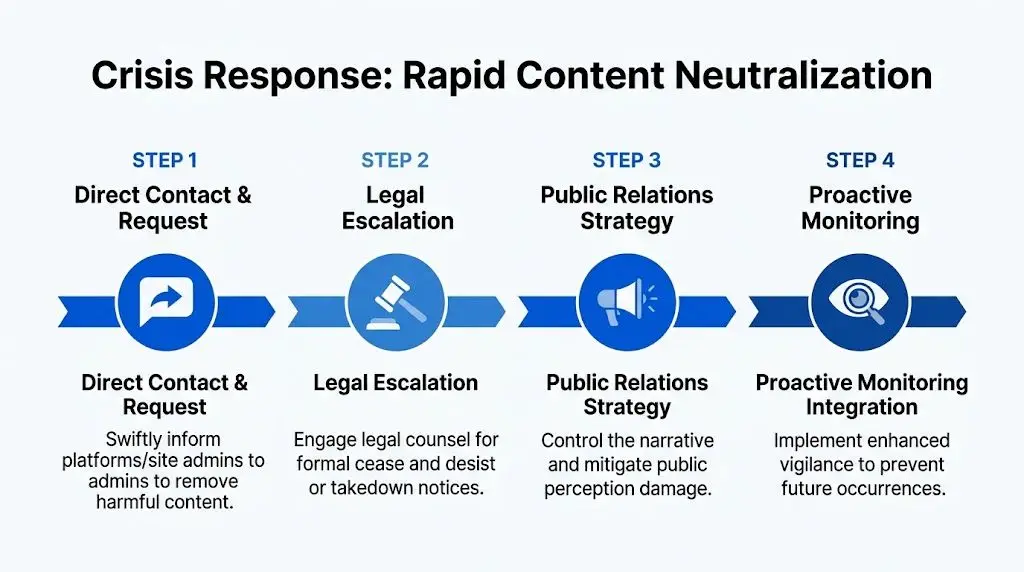
The Crisis Response Protocol Rapid Content Neutralization
When harmful content involving a child is live, speed matters. So does sequence. Families often waste critical time sending emotional messages to the wrong inbox, arguing in comments, or threatening legal action without a valid claim. That approach hardens opposition and creates screenshots that make the situation worse.
The correct objective is rapid content neutralization. That means removing the material at the source where possible, reducing its visibility where immediate removal isn’t possible, and preserving enough evidence to support the next escalation if the first one fails.
Step one is evidence, not outrage
Before anyone reports, comments, or contacts the uploader, preserve the record. Capture the URL, username, timestamps, full-screen screenshots, and surrounding context. If the content appears in stories, disappearing messages, or private groups, document access details immediately.
This isn’t busywork. Platforms often remove content without preserving enough information for later legal action. If the issue evolves into impersonation, harassment, or exploitation, your first screenshots may become the most valuable evidence you have.
Step two is platform-specific reporting
Every major platform has different pathways. Generic abuse reports are often the slowest route because they land in broad moderation queues. Better results come from matching the complaint to the platform’s own taxonomy: harassment, privacy violation, impersonation, minor safety issue, copyright infringement, or nonconsensual intimate imagery.
The wording matters. You are not writing an essay. You are establishing a rule violation with attached evidence.
Use this decision table:
| Situation | Best initial route | Common mistake |
|---|---|---|
| Fake account posing as a child | Impersonation report with identity proof | Reporting it as “spam” |
| Shared private image | Privacy or intimate image tool | Arguing in public comments |
| Reposted photo you own | Copyright takedown if you hold rights | Claiming defamation without evidence |
| Search result to removed page | De-indexing request after source action | Requesting de-indexing before removal |
| School or club post exposing data | Direct removal request to administrator | Assuming platform report is faster |
Step three is legal escalation with the right claim
DIY efforts typically fail. Families realize a problem exists, yet they are unaware of the legal grounds compelling intervention.
Use the narrowest valid tool that fits the facts:
- Copyright claims work when a parent or family member owns the original photo or video and someone reposted it without permission.
- Trademark and impersonation theories can help when a fake account uses a known name, likeness, or family-associated branding to deceive.
- Privacy and child protection mechanisms are often stronger than defamation arguments because they don’t require proving reputational damage in the abstract.
- Formal legal notices become necessary when platforms ignore clear violations or when the poster is identifiable and within reach.
A weak legal theory wastes time. A precise one gets reviewed faster.
Counsel’s view: Don’t lead with the loudest accusation. Lead with the claim the platform already has a process to honor.
NCII and minor-sensitive image cases require special handling
If the material involves sexualized content, coercive sharing, or intimate imagery, treat it as a specialized removal matter immediately. Do not negotiate with uploaders. Do not test whether they’ll “do the right thing.” Use the platform’s NCII procedures and child safety reporting routes without delay.
In these cases, the challenge isn’t just removal. It’s containment. Copies move quickly. Search results may lag behind source removal. Hash-matching systems and trusted flagger channels can materially improve results when properly used, but they depend on fast evidence collection and accurate categorization.
For image-specific matters, a focused process such as removing online images and copies across platforms is often the practical starting point because images rarely remain isolated to one URL.
Search engines are a separate battlefield
Families routinely assume that once a page is removed, the problem is over. It isn’t. Search engines may continue to show cached titles, snippets, and outdated results. If you don’t follow through, the public may still find traces of the incident.
De-indexing is not the same as source removal. You often need both. The first attacks discoverability. The second attacks existence.
The methodology many firms use combines monitoring, reporting, direct outreach, and search suppression. That approach aligns with guidance summarized by Fielding’s discussion of protecting a child’s digital reputation, which notes that NTIA benchmarks show platforms achieving 85-95% takedown rates for reported child exploitation content via privacy-preserving detection and cross-platform data sharing.
Know when to stop DIY efforts
There’s a point where self-help starts causing damage. That point usually arrives when any of the following are true:
- The content has spread across multiple platforms
- The poster is hostile, anonymous, or extorting
- The child’s school or social circle is actively sharing it
- The material concerns intimate imagery, identity theft, or impersonation
- Search engines have already indexed the content
At that stage, one option among others is to use a specialist service such as ContentRemoval.com for coordinated takedowns, de-indexing, and monitoring. The advantage is not marketing language. It’s procedural discipline. Someone has to run the matter like a case, not like a family argument.
Strategic Communication and Psychological Support
Parents often fixate on removal because it feels concrete. They can file a report, send a letter, and watch a link disappear. What they can’t see as easily is the internal damage to the child. Shame, panic, social withdrawal, and anticipatory dread often last longer than the content itself.
That is why technical resolution is only half the assignment. If you remove the material and mishandle the child, you haven’t solved the problem. You’ve only cleaned up the visible part of it.

The first conversation sets the tone
Your child needs to hear three things quickly. They are not alone. The situation is being handled. They are expected to cooperate, not defend themselves online.
What they do not need is a lecture in the first hour. Blame produces secrecy. Secrecy destroys evidence and delays intervention. Even if the child exercised poor judgment, you need information before you need accountability.
A strong opening sounds like this: we’re going to get the facts, preserve what matters, stop further spread, and decide together who needs to be told. Calm authority is more protective than visible outrage.
“Don’t respond, don’t delete your own evidence, and don’t try to fix this with your friends. Bring everything to us.”
Decide who must be informed
Not every incident belongs at school. Some do. If the content is being circulated by classmates, affects attendance, or creates a credible risk of in-person humiliation or harassment, the school needs notice. Give administrators evidence, a concise chronology, and a specific request. Vague complaints invite vague responses.
Mental health support should also be considered early, not as a sign that the child is fragile, but because humiliation and social fear can escalate quickly. Children often minimize distress to avoid losing device access or disappointing parents. Don’t mistake silence for resilience.
Discretion protects recovery
High-profile families have an added complication. Adults around them may gossip under the pretense of concern. Keep the circle tight. One parent or adviser should coordinate outside communications so the child isn’t repeatedly asked to relive the event by teachers, relatives, staff, and family friends.
Containment is emotional as well as digital. A child who believes the family has a plan is far less likely to spiral into self-blame or reckless attempts at self-defense online. That confidence becomes part of the repair.
Long-Term Remediation and Reputation Fortification
Removal is defensive work. Fortification is strategic work. Families that stop after takedowns leave their child vulnerable to resurfacing, reposts, cached references, and future search scrutiny.
The more durable approach is to build a controlled digital record that outranks, outlasts, and reframes whatever remains. That doesn’t mean manufacturing a false persona. It means ensuring that a child’s searchable identity is not defined by one bad moment, one malicious post, or one copied image.
Why suppression belongs in the plan
Deletion is ideal. It’s not always possible. Screenshots survive. Aggregator sites ignore requests. Search remnants linger. In those situations, suppression often outperforms deletion alone.
As summarized by Internet Matters’ guidance on protecting a child’s online reputation, Google’s recent algorithms prioritize fresh, authoritative content, with studies showing a 40% drop in negative search visibility after six months of optimized positive profiles. The same source also notes that dark web child data leaks surged 200% in early 2026, which underscores why suppression and monitoring have to accompany removal.
Build assets you control
A strong reputation stack for a child or older teen may include several controlled properties, depending on age and exposure level.
- A simple personal site: appropriate for older teens with academic, artistic, athletic, or philanthropic accomplishments.
- Structured public profiles: only where age-appropriate and only with careful privacy controls.
- Credible third-party mentions: school achievements, competition results, or portfolio references on reputable domains.
- Updated media hygiene: replacing old or low-quality public traces with accurate, current, and controlled material.
This works because search engines prefer coherent identity signals. If you provide them with better ones, the negative residue loses prominence over time.
Fortification has to stay authentic
Parents sometimes overcorrect and create a polished but artificial profile that doesn’t match the child. That can backfire socially and psychologically. The objective isn’t image laundering. It’s control, accuracy, and resilience.
A child’s digital presence should be sparse, credible, and age-appropriate. For younger children, that may mean very little public content at all. For older teens preparing for university, it may mean a curated academic or creative footprint with minimal personal exposure.
The best long-term reputation strategy is not maximum visibility. It’s selective visibility under family control.
A fortified profile gives future viewers something legitimate to find first. That is how you shift a child’s digital identity from vulnerability to managed asset.
Conclusion Establishing Perpetual Digital Vigilance
Protecting a child online isn’t a weekend task. It’s an ongoing discipline that combines governance, monitoring, evidence handling, legal precision, search strategy, and emotional containment. Families who approach it casually usually discover the gaps only after someone else has exploited them.
When the situation is critical, rely on systems, not instincts. Build the account inventory before there’s a crisis. Monitor before rumors harden into search results. Escalate with the correct legal and platform tools. Support the child with the same seriousness you bring to removal. Then fortify the digital record so one incident doesn’t define the future.
That is how you protect children reputation online in any meaningful sense. Not with generic safety advice. With disciplined control.
When a child’s online reputation is at risk, delay is expensive. ContentRemoval.com works with families, executives, and advisers who need discreet action on takedowns, de-indexing, leaked images, impersonation, and ongoing monitoring. Start with a confidential assessment and get a clear plan for neutralizing the threat and protecting the child’s long-term digital identity.
Frequently asked questions
What should I do first if a photo of my child is being shared online?
Preserve the evidence before reporting or contacting anyone: capture the URL, username, timestamps, full-screen screenshots and surrounding context. Then report under the platform’s specific category such as privacy violation, impersonation or minor safety, since generic abuse reports land in slow moderation queues.
When should parents stop handling online harassment of a child themselves?
When the content has spread across multiple platforms, the poster is anonymous, hostile or extorting, classmates are actively sharing it, the material involves intimate imagery or impersonation, or search engines have already indexed it. At that point the matter needs procedural discipline rather than family improvisation.
How do I stop family members from oversharing about my child?
Set a household publication standard that applies to grandparents and co-parents as well: no school logos, no real-time location, no documents in the background and no embarrassing stories framed as cute. Review it on a recurring schedule alongside account settings and photo exposure audits.