
Private equity reputation now sits inside risk management, transaction execution and investor confidence rather than PR. Harm arrives through portfolio company failures, fund-level conduct, external narrative attacks and digital vectors like leaked decks and persistent search results. Firms protect it by diligencing digital risk before acquiring, governing disclosure credibly, and using legal removal, de-indexing, suppression and monitoring.
Key facts
- McKinsey reported more than 16,000 companies held over four years, extending each asset’s exposure window.
- Research on PE contracting found targets demanded stronger nonperformance penalties from sponsors who had walked away.
- Triage in the first 48 hours must classify content as false, unlawfully posted, confidential or merely damaging.
- Suppression is the fallback when content is lawful enough to stay online but should not dominate results.
Where ContentRemoval.com comes in. ContentRemoval.com works with general partners, portfolio company leadership and their counsel when a controversy starts attaching itself to the sponsor’s name in search: leaked transaction materials, defamatory forum threads, impersonation of partners or executives. Investor relations and general counsel usually make the first call, often mid-fundraise or ahead of an exit. A free, confidential 15-minute Exposure Scan maps what is removable and what needs suppression, and the report is yours to keep. Get a Free, Confidential Exposure Scan or read how our reputation management work is done.
A portfolio company issue rarely stays at the portfolio company level now. A labor complaint, a product safety allegation, an executive screenshot, or a leaked internal slide can move from a niche forum to Google results, industry newsletters, AI summaries, and LP diligence calls before your communications team has agreed on a holding statement. If you’re in market raising capital, negotiating an exit, or trying to win a contested deal, that lag is expensive.
Most private equity firms still treat reputation as a PR matter. That’s outdated. In practice, private equity reputation now sits inside risk management, transaction execution, and investor confidence. The firms that understand that move faster, disclose better, and use legal and technical remediation before a narrative hardens online.
The New Calculus of Private Equity Reputation
A decade ago, many firms could rely on the industry’s institutional credibility to absorb a rough headline cycle. That cushion was built on performance. Academic analysis of 1,373 funds from 1984 to 2008 found that the average U.S. buyout fund beat the S&P 500 by at least 20% over the life of the fund, a result that helped establish private equity as a credible value-adding asset class for institutional investors, as discussed in Chicago Booth’s review of the historical evidence.
That historical reputation still matters, but it no longer resolves today’s problem. Your LPs aren’t evaluating private equity in the abstract. They’re evaluating your firm, your portfolio, your controls, your disclosures, and how quickly you contain digital fallout when something goes wrong.
A familiar scenario proves the point. You’re midway through a fundraise. One portfolio company is dealing with an employment dispute. A former employee publishes allegations online. An activist account amplifies them. Search results for the company shift within days. Then your firm name starts appearing alongside the controversy because old press releases, board biographies, and deal announcements connect the entities clearly enough for search engines and AI systems to cluster them. By the time an LP asks about it, the issue isn’t just the allegation. It’s whether you saw it early, whether you disclosed it clearly, and whether your operating model can control reputational spillover.
Private equity managers don’t lose credibility only when an allegation is true. They lose credibility when they look slow, evasive, or operationally unprepared.
Traditional crisis communications can’t solve that on its own. Media statements don’t remove defamatory pages. A carefully drafted quote doesn’t de-index leaked documents. A reactive PR shop usually isn’t built to handle source removal, search suppression, impersonation, or re-upload control. If you’re budgeting for this category, you need to understand the operational side of it, not just the messaging side. This is the part many firms underestimate, and it’s why a realistic strategic cost analysis of online reputation management belongs in the same discussion as legal reserves and cyber response planning.
Anatomy of Reputational Harm in Private Equity
Private equity reputation usually breaks down through four channels. The mistake is treating them as one problem called “bad press.” They aren’t the same, and they don’t require the same response.
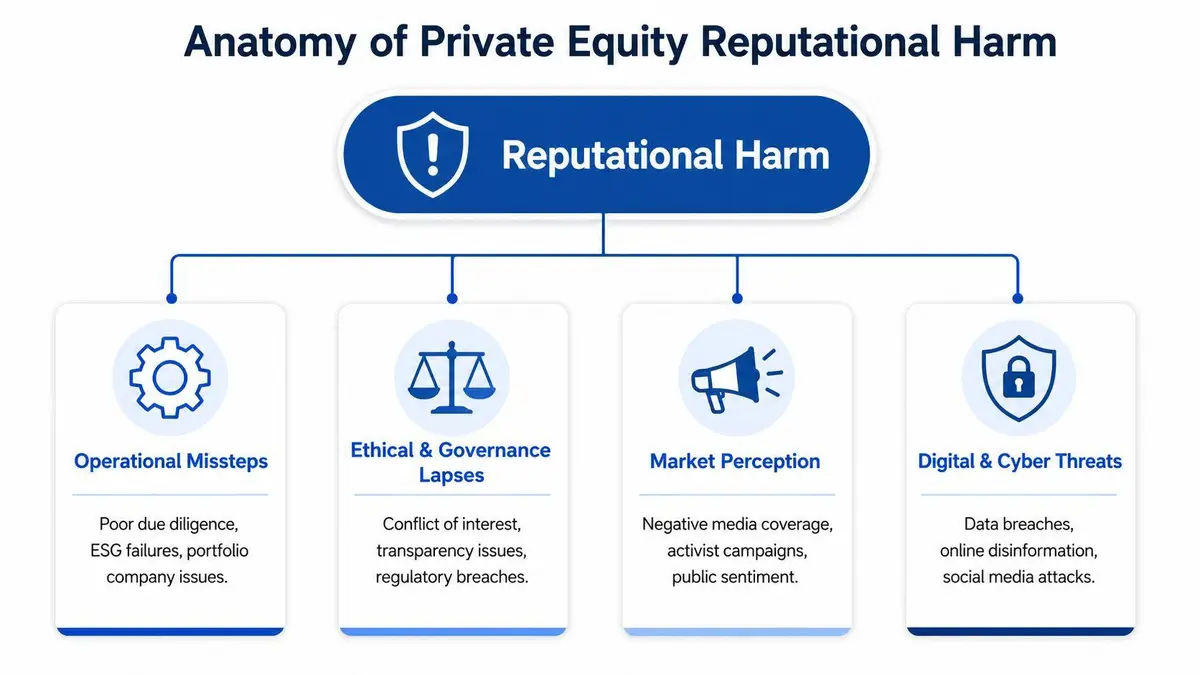
Operational failures inside the portfolio
The first category starts where most firms least want attention focused, inside operating companies. Product complaints, labor disputes, executive misconduct, vendor nonpayment allegations, environmental claims, and customer harm stories all create a direct narrative bridge back to the sponsor. That bridge gets stronger if the firm marketed itself as operationally intensive or publicly highlighted its governance standards during acquisition.
When hold periods extend, these issues matter more because the market has more time to discover and archive them. McKinsey reported that buyout funds underperformed public equities for the third consecutive year in 2025, with returns of about 7% versus the S&P 500’s 18% and the MSCI World’s 22%. It also reported that more than 16,000 companies globally had been held for more than four years, the highest level on record, in a backdrop where delayed exits and weaker distributions have increased LP scrutiny, as outlined in McKinsey’s private equity market report.
A longer hold doesn’t just delay liquidity. It extends exposure.
Conduct at the fund level
Some reputational hits are self-inflicted by the GP rather than the company. Inconsistent LP reporting, selective use of performance metrics, aggressive deal behavior, executive misalignment, and visible conflict around governance all send a simple message to the market: this firm may optimize presentation before substance.
That message spreads quickly because counterparties compare notes. Lawyers talk. intermediaries talk. lenders talk. former executives talk. Once the market decides you’re opaque, every future disclosure gets examined through that lens.
External narrative attacks
The third category comes from outside the cap table. Activist groups, advocacy journalists, competitors, litigants, and disgruntled former stakeholders often know that pressure works best when aimed at the sponsor rather than the subsidiary. They don’t need to prove a broad thesis about your firm. They need only one emotionally sticky story and enough digital distribution to make it rank.
A sponsor with several consumer-facing portfolio companies is especially exposed because a single controversy can be framed as evidence of a pattern. That’s often unfair. It still works.
Digital and cyber vectors
Generic reputation advice usually fails given how harm now arrives through search indexing, scraped copies, fake profiles, leaked decks, manipulated screenshots, complaint sites, social reposting, and AI-generated summaries that repeat unsupported allegations as if they’re settled background. Some of this content is unlawful. Some is authentic but contextless. Some is impossible to erase at source and must instead be neutralized through de-indexing, suppression, or counter-positioning.
Here is the practical breakdown most firms should use:
- Portfolio-level exposure: complaints, employee allegations, regulatory inquiries, product incidents, executive conduct issues.
- Fund-level exposure: disputed deal tactics, benchmark opacity, governance concerns, LP communication failures.
- Narrative exposure: campaigns designed to connect isolated events into a broader anti-sponsor story.
- Digital exposure: searchable content that persists, duplicates, and resurfaces long after the underlying issue is supposedly closed.
If you don’t separate those buckets, you’ll waste time applying PR language to what is really a legal, technical, and search visibility problem.
The Tangible Costs of a Compromised Reputation
Private equity managers often ask whether a reputational issue is “material.” That’s the wrong threshold. The useful question is whether it changes behavior from LPs, targets, lenders, management teams, or buyers. If it does, the cost is real whether or not it ever appears as a line item.
Why counterparties reprice trust
Reputation affects transactions because contracts never capture every contingency. In stressed markets, counterparties rely on assumptions about how a sponsor behaves when a deal becomes painful. Academic research on private equity contracting found that reputation for honoring deals functions as a critical non-contractual asset. When a sponsor did walk away, targets often didn’t stop dealing with that firm forever, but they did seek stronger nonperformance penalties in later transactions, a direct consequence documented in the study on private equity contracting and strategic default.
That point deserves more attention in modern markets. Reputational damage doesn’t always kill access. Often it makes access more expensive, more conditional, and slower.
Practical rule: If your name creates hesitation in a process, the market has already converted reputation into economics.
An LP may continue re-upping but ask harder questions, require more diligence support, or view every surprise as evidence of weak controls. A target may still sell to you but demand tougher terms. A management candidate may still join, but only after extended diligence on your firm. A buyer may still bid, but use publicly indexed controversy to grind on price or insist on heavier protections.
Where the losses show up
The damage usually appears in four places.
| Reputational Event | Impact on LPs | Impact on Deal Flow | Impact on Exit Value |
|---|---|---|---|
| Portfolio company misconduct allegation | Raises questions about oversight and disclosure discipline | Founders and advisers may worry about sponsor spillover | Buyers use controversy to challenge quality of earnings and management stability |
| Public dispute over deal behavior | Undermines confidence in judgment and execution culture | Targets and bankers may insist on stricter protections | Acquirers may read sponsor conflict as a sign of hidden process risk |
| Leaked internal documents or emails | Creates concern about information governance and candor | Counterparties become more guarded in data sharing | Diligence expands because buyers expect more undisclosed issues |
| Persistent negative search results tied to firm or partner names | Makes every diligence meeting start on defense | Referral networks become less willing to advocate strongly | Exit messaging gets crowded out by archived negative content |
None of this requires a scandal of historic scale. In a slower exit market, even a manageable controversy can become costly because there is less performance cushion around the asset.
Fundraising gets hit first, even when the issue starts elsewhere
Fund managers sometimes assume LPs compartmentalize. They usually don’t. They may distinguish between a portfolio incident and a GP conduct issue intellectually, but in real diligence they still ask a broader question: what does this reveal about the firm’s judgment, controls, and truthfulness under pressure?
That is why private equity reputation needs an operating response, not a cosmetic one. If the first answer is “our PR team is handling it,” you’ve already signaled that you don’t understand the problem.
Proactive Defense Through Governance and Due Diligence
A strong reputation isn’t built with slogans. It’s built with systems that reduce avoidable surprises and make your disclosures believable when a surprise still occurs.

Put digital diligence into the deal process
Most firms diligence financials, legal exposures, tax structure, cyber controls, and commercial positioning. Many still don’t run a serious digital reputation workstream before signing. That’s careless.
A proper review should test what already ranks for the company, the founder, the CEO, and the brand’s common misspellings. It should identify legacy forum threads, executive accusations, litigation chatter, leaked materials, duplicate complaint pages, fake social profiles, and image-based content that can be reintroduced later. It should also assess how easily the sponsor itself will become connected to those results once the acquisition is announced.
The question isn’t whether the target has criticism online. Most businesses do. The question is whether there is a searchable narrative that can be revived against the company or the fund at the worst possible moment.
Standardize reputational governance with performance reporting
LPs trust firms that explain performance accurately and comparably. HBS Online’s discussion of private equity performance explains why IRR, MOIC, and PME should be used together rather than selectively, because each metric captures something different and each has blind spots. Firms that benchmark responsibly and avoid cherry-picking are viewed as more credible, as described in HBS Online’s overview of private equity performance metrics.
That has reputational value beyond the quarterly report. It establishes a pattern. If you’re disciplined with numbers, LPs are more likely to believe you’re disciplined with bad news.
Don’t let your investor materials create the same impression as an over-lawyered crisis statement. If every disclosure looks optimized, none of it looks trustworthy.
Build a governance checklist that actually changes behavior
Most firms don’t need another policy binder. They need a short operating checklist used before every acquisition, board appointment, and major communications event.
- Screen key people thoroughly: Review public allegations, archived media, litigation references, impersonation risk, and social media footprint for fund leaders and portfolio executives.
- Map known narrative vulnerabilities: Identify which allegations, old stories, or activist themes are most likely to be revived after the deal closes.
- Set disclosure thresholds early: Decide what gets escalated to the GP, outside counsel, investor relations, and operating partners before a crisis starts.
- Benchmark without spin: Use multiple performance measures and comparable benchmarks, then explain why they were chosen.
- Rehearse search-result scenarios: Know what an LP, lender, journalist, candidate, or buyer sees when they search the firm and major portfolio names.
Governance only matters if it creates speed and consistency under pressure. If your team still debates ownership when a digital issue lands, your governance model is decorative.
Active Response Digital Remediation and Takedowns
When a reputational issue breaks online, the first mistake is treating every harmful page the same. Some content should be litigated. Some should be removed through platform rules. Some should be de-indexed from search. Some should be suppressed because removal isn’t realistic. Those are different tracks, with different evidence requirements and different time horizons.
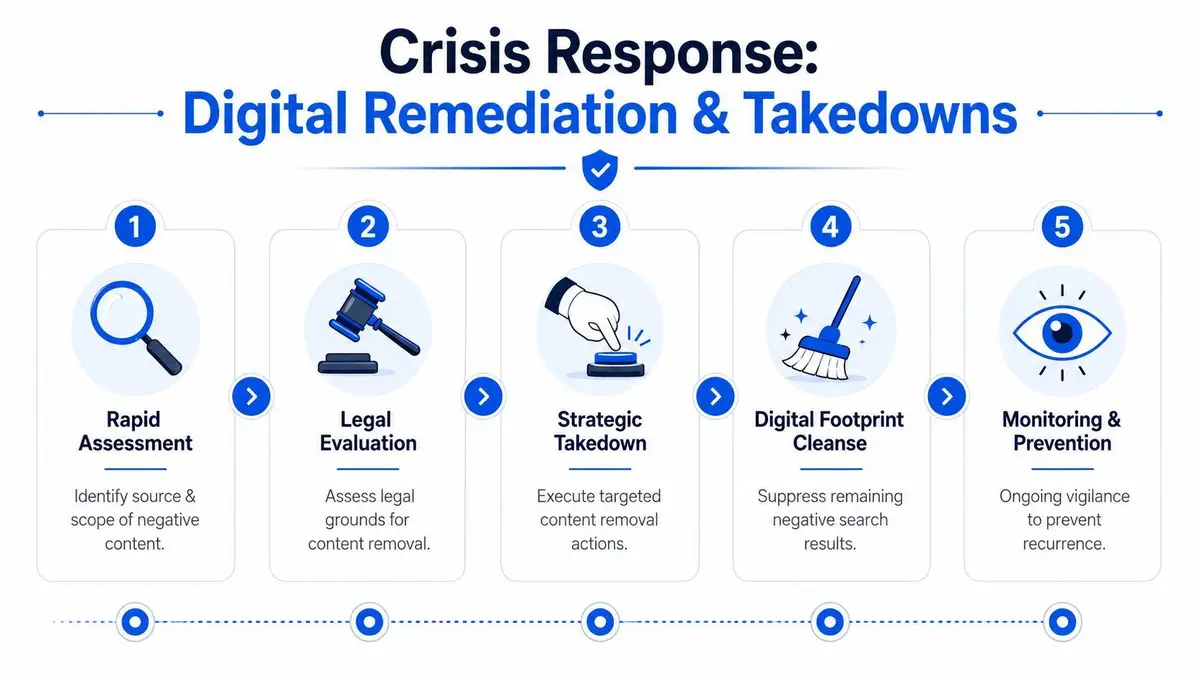
The first 48 hours decide the shape of the problem
You need a triage process that answers five questions fast.
- What exactly is live? Not the summary. The actual URLs, screenshots, videos, cached copies, and search queries.
- Is the content false, unlawfully posted, confidential, or merely damaging? The legal route depends on that distinction.
- Where is the point of influence? Publisher, platform, search engine, hosting provider, court order, or negotiated removal.
- Can it spread through duplication? If yes, preserve evidence and prepare for re-uploads before taking action.
- Who needs to know internally? Usually legal, compliance, IR, the deal team, and the portfolio company’s leadership.
Most firms waste valuable time in internal debate because no one has authority to classify the issue. Fix that before the crisis.
Choose the right remedy, not the loudest one
Legal removal works when content is defamatory, privacy-invasive, unauthorized, infringing, impersonating, or based on leaked confidential material. Technical removal or de-indexing may be more realistic when the publisher won’t cooperate but search visibility can still be reduced. Suppression is the fallback when content is lawful enough to remain online but shouldn’t dominate results.
That last category matters more than many fund managers realize. Search engines and AI systems often privilege recency, repetition, and page structure over fairness. If the source won’t come down, you may need to out-position it with authoritative pages, controlled profiles, corrected narratives, and stronger owned assets.
For firms dealing with leaked internal files, board decks, or transaction materials, the response has to be document-specific and preservation-focused. In such cases, a practical executive guide to removing leaked business documents from the internet proves valuable, since the appropriate remedy depends on whether the issue involves confidentiality, trade secrets, copyright, platform violations, or all three.
A specialist provider can help here. ContentRemoval.com handles source removal, de-indexing, false profile takedowns, leaked-document response, and ongoing re-upload monitoring. That’s not a substitute for counsel or crisis communications. It’s a separate capability that most private equity firms need available before a serious event.
Use AI and workflow tools carefully
Some firms are starting to formalize triage workflows with internal automation and conversational systems so legal, investor relations, and operating teams can classify incidents quickly and respond consistently. If you’re exploring that route, Wispra’s examples of applications pour l’IA conversationnelle des entreprises are a useful reference point for how structured AI interactions can support reputation workflows without turning the process into generic chatbot theater.
This topic also benefits from a visual walkthrough:
Suppression is not surrender
A lot of executives hear “suppression” and assume it means burying the truth. That’s not the point. The point is to stop stale, false, disproportionate, or contextless material from becoming the dominant public record.
Use suppression when the content isn’t removable or when removal will take too long. Build stronger executive profiles. Publish accurate transaction and governance information. Strengthen portfolio company bios, leadership pages, and press resources. Correct data aggregator errors. Claim and optimize high-authority profiles. Then monitor whether the negative material is dropping or migrating.
A search result is not a verdict. It’s a ranking outcome. Treat it like an operational surface you can influence.
Continuous Monitoring and Reputation Intelligence
Monitoring isn’t about counting mentions. Serious firms use it to detect whether a narrative is forming before it becomes a diligence problem.

Watch the entities that create fund-level spillover
Monitoring efforts frequently center on the fund name and maybe the flagship portfolio companies. That’s too narrow. A real program tracks the people and themes most likely to transfer risk across the portfolio.
That includes senior partners, operating executives, portfolio CEOs, controversial business lines, recurring allegations, litigations that attract online commentary, and high-risk keywords attached to each asset. You also need to watch the spaces where narratives incubate before mainstream pickup, not just large social platforms but niche forums, complaint sites, trade comments, scraped reposts, and AI-discoverable web pages.
For data collection, many teams now combine standard alerting with custom web capture pipelines so they can see page changes, reposting behavior, and structured page content before a search issue escalates. If you’re assembling that stack internally, a tool like Context.dev’s html scraping api can be useful for gathering raw web content into a monitoring workflow.
Build an escalation model, not a dashboard museum
The value of monitoring isn’t the dashboard. It’s the decision tree tied to it.
Create clear categories. One category covers routine noise that needs no action. Another covers factual criticism that should be tracked but not challenged. Another covers harmful falsehoods, leaks, impersonation, or content that links the firm to an issue in a misleading way. Each category should trigger a defined owner and response path.
A strong system also records whether a risk is recurring. If the same allegation keeps resurfacing around a portfolio company, that is no longer a one-off communications problem. It’s an asset-management issue. If a partner’s name repeatedly attracts manipulated content or impersonation, that becomes a security and governance issue.
Feed intelligence back into the firm
Most monitoring programs fail in this regard. They produce alerts, not changes.
The useful model is circular. Monitoring informs M&A diligence, executive vetting, LP communications prep, and crisis playbooks. Then those improved processes reduce the next monitoring burden. For firms that want a cleaner operating framework, a dedicated reputation monitoring program should function as an intelligence layer tied directly to legal, investor relations, and portfolio operations, not as a marketing accessory.
If your current setup only tells you that someone mentioned the company, you’re not doing reputation intelligence. You’re doing notification management.
Securing Your Firm’s Most Valuable Asset
Private equity reputation is no longer a soft-variable issue delegated to media relations after something goes wrong. It sits beside cyber, compliance, and transaction risk because it affects fundraising, deal certainty, management recruitment, and exit economics. The digital layer changed the equation. Harm is faster, more searchable, more persistent, and more likely to spread from one company to the sponsor itself.
The firms that handle this well do three things consistently. They diligence digital risk before they acquire it. They build governance that makes disclosure credible when pressure hits, and when harmful content appears, they use the correct mix of legal action, technical takedown work, de-indexing, suppression, and monitoring instead of hoping a statement will calm the market.
This matters even more as AI systems become another discovery surface for investors, journalists, recruits, and counterparties. If you’re thinking about how brand and reputational narratives are now interpreted across AI platforms as well as search, this broader guide to AI brand visibility for marketers is worth reviewing for the mechanics, even if your use case is more sensitive than standard marketing.
You don’t need theatrics. You need control. That means identifying where your name is vulnerable, deciding which issues are removable, building suppression assets before they’re urgently needed, and making sure your team can act fast when a portfolio event starts contaminating the fund’s own reputation.
If you’re a GP, this is part of fiduciary discipline. A reputation problem that affects LP confidence, transaction advantage, or exit value is not a communications nuisance. It’s an asset-protection issue.
If your firm is dealing with harmful search results, leaks, impersonation, false allegations, or a portfolio company controversy that’s starting to affect LP confidence or deal flow, ContentRemoval.com can provide a confidential assessment and a clear remediation plan focused on removal, de-indexing, suppression, and ongoing monitoring.
Frequently asked questions
How does a portfolio company scandal affect the private equity sponsor?
Old press releases, board biographies and deal announcements connect the entities clearly enough for search engines and AI systems to cluster them, so the firm name appears alongside the controversy within days. LPs then ask not only about the allegation but whether the sponsor saw it early, disclosed it clearly and could contain the spillover.
Should private equity firms run digital reputation due diligence before a deal?
Yes. Test what already ranks for the company, founder, CEO and common misspellings, and look for legacy forum threads, executive accusations, leaked materials, complaint pages and fake profiles. The question is whether a searchable narrative could be revived against the company or the fund at the worst moment.
Can leaked private equity documents be removed from the internet?
Often, depending on whether the issue involves confidentiality, trade secrets, copyright, platform violations or all three. The response must be document-specific and preservation-focused, with evidence captured before action because leaked files tend to be re-uploaded across hosts.