
Your phone number on the internet is a security problem, not a privacy nuisance, because it links to account recovery, messaging apps and broker profiles. Removal follows a sequence: map every instance in every format, triage listings by the harm they enable today, apply source takedowns, broker opt-outs, de-indexing or legal demands, then monitor for reappearance.
Key facts
- Search the number with and without country code, with spaces, dashes and parentheses, each in quotation marks.
- Listings tied to a home address, threats or impersonation are incident response matters and go first.
- Remove primary broker profiles before chasing mirror sites that refresh from them.
- Use carrier port-out locks and move key accounts away from SMS recovery while removals run.
Where ContentRemoval.com comes in. ContentRemoval.com handles source removal, de-indexing and monitoring when an executive’s or family member’s phone number is circulating in doxxing threads, broker networks or scraped directories. The request often comes from a chief of staff, a family office or security adviser once hostile calls begin. A free, confidential 15-minute Exposure Scan maps where the number appears and what is removable, and the report is yours to keep. Get a Free, Confidential Exposure Scan or read how our content removal work is done.
Your phone starts ringing from unfamiliar numbers. Then the texts begin. A stranger uses your first name. Another caller references your company, your home city, or a family member. At that point, you’re no longer dealing with an annoyance. You’re dealing with an exposed identifier that can be used to find, verify, and pressure you.
For executives, founders, public figures, and their families, a phone number on the internet is rarely an isolated leak. It’s usually a pivot point. Once exposed, it can connect to messaging apps, data broker profiles, account recovery flows, business filings, old social media records, and public contact databases. People think of it as a privacy problem. In practice, it’s often a security and reputational control problem.
That distinction matters. If your number is circulating online, the right response isn’t random opt-outs and a few angry emails to website administrators. You need a strategic removal plan that identifies where the number appears, why it appears, who can use it, and which exposures create real-world risk right now.
The Compromise of a Private Number
The first sign is often small. An unknown caller gets past your usual screening. A text arrives with enough personal detail to feel invasive. A journalist, recruiter, scammer, or hostile actor reaches a number you never intended to publish. Clients often describe the same reaction: confusion first, then a sharp realization that someone has connected private infrastructure to the public web.
That reaction is justified. Your phone number isn’t just contact information. It’s a live access point. It reaches you directly, follows you across services, and often sits inside account recovery and authentication systems. Once exposed, it can support impersonation attempts, social engineering, and targeted harassment.
The broader environment has made this worse. In 2025, mobile devices generated 64.35% of all website traffic, up from 6.1% in 2011, according to Exploding Topics’ summary of mobile internet traffic data. The practical implication is obvious. The device individuals carry at all times is now central to how they work, communicate, authenticate, and respond. A phone-first internet turns a leaked number into an operational vulnerability.
Why high-profile people get hit harder
If you run a company, manage capital, appear in the press, or have a visible family name, your number carries extra value. Attackers don’t need to breach a system if they can pressure a person. A published number gives them a direct route to your attention and a way to test your defenses.
That’s why generic privacy advice usually fails. It treats every exposure the same. It tells you to remove your number from “the internet” as if all listings carry equal risk. They don’t. A stale directory entry is one problem. A number attached to a doxxing thread, account recovery clue, or executive bio scraped by aggregators is a different problem entirely.
A private number becomes dangerous when it stops being private in only one place. The real risk begins when multiple systems can confirm it belongs to you.
If your exposure is tied to harassment, extortion, or targeted publication, treat it accordingly. A tactical response matters in the first hours. ContentRemoval.com has published a useful strategic response checklist for doxxing incidents, and that’s the right posture here. Stabilize first. Then remove. Then monitor for recurrence.
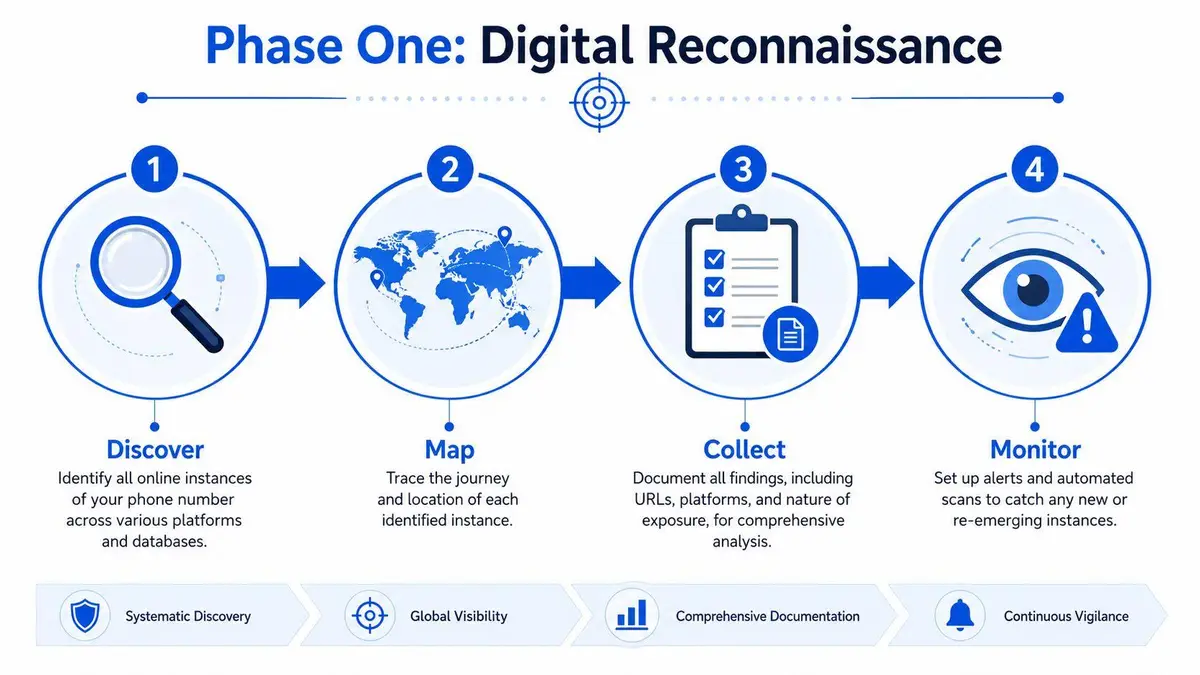
Phase One Digital Reconnaissance
Individuals often start badly. They search their number once, find a few results, and assume they understand the problem. They don’t. A proper review treats your phone number on the internet as an intelligence target. You need to know every visible instance, every derivative listing, and every system that can validate the number as yours.
Search the obvious formats first
Start with the number exactly as a machine and a person might store it. Search the full number with country code, without country code, with spaces, with dashes, and in parentheses. Put each variation in quotation marks. Search the number alongside your name, company name, city, assistant’s name, and any brand or property commonly associated with you.
Then widen the scope:
- Search by formatting variant. A number may appear as local format on one site and international format on another.
- Search image and PDF results. Numbers are often buried in press kits, brochures, conference agendas, archived newsletters, and scanned filings.
Audit the full exposure chain
A visible result is only the surface layer. You also need to identify where the listing was sourced from. One people-search site may have copied another. A local directory may have scraped a corporate profile. A data broker may have linked your number to an old address or relative.
Use a simple log. Record the URL, what appears on the page, whether the page is indexed in search, whether the number is partial or complete, and whether the site allows direct edits or requires formal requests.
A short table keeps the process disciplined:
| Exposure type | What to record | Why it matters |
|---|---|---|
| People-search listing | URL, full number, related names, addresses | These profiles often propagate widely |
| Business directory | Entity name, role, whether listing is intentional | Some entries are legitimate and should be replaced, not deleted |
| Forum or post | Username, context, hostility level | Intent determines urgency |
| Cached or archived page | Original source, archive source, indexing status | Removal may require separate steps |
Understand why numbers are easy to find
Phone systems online are built for interoperability, not secrecy. The operational standard is E.164, which creates a globally unique identifier for phone numbers. Validation workflows commonly move through syntax and format checks, number-type identification, pattern checks where applicable, and then live verification such as OTP delivery. Telesign explains this clearly in its guide to phone number validation and E.164 handling. The security takeaway is simple: once a number enters online systems in a standardized form, automated tools can validate and sort it quickly.
There’s also a technical layer many people never see. ENUM can convert a normal telephone number into a DNS-resolvable identifier by reversing the digits and appending e164.arpa. The Center for Democracy & Technology describes the mechanism in its analysis of ENUM and internet telephony routing. You don’t need to implement anything to understand the significance. A phone number can be treated as an internet-readable identifier, not just a dial string.
Practical rule: Don’t send a single takedown request until you’ve mapped the full spread. If you move too early, you remove symptoms and miss the system producing them.
Threat Triage and Action Prioritization
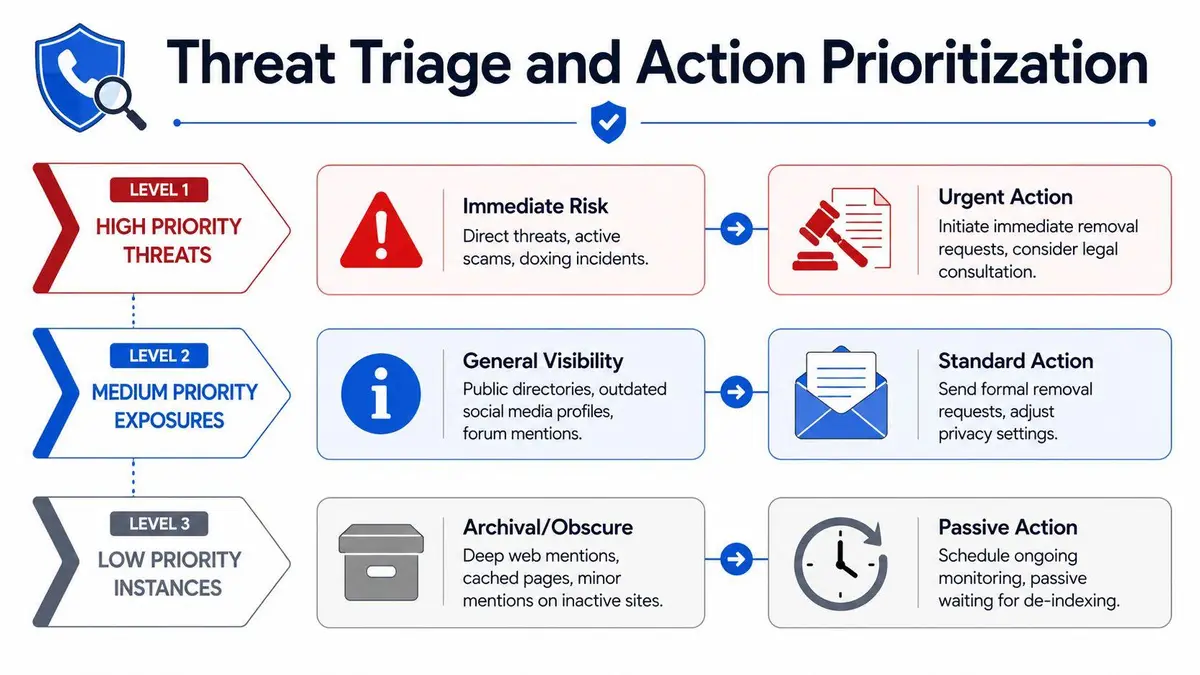
Once the map is complete, stop collecting and start judging. Not every mention deserves the same response time, and treating everything as equally urgent is how people waste days while the serious exposure remains live.
High priority means active security risk
Some exposures demand immediate action because they create direct operational danger. That includes a number posted in connection with your home address, family details, threats, impersonation, extortion attempts, or instructions to contact or harass you. It also includes instances where the number appears to support account takeover, executive impersonation, or social engineering against colleagues.
These are not “privacy clean-up” issues. They are incident response matters. The question isn’t whether the listing is annoying. The question is whether the listing enables harm today.
Medium priority means persistence and spread
The next category covers data brokers, people-search engines, stale social media bios, outdated staff pages, conference archives, and scraped business directories. These listings may not be malicious, but they create discoverability. They also feed one another. One bad profile becomes ten mirror profiles if left alone.
Many high-profile clients get stuck here. They underestimate persistence because the page looks low-grade or obscure. That’s a mistake. A weak source can still rank, still be scraped, and still be used to verify identity.
The underlying principle is straightforward. The problem isn’t monolithic. The harm changes with context. As the ASPE material notes in the framing provided above, general data-broker exposure is a privacy issue, while targeted doxxing or account-recovery leakage is an immediate security threat. The remedy must match the category.
Low priority still matters, just not first
Deep archival mentions, dormant forum posts on inactive sites, and low-visibility cached records belong at the bottom of the stack. They still matter because they can reappear in search or support broader profiling, but they shouldn’t delay urgent work.
Use this decision grid:
- Escalate immediately when the listing enables contact, coercion, impersonation, or physical-world targeting.
- Work systematically when the listing is widespread, syndicated, or structurally tied to brokers and directory networks.
- Monitor and queue when the listing is obscure, stale, or hard to access but currently low impact.
If a page tells hostile people how to reach you, it sits at the top of the queue. If a page merely proves your number existed at some point, it sits lower.
A disciplined triage model also prevents another common mistake: deleting useful public channels without replacements. Some executives remove every visible number at once, then break legitimate contact paths for legal notices, media inquiries, clients, or staff. That creates fresh operational problems. A strategic plan removes dangerous exposure while preserving controlled routes of communication.
Execution A Multi-Pronged Removal Strategy
Execution decides whether this becomes a contained privacy issue or a recurring security problem. Once your priorities are clear, apply the correct removal method to each source, in the correct order, and document every action.

Direct takedowns for source control
Start with the original source whenever you can identify it. A forum thread, staff bio, event page, comment section, cached directory, or user profile can often be edited or removed faster than people expect. Source control matters because copies tend to follow originals.
Make the request precise. Identify the exact URL. Quote the exposed number. State the security risk in plain language. Ask for removal of the number, page snippets, and any associated metadata that could keep the record searchable. Keep the tone professional. Site operators respond faster to a clear instruction than to a long narrative.
This approach works best on smaller publishers, niche communities, and pages where a third party posted the number casually rather than as part of a structured public record.
Broker opt-outs for systemic exposure
Broker listings require a different playbook. They are usually part of a syndication chain, not an isolated post. If your number appears across multiple people-search sites, directory networks, and profile aggregators, treat that as infrastructure-level exposure and clear the most connected records first.
Order matters. Remove primary broker profiles before chasing smaller mirrors that refresh from them. Track each submission, confirmation, and reappearance. If a listing returns, identify which upstream record repopulated it and suppress that source. Otherwise you waste time deleting copies while the system keeps rebuilding them.
For public figures and executives, that trade-off matters. Broad broker visibility may not look urgent on its own, but it lowers the cost of targeting you.
Search de-indexing when the source stays live
Some publishers will ignore you, stall, or hide behind weak moderation policies. Search de-indexing reduces discoverability even when the page itself remains online. That does not solve the whole problem. It does reduce casual exposure, which often cuts off opportunistic calls, texts, and lookups.
Use it selectively. If the page is old, duplicated across low-quality sites, or surfaced mainly through search, de-indexing can buy time and reduce volume while you keep pressure on the source.
A practical comparison:
| Method | Best use case | Limitation |
|---|---|---|
| Source removal | You can reach the publisher or platform directly | May be delayed or denied |
| Broker opt-out | Structured listings across aggregator networks | Records often reappear without follow-up |
| De-indexing | Search visibility is the main driver of exposure | The page may stay live |
| Legal demand | Harassment, impersonation, repeated publication, clear rights issues | Requires careful drafting and jurisdictional judgment |
Legal escalation when the facts support it
Use legal pressure where it will change behavior. If the publication is malicious, repeated, deceptive, tied to impersonation, or clearly unlawful, send a formal demand early. The same applies when a site republishes after notice or refuses to remove a number that creates a credible security risk.
Poorly drafted threats make operators defensive. Precise legal notices get results. They define the harm, preserve your position, and force a decision.
For mixed cases that involve publisher outreach, platform complaints, and de-indexing requests, this guide to removing personal data from websites for executives explains the operational process well. The standard is simple. Match the tactic to the source, the threat, and the practical cost of leaving the exposure in place.
Immediate Mitigation and Ongoing Monitoring
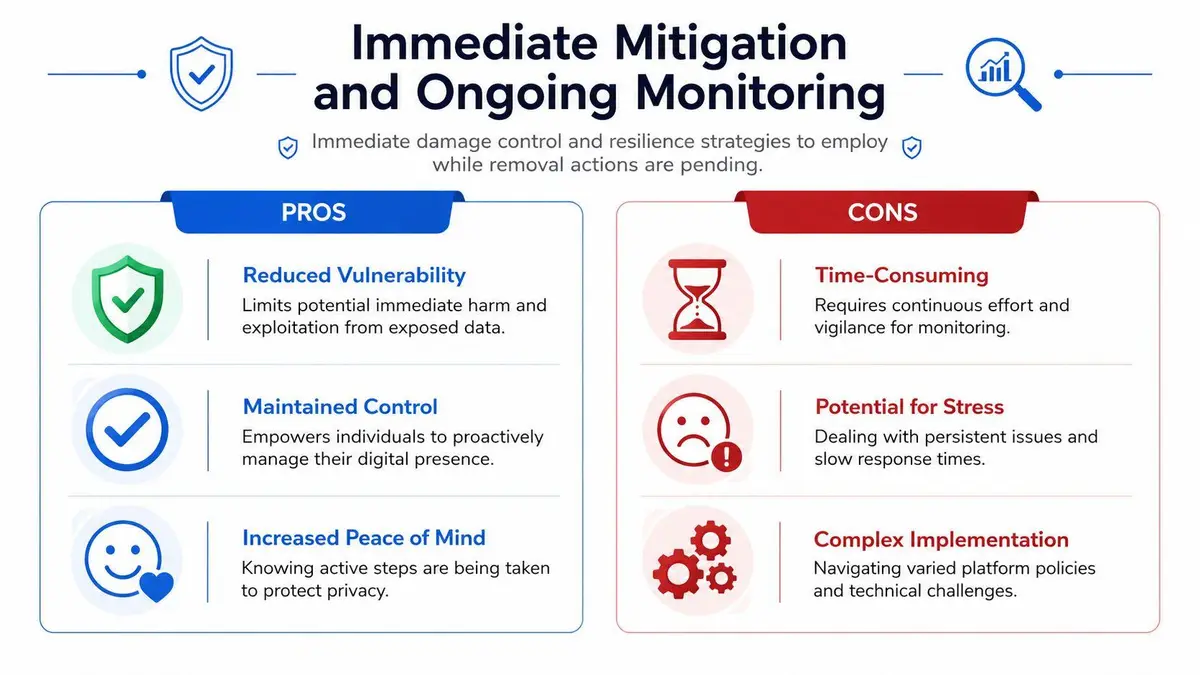
Removal takes time. During that window, you still need control.
Contain the live risk
If the number is receiving hostile traffic, tighten the line immediately. Use carrier-level protections such as port-out lock to reduce SIM-swap risk. Strengthen call and text filtering. Route unknown callers through screening where possible. Brief your assistant, chief of staff, family office, and close relatives so they know not to trust inbound calls or texts that rely on urgency and familiarity.
If the number supports key accounts, review every service tied to it. Remove it from public-facing profiles. Tighten recovery settings. Shift sensitive accounts away from that number where practical.
Change the number or defend the existing one
Changing the number sounds decisive. Sometimes it is. If the number is tied to active harassment, repeated impersonation, or broad publication across hostile channels, replacement may be the cleanest path.
But number changes carry costs. You may disrupt banking, legal, travel, internal contact protocols, and long-standing authentication setups. You may also lose control of a number that remains publicly associated with you.
A side-by-side view helps:
- Keep the number if it is an integral part of critical services and the exposure can be contained through takedowns, filtering, and replacement of public contact paths.
- Change the number if the abuse is intense, the line is no longer operationally usable, or the number has become a stable target for ongoing attacks.
Don’t change a number in panic. Change it because you’ve decided the containment cost is higher than the migration cost.
Monitoring is not optional
A phone number on the internet has a habit of returning. Sites republish. Brokers refresh. Search results shift. An old PDF can surface months after the original page was removed.
That’s why one-time cleanups fail. Set recurring searches. Monitor search results, people-search databases, and any sector-specific directories relevant to your role. Watch for partial-number mentions too. Skilled actors often use fragments to confirm identity without publishing the full string.
Long-Term Prevention and Digital Hygiene
At this stage, the objective changes. You are no longer reacting to exposure. You are reducing the odds of the next exposure and limiting the damage if one occurs.
Treat your phone number like a protected asset with defined access rules. Public figures, executives, and family offices get into trouble when one number becomes the default key for everything. It ends up on forms, in vendor records, inside old account profiles, and in routine workflows no one has reviewed in years. That is how a private number turns into a searchable identifier.
The right model is separation by function. Keep one primary number tightly restricted to trusted contacts and high-value accounts. Use a second number for business interactions that may circulate outside your inner circle. Use a third number for low-trust registrations, event signups, and temporary situations where disclosure risk is high.
Authentication deserves the same discipline. Reduce your dependence on SMS wherever you can. Shift important accounts to app-based authenticators or hardware keys. Then review recovery settings, inherited team accounts, and older services that still expose a phone number in profile pages, directories, or customer-facing portals.
For outbound privacy controls, Hosted Telecommunications offers a practical guide to managing hidden caller ID in Australia. The broader point is straightforward. Caller ID behavior should be configured deliberately, not left to carrier defaults or staff habits.
Policy matters because routine behavior causes routine leaks. An assistant uses the wrong number on a booking form. A vendor copies a contact field into a public support page. A family member shares a digital contact card. A business filing gets scraped and redistributed.
Set operating rules and enforce them:
- Restrict the primary number to a short list of approved people and systems.
- Route media, vendor, and public inquiries through controlled contact channels.
- Review executive bios, corporate filings, directory entries, and managed profiles on a fixed schedule.
- Remove unnecessary phone-based recovery options from high-value accounts.
- Check new vendors before they publish contact details in portals, listings, or knowledge bases.
This is a security operation, not a cosmetic privacy exercise. The standard is not invisibility. The standard is controlled exposure with clear fallback channels when access, travel, legal, or operational issues arise.
If broker-driven exposure is part of the problem, the executive privacy guide to removing yourself from data broker lists explains the removal workflow in more detail.
If your phone number is already circulating online, speed matters, but sequence matters more. ContentRemoval.com handles source removal, de-indexing, and ongoing monitoring for high-risk digital exposure cases, including personal contact information tied to executives, public figures, and families. Start with a confidential assessment, identify the key threat surface, and act on the highest-risk exposures first.
Frequently asked questions
How do I find everywhere my phone number appears online?
Search every formatting variant of the number in quotation marks, then search it alongside your name, company, city and assistant’s name. Check image and PDF results too, since numbers hide in press kits, conference agendas and scanned filings, and log each URL, its source and whether it is indexed.
Should I change my phone number if it is posted online?
Only if the abuse is intense, the line is no longer usable or it has become a stable target for repeated attacks. Changing a number disrupts banking, legal, travel and authentication setups, so keep it when the exposure can be contained through takedowns, filtering and replacement public contact routes.
Why does my phone number keep reappearing on people-search sites?
Broker listings are part of a syndication chain, so mirror sites refresh from upstream records. If you delete copies without suppressing the primary profile that feeds them, the system rebuilds the listing. Track each submission and identify which source repopulated any returning entry.