
Personal reputation management services protect an executive’s name the way asset protection guards a portfolio: proactive work that builds a digital footprint you control, plus a reactive toolkit of source takedowns, de-indexing, suppression, impersonation removal and leaked data remediation. Removal at source is the definitive fix; suppression pushes what cannot be removed off the first page.
Key facts
- Source takedowns rest on defamation, copyright infringement or privacy violation arguments, escalating to cease-and-desist letters if needed.
- De-indexing asks Google to drop a URL; suppression displaces it with authoritative positive content.
- Fewer than 5% of users click past the first page of search results.
- Simple takedowns like impersonation accounts can close in days; entrenched news articles can take months.
Where ContentRemoval.com comes in. ContentRemoval.com is the removal specialist executives and family offices bring in when a defamatory post, leaked document or fake profile starts shaping how they are seen. The first call often comes from a chief of staff, general counsel or a trusted adviser. A free, confidential 15-minute Exposure Scan maps which items are removable, which need suppression and which need legal support, and the report is yours to keep. Get a Free, Confidential Exposure Scan or read how our reputation management work is done.
Personal reputation management services are a form of high-stakes asset protection. The asset is not a stock portfolio or real estate. It is your name. For executives and high-net-worth individuals, this requires both a proactive defense and a reactive plan to counter digital threats that cause immediate, measurable harm.
Defining Digital Sovereignty for Modern Leaders

Your online reputation is a core component of your professional valuation. It is the first impression that shapes investor confidence, board appointments, and your ability to attract top-tier talent. A career built over decades can be jeopardized in an instant by a single negative article, a leaked document, or a fraudulent review.
This is the specific domain of personal reputation management services. This is not a public relations exercise. It is a precise discipline blending legal strategy, technical execution, and intelligence gathering. The objective is to establish control over your online narrative and shield it from false information, malicious attacks, and outdated content that can derail your future.
In this environment, digital sovereignty, the absolute authority over one’s own online identity, is no longer an abstract concept. It is a measurable imperative for professional survival and growth.
A Proactive Defense in a Hostile Environment
Establishing control requires a two-part strategy. The first is proactive defense: constructing a formidable digital footprint that you own and direct. This functions as a fortress, making your personal narrative far more resistant to attack or manipulation.
For example, learning how to write a thought leadership book can be a powerful action, enabling you to establish expertise and define your legacy on your own terms. Well-managed professional profiles and strategic articles also fortify your image by populating search results with authoritative, positive content. You can find more on this in our strategic framework for executives.
The Reactive Arsenal for Crisis Mitigation
The second component of the strategy is reactive, possessing the tools and expertise to neutralize threats as they materialize. The internet is a hostile environment, and even the most robust defense cannot prevent every attack. This is why premier firms maintain a sophisticated arsenal for rapid crisis response.
These reactive services are designed for surgical precision. They include source content takedowns, which use legal and technical means to compel a website to remove damaging content. Search engine suppression methodically displaces negative search results from the first page, where they become practically invisible. Leaked data remediation involves the rapid containment and removal of sensitive personal or corporate information that has been exposed online.
Effective reputation management means treating your online presence as the high-value asset it is. It is a synthesis of preemptive fortification and decisive action, ensuring your legacy is defined by your accomplishments, not by anonymous detractors.
The Arsenal of Reputation Management Solutions
When damaging information appears online, you require more than advice. You require a specific, potent response. Professional reputation management is not a single tool but a specialist’s toolkit, with each instrument engineered for a distinct problem.
The objective is unambiguous: compel the removal of harmful content or, failing that, ensure it is not seen. This is not an exercise in trial and error; it is the application of a precise combination of technical skill, legal strategy, and direct negotiation to neutralize a threat.
Search Engine De-indexing and Suppression
The first page of Google is, for all practical purposes, your public reputation. A high-ranking negative article inflicts immediate damage. When a webpage cannot be removed at its source, the next tactical objective is to control what individuals find when they search your name.
Search engine de-indexing is the most direct approach. This is a formal request submitted to a search engine to remove a specific URL from its results. This method is effective when content clearly violates a law, such as copyright infringement, or a platform’s terms of service. If Google accepts the request, the link vanishes from its search results, even if the original webpage remains live.
When de-indexing is not a viable option, suppression becomes the primary strategy. This is a strategic, long-term operation involving the creation and promotion of a high volume of positive or neutral content associated with you. By establishing the authority of these new assets (professional biographies, articles, positive news, and personal websites) we can systematically displace the negative link in search rankings. The goal is to bury it so deeply that it becomes effectively invisible. Fewer than 5% of users ever click past the first page of search results.
Source Content and Leaked Data Removal
While suppression is effective, removal at the source is the definitive solution. A complete takedown ensures the content is permanently eradicated, undiscoverable by anyone.
This process typically begins with a direct, discreet negotiation with the website owner. We present a clear legal case for removal, often based on specific arguments:
- Defamation: The content contains false, damaging statements presented as fact.
- Copyright Infringement: Your proprietary photos, videos, or written work were used without authorization.
- Privacy Violations: Your private, personal information was published without consent.
If negotiation fails, we escalate. This may involve a formal cease-and-desist letter from legal counsel or the use of a platform’s internal complaint mechanisms. For incidents involving leaked personal data or non-consensual intimate imagery, this escalates to an emergency response. We must act with extreme prejudice to remove the content from dozens or even hundreds of sites before it proliferates. Every second is critical.
A successful takedown is rarely just a technical fix. It is a carefully managed campaign that blends legal pressure, direct negotiation, and a deep understanding of how online publishers think and operate.
To better understand the deployment of these tools, it helps to match the specific threat to the appropriate solution.
Matching Digital Threats to Tactical Solutions
| Digital Threat | Primary Service Solution | Strategic Objective |
|---|---|---|
| A negative news article or blog post | Search Engine Suppression | Push the damaging link off the first page of search results, making it practically invisible. |
| A fake review or defamatory comment | Content Removal & Takedown | Directly remove the false and harmful content from the source website. |
| Leaked personal photos or documents | Rapid Content Removal | Contain the breach by quickly removing the content from all hosting sites and search engines. |
| Fake social media or professional profile | Impersonation Takedown | Verify your identity with the platform and have the fraudulent account permanently removed. |
| A general lack of positive online presence | Content Creation & Promotion | Build a portfolio of positive, high-ranking content to control your search results proactively. |
Ultimately, every strategy is selected to achieve a specific, measurable outcome. It is about using the correct tool for the job to restore control over your digital identity.
Impersonation and AI-Driven Monitoring
The final components of a comprehensive strategy involve addressing active threats and monitoring for future ones.
Impersonation and fake account takedowns are critical. Malicious actors frequently create fraudulent social media profiles to disseminate misinformation or deceive colleagues and associates. We maintain established backchannels with major platforms to expedite client identity verification and secure the shutdown of these accounts, often in less than 24 to 48 hours.
Finally, AI-driven continuous monitoring serves as your digital sentinel. These systems perpetually scan the internet, from social media and news sites to the dark web, for any mention of your name. This provides a powerful early warning system, enabling us to detect and neutralize a new threat before it escalates into a full-blown crisis. It transforms reputation management from a reactive defense into a state of proactive readiness.
The Strategic Process and Realistic Timelines
When your reputation is under attack, the uncertainty is often the most debilitating aspect. You are left to question the timeline for a resolution, the nature of the process, and whether a solution is truly achievable. A professional firm eliminates this ambiguity by providing a clear, methodical roadmap from the outset.
This is not about bureaucratic layering; it is about executing a proven playbook for delivering results. Every step is deliberate, legally sound, and focused on resolving the issue as quickly and discreetly as possible.
Phase 1: Threat Triage and Assessment
The first step is a deep, confidential assessment of the situation. This extends far beyond a cursory Google search. We conduct a thorough analysis to understand the nature of the harmful content, its origin, its proliferation, and the legal or technical angles available for its removal.
Is it an anonymous, defamatory blog post? A coordinated attack of fraudulent reviews? A complex data leak spread across international jurisdictions? Each problem demands a unique strategic plan. This initial triage is critical and is typically completed within hours of initial contact.
The infographic below outlines the general operational flow, from direct removal attempts to broader suppression and long-term protection.
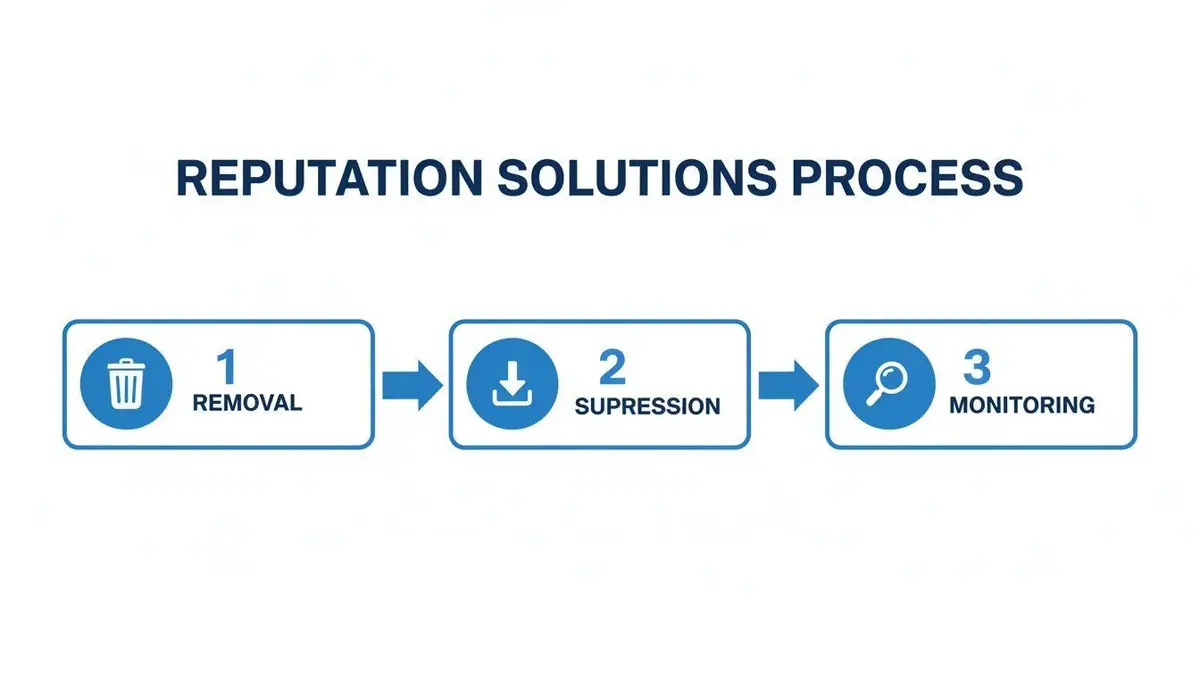
This process illustrates how professional personal reputation management services integrate offensive and defensive tactics to restore and then protect your online identity.
Phase 2: Strategy Formulation and Legal Review
With a clear intelligence picture of the threat, we construct your custom action plan. Our technical and legal experts convene to map out the most direct path to resolution. We determine the optimal combination of tools, be it direct content removal, search engine suppression, or a hybrid campaign.
Every planned action is vetted by our legal team to ensure compliance and maximum leverage. For instance, a takedown request might be framed as a DMCA notice for copyright infringement, a GDPR privacy complaint, or a defamation claim, depending on which argument presents the strongest case for the specific situation. This step ensures that when we act, we do so with confidence and a high probability of success.
A superior strategy is not a list of tasks. It is a compelling legal and technical case for why the damaging content must be removed, setting the stage for a successful resolution.
Phase 3: Active Remediation and Execution
This is the phase where the plan is executed. For urgent matters such as data leaks or account impersonations, we typically commence active remediation within 24-48 hours of engagement. Our teams immediately begin filing takedown requests, submitting formal complaints, and deploying assets to displace negative search results.
Unlike slow-moving traditional legal channels, our established protocols and direct relationships with platforms and hosting providers enable rapid action. We know how to bypass bureaucratic hurdles and place the issue before the decision-makers who can remove the content. Throughout this process, we maintain client communication with regular updates so you are never left in the dark.
Phase 4: Verification and Ongoing Monitoring
Removing the content is a significant victory, but the work is not complete. We then verify its eradication from all platforms and search engine caches. A determined adversary may attempt to repost it.
The final phase is therefore one of vigilance. We implement advanced monitoring systems that perpetually scan the web, watching for the threat’s reappearance or for any new negative content. This proactive defense transforms a one-time fix into a long-term solution, ensuring your reputation remains protected. The timelines for these efforts can vary, and you can learn more about professional timelines for removing a search result in our detailed guide.
Calculating the Financial and Reputational Stakes
It is a mistake to view professional reputation management as a mere business expense. For any executive, investor, or public figure, it is a critical form of risk management. The stakes are too high. A damaged digital reputation has real, measurable financial consequences that can cascade across your professional life, impacting everything from your company’s stock price to your ability to secure capital.
The value tied to a leader’s name is not an abstract concept. The data are conclusive. A 2025 analysis from PassiveSecrets revealed that a company’s reputation can account for an estimated 63% of its total market value. That same report pointed to $3.5 trillion in global losses tied directly to reputation failures. It is no wonder executives are increasingly engaging specialists for everything from defamation takedowns to news suppression. You can see more of these online reputation management findings for yourself.
This financial exposure makes the return on investment (ROI) for these services clear. You are not merely spending money; you are weighing the cost of a strategic campaign against the potential for catastrophic financial and career-ending losses.
Understanding the Investment Structure
During a crisis, the last thing you need is billing ambiguity. Top-tier firms understand this and offer transparent pricing structured around the problem at hand. The cost directly reflects the scope of work, situational complexity, and the required speed of resolution.
Most pricing models fall into one of three structures:
- Project-Based Fees: This is the standard for specific, one-off problems. It is a surgical strike. You have a single defamatory article or a set of fraudulent reviews to be removed, and the firm quotes a flat fee for the engagement. The pricing is clean and predictable.
- Monthly Retainers: For larger challenges requiring a sustained effort, such as an ongoing suppression campaign or a complex legal battle, a monthly retainer is the norm. This approach funds the continuous monitoring, content development, and strategic work required to prevail in a long-term conflict.
- Success-Based Incentives: In certain high-stakes cases, a portion of the fee is tied directly to a specific outcome. For example, a bonus may be paid only upon the successful removal of a particularly damaging video. This model aligns the firm’s incentives directly with yours.
The cost of expert engagement is not an expense. It is an essential investment to protect a far greater asset. It is the insurance policy on your name, your market value, and your career.
Quantifying the ROI of Reputation Defense
Calculating the ROI is a straightforward exercise in risk analysis. Consider the potential damage from a single negative search result on the first page of Google. It could derail a business deal, deter investors, compromise a board appointment, or devalue your company during an M&A event.
The cost of just one such lost opportunity will almost always exceed the entire investment in reputation repair.
For instance, a family office might weigh the cost of a six-month suppression campaign. That cost becomes negligible when compared to the risk of a $50 million private equity deal collapsing due to a partner’s online discovery. Similarly, an executive might compare a project fee for removing a false accusation to the loss of their seven-figure compensation package.
Viewed through this lens, personal reputation management services are not a cost center. They are a fundamental component of modern asset protection, delivering a clear and powerful return by defending your single most valuable professional asset: your reputation.
How to Vet and Select a Premier Service Provider

Selecting a partner to manage a reputation crisis is a critical decision. The market for personal reputation management services is crowded with firms making bold claims, but the number of providers who are genuinely effective, discreet, and legally astute is small. Your task is to penetrate the marketing and focus on verifiable capabilities.
You are not hiring a standard marketing agency. You are engaging a specialized crisis management team. The best firms operate with the strategic rigor of a top law firm and the agility of an intelligence unit. The wrong choice will not just leave the original problem unresolved; it can backfire, creating new legal liabilities and exacerbating the situation.
The industry is expanding rapidly. The global market for these services was valued at USD 427.96 million in 2025 and is projected to reach USD 1,305.72 million by 2032: a compound annual growth rate of 17.27%. This explosive growth has attracted a flood of new, often inexperienced, players. A rigorous vetting process is therefore more critical than ever.
Evaluate Verifiable Case Studies and Client Profiles
The clearest indicator of a firm’s competence is its track record with clients in situations analogous to yours. A company that primarily helps small businesses remove negative Yelp reviews likely lacks the capability to handle a coordinated attack on a C-suite executive or a prominent family office.
Insist on seeing real-world case studies that mirror your challenges. You need evidence that they have a history of successfully managing:
- High-stakes defamation campaigns from anonymous actors.
- Leaks of confidential documents or valuable intellectual property.
- Coordinated negative media blitzes.
- Reputation crises within highly regulated industries.
A top-tier firm will be able to discuss past scenarios, without breaching client confidentiality, that prove they understand the unique pressures and risks you face.
Scrutinize Legal and Technical Mastery
Effective reputation management is built on a deep understanding of law and technology. Any firm you consider must have mastered the specific regulations and platform policies that govern content moderation.
A firm without deep legal acumen is merely guessing. Real experts build their entire strategy on a solid foundation of international law, platform terms of service, and legal precedent. This ensures every move they make is both effective and defensible.
During your evaluation, confirm their team possesses genuine expertise in these key areas:
- International Laws: A working knowledge of global regulations is crucial. This includes regulations like the GDPR in Europe and its “right to erasure,” or the correct application of the DMCA in the U.S. for copyright-based removals.
- Platform Policies: They must have an intimate, up-to-date familiarity with the terms of service for Google, all major social media platforms, and other relevant content hosts.
- Technical Execution: Can they trace anonymous sources, identify the host of a malicious website, and use technical evidence to strengthen a takedown request?
Demand Ironclad Confidentiality and Discretion
For executives and high-net-worth individuals, privacy is not a feature; it is the bedrock of the engagement. From the initial contact, your relationship with a reputation firm must be governed by absolute confidentiality.
Scrutinize their data security practices. Inquire how they store and transmit client information. Who, specifically, on their team will have access to the sensitive details of your case? A trustworthy firm will have clear, strict protocols and will readily execute a comprehensive non-disclosure agreement (NDA) before you share any substantial information.
A casual attitude toward confidentiality is a major red flag. As we point out in our guide on the best reputation management companies for executives, uncompromising security is non-negotiable. Any firm that treats this lightly is not equipped for high-stakes work.
Your Guide to Navigating a Reputation Crisis
When your name is being attacked online, you have no time for vague promises. Executives, founders, and high-net-worth individuals under pressure require clear answers and a concrete action plan. This guide provides the essential information needed to make critical decisions now.
Can You Really Erase Something From the Internet for Good?
In some cases, yes. Complete removal of negative content is achievable, but it is never guaranteed. Success depends on several key factors: the content’s hosting jurisdiction (which country’s laws apply), the nature of the content (a defamatory blog post is different from a major news story), and the policies of the host website or platform.
When outright removal is not an option, our primary strategy shifts to suppression.
Suppression is a strategic burial. We work methodically to push the negative link so far down in Google’s search results that it becomes, for all practical purposes, invisible. An experienced firm’s first step is to determine which approach, removal or suppression, offers the most direct and permanent solution for your situation. The objective remains the same: to neutralize the damage.
How Long Does This Process Actually Take?
The timeline for resolving a reputation issue varies dramatically based on its complexity. A simple, straightforward takedown, such as removing an impersonation account from a responsive social media platform, can sometimes be concluded in a few days. This is the best-case scenario.
However, a serious campaign can easily extend into a multi-month engagement. Factors that prolong the timeline include dealing with uncooperative website owners, navigating different international legal systems, or attempting to displace deeply entrenched negative news articles with high search engine authority. Any competent provider of personal reputation management services will furnish a realistic, phased timeline only after a complete analysis of the situation.
Can You Guarantee a Negative News Article Will Be Removed?
No. Any firm promising a 100% guarantee to remove a legitimate news article from a major publication is not being truthful. In jurisdictions like the United States, First Amendment rights and journalistic protections present a formidable barrier to forced removals.
With hostile news coverage, the goal is not to rewrite history. It is to seize control of the narrative being told today so that one negative article no longer defines you online.
That said, there are proven strategies that are effective:
- Finding and Proving Inaccuracies: If we can present a publisher with irrefutable evidence of factual errors in their article, it can lead to a correction, an update, or, in rare cases, a full takedown.
- Backchannel Negotiations: We can often engage in discreet, professional discussions with publishers to argue for removal or de-indexing, especially if a story is old and no longer serves the public interest.
- Aggressive SEO Suppression: This is the most reliable playbook. By creating and heavily promoting a portfolio of positive, high-authority content about you, we systematically displace the negative article from the first page of search results, effectively neutralizing its impact.
What Does Personal Reputation Management Cost?
There is no standard price for professional reputation defense. The investment is based entirely on the volume and difficulty of the required work. A single takedown might cost a few thousand dollars, whereas a comprehensive, long-term campaign against a sophisticated or well-funded adversary could represent a significant six-figure investment.
Top-tier firms serving executives and family offices typically use one of two pricing models:
- Project-Based Fees: You pay a fixed price for a specific, defined objective. This could be the removal of a batch of defamatory reviews or the suppression of one particular negative search result.
- Monthly Retainers: You pay an ongoing fee for sustained work. This covers complex suppression campaigns, 24/7 monitoring for new threats, and proactive work to build a more resilient digital footprint over time.
This cost must be viewed as an investment in protecting your most valuable assets: your name and your career. When weighed against the financial and professional damage of inaction, its value becomes clear. To fully protect your professional image, this guide should be used alongside practical Online Reputation Management Tips that help you stay in control.
This is not merely a domestic issue; it is a global one. The market for these services is expanding at an accelerated rate. Analysts predict the online reputation management market in the Asia-Pacific region, for example, will grow at a staggering 18.13% CAGR through 2031, making it the fastest-growing market in the world. This growth is fueled by millions of new internet users in countries like India and the challenges that automated monitoring tools face with diverse languages, highlighting the universal need for expert reputation oversight.
When your career, finances, and good name are on the line, you need a partner who knows how to neutralize digital threats with speed and absolute discretion. At ContentRemoval.com, we combine legal strategy, technology, and intelligence work to help our clients take back control of their online narrative. If you’re facing a reputation crisis, start with a confidential assessment. We’ll give you a clear, results-focused action plan. Take control of your story today by visiting us at ContentRemoval.com.
Frequently asked questions
Can a negative news article about me be removed from Google?
No firm can promise removal of a legitimate article from a major publication, especially in the United States where journalistic protections are strong. Proven approaches include presenting the publisher with evidence of factual errors, discreet negotiation for removal or de-indexing of old stories, and suppression campaigns that push the article off the first page.
What is the process when hiring a personal reputation management firm?
It usually runs in four phases: a confidential threat assessment, a strategy vetted by legal experts choosing the strongest argument such as DMCA, GDPR or defamation, active remediation, then verification and ongoing monitoring. Urgent matters like data leaks often see remediation begin within 24 to 48 hours.
How do I vet a reputation management provider for executive work?
Ask for case studies that mirror your situation, such as anonymous defamation campaigns or leaked documents, rather than small business review cleanup. Confirm genuine knowledge of GDPR, the DMCA and platform policies, and insist on strict confidentiality protocols and a non-disclosure agreement before sharing details.