
A personal reputation management service in the UK treats a serious online attack as a legal and technical problem rather than a PR one. Instead of burying negative results, a specialist pursues source removal and de-indexing using the Defamation Act 2013, the GDPR Right to be Forgotten, the Protection from Harassment Act and platform policies, then monitors for reuploads.
Key facts
- The Defamation Act 2013 requires showing a statement is false and causes or is likely to cause serious harm.
- GDPR Article 17 lets you petition Google to de-index outdated or irrelevant results in the UK and Europe.
- De-indexing hides a page from search; source removal deletes it from the host and is the primary goal.
- The DMCC Act lets regulators fine businesses up to 10% of global turnover over fake reviews.
Where ContentRemoval.com comes in. ContentRemoval.com works on UK matters where a defamatory article, a leaked image or a hostile campaign needs removing at source rather than hidden. Clients approach us directly, or through their solicitor, family office or communications adviser, and every conversation is confidential from the first call. A free 15-minute Exposure Scan maps what is removable under UK and platform rules, and the report is yours to keep whatever you decide. Get a Free, Confidential Exposure Scan or read how our reputation management work is done.
When your name is being dragged through the mud online (whether through lies, leaked private information, or a misleading story) your first thought might be to call a PR firm. This is an understandable instinct, but in most cases, it’s the wrong one.
Dealing with a serious online attack is not a public relations problem; it is a technical and legal one. Standard PR is not equipped for this kind of fight.
Why Your Usual PR Team Cannot Handle a Serious Reputation Crisis
Traditional PR is designed to build a positive narrative. It is the art of promotion, shaping public perception through press releases, media outreach, and positive stories. When you’re facing a deliberate smear campaign or the unlawful dissemination of personal data, you do not have a perception problem. You have an attack that must be shut down.
A conventional PR agency lacks the necessary tools. They can issue a positive press release, but they cannot force Google to de-index a defamatory article. They can pitch a friendly journalist, but they cannot issue a legal takedown notice to remove a video hosted without consent.
Trying to solve a digital crisis with positive PR is like trying to put out a house fire with a can of air freshener. It might briefly mask the smell of smoke, but the fire is still burning everything down.
This is a critical distinction. Engaging a generalist PR firm or attempting to handle the matter yourself often makes things worse. By drawing attention to the negative content in the wrong way, you can trigger the Streisand Effect, where attempts to suppress information only amplify its visibility. It is a loud, clumsy approach when what is required is surgical precision.
Where Conventional Methods Fail
The toolkit of a PR agency is based on communication and relationships. The tools needed to dismantle a reputation attack are rooted in law and technical expertise.
A PR firm can ask for content to be taken down. Without the backing of the Defamation Act, GDPR, or harassment laws, those requests are almost always ignored. They cannot compel action.
They also lack the specialist knowledge required to navigate the labyrinthine internal policies of search engines, web hosts, and social media platforms to secure content removal at the source.
Many non-specialist agencies fall back on a tactic called suppression. This involves generating positive content to push negative search results further down the page. It is a temporary, expensive, and ultimately flawed strategy that leaves the damaging material online, waiting to be rediscovered.
Why a Specialist Is Essential
A high-stakes reputation crisis demands a specialist. It is the difference between a general practitioner and a surgeon. A premier personal reputation management service in the UK combines the sharp legal mind of a specialist law firm with the technical capabilities of a digital forensics team.
The objective is not to distract from the problem; it is to eliminate it. This involves a direct, assertive process that targets hostile content at its source, using legal and technical force to achieve permanent removal. When your career, finances, and personal wellbeing are on the line, settling for anything less is an unacceptable risk.
The Arsenal of Digital Defence
When your reputation is under attack online, you require more than good PR. You need a specific set of tools designed to fight back effectively. A specialist personal reputation management service in the UK does not spin a story; it uses precise, technical, and legally-backed methods to remove harmful content permanently. Understanding these tools is the first step to regaining control.
This flowchart contrasts the outcomes of DIY efforts or standard PR with the definitive results achieved by a specialist firm.
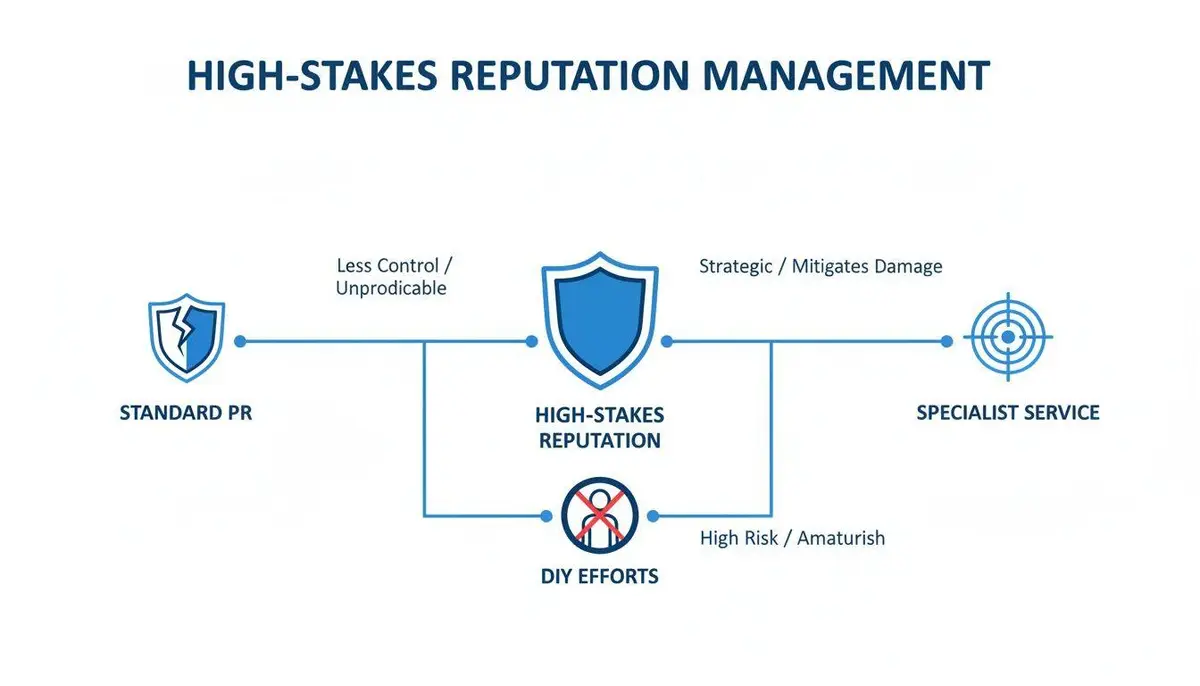
A specialist service is structured to achieve a definitive result. The goal is to build a permanent defence, not apply a temporary patch.
The following table outlines the core services we deploy to protect our clients’ reputations.
Core Services for Personal Reputation Protection
| Service | Primary Objective | Common Application Scenario |
|---|---|---|
| Source Removal | To permanently delete the harmful content from the original website or server. | A defamatory blog post, a negative news article, or an unauthorised image on a website. |
| De-Indexing | To remove a webpage from search engine results (like Google), making it impossible to find via search. | A court document or old forum post on a site that will not remove the content, but you need it hidden quickly. |
| Defamation Takedown | To use legal arguments (e.g., the Defamation Act) to force the removal of false and damaging statements. | Libellous reviews on a business platform or false accusations made in an online article. |
| NCII Removal | To rapidly remove non-consensual intimate images from platforms and prevent their spread. | An ex-partner sharing private photos on social media or adult websites without consent. |
| Proactive Monitoring | To continuously scan the internet for mentions of your name and identify potential threats early. | An executive wants to protect their online image from negative press or activist campaigns before they escalate. |
These services form the foundation of a serious reputation management strategy, each deployed based on the specific details of the situation.
De-Indexing vs. Source Removal: A Critical Distinction
Clients frequently ask about the difference between “de-indexing” and “removal.” The distinction is fundamental.
De-indexing is analogous to removing a book from a library’s catalogue. The book remains on a shelf, but no one can find it using the search system. We achieve this by petitioning search engines like Google to stop showing a specific page in their results. The harmful content still exists on its original host, but it becomes effectively invisible to the public.
Source removal is analogous to having the book itself physically destroyed. The content is erased from the server where it was hosted. This is always the primary objective because it is a permanent solution.
We often pursue de-indexing as an immediate measure for a quick victory, making the problem disappear from public view, while we execute the more complex, but final, solution of source removal.
Countering Defamation and Falsehoods
When someone attacks you with falsehoods online, a firm, targeted response is required. This is not about flagging a post and hoping for the best. It involves constructing an undeniable legal case.
We begin by analysing the content through the lens of UK law, specifically the Defamation Act, to establish that the material is both false and causing serious real-world harm. We then draft and serve formal takedown notices that are not mere requests. They are legal demands that website owners and their counsel must take seriously. This professional intervention is what separates a successful outcome from a user complaint that gets ignored.
Combating NCII and Data Leaks
The non-consensual sharing of intimate images (NCII) is a devastating violation. In these situations, speed is paramount. The objective is immediate containment to prevent viral dissemination.
This requires an emergency-level response involving three key actions:
- Immediate Takedown: We use direct channels and specialised tools to remove the content from platforms, often within hours.
- Constant Scanning: Automated systems are deployed to find and report any re-uploads across social media, forums, and the wider web.
- Legal Pressure: We engage with hosting companies and, where necessary, law enforcement to trace the source and secure your data.
Every minute this type of content remains online, the damage escalates. It is a high-stakes battle where rapid, decisive action is the only effective strategy. The reputation management market is expected to reach USD 14.01 billion by 2031, with expert services comprising 64.90% of that figure. This reflects the necessity of human expertise in crises that software alone cannot resolve. For public figures, the risks are compounded, particularly as 45% of consumers now use AI for recommendations, a significant increase from 2025.
Proactive Defence Through Monitoring
The most effective way to handle a crisis is to prevent it from occurring. Proactive monitoring shifts your posture from reactive clean-up to a state of constant vigilance. It is your digital early-warning system.
A critical component is understanding your search engine results page (SERP). Our monitoring systems do more than search for your name; they track subtle changes that could signal a developing threat, demonstrating the vital importance of SERP positioning in a defensive strategy. By scanning the web, including the deep and dark web, we can often identify and neutralise threats before they become public knowledge. Discover how our advanced reputation monitoring services can secure your digital footprint.
Navigating UK Legal and Regulatory Frameworks
Managing an online reputation crisis in the UK requires more than technical acumen; it demands legal expertise. Simply emailing a website owner with a takedown request is rarely effective. The majority of such requests are ignored.
A professional personal reputation management service in the UK does not ask politely. We use the law as a precision tool to compel platforms, publishers, and search engines to act. This legally-grounded approach transforms a hopeful request into a non-negotiable demand, delivering permanent results.
The Right to Be Forgotten Under GDPR
One of the most powerful instruments in our arsenal is the ‘Right to be Forgotten’ (RTBF), established under Article 17 of the General Data Protection Regulation (GDPR). This right allows us to argue that an individual’s right to privacy outweighs the public’s interest in accessing outdated, irrelevant, or inaccurate information.
An old news article about a dropped legal charge or a settled dispute that persists in search results can cause immense career damage. The original publisher may refuse to delete the story, but that is not the end of the matter. We can petition Google directly under the RTBF, making a formal case that the information is no longer relevant. When successful, the link is de-indexed from search results, rendering it practically invisible to anyone searching in the UK and Europe.
Learn more about using GDPR for content removal in our detailed guide.
A successful Right to be Forgotten request is not a negotiation; it is the enforcement of a legal right. It forces a search engine to comply based on a structured legal argument, demonstrating that the data’s continued presence is no longer justified.
This is not a simple form-filling exercise. It is a formal legal process requiring a carefully constructed application that balances privacy rights against freedom of information. A specialist knows precisely how to frame the argument to satisfy the strict criteria set by Google and other regulators.
Wielding the Defamation and Harassment Acts
When facing outright falsehoods, the Defamation Act 2013 is our primary legal tool. To use it effectively, we must prove that a statement is not only false but has caused or is likely to cause “serious harm” to your reputation. While this is a high standard, it is an incredibly potent weapon against malicious reviews, libellous articles, and false accusations online.
For more persistent attacks, we turn to the Protection from Harassment Act 1997. If an individual is systematically targeting you across different websites or social media platforms, their behaviour can be legally defined as a course of conduct amounting to harassment. We use these laws to build a strong case that applies legal pressure on hosting companies and platforms, compelling them to remove the material to avoid their own liability.
The Impact of Emerging Regulations
The online legal landscape is in constant flux, and staying ahead of new legislation is critical. The Digital Markets, Competition and Consumers (DMCC) Act, for example, is a game-changer for tackling fake reviews. It grants regulators the power to fine businesses up to 10% of their global turnover for failing to take reasonable measures to stop fraudulent content.
This significant financial risk provides platforms with a powerful incentive to take our removal requests seriously. The growing importance of this field is evidenced by projections showing the UK’s enterprise internet reputation management market is expected to reach USD 240.3 million by 2035. This growth is a direct result of the high stakes involved and underscores why a legally astute partner is a necessity, not a luxury.
The Anatomy of a Successful Takedown

When facing an online attack, you need a methodical plan of action, not wishful thinking. Uncertainty and hesitation only exacerbate the problem. A premier personal reputation management service UK does not rely on hope; we operate with a disciplined, structured process designed to restore control, quickly and definitively.
This framework is our operational roadmap. It outlines what to expect from the initial confidential consultation to the final confirmation that the damaging content has been eliminated. Our objective is to ensure you remain informed and confident as we work to dismantle the problem.
Stage 1: Confidential Assessment and Triage
The process begins with a forensic analysis of the online threat. This initial review is conducted under a strict non-disclosure agreement, permitting you to speak freely. We treat this as a triage phase, pinpointing the source and scale of the harmful content and assessing the immediate threat to your personal and professional life.
We map where the content is hosted, how it is spreading, and its visibility on search engines like Google. Is this a case of defamation? A private data leak? A coordinated smear campaign? An accurate diagnosis is essential as it dictates every subsequent action.
Stage 2: Building Your Strategic Action Plan
With a complete intelligence picture, we craft a customised action plan. There are no one-size-fits-all solutions in reputation management; your situation is unique, and so your strategy must be. The plan we deliver is a detailed document explaining the specific legal and technical tactics we will employ.
For instance, if the issue is a defamatory article on a UK news site, the plan will likely centre on the Defamation Act 2013. If it is a case of intimate images being shared without consent, the strategy will be geared towards rapid removal using NCII protocols. This action plan is our blueprint, setting out clear goals, timelines, and the rationale behind each step.
A strategic action plan transforms client anxiety into a structured, manageable process. It replaces the chaos of a digital attack with a clear sequence of decisive countermeasures, providing a pathway to resolution.
This stage is about precision. We identify the most potent combination of source removal, de-indexing, and legal pressure to achieve the fastest, most permanent result. You review and approve this plan before we take any action.
Stage 3: Rapid Execution and Ongoing Monitoring
Upon your approval, we execute the plan with speed. Our team typically initiates takedown procedures and de-indexing requests within 24-48 hours of your authorisation. We leverage established connections and proven methodologies with web hosts, platforms, and search engines to cut through bureaucracy and accelerate the process.
This execution phase is not a single task; it is a sustained campaign involving:
- Direct Engagement: We contact website administrators and hosting companies with legally sound takedown notices.
- Search Engine Petitions: We file formal de-indexing requests with Google and others, citing relevant laws like GDPR’s Right to be Forgotten.
- Sustained Pressure: We do not simply send a notice and wait. We follow up relentlessly and escalate when necessary to ensure action is taken.
Simultaneously, we activate our continuous monitoring systems. Our technology scans the web 24/7, searching for any new uploads of the harmful material. This means that as we remove content in one location, we can prevent it from reappearing elsewhere. This proactive defence stops the problem from spreading and neutralises attempts to circumvent our removal efforts. This phase concludes only when all objectives have been met and the result has been verified.
How to Select a Premier Reputation Management Partner
During a reputational crisis, your choice of firm is one of the most critical decisions you will make. The market is saturated with generalist agencies and unqualified operators who promise comprehensive solutions but deliver only temporary, ineffective fixes.
Choosing the wrong partner not only wastes time and money; it can make a bad situation catastrophically worse.
You must vet these firms as rigorously as you would a top-tier law firm or a critical financial advisor. The focus must be on verifiable expertise, a proven methodology, and absolute, iron-clad confidentiality.
Key Questions to Ask Any Provider
Before signing any contract, you must ask direct questions. Vague or evasive answers are a clear signal to disengage.
- What are your legal credentials? Ask directly: do you have qualified in-house lawyers leading your strategy? A firm that cannot leverage legal tools like the Defamation Act or GDPR’s Right to be Forgotten is limited to making polite requests that are easily ignored.
- Do you focus on removing content at the source, or just suppressing it? Suppression, attempting to bury negative links with positive ones, is a flawed, outdated tactic. The primary objective must always be the permanent deletion of harmful content from the host website, followed by its removal from search engine results.
- What is your documented success rate with Google? Any credible firm can provide anonymised data or case studies proving their track record. Request specifics about how they petition search engines and what their success rates are.
- How do you guarantee confidentiality? Your situation demands total discretion. A professional organisation will operate under a strict, legally binding non-disclosure agreement (NDA) from the first conversation. They should also have robust internal systems to protect your identity and all case details.
By demanding specifics, you will quickly separate the experts from the pretenders. For a deeper analysis of this vetting process, consult our comprehensive guide on evaluating professional content removal services for executives.
Distinguishing True Expertise from Empty Promises
While many companies claim to offer a personal reputation management service UK, genuine expertise is rare. The industry has clear warning signs that a discerning client can spot.
An offer of a “guaranteed removal” is the most significant red flag. No ethical firm can guarantee an outcome, as the final decision often rests with third parties like platform moderators or search engine review teams. True confidence is demonstrated through a transparent, strategic process, not an impossible promise.
Other red flags include a heavy reliance on automated software without human legal oversight, or an inability to articulate the specific legal and technical tactics they intend to use.
The reputation management software market is projected to reach USD 19.29 billion by 2035, but these tools alone are insufficient for the complex, high-stakes cases faced by executives and public figures. These situations require a hybrid model combining sophisticated technology with human legal expertise, a reality reflected in enterprise service costs that can exceed £5,000 per month. You can learn more about the growing reputation management market and its segmentation on marketresearchfuture.com.
The right partner will operate with the precision of a specialist legal practice. They will be founder-led, use proprietary processes refined over years of handling complex cases, and have an unwavering focus on permanent, verifiable results. Your legacy is too important to entrust to anyone but a specialist with a proven ability to dismantle threats, not just hide them.
Protecting Your Legacy in a Digital World

When facing a serious reputational attack, the challenge is not merely damage control. It is about protecting the future you have worked to build. We have outlined the specific legal and technical instruments required to fight back, from leveraging GDPR and the Defamation Act to achieving content removal at the source.
This level of intervention is fundamentally different from standard PR or self-managed efforts. It highlights a simple truth: your online reputation is a high-value asset, and it demands specialist protection.
An Investment in Your Future
Viewing professional assistance as an expense misses the strategic imperative. It is an investment. The financial and personal cost of a single negative search result left unaddressed can easily eclipse the cost of taking decisive action with an expert.
To truly safeguard your legacy, you need a robust reputation management strategy. This is not just about defence; it is about taking control and building a digital presence resilient enough to withstand future challenges.
A meticulously managed reputation is the ultimate currency. It unlocks opportunities, safeguards financial stability, and ensures that your legacy is defined by your achievements, not by a third party’s malicious narrative.
Choosing a premier personal reputation management service in the UK is a strategic decision. It is the final, crucial step in ensuring your online footprint accurately reflects your identity, and that your future is not dictated by the past.
The threat is real, but so is the solution. You now possess the blueprint for a permanent resolution. The time to take action is now.
Your legacy is too important to leave to chance. Schedule a confidential assessment with our specialists today and take the first concrete step towards securing your digital future.
Frequently Asked Questions
When facing a digital crisis, you require direct answers, not vague assurances. Here are the most common questions from our clients, with our direct responses forged from years of front-line experience in reputation management.
How Can You Guarantee Confidentiality?
Confidentiality is not a policy; it is the foundation of our practice. From the initial contact, all communications are protected by a legally binding Non-Disclosure Agreement (NDA). You can disclose the details of your situation with complete confidence before committing to our services.
Internally, your case is handled with the discretion of a top-tier law firm during sensitive litigation. We operate on a strict need-to-know basis, and your information is siloed within secure systems, accessible only to the senior team assigned to your case. We never use client details for marketing. Your privacy is absolute.
Is It Possible to Remove Negative Content Permanently?
Yes. However, there is a critical distinction between hiding a problem and solving it. Many services focus on “de-indexing”, removing a link from Google’s search results. This offers immediate relief but leaves the damaging content on the original website, where it can be rediscovered or re-indexed.
Our primary objective is always source removal. This means achieving the complete deletion of the content from the host server. It is the only way to ensure the problem is gone for good.
Source removal is an intensive process. It often requires the application of direct legal pressure, leveraging UK laws like the Defamation Act or proving that the content violates a platform’s own Terms of Service. It demands more effort but is the only path to a permanent solution.
What Is the Process for Engaging Your Services?
Our engagement process is refined for clarity and efficiency. Under pressure, the last thing you need is procedural confusion. It consists of three distinct steps.
- Confidential Assessment: The process begins with a private consultation with a senior strategist. You explain the situation, and we conduct an initial review, providing a frank assessment of what is legally and technically achievable.
- Strategic Proposal: We then create a detailed Action Plan. This document outlines the precise strategy, the legal grounds for action, realistic timelines, and a fixed fee structure. There are no hidden costs.
- Execution: Upon your approval, we move immediately. Our team handles all complex communications and legal procedures, providing you with regular, straightforward updates until we confirm the content has been successfully removed.
This approach is designed to take the chaos of the situation off your shoulders and convert it into a controlled, effective campaign.
If your reputation is on the line, you do not have to fight this battle alone. ContentRemoval.com provides the expert, legally-driven solutions required to reclaim your good name.