
Personal data removal services reduce your exposed attack surface by clearing addresses, phone numbers and relatives from data brokers and people-search sites, then pursuing source removal, de-indexing or legal action against defamation, impersonation and leaked media. For high-profile people it is a security function: rank the dangerous material first, remove what is removable and monitor for reappearance.
Key facts
- De-indexing hides a page from search results; source removal deletes it from the hosting platform.
- Consumer Reports found only 35% of 332 exposed items removed across services after four months.
- Platforms remove content for harassment, impersonation, doxxing, copyright and non-consensual imagery when requests match their rules.
- Broker opt-outs can start clearing within days; publisher disputes and legal cycles take longer.
Where ContentRemoval.com comes in. ContentRemoval.com takes on the matters that subscription opt-out tools cannot: exposed addresses tied to family members, false allegations, fake profiles, leaked media and search results that persist after a page changes. Executives, family offices and their chiefs of staff usually make the first contact. A free, confidential 15-minute Exposure Scan ranks what is exposed by risk and maps what is removable, and the report is yours to keep. Get a Free, Confidential Exposure Scan or read how our reputation management work is done.
You search your name before a board meeting, a financing round, a custody dispute, or a political appointment. You expect the usual. A biography, a company profile, maybe an old interview.
Instead, you find your home address. A relative’s name. A mobile number that should never have been public. Or worse, a false allegation, a scraped profile, a stale record, or intimate material no one had the right to publish.
That moment changes the problem. It’s no longer about “privacy settings.” It’s about exposure. For high-profile people, exposed personal data creates three immediate risks at once: physical security risk, reputational distortion, and a basis for harassment, extortion, or impersonation. The compounding effect is often underestimated. A home address on a people-search site connects to a family member on another site, which connects to a property record, which connects to social profiles and archived content. A hostile actor doesn’t need perfect information. They need enough.
Consumer-grade tools can help with part of this. But if your profile makes you visible, controversial, wealthy, litigious, or easy to target, you need to treat personal data removal as a strategic function. The right question isn’t whether a subscription can submit opt-out forms. The right question is whether someone can reduce your attack surface, prioritize the dangerous material, and keep it from returning.
That same principle appears in corporate reputation work. The mechanics differ, but the pattern is familiar: once information spreads across search, aggregators, and commentary channels, cleanup requires process, influence, and persistence. For readers who want a parallel from the business side, these reputation insights for businesses show how quickly visibility problems become operating problems.
The Moment of Unwanted Discovery
What high-stakes exposure actually means
An exposed address is not just an exposed address. It can signal where your family sleeps, where service can be attempted, where a protester can appear, or where a fraudster can anchor a convincing impersonation attempt. A false review is not just an annoyance. It can become the first thing a journalist, investor, opposing counsel, or school administrator sees.
That’s why I don’t advise high-profile clients to think in terms of embarrassment. I advise them to think in terms of surface area. Every publicly accessible detail expands the number of ways someone can profile you, contact you, pressure you, or misrepresent you.
Practical rule: If a hostile stranger can assemble a plausible dossier on you in one sitting, your digital footprint is already too exposed.
Why speed matters
Delay is expensive. Once bad data circulates through broker networks, search caches, forum reposts, and mirror sites, removal gets harder. Not impossible. Harder. The same is true when a defamatory claim sits unchallenged long enough to be copied into summaries, discussion threads, or AI-generated snippets.
The clients who do this well move fast and stay methodical. They preserve evidence, identify the highest-risk nodes, and separate what can be removed, what can be de-indexed, what must be suppressed, and what requires legal escalation. That is the work. Not panic. Not endless self-searching. Not sending emotional emails to site owners.
The Anatomy of Your Digital Footprint
A thorough cleanup starts by separating categories of exposure. A common error involves lumping everything together and calling it “stuff online.” That’s a mistake. Different classes of content require different tactics, different legal theories, and different expectations.
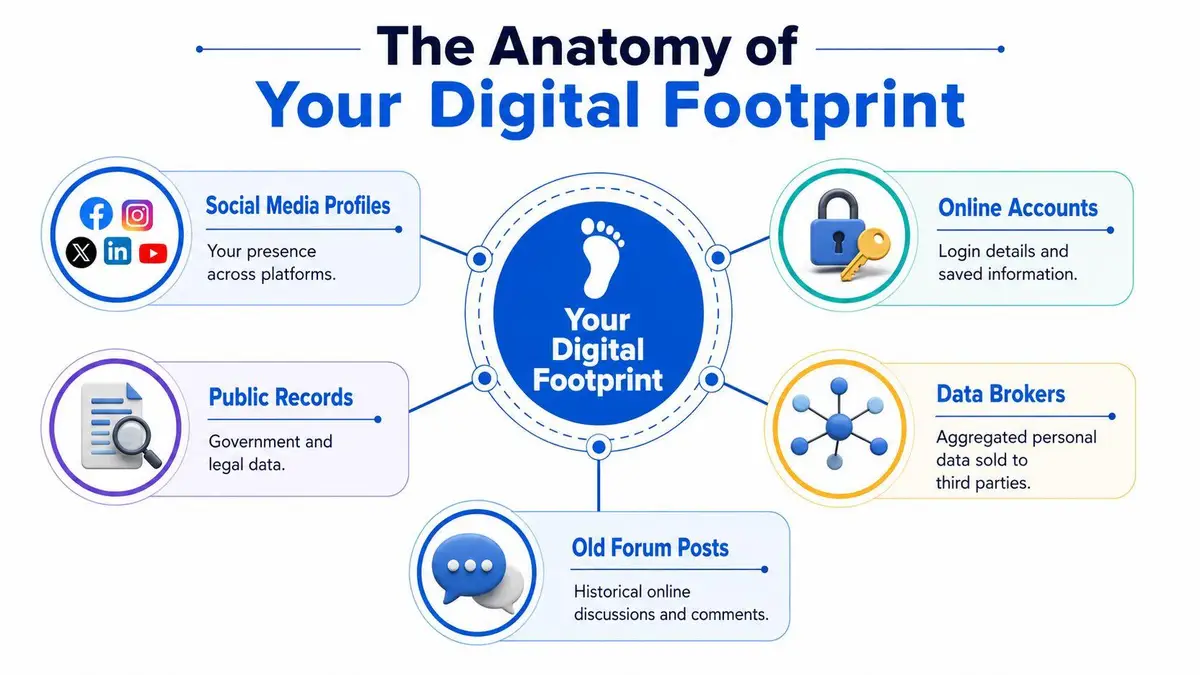
Broker data and people-search records
This is the broadest layer. It includes names, aliases, age ranges, prior addresses, relatives, phone numbers, and email associations pulled into broker databases and public-facing lookup sites. These services emerged because of the modern data broker ecosystem, and one widely cited privacy test found that removing entries from 13 prominent people-search sites required repeated opt-out work, with some privacy experts treating it as a twice-annual maintenance task because information can reappear after deletion, as summarized in this overview of personal information removal services.
For a deeper look at the cleanup side of that problem, digital footprint cleanup strategies are useful when you need to map exposure beyond a single broker list.
Public records, archives, and semi-public traces
Some information is exposed because it sits inside public record systems, court references, archived directories, campaign filings, old company registrations, or cached databases. Some of that material is legally removable. Some is not. Some can be suppressed from search visibility while the underlying source remains available.
Then there’s the gray zone. Old forum posts. Comment sections. Legacy bios. Cached staff pages. Obsolete event listings. These aren’t always dangerous by themselves, but they often supply corroborating details that make more serious abuse easier.
Defamation, impersonation, and intimate exposure
The most urgent cases usually involve one of four patterns:
- False factual claims: Allegations framed as fact that damage trust, employment, custody, licensing, or deal flow.
- Impersonation and fake profiles: Accounts or listings that mimic identity, solicit contact, or mislead the public.
- Leaked media and NCII: Images or videos posted without consent, often mirrored quickly across multiple hosts.
- Misleading but technically “old” content: Material that’s no longer accurate but still shapes search perception.
A serious personal data removal strategy has to cover all of that. If a provider only handles broker opt-outs, they are solving one slice of the problem.
Mechanisms of Digital Erasure
People use “removal” as if it means one thing. It doesn’t. There are different mechanisms, and they produce very different outcomes.

De-indexing versus source removal
De-indexing means a search engine stops showing a result for certain queries. The page may still exist on the original website. If someone has the direct link, they may still reach it. If another search engine indexes it, it may still be discoverable there.
Source removal means the content is removed from the hosting platform itself. That is usually the stronger outcome. It reduces recirculation risk, cuts off direct access, and limits later republication from the same URL.
Here’s the distinction in plain terms:
| Method | What changes | Main limitation |
|---|---|---|
| De-indexing | Search visibility drops | The source content may remain live |
| Source removal | The hosted content is deleted or disabled | It can require platform leverage, legal process, or both |
If I had to choose one objective first, I’d choose source removal whenever it’s available. De-indexing is useful. It is not the same thing.
Platform enforcement and policy leverage
A large share of successful takedowns happen through policy, not courtroom drama. Platforms remove content for harassment, privacy violations, impersonation, doxxing, copyright infringement, non-consensual imagery, and terms-of-service abuse. The key is precision. Vague complaints fail. Well-framed submissions tied to the platform’s own rules perform better.
That’s especially true when content is technically “user-generated” but still violates platform standards. Many individuals waste time arguing morality. Platforms respond to policy categories, evidence, and compliance pathways.
The strongest takedown request isn’t the angriest one. It’s the one that matches the platform’s rulebook exactly.
Legal interventions that actually matter
Some cases need legal process. Defamation may require court findings or carefully structured pre-litigation work. Copyright claims can be effective when original ownership is clear. Privacy rights vary by jurisdiction. Record sealing can change the practical search environment when underlying records are eligible to be restricted. For readers evaluating that route, Bryan Fagan PLLC record sealing information offers a useful example of how record access can change through legal procedure.
For executives specifically, guidance on removing yourself from data broker lists is relevant when the immediate issue is broad personal exposure rather than a single defamatory page.
One more point matters. Automated services are good at repetitive broker requests. They are weak at nuance. If the problem involves a news publisher, a revenge site, a leak forum, a hostile ex-partner, or a malicious review network, a form submission alone won’t carry the day.
Jurisdiction and The Limits of Law
The law does not offer a universal delete button. Anyone who promises that is either careless or selling to unwary buyers.
Europe, the United States, and the strategic gap
In the European Union, privacy law can give subjects stronger grounds to challenge certain search visibility and processing practices. In the United States, free speech protections are broader, publisher defenses are stronger, and privacy rights are fragmented across state law, platform policy, and sector-specific rules. The result is simple. A request that has legal force in one jurisdiction may be only a persuasion exercise in another.
That’s why high-level removal work starts with three location questions: where the subject resides, where the publisher operates, and where the platform or processing entity falls under applicable law. Those variables shape the available path.
For a plain-language overview of one major privacy framework, PostPlanify and GDPR is a useful reference point.
The host, the publisher, and the target
The country where a server sits isn’t always the decisive issue. Sometimes the controlling factor is the entity operating the site. Sometimes it’s the audience targeted by the publication. Sometimes the best route isn’t legal compulsion at all, but platform enforcement, search suppression, or commercial pressure through intermediaries.
That complexity frustrates clients because it feels inconsistent. It is inconsistent. Two visually similar pages can require completely different tactics because one is hosted by a compliant intermediary and the other by an offshore operator who ignores ordinary notices.
Expect limits, not magic
Some material is lawful and ugly. Some is false but expensive to prove. Some is outdated yet still protected. Some can be minimized but not erased. A credible advisor tells you that early.
Your leverage comes from choosing the right jurisdictional tool for the right target. It doesn’t come from sending the same threat letter to every site you dislike.
The practical value of experienced counsel or a specialized removal team isn’t just form drafting. It’s case triage. They know when to push legal rights, when to use platform channels, when to negotiate, and when to stop wasting time on an uncooperative host and move to containment.
The Professional Removal Workflow and Timelines
At 6:30 a.m., your chief of staff forwards a search result that exposes a residence tied to a family member. By 8:00, that page has been screenshotted, indexed elsewhere, and sent around privately. In this work, speed matters, but sequence matters more. A disciplined removal team moves fast on the right targets first.
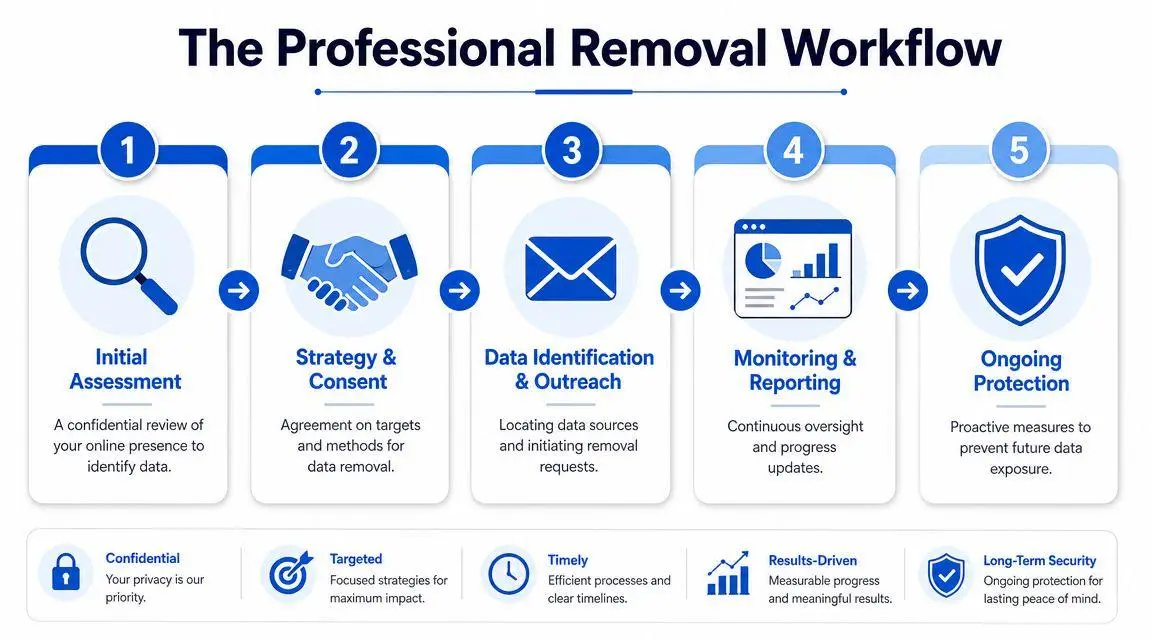
Phase one and the risk map
The opening phase is a confidential assessment built for exposure control, not a generic privacy scan. The team identifies direct identifiers, family connections, property records, prior addresses, personal images, search-result patterns, impersonation, and hostile or false content. Then it ranks them by consequence.
I sort matters into three buckets: immediate threat, active business or reputational harm, and background exposure. Doxxing tied to relatives, non-consensual intimate imagery, impersonation, and defamatory content affecting a transaction or appointment go first. Old people-search listings with no current amplification do not.
That triage determines the timetable.
Execution across two tracks
Professional removals run on two tracks at the same time:
- Automated or semi-automated broker removals for repetitive opt-outs across data-broker networks.
- Manual specialist intervention for source-page takedowns, platform appeals, legal notices, publisher contact, and search suppression work.
High-stakes clients need both. Subscription services are built for volume. They are not built for judgment, escalation, or pressure.
Independent testing discussed by BlackCloak found that only 35% of exposed profiles were removed within four months across multiple consumer data-broker removal services, with the best-performing service reaching 68% (BlackCloak’s discussion of data broker removal performance). That gap is the point. Automated submissions handle routine broker records. They do not resolve a defamatory article, a copied mugshot, a fake executive profile, or a search result that remains visible after the source page changes.
For a grounded view of search timing, professional timelines for removing a search result sets expectations better than any sales call.
What timelines actually look like
Simple broker opt-outs can start clearing within days, then continue in waves as sites verify identity, reject incomplete requests, or republish from fresh feeds. Platform-based takedowns can move quickly if the violation is obvious and the evidence package is tight. Publisher disputes, legal notice cycles, and deindexing work usually take longer because each step depends on review queues, counterarguments, and the behavior of third parties.
Clients should expect staggered wins, not one clean finish line. The first objective is risk reduction. Remove the most dangerous exposures, cut discoverability, and stop spread. After that, the work shifts to persistence, follow-up, and containment.
Monitoring after the takedown
Removal without monitoring is incomplete. Data returns. Cached snippets linger. Mirror pages appear. Aggregators ingest old records again.
The provider’s operating model matters here. Some vendors send the first round of requests and count submissions. A serious firm tracks what reappears, retries with better evidence, escalates when needed, and coordinates source removal with search-result work. That is the difference between a consumer privacy product and a reputation management function.
ContentRemoval.com is one option for matters that extend beyond broker listings into defamation, impersonation, leaked media, or search-result suppression.
Evaluating Providers A Decision Checklist
Most personal data removal services sell reassurance first and process second. That’s backwards. You should buy process.
What to demand before you hire anyone
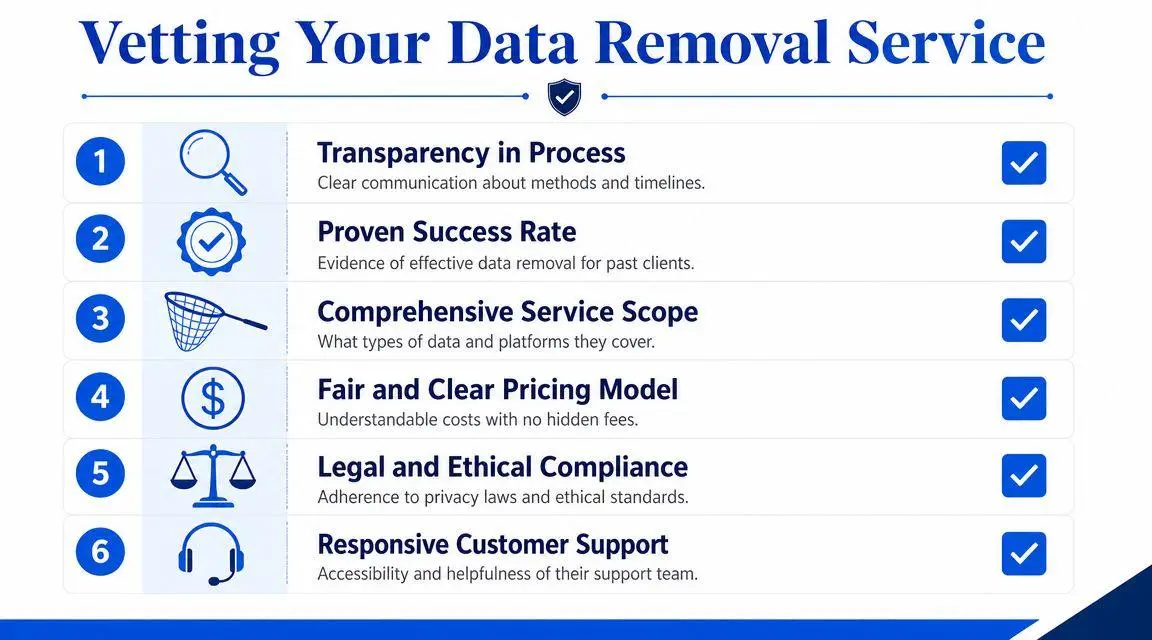
Ask hard questions. A serious provider should answer them without theatrics.
- Service scope: Do they handle only data brokers, or can they work on source removals, impersonation, false reviews, leaked media, and search-result issues?
- Legal integration: Can they coordinate with counsel, draft legally coherent notices, and adapt by jurisdiction?
- Monitoring discipline: Do they rescan and retry, or do they just send initial requests?
- Confidentiality controls: How is your matter handled internally, and who sees identifying information?
- Evidence standard: Can they explain why a page is removable, not just whether they dislike it?
A provider that can’t articulate its decision logic usually can’t win complex removals.
The performance gap is real
The spread between providers isn’t minor. A 2024 Consumer Reports review found that among the services tested, EasyOptOuts and Optery reached 65% and 68% removal rates after four months, while Confidently and ReputationDefender managed 4% and 6%. The same review examined 332 pieces of personal information across 28 volunteers, and after four months only 117 items (35%) had been removed overall. Consumer Reports also noted that removed data can reappear, which is why the process requires ongoing maintenance. You can review that benchmark in Consumer Reports’ review of personal-data-removal services.
That data should end the fantasy that all subscription products are interchangeable.
Red flags that should end the conversation
Use this short filter:
| Red flag | What it usually means |
|---|---|
| Guaranteed removal of everything | They don’t understand law, platforms, or both |
| No distinction between de-indexing and source removal | They’re overselling a partial remedy |
| Consumer subscription framed as executive protection | The service is too narrow for a high-stakes matter |
| Opaque pricing and vague deliverables | You’ll get activity reports instead of outcomes |
If a provider talks more about peace of mind than about target categories, legal pathways, and monitoring, walk away.
Coverage breadth still matters in broker work. Industry reviews describe services covering 420+ data brokers and others scanning 750+ people-search sites and data brokers, which matters because wider coverage reduces residual exposure across re-aggregating broker ecosystems, as noted in this review of data removal service coverage breadth. But breadth alone is not enough. For a high-profile client, precision beats volume when the issue is a dangerous source page.
Initiating Your Confidential Assessment
If your information is already exposed, this is not the moment for passive monitoring. It’s the moment for triage and control.
Start with three priorities. First, identify what creates immediate personal risk. Second, separate broker exposure from content that requires direct takedown or legal review. Third, assign ownership of the process to someone who can act with discretion and consistency. Ad hoc cleanup usually fails because no one is managing the whole map.
The strongest clients I advise do not treat this as a vanity project. They treat it the way they treat any other security issue. They contain risk, preserve optionality, and act before the matter becomes a larger public story.
That’s the right frame for personal data removal services. Not convenience. Not gadgetry. Not another monthly subscription promising a clean internet. A serious removal program is a reputation and security function. For executives, founders, family offices, public figures, and litigants, it belongs in the same conversation as counsel, physical security, and communications strategy.
You do not need every trace of yourself erased to regain control. You need the dangerous material addressed first, the removable material pursued properly, and the recurring exposure monitored so it doesn’t return unobserved.
If you need a discreet starting point, request a confidential assessment with ContentRemoval.com. A proper review should identify the exposed data, rank the actual risks, and give you a clear action plan for removal, suppression, and ongoing protection.
Frequently asked questions
Are automated data broker removal services enough for an executive?
They handle repetitive opt-outs across broker networks but are weak at nuance. They cannot resolve a defamatory article, a copied mugshot, a fake executive profile or a leak forum post, which need manual specialist work, platform appeals or legal notices.
How long does personal data removal take?
Simple broker opt-outs can begin clearing within days and continue in waves as sites verify identity or republish from fresh feeds. Platform takedowns move quickly when the violation is obvious and evidence is tight. Publisher disputes, legal notices and de-indexing usually take longer because they depend on review queues and third parties.
Does removed personal data come back?
Often, yes. Brokers re-ingest old records, cached snippets linger and mirror pages appear, which is why privacy experts treat opt-outs as recurring maintenance. A serious provider rescans, retries with better evidence and coordinates source removal with search-result work rather than counting initial submissions.