
A personal brand statement is a precise, defensible summary of the value you deliver, the audience you serve and the method you use. For an executive it works as a reputational shield: when the same authoritative narrative appears across your website, LinkedIn and speaker bios, search engines treat it as the definitive story and negative content struggles to gain purchase.
Key facts
- A defensible statement has three parts: unique value proposition, specific audience, and distinct methodology.
- Deploy it first on your LinkedIn headline and bio, website About page, and speaker bios.
- Vague jargon and unprovable claims like foremost expert hand critics ammunition and weaken your defense.
- Review the statement at least annually and after any major promotion, venture or strategic shift.
Where ContentRemoval.com comes in. ContentRemoval.com works with executives and founders whose search results no longer match the narrative they have built, whether through a hostile article, a false review or a leaked document. The person, their chief of staff or their communications adviser usually makes the first call. A free 15-minute Exposure Scan maps what can be removed and what should be addressed another way, and the report is yours to keep. Get a Free, Confidential Exposure Scan or read how our reputation management work is done.
A personal brand statement is not a marketing tagline. It is the core of your professional identity: a precise, defensible summary of your value, your audience, and your unique methodology. For an executive, founder, or public figure, it is the foundation of your digital presence and your first line of defense in managing your reputation.
Why a Personal Brand Statement Is a Strategic Imperative

If you fail to define your own professional narrative, search engine algorithms, a disgruntled former employee, or inaccurate media reports will define it for you. This vacuum creates an uncontrolled liability. Misinformation and negative press can rapidly dominate your search results, eroding your authority and creating significant personal and professional risk.
A strategically crafted personal brand statement preempts this threat. It establishes a powerful, controlled narrative that neutralizes negative content before it can gain traction. This is not a branding exercise; it is a fundamental security measure.
A Firewall Against Reputational Threats
A personal brand statement functions as a digital firewall. It establishes a consistent and authoritative identity that is difficult to compromise with false claims or damaging content. In an environment where reputational attacks can materialize without warning, this preemptive definition is non-negotiable. This strategy is echoed in expert guidance on personal branding for consultants, where a clear brand is critical for establishing trust and commanding authority.
The influence of individual leaders often eclipses that of the organizations they lead. Research indicates that 82% of consumers trust companies more when their executives are active on social media. This visibility, however, introduces risk. An undefined brand becomes a prime target.
Your statement is the primary piece of evidence in your favor. It establishes the “true” narrative that all other content (and any necessary corrective actions, such as content removal) will reference.
Ultimately, your brand statement anchors your entire digital defense. By proactively defining your value proposition, you construct a resilient online presence. This foundation is a critical prerequisite before deploying advanced strategies like proactive reputation monitoring (<https://www.contentremoval.com/reputation-monitoring>) to identify and mitigate threats. It ensures the legacy you build is the one you intend.
The Architecture of a Defensible Brand Statement
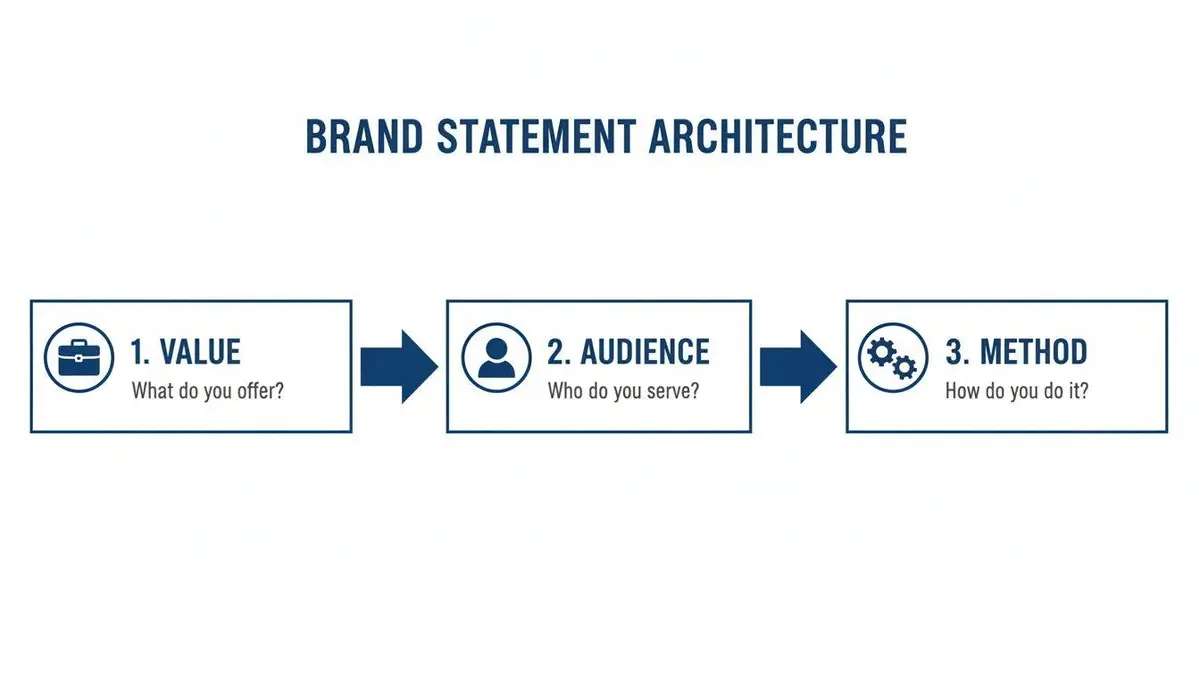
A personal brand statement is a strategic asset, not a creative tagline. It is a declaration built on a solid, defensible structure, ensuring it is not only compelling but also consistently and verifiably true. This framework is constructed from three core components extracted directly from your career, transforming a simple sentence into a tool for narrative control.
The Three Core Components
A statement that withstands real-world pressure is built from three parts. Each answers a crucial question, forming a complete and powerful narrative of your expertise.
1. Unique Value Proposition (UVP): What Do You Deliver?
This is the specific, tangible outcome you produce. It is not your job title; it is the result you create. A weak statement describes an action: “I manage portfolios.” A strong one defines the result: “I preserve and grow generational wealth through risk-mitigated investment strategies.” One is a task; the other is a binding promise.
2. Specific Audience: Who Do You Serve?
Vague statements are dismissed. A statement aimed at “businesses” is too broad to be credible. In contrast, one targeting “family offices and UHNW individuals” is specific, authoritative, and immediately signals your specialized expertise. This focus demonstrates a deep understanding of a particular group’s unique challenges, goals, and lexicon.
3. Distinct Methodology: How Do You Achieve It?
This component defines your proprietary process or unique perspective, the “how” behind your results. Phrases like “by leveraging proprietary forensic accounting” or “through discreet digital intelligence and counter-narrative campaigns” articulate a methodology that cannot be easily replicated. This is your intellectual property.
Assembling these components creates a declaration that is far more than a simple introduction.
A well-constructed personal brand statement acts as a “north star” for your reputation. It guides your content, frames your media appearances, and provides the authoritative reference point during a crisis, ensuring your public narrative remains under your control.
This architectural approach makes your statement a defensible truth, not a mere claim. It becomes the bedrock of your professional identity, broadcasting a clear and consistent message across your entire digital footprint and leaving no room for misinterpretation.
How to Craft Your Personal Brand Statement: A Framework
Constructing a personal brand statement is a disciplined process of analysis, not a creative writing exercise. The objective is to distill the truth of your professional value into a declaration you can stand behind in a high-stakes media interview or a private boardroom. A structured approach ensures you produce a clear, consistent narrative for deployment across all platforms.
The Guided Discovery Process
This process is built on three pillars of self-interrogation. Answering these questions with precision will furnish the building blocks for a powerful statement.
1. Pinpoint Your Core Competency: What is the specific, high-value skill that has consistently delivered measurable results throughout your career? Move beyond your official title. Is it structuring complex M&A deals, navigating high-stakes litigation, or executing discreet corporate turnarounds? Isolate the one thing you do better than almost anyone else.
2. Define Your Beneficiary and Their Problem: Who, specifically, benefits from your expertise? Articulate the exact problem you solve for them. A claim to help “businesses” is meaningless. A claim to help “founder-led tech companies facing complex regulatory hurdles” carries weight. Specificity here defines your operational theater.
3. Crystallize Your Guiding Principles: What are the non-negotiable values that govern your professional conduct? This is not about generic terms like “integrity.” This is about your unique operational philosophy. Examples include “unyielding discretion,” “data-driven decisiveness,” or a commitment to “challenging standard risk models.” These principles differentiate your approach.
The Statement Development Framework
Use this framework to distill your analysis and organize the core elements of your statement.
| Component | Guiding Question | Example Output Element |
|---|---|---|
| Core Value | What unique skill consistently delivers superior results? | “Structuring complex, cross-border M&A deals” |
| Target Audience | Which specific group requires your expertise most? | “for growth-stage SaaS companies” |
| Problem/Solution | What critical pain point do you solve for this audience? | “to navigate international expansion and compliance” |
| Unique Method | What guiding principle or approach makes your work distinct? | “with a focus on discretion and capital efficiency” |
Answering each question provides the raw materials to assemble into a cohesive and powerful declaration.
The Strategic Edge of Authenticity
This deep self-analysis delivers a direct payoff. Research shows 77% of professionals see positive career impacts from an effective personal brand. However, 40% of leaders have no strategy to connect their personal brand with their business goals, leaving their reputation vulnerable. You can explore more data in Tenet’s personal branding research.
Your personal brand statement is the direct result of this strategic deep dive. It is your official, vetted position on your market value, articulated with enough precision to withstand scrutiny.
When you adhere to this framework, your statement transforms from a string of words into a strategic asset. It becomes a defensible declaration of who you are and the value you deliver.
Deploying Your Statement as Digital Armor

A personal brand statement confined to a private document is inert. Its protective power is activated only through consistent deployment across your entire digital presence. This transforms the concept into active reputational armor.
The objective is to disseminate your core message so clearly and consistently that it becomes the primary association for your name in search engine results. Strategic digital content creation is the mechanism for this deployment.
Fortifying Critical Digital Profiles
Consistency is a deliberate strategy to control your narrative and enhance your search engine visibility. When search algorithms detect the same authoritative message across multiple high-authority domains, they recognize it as the definitive narrative. This builds a robust defense that suppresses random, negative, or irrelevant content.
Concentrate your efforts on these key digital assets first:
- LinkedIn Headline & Bio: Your headline should be a condensed version of your statement. The “About” section must expand on your value, audience, and methodology.
- Professional Website: The “About” page is the canonical source of truth for your professional identity. Your statement should form its foundation and be adapted for homepage messaging.
- Speaker & Contributor Bios: Every biography provided for conferences, publications, or media appearances must echo your core statement, compelling third parties to reinforce your controlled message.
Establishing this unified front is your first line of defense. It creates a digital footprint that is both authentic and defensible. This functions as a protective barrier, a key principle in executing a digital footprint cleanup.
Practical Application: The Statement in Action
Effective deployment requires translation, not just replication. You must adapt the core essence of your statement to fit the constraints and formats of different platforms while preserving the primary message.
Consider this example statement: “I structure complex, cross-border M&A deals for growth-stage SaaS companies, navigating international expansion and compliance with a focus on discretion and capital efficiency.”
This translates into digital armor as follows:
- LinkedIn Headline: Structuring Complex M&A for SaaS Global Expansion | Capital Efficiency & Discretion
- Short Bio for a Panel: As an expert in cross-border M&A, [Name] enables growth-stage SaaS companies to execute international expansion with capital efficiency and complete discretion.
- Website Sub-headline: Your Strategic Partner for Complex International M&A in the SaaS Sector.
Each variation reinforces the others, creating a powerful echo chamber for your controlled narrative. This consistency makes your authentic brand more visible and resilient, displacing irrelevant or malicious content.
By actively deploying your personal brand statement, you shift from a passive position to one of active defense. You are fundamentally shaping how search engines and key audiences perceive your expertise, creating a formidable shield against reputational threats.
Critical Errors That Undermine Your Brand Defense
A poorly crafted personal brand statement can backfire, transforming a reputational shield into a liability. It can provide critics with the exact ammunition needed to attack your credibility, inviting the scrutiny you sought to avoid. Understanding these common failures is essential to ensuring your statement functions as a defensive asset.
Vague Jargon and Empty Buzzwords
The most common error is the use of generic corporate jargon. Describing yourself with phrases like “synergistic visionary” or “results-oriented leader” communicates nothing of substance and erodes credibility. This vagueness is a critical defensive weakness. A statement that lacks concrete detail offers no value when your reputation is challenged. A precise, specific personal brand statement is defensible; a generic one is a liability that can be easily mocked or contrasted with any perceived failure.
Unsubstantiated and Grandiose Claims
Your statement must be anchored in provable reality. Proclaiming yourself a “pioneer” or the “foremost expert” without a clear, verifiable track record paints a target on your back. Journalists, competitors, and online detractors are incentivized to dismantle such grandiose claims.
When your actions cannot support your words, your statement becomes an indictment of your credibility. Authenticity is not a suggestion; it is a core requirement for a defensible brand. A statement that is misaligned with observable reality will always backfire, often with severe consequences for your reputation.
This misalignment creates a credibility gap that is easily exploited. Every claim you make must be substantiated by tangible evidence from your career. Failure to do so hands your critics a weapon.
Creating a Static, Unchanging Statement
A final, fatal flaw is treating your personal brand statement as a “one-and-done” project. Your career evolves, your focus shifts, and your goals are refined. A statement written five years ago is unlikely to capture the value you deliver today. An outdated statement creates a disconnect between your stated identity and your current professional reality. This gap can be used to portray you as out of touch or, worse, deceptive. Your statement must be a living document, reviewed annually and updated after any significant career transition to remain a sharp and effective defensive tool.
Integrating Your Brand with Proactive Reputation Defense
Your personal brand statement and your online reputation are inextricably linked. A well-defined statement is not merely a professional summary; it is the foundational element of your entire defense against online attacks. Without a clear, authentic narrative, you are forced into a reactive posture, perpetually responding to threats as they emerge. A strong brand statement sets the record straight from the outset, establishing the official narrative and making it substantially more difficult for negative content to gain purchase.
Aligning Brand Authority with Defensive Action
In a reputation crisis, a clearly articulated brand provides the high ground. The power lies in consistency. When you have established an authentic identity across the web, false narratives appear incongruous and lose credibility with both human audiences and search algorithms.
This is how your narrative becomes your strategy:
- Content Suppression: When a negative article surfaces, an established brand backed by a history of positive, authoritative content provides a powerful arsenal to suppress that negative result in search rankings.
- Defamation and Takedown Campaigns: When pursuing legal challenges or removal requests against false content, your public brand statement serves as powerful evidence of your established character and professional reputation, adding significant weight to your case.
A strong brand is a tool, not just a shield. It confers the authority to challenge, dismantle, and remove malicious content with far greater efficacy. This proactive posture is a non-negotiable component of modern risk management.
Continuous Monitoring and Rapid Response
A brand statement’s effectiveness is contingent upon the digital environment it occupies. It cannot be “set and forgotten.” You must actively monitor your online presence to detect attempts to undermine your narrative. Early threat identification enables rapid response before a situation spirals out of control. This vigilance transforms your brand from a static declaration into a living defense system.
For executives and public figures who are prime targets for attack, pairing a robust brand strategy with specialized reputation management services is essential. Professional oversight ensures that your work in defining your brand is backed by a system poised to defend it against any threat.
Frequently Asked Questions
How Often Should I Update My Personal Brand Statement?
Treat your brand statement as a living document. It requires review at least annually, or following any significant career event such as a major promotion, new venture, or strategic shift in your professional focus. An outdated statement is a liability; it creates a credibility gap between your stated identity and your current activities that can be easily exploited.
Can a Personal Brand Statement Attract Negative Attention?
Yes, if it is poorly constructed. A statement that is exaggerated, unsubstantiated, or misaligned with your verifiable actions invites criticism. Making claims you cannot prove provides ammunition to those seeking to discredit you. A statement built on provable facts and consistent actions, however, is a powerful reputational shield.
The purpose of a personal brand statement is not to aggrandize, but to clarify. Its strength lies in its defensible truth, which makes it a poor target for detractors and a solid foundation for your reputation.
I Have a Minimal Online Presence. Do I Still Need One?
Yes. A minimal online presence creates a dangerous informational vacuum. Without a defined narrative, the first negative article, false review, or malicious post that appears becomes your de facto online identity. A personal brand statement allows you to proactively establish your reputation on your own terms, preempting the need for a defensive scramble later.
Your digital reputation is a high-value asset that demands a professional defense. If you are facing online attacks or need to secure your narrative, contact ContentRemoval.com for a confidential assessment at ContentRemoval.com.