
People search removal for executives means treating exposed addresses, relatives, and residences as a security perimeter problem, not a privacy annoyance. Data flows from primary brokers to secondary aggregators to regional clones, so manual opt-outs act as notice rather than control. Durable results combine source removal, legal instruments such as CCPA, GDPR, and DMCA, and continuous monitoring for relisting.
Key facts
- Privacy Rights Clearinghouse has identified over 500 companies collecting and selling personal information
- A 2025 arXiv study found removal services correctly matched only 41.1% of identified records to the participant
- Consumer Reports found the best removal service reached 68% success after four months; the weakest 4 to 6%
- De-indexing hides the search result; source removal deletes the page; monitoring stops it being written back
Where ContentRemoval.com comes in. ContentRemoval.com handles people-search removal as risk counsel rather than a subscription: confidential intake, an exposure assessment covering spouse, children, trusts, and property-linked names, source-versus-index analysis, statutory and copyright escalation where brokers stall, and reporting a principal or family office can use. Protection teams, executive assistants, and family office heads usually make contact. A free 15-minute Exposure Scan maps what is removable, and the report is yours to keep. Get a Free, Confidential Exposure Scan or read how our data broker removal work is done.
You search your own name after a board dispute, a financing round, or a press cycle. The first unpleasant result isn’t a headline. It’s your home address, age, relatives, prior residences, and a list of associates on a people-search site you’ve never heard of. Your spouse appears on another. One of your children appears in a cached result. At that point, this stops being a privacy annoyance. It becomes an exposure problem with security, reputational, and operational consequences.
That’s how high-net-worth clients usually arrive at this issue. Not out of curiosity. Out of pressure. A family office notices increased phishing. An executive assistant sees strange calls routed through switchboards. A protection team flags that residential data is easy to assemble from public sources and secondary aggregators. People search removal belongs in the same risk category as executive travel protocols and credential hygiene. If your name, family ties, and address history are exposed at scale, you’ve left an unnecessary opening.
The Anatomy of Your Digital Exposure
An executive rarely appears on just one site. Their data spreads through a chain. A primary data broker acquires information from public records, commercial datasets, and other brokers. A secondary aggregator republishes, reformats, and cross-links it. Then smaller regional sites and niche directories clone the same profile and rank for long-tail searches. That’s how one home address becomes a durable footprint.

For an executive, the exposed record isn’t just a name and address. It’s context. Maiden names, relatives, prior entities, phone numbers, age bands, and property-linked identifiers give an attacker enough to build a convincing pretext. Security teams know this. So do fraud actors. If someone can extract social data at scale, they can enrich what they already know about you with surprising speed.
What the exposure actually creates
The immediate risk is physical. A listed residence, combined with family names and historical addresses, reduces the effort required for stalking, harassment, and in-person targeting.
The second risk is social engineering. An attacker doesn’t need full identity theft to cause damage. They need just enough truth to sound legitimate to your assistant, your banker, your house manager, or a junior employee in finance.
Practical rule: If a stranger can map your household, prior addresses, and close associates from public-facing broker pages, your threat surface is already wider than it should be.
The third risk is reputational manipulation. People-search data gives adversaries raw material for false narratives, impersonation, and defamatory content that appears plausible because it contains fragments of truth. That’s why a serious response starts with a map of exposure, not random opt-out forms.
A large part of the problem is scale. The Privacy Rights Clearinghouse has identified over 500 companies collecting and selling personal information, while a Security.org study on data removal service awareness found that fewer than half of U.S. adults are even aware these services exist. The market is vast. Public preparedness is not.
For a deeper breakdown of the ecosystem behind these listings, see this strategic guide to data brokers. You need to understand the machine before you try to shut down its outputs.
The Manual Opt-Out Fallacy
Manual opt-outs are necessary. They are not a strategy.
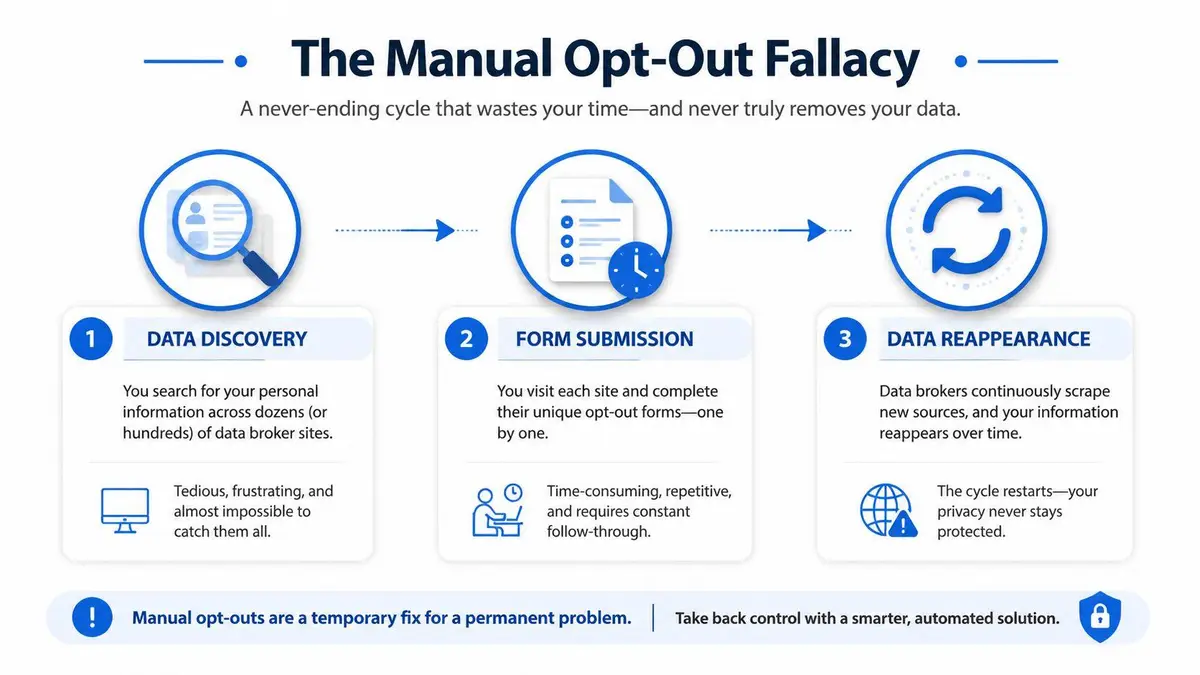
Most executives start with the obvious names. Whitepages. Spokeo. BeenVerified. FastPeopleSearch. That’s reasonable. You should remove the visible records first, especially where a listing includes a current address, phone number, or relatives. But the common advice to “just opt out of the major sites” badly understates the actual workload and overstates the result.
Why the DIY approach breaks down
The forms are often cumbersome by design. Some require identity confirmation. Some force repeated submissions. Some suppress one profile while leaving duplicates untouched. Others remove a listing from public search while retaining the underlying record in the broker’s database. That distinction matters.
The larger flaw is discovery. Search engines surface the biggest brokers first, but they don’t reveal the full range of brokers. Fox News guidance on removing personal information from people-search sites notes that search engines tend to surface the largest data brokers, while hundreds of smaller, state-specific, or niche sites remain undiscovered by standard searches. That invisible database problem is why a name search gives many clients false confidence.
If you want a practical consumer-facing checklist before escalating, this executive privacy guide to removing yourself from data broker lists is a useful starting point. Treat it as triage, not closure.
What manual removal should still include
If you’re doing this yourself at the outset, work in a disciplined order:
- Start with immediate safety risks: Remove records that show a current home address, direct phone number, or household members first.
- Preserve evidence before submission: Save screenshots, URLs, and timestamps. Brokers change page structures and may later deny that a listing existed.
- Track duplicates and variants: Search by full name, common abbreviations, prior city, former state, and family-member combinations.
- Check the broker page directly: Don’t rely on Google alone. A de-indexed or weakly indexed page can still be live on the source site.
- Recheck after removal: Some sites confirm a request but leave related records active under alternate formatting.
Later in the process, it helps to see how consumer removals are typically presented and where they fall short in practice:
> A manual opt-out is a form of notice. It is not control.That’s the core fallacy. DIY guidance assumes your exposure is visible, finite, and stable. For a high-net-worth household, it usually isn’t. It’s distributed across obvious listings, obscure mirrors, region-specific databases, and broker-to-broker replication. Manual work helps at the edges. It rarely resolves the system.
Legal Instruments for Forced Removal
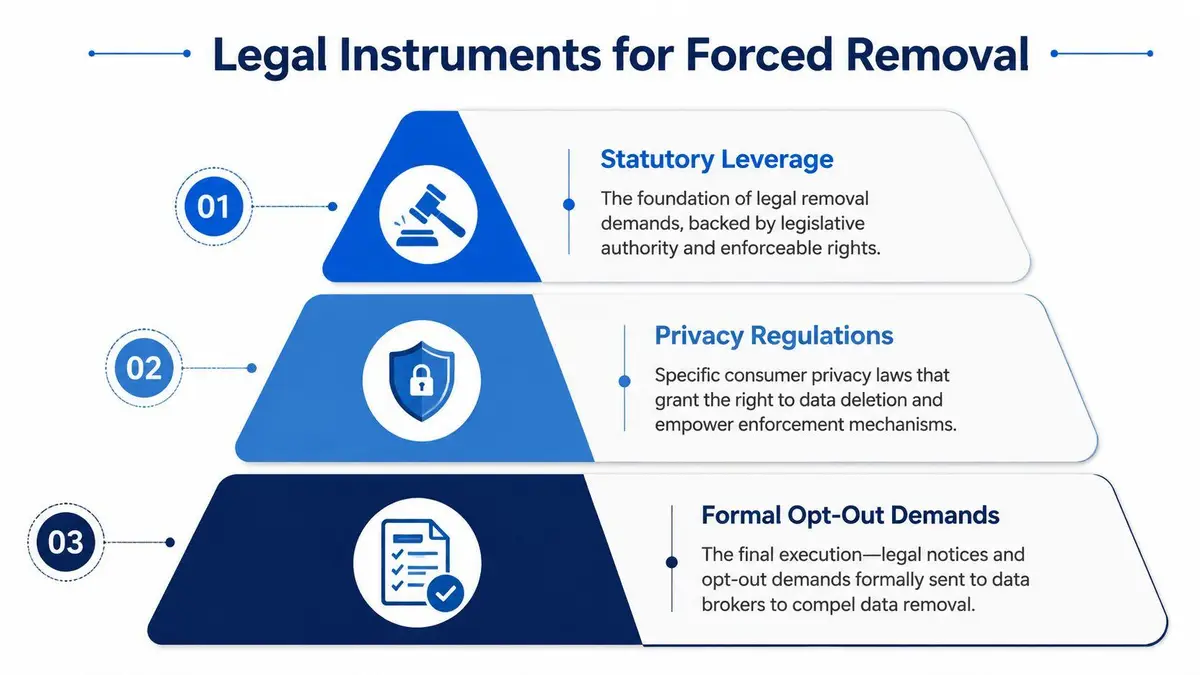
When polite requests stall, legal arguments start to matter. At this point, advanced people search removal diverges from consumer privacy housekeeping. You are no longer asking a broker to do you a favor. You are identifying a legal basis that makes continued publication or retention harder to defend.
Privacy rights with statutory force
If you have a California nexus, deletion rights under CCPA and CPRA can provide a stronger basis than a generic site opt-out. The difference is practical. A broker that ignores a casual request may respond more seriously to a properly framed statutory demand tied to identity verification, category-specific data, and retention objections.
If you have an EU nexus, GDPR can be even more useful. The “right to be forgotten” isn’t a magic wand, but it creates a structured argument around necessity, proportionality, accuracy, and lawful basis. For executives with multinational footprints, this often changes the tone of engagement immediately.
Copyright and platform enforcement
Some people-search and profile pages reuse protected assets. A professional headshot, company biography photo, conference image, or licensed media asset can create a copyright hook where privacy arguments alone are weak. A DMCA notice doesn’t solve every exposure problem, but it can remove specific visual elements that make a page more credible and more damaging.
Terms-of-service complaints also matter in more serious matters. Harassment, impersonation, fabricated allegations, and non-consensual intimate imagery require a different approach than routine broker removals. The strongest complaints are factual, documented, and tied to the platform’s own enforcement language. Vague outrage performs poorly. Specific violation mapping performs better.
What a proper escalation packet looks like
A weak complaint says, “Please remove this. It invades my privacy.”
A stronger complaint usually includes the following:
| Component | Why it matters |
|---|---|
| Precise URL inventory | Forces the recipient to address exact pages, not general complaints |
| Identity and authority proof | Reduces delay tactics tied to verification |
| Legal basis | Grounds the demand in statute, copyright, or platform policy |
| Evidence exhibits | Preserves screenshots and cached appearances |
| Deadline and follow-up posture | Signals that silence won’t end the matter |
The quality of the legal framing often determines whether your request is treated as customer service noise or a compliance issue.
Not every listing justifies counsel-level escalation. But if your exposure affects family security, executive safety, or active reputational threats, legal instruments should enter the picture early. Delay usually benefits the broker, not you.
De-indexing Versus Source Removal
Clients often say, “Can’t we just get this off Google?” Sometimes yes. Often that’s only partial relief.
De-indexing removes or suppresses a result from a search engine. Source removal deletes the underlying content from the website that hosts it. Those are not equivalent outcomes. De-indexing hides the sign. Source removal tears down the structure behind it.
Why the distinction matters
If Google no longer shows a page for your name, the page may still exist. Anyone with the direct URL can still access it. Other search engines may still surface it. A broker can alter the page and reintroduce it. Another site can clone the same data and create a fresh indexable result. That’s why a search-result cleanup often feels successful at first and disappointing later.
Google’s removal tools can be useful for certain categories of personally identifiable information and explicit content. Use them when they apply. But don’t confuse search suppression with actual deletion.
The hidden technical failure
Source removal is harder because the primary challenge isn’t only deletion. It’s identification and attribution. A 2025 arXiv study on removal service accuracy found that, on average, only 41.1% of records identified by the services were correctly matched to the participant. That figure tells you something uncomfortable. Even services designed for removal often struggle to link the right records to the right person.
That has two consequences for executives. First, your real exposure may be broader than the service report suggests. Second, a “removal completed” notice may refer to the wrong record, a duplicate variant, or only one instance in a chain.
A useful way to think about it
Consider the difference this way:
- De-indexing is like removing your address from the sign at the front gate.
- Source removal is like removing your address from the file room, the mail roster, and the copied ledgers in circulation.
- Monitoring after removal is making sure someone doesn’t write it back into the next edition.
That’s why I don’t treat de-indexing as the endpoint except in narrow cases. It’s a tactical measure. The strategic objective is source control across the host site, mirrors, broker resellers, and obvious republication channels.
Implementing Continuous Monitoring and Re-Upload Prevention
A one-time cleanup creates a dangerous illusion. The page disappears. The client relaxes. A few weeks later the listing returns on a sister site, a cached variant, or a broker that bought the same dataset from another source. That cycle is normal in this market.
The reason is structural. Brokers scrape, buy, trade, refresh, and republish. If the upstream data source stays active, your profile can reappear even after a valid removal. If a secondary broker copied the record before deletion, your data can propagate again without any new public filing on your part.
Why continuous monitoring is the real service
Many low-cost subscriptions underperform in a critical aspect. They emphasize a removal event. High-risk clients need a monitoring system.
A Consumer Reports review of people-search removal services found that even after four months of using paid removal services, data about every participant still appeared on some people-search sites. That is the operational reality. Persistence is the problem.
A proper monitoring program does several things at once:
- Scans for reappearance: New and relisted profiles must be detected quickly.
- Checks source status: A page removed from search but still live at the source needs a different response.
- Tracks household exposure: Spouses, adult children, trusts, and property-linked names often become the weak point.
- Maintains evidence history: If a site relists data after prior removal, your escalation posture changes.
Ongoing people search removal is closer to perimeter defense than spring cleaning.
What executives should actually ask for
When I review a vendor or internal process, I don’t start by asking how many sites they “cover.” Coverage claims are easy to market and hard to verify. I ask how they detect relisting, how they distinguish source deletion from search suppression, and how they report unresolved records tied to household members and known aliases.
For clients who need sustained oversight, a dedicated reputation monitoring program is usually more valuable than a static removal package. The point isn’t just to remove what is visible today. The point is to know when your data perimeter changes tomorrow.
Re-upload prevention requires process, not hope
The strongest campaigns combine removal with prevention habits inside the household and organization. That includes limiting new exposure through property records where lawful options exist, controlling where professional biographies and images are published, tightening staff protocols around verification, and reducing data leakage through vendors.
You are not trying to disappear completely. In most executive cases, that isn’t realistic. You are trying to make your personal data materially harder to assemble, weaponize, and republish.
When to Engage Professional Removal Services
Not every exposed executive needs a bespoke intervention on day one. Some do.
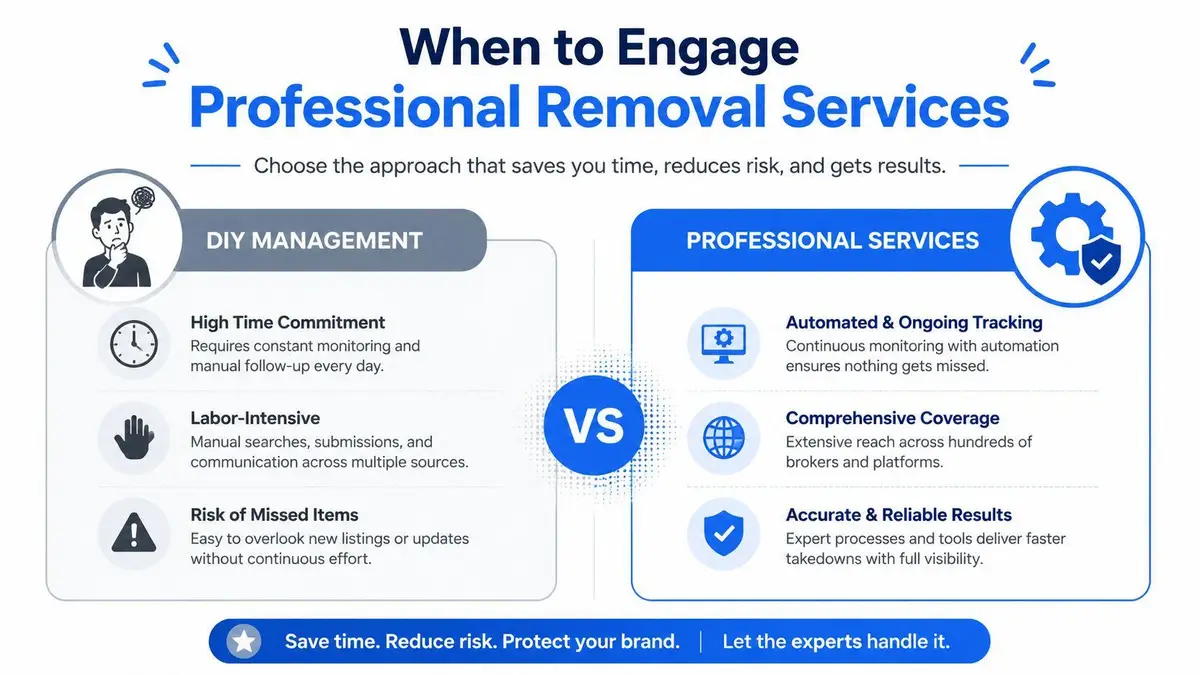
If your listing includes a current residence, family members, or information that could support stalking, extortion, spear-phishing, or litigation pressure, professional handling should start immediately. The same is true if you’re in an active reputational dispute, a contested transaction, a public-facing leadership role, or a family-office environment where personal and commercial identities overlap.
Not all services deserve the same trust
The label “professional removal service” covers very different offerings. Some are automated subscriptions with limited escalation. Some are broad privacy products with minimal legal strategy. Some are hands-on campaigns with counsel involvement, source-level pressure, and continuous review.
That distinction matters because performance varies sharply. A Consumer Reports evaluation of seven people-search removal services found that the best service achieved a 68% success rate after four months, while the weakest managed 4% to 6%. If you’re choosing a provider for executive protection, “we remove data brokers” is not enough. Ask what they remove, what remains unresolved, and what legal escalation they can deploy when standard requests fail.
What a premium engagement should include
A serious engagement should feel less like a subscription and more like risk counsel. You want confidential intake, an exposure assessment, prioritization by threat level, source-versus-index analysis, escalation pathways, and reporting that a principal or family office can use.
One option in this category is ContentRemoval.com, which handles people-search removal as part of broader content takedown and reputation protection work. The relevant question isn’t branding. It’s whether the firm can run a managed campaign that addresses source removal, legal pressure, and monitoring together.
If your time is limited, your profile is public, or your household has already been exposed, don’t outsource this problem to generic consumer workflows. The cost of delay isn’t theoretical. It shows up in access, advantage, and risk.
If your name, address history, or family data is surfacing on people-search sites, start with a confidential assessment at ContentRemoval.com. The right response isn’t a pile of opt-out forms. It’s a controlled removal campaign that matches your risk profile, applies legal pressure where needed, and keeps watch for relisting before exposure turns into a larger security or reputational problem.
Frequently asked questions
Is opting out of people search sites enough to protect an executive?
No. Manual opt-outs are necessary but act as notice rather than control. Search engines surface the largest brokers while hundreds of smaller, state-specific, or niche sites stay hidden, some forms suppress one profile while leaving duplicates, and brokers replicate records to each other. Use opt-outs as triage, not closure.
Can I use privacy law to force a data broker to delete my information?
A California nexus brings CCPA and CPRA deletion rights; an EU nexus brings GDPR arguments around necessity, proportionality, and accuracy. A properly framed statutory demand with identity verification and a precise URL inventory gets more serious treatment than a casual request. A DMCA notice can also remove a reused headshot or licensed photo from a page.
What is the difference between getting a listing off Google and removing it from the broker?
De-indexing removes the result from a search engine while the page stays live for anyone with the URL, other search engines, or a clone site. Source removal deletes the content from the host. Monitoring afterward matters because upstream data can write the record back into the next refresh.