
An online reputation repair company should be treated like specialist crisis counsel: it diagnoses what can be removed at source, what can be de-indexed, what must be suppressed, and what needs continuous monitoring so it does not return. Serious repair works in three layers, removal, suppression, and protection, and starts with legal removal whenever a credible basis exists.
Key facts
- First-hours moves: preserve evidence, map the spread across mirrors and reposts, choose the pressure point, control internal comms
- Legal-tactical removal covers defamation, privacy abuse, NCII, impersonation, copyright, and policy violations
- A cited HelloPrivacy figure puts EU right-to-be-forgotten requests to Google at roughly 45% success
- Ask the firm how it handles unlawful content, lawful but harmful content, and highly sensitive private material
Where ContentRemoval.com comes in. ContentRemoval.com is built around the removal layer most agencies skip: platform reporting, DMCA and privacy-based notices, publisher negotiation, court-backed demands where warranted, then de-indexing and suppression for what remains, with monitoring for reposts. General counsel, a family office, or a spouse who found the result usually makes the first call. A free 15-minute Exposure Scan maps what is removable, and the report is yours to keep. Get a Free, Confidential Exposure Scan or read how our reputation management work is done.
The call usually comes after midnight. A board member has forwarded a search result. A spouse has found a leaked image. General counsel has seen a defamatory post gaining traction. An investor has asked a polite question that is not polite at all: “What exactly is going on here?”
At that moment, you do not have a marketing problem. You have a control problem.
Search results, review platforms, social media threads, scraped personal data, fake profiles, and hostile blogs can alter how counterparties evaluate you before you ever enter the room. For executives, founders, family offices, and public figures, that can affect financing, hiring, partnerships, litigation posture, and personal safety. Delay makes the situation worse because damaging material gets copied, indexed, screenshot, and redistributed.
An online reputation repair company should be treated like specialist crisis counsel. You hire one to diagnose what can be removed, what can be de-indexed, what must be suppressed, and what needs continuous monitoring so it does not return. That work is part legal, part technical, and part strategic. It is not a generic PR exercise, and it is not a matter of posting a few flattering articles and hoping Google gets distracted.
The market has grown for a reason. Mordor Intelligence projects the online reputation management market at USD 7.75 billion in 2026 and USD 14.01 billion by 2031 (Mordor Intelligence online reputation management market report). Buyers act because digital reputation now carries measurable commercial consequences.
Navigating a Digital Reputation Crisis
You search your own name. Or your company’s name. Or your child’s.
The first result is an accusation. The second is an old arrest record that should never have been indexed this prominently. The third is a forum thread built on half-truths and spite. Your phone starts buzzing because other people have seen it too.

That shock is rational. Harmful content online can trigger immediate business and personal consequences long before the truth catches up. You do not get the luxury of a slow response when a journalist, investor, client, recruiter, or hostile litigant can pull the same search results in seconds.
Why panic is the wrong response
Panic leads people to contact the website directly, threaten litigation without a strategy, or publish defensive content that amplifies the issue. Those are amateur moves. They often alert the publisher, create a record, and make the target easier to pressure.
A specialist approaches the matter differently. First, classify the content. Is it defamatory, private, pirated, impersonating, extortionate, or unhelpful but lawful? Then identify the means of influence. Platform policy. Copyright. privacy law. court process. search engine removal criteria. webmaster controls. publisher contact points. indexing behavior.
Treat first-page harm as active exposure, not reputational noise. The right first step is diagnosis, not reaction.
What a specialist firm does in the first hours
In a serious matter, the opening moves are narrow and disciplined:
- Preserve evidence: Screenshots, URLs, cache copies, timestamps, account identifiers, and search placements.
- Map the spread: Original source, mirrors, embeds, social reposts, and search engine indexation.
- Choose the pressure point: Takedown demand, legal notice, platform report, de-indexing request, or suppression campaign.
- Control internal communications: One approved narrative, one reporting line, no freelance outreach.
A proper online reputation repair company functions as a command center. It coordinates legal analysis, technical removal work, and visibility control. That is the difference between reducing damage and chasing it.
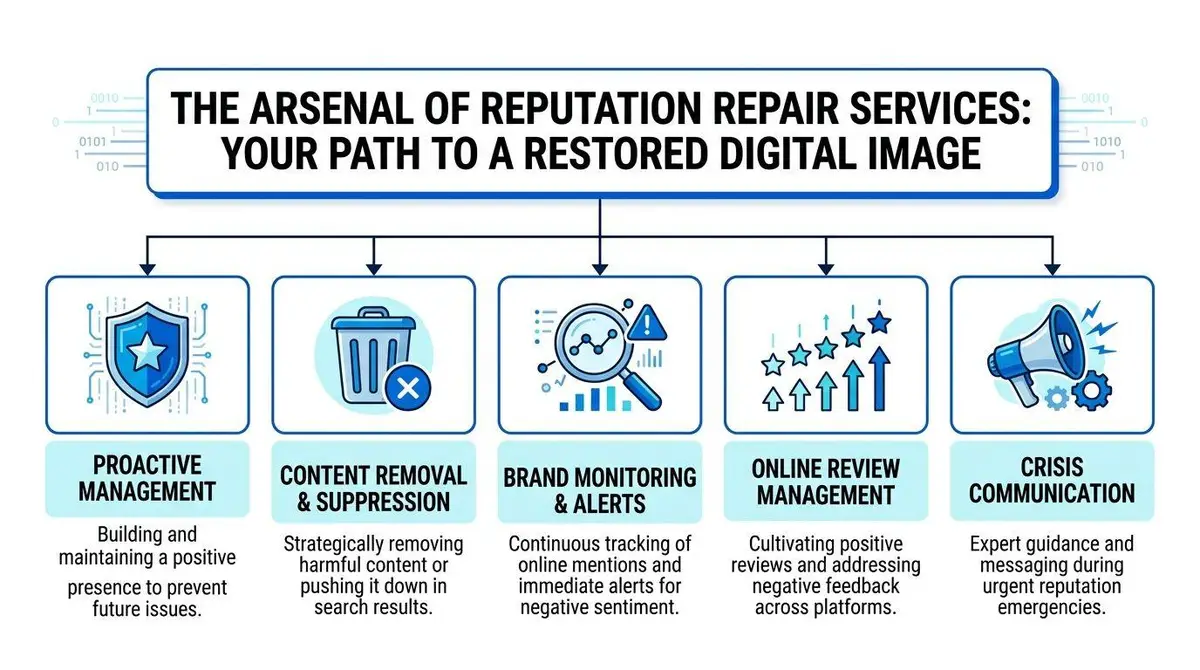
The Arsenal of Reputation Repair Services
Most buyers arrive with the wrong mental model. They think reputation repair means “bury the bad result.” Sometimes that is necessary. It is rarely the whole job.
Serious reputation work has three layers: removal, suppression, and protection. They are not interchangeable. They operate at different levels of permanence.
Source removal
Source removal is the highest-value outcome because it attacks the material where it lives.
If the content violates platform rules, infringes copyright, exposes private information, impersonates you, distributes intimate content, or crosses into actionable defamation, a firm should pursue direct removal first. This can involve platform reporting systems, publisher negotiations, DMCA notices, privacy-based requests, and court-backed demands where necessary.
The advantage is obvious. If the page, image, account, or file is removed at the source, search engines lose the underlying asset. Future redistributions become easier to track because you are no longer dealing with a live original.
Many firms are weak in this area. They sell “reputation management” while doing little or no takedown work. If a provider cannot explain its source-removal protocols in concrete terms, it is not offering elite repair. It is selling visibility management.
For a practical example of what this category includes, see these content removal services.
De-indexing and search suppression
Some material will not come down at the source. Major news archives, lawful public records, and stubborn third-party commentary often stay online even when they are damaging or misleading.
That is when the strategy shifts to de-indexing where available, then to suppression.
De-indexing aims to remove a result from search visibility even if the underlying page still exists. Suppression pushes harmful results down by increasing the authority and relevance of better assets. These are different tasks. One targets indexation. The other targets rank order.
According to HelloPrivacy’s explanation of online reputation repair, advanced repair combines legal notices with search engine-specific protocols and can achieve 70-85% success rates for harmful content removal, often within 48-72 hours. The same source notes that right-to-be-forgotten requests to Google under EU law have an approximate 45% success rate.
That does not mean every matter resolves in days. It means competent firms know which requests have legal and technical traction, and they move quickly when the facts support removal.
If a result cannot be erased, reduce its visibility, challenge its indexation, and surround it with stronger assets. Control of discovery matters.
Proactive remediation and relapse prevention
The third layer is where advanced firms separate themselves from vendors chasing quick wins.
Once harmful content is removed or suppressed, the problem is not over. Copies reappear. scraped data resurfaces. Fake accounts come back under new handles. Adversaries test whether anyone is watching.
A serious engagement includes ongoing monitoring, leak detection, and reupload prevention. That can involve dark web scanning, image matching, account impersonation surveillance, and rapid escalation channels with major platforms.
Protection also includes hardening your digital footprint. Claiming key profiles, updating stale pages, consolidating official biographies, correcting business listings, and publishing defensible factual assets gives search engines and counterparties cleaner material to find. The point is not vanity. The point is reducing the amount of empty space that attackers can occupy.
Legal vs Technical Methodologies
Most firms blur this distinction because it is commercially convenient. You should not let them.
There are two core approaches in reputation repair: legal-tactical removal and technical visibility control. They solve different problems. They require different evidence. They produce different kinds of outcomes.
The legal route
Legal methodology targets the right to keep the material online at all.
That includes copyright claims, privacy arguments, non-consensual intimate image reporting, impersonation complaints, terms-of-service violations, defamation demands, and search engine removal requests grounded in jurisdiction-specific law. In the right case, this is the cleanest route because it aims for permanence rather than camouflage.
Its weakness is jurisdiction. Platforms operate globally. Publishers may sit in one country, host in another, and target an audience in a third. A notice that is effective in one jurisdiction may have limited force in another. That is why legal skill matters more than noise.
The challenge is not abstract. As noted in this analysis of online reputation repair company legal challenges, direct takedowns under GDPR-style right-to-be-forgotten rules or DMCA mechanisms are often more effective than pure SEO suppression, but success varies. The same source cites that Google granted only 45% of such requests in the EU in 2024.
For high-stakes matters involving false allegations or malicious publication, legal strategy should be built with counsel who understand internet defamation, platform process, and evidentiary standards. This overview of an internet defamation attorney navigating high-stakes content removal in 2026 captures the legal posture such matters require.
The technical route
Technical methodology accepts that the content may stay online and instead fights over who sees it.
That means publishing stronger assets, improving authority signals, cleaning up entity associations, optimizing controlled profiles, and engineering search results so harmful pages fall out of prominent positions. This is not fake review spam and not low-grade blog farming. Done properly, it is disciplined search architecture.
Its strength is flexibility. It works even when direct removal is unavailable. Its weakness is maintenance. Visibility can be regained by the negative result if the campaign is weak, static, or built on junk assets.
Which one should come first
Start with legal removal whenever a credible basis exists. Use technical suppression as reinforcement or as the primary route only when law and platform policy will not move the source.
A simple comparison helps:
| Method | Best use | Main benefit | Main limitation |
|---|---|---|---|
| Legal-tactical removal | Defamation, privacy abuse, NCII, impersonation, copyright, policy violations | Potentially permanent removal or de-indexing | Jurisdiction and platform discretion |
| Technical visibility control | Lawful but damaging content, entrenched press, legacy records | Controls discoverability and reframes search results | Requires maintenance and patience |
An online reputation repair company that only sells SEO is underpowered. One that ignores technical suppression is incomplete. Serious matters need both disciplines, used in the right order.
Timelines Costs and Realistic Outcomes
Clients usually ask the cost question first. The better question is what kind of problem you have.
A false review cluster on a platform with clear policy violations is one category. A hostile article in a major publication is another. A leak copied across forums, social platforms, and search results is a third. The timeline and fee structure follow the complexity, not your level of frustration.

What moves quickly
Clear platform violations can often be addressed first because the rules are defined and the proof is usually straightforward. Impersonation, copyright misuse, certain privacy exposures, and non-consensual content often justify immediate action.
That does not mean instant closure. It means the work can begin without waiting for a long editorial or legal debate. If the source is cooperative or the platform process is mature, movement is fast. If the source is hostile, anonymous, or offshore, the same matter becomes slower and more expensive.
What takes time
Suppression campaigns, record cleanup, publisher negotiations, and cross-jurisdiction matters take longer because there are more moving parts and fewer direct controls. Search engines recrawl on their own timelines. Publishers consult counsel. Mirror sites replicate.
The economic stakes explain why businesses keep funding this work. Mordor Intelligence projects the market at USD 7.75 billion in 2026 and over USD 14 billion by 2031, and notes that a single negative article can cost a business 22% of its customers, while a one-star rating drop can cut revenue by 5-9% (Mordor Intelligence online reputation management market report). Reputation work is not cosmetic when the commercial exposure is this direct.
What drives cost
Price is usually determined by the following variables:
- Content type: A fake social profile is different from a search result tied to a legacy news article.
- Platform and publisher behavior: Some channels process reports quickly. Others resist.
- Jurisdiction: Privacy law, defamation standards, and disclosure rules vary sharply.
- Volume: One URL is one matter. Fifty indexed copies are a campaign.
- Urgency: Weekend filings, active media cycles, and investor diligence windows change staffing.
- Persistence risk: If the attacker is likely to repost, monitoring and recurrence control become part of the budget.
Clients considering engagement should review a pricing framework such as this guide on the true cost of content removal a professional pricing guide for 2026.
A useful explainer on process and expectations is below.
> The honest promise is not that every page disappears. The honest promise is that every serious matter can be assessed for removal, de-indexing, suppression, and containment.What realistic outcomes look like
Realistic outcomes are specific. A page is removed. A search result is de-indexed. An impersonation account is disabled. Harmful content moves off page one. Monitoring catches reposts before they gain traction.
Unrealistic outcomes are absolute guarantees. No legitimate firm can promise that every negative mention on the internet will vanish. The firms that say otherwise are either naïve or dishonest.
Vetting a Firm A Checklist for Due Diligence
Most buyers perform less diligence on a reputation firm than they would on a mid-level software vendor. That is a mistake.
You are not buying content. You are entrusting a third party with litigation-sensitive facts, private data, family exposure, and a digital crisis that may affect transactions and personal security. The wrong provider can worsen the problem through bad outreach, black-hat tactics, or simple incompetence.
What to ask before you engage
Ask the firm to explain how it handles three distinct scenarios: unlawful content, lawful but harmful content, and highly sensitive private material. If their answer sounds the same in each case, they do not know what they are doing.
Ask who performs legal analysis. Many agencies imply legal capability when they mean they have a template notice and a contractor. That is not the same thing. Ask how they preserve evidence, whether they coordinate with outside counsel, how they handle escalation if a publisher refuses removal, and what their protocol is for reuploads.
Ask how they report progress. You should receive specifics: targets, actions taken, platform responses, search movement, and next decisions. “We’re working on it” is not reporting.
What a credible answer sounds like
A credible firm is comfortable discussing limitations. It will tell you when source removal is possible, when de-indexing is more realistic, and when suppression is the only available route. It will not promise universal deletion. It will explain how confidentiality is maintained and who gets access to your matter.
The commercial stakes justify rigorous screening. According to WiserReview’s online reputation management statistics, 86% of consumers hesitate to purchase from a business with negative reviews, a single negative review can cause a 22% drop in customers, and that can escalate to a 70% decrease with four or more negative reviews. Hiring the wrong firm while those losses continue is not a harmless experiment.
Here is the due diligence table I would use.
| Vetting Criteria | What to Look For | Red Flag |
|---|---|---|
| Legal capability | Clear explanation of DMCA, privacy, defamation, impersonation, and platform-policy pathways | Vague references to “special relationships” or “proprietary secrets” with no method |
| Technical depth | Ability to explain de-indexing, suppression, entity cleanup, and monitoring without jargon theater | “We just publish positive content” |
| Evidence handling | Structured intake, screenshots, URL mapping, and preservation protocols | Asks you to send casual screenshots by text and starts outreach immediately |
| Confidentiality | Controlled communications, limited access, NDA-ready process, discreet billing if needed | Sales team wants unnecessary personal details before any engagement terms |
| Reporting | Written action plan, target list, status updates, and decision points | No timeline, no milestones, no documentation |
| Sensitive-content protocols | Specific process for leaks, NCII, fake accounts, and extortion-adjacent conduct | Treats all matters as generic review management |
| Candor | Explains what cannot be promised and where resistance is likely | Guarantees removal of everything |
| Recurrence planning | Ongoing monitoring and reupload response process | Declares the job complete the moment one URL disappears |
Red flags you should treat as disqualifying
- Guaranteed universal removal: No one can credibly guarantee that.
- No discussion of law or policy: Then they are not doing serious repair.
- Black-hat suppression tactics: Low-quality sites, spun content, fake reviews, fake profiles.
- No mention of monitoring: Then they are selling a moment, not a solution.
- Pressure to sign immediately: Good firms do not need to rush frightened clients into blind commitments.
Hire the firm that can tell you where it may fail, why, and what it will do next. That is usually the firm that knows the terrain.
The Engagement Process A Confidential Action Plan
A proper engagement should feel controlled from the first contact. If the process feels chaotic, the execution usually is too.
Confidential assessment
The first stage is a closed assessment. You provide the URLs, search terms, screenshots, chronology, and any legal or business constraints. The firm determines what the content is, where it originated, how widely it has spread, and which levers are available.
This stage should also identify hidden exposure. The visible search result is often only the front end of a larger problem that includes duplicate posts, scraped archives, fake accounts, or data broker references.
Strategic proposal
The second stage is a written plan. Not a slogan. A plan.
That plan should separate immediate actions from medium-term work. It should distinguish source removal from search suppression, identify jurisdictional issues, state what cooperation is required from you, and set expectations about likely outcomes. It should also define who speaks to whom. In many matters, reducing unnecessary communication is as important as the takedown itself.
Discreet execution
Then the work starts. Notices are filed. Platforms are engaged. search engine requests are submitted. publisher outreach is handled. controlled assets are strengthened. Monitoring is turned on.
Modern campaigns rely on machine support, but not machine judgment alone. According to Thrive Agency’s overview of online reputation repair, AI-powered monitoring can detect negative content in real time with over 90% accuracy, reduce response times from weeks to hours, and improve reputation scores by 25-35% within 3-6 months when paired with rapid suppression and removal actions.
That matters because the first advantage in a digital crisis is speed. The second is discretion.
Continuous monitoring
The final stage is not glamorous, but it is what protects the result.
Once the most visible harm is contained, the firm should continue scanning for recurrence, index changes, copied media, fake accounts, and fresh mentions that could reopen the issue. At this point, many clients realize the objective is durable control over what appears, what spreads, and what gets answered.
An online reputation repair company earns its value by making the process legible. You should know what is being done, why it is being done, and what happens if the target resists.
Frequently Asked Questions on Reputation Repair
Can a firm remove a news article from a major publication
Usually not at the source unless the article is unlawful, demonstrably false in a way the publisher will correct, or violates a specific policy. The practical route is often de-indexing where the facts permit it, then suppression and surrounding the result with stronger, controlled assets.
Is online reputation repair legal
Yes, if the firm uses lawful methods. That means platform reporting, privacy and copyright procedures, negotiated removals, court-backed action where appropriate, de-indexing requests, and compliant search suppression. Hacking, fake legal threats, fake reviews, and fabricated articles are not legitimate methods.
Can you stop removed content from coming back
Often yes, but not by wishful thinking. You reduce recurrence through monitoring, repeat-notice protocols, account surveillance, image matching, and by addressing the original source of the leak or attack. If no one is watching after removal, reposting is common.
What if the harmful content is true
Then the strategy changes. If the content is lawful and accurate, removal options narrow. The work usually shifts to visibility control, contextualization, profile strengthening, and limiting how prominently the material appears when someone searches your name or brand.
Should I contact the website myself
Usually no. Direct contact by the target often gives an advantage to the publisher, alerts bad actors, and can harden their position. The first move should be evidence preservation and a professional assessment.
How quickly should I act
Immediately. Delay allows indexing, copying, screenshotting, reposting, and narrative hardening. Early intervention does not guarantee perfect removal, but late intervention almost always reduces your options.
If harmful content is affecting your name, company, or family, start with a confidential assessment through ContentRemoval.com. The sensible first step is not a public response. It is a private, strategic review of what can be removed, what can be de-indexed, and how to prevent the problem from returning.