
A premium online reputation management firm is built to remove harmful content, not merely bury it. Its starting point is source removal, de-indexing, account takedowns, host escalation, and control of copied or republished material across jurisdictions, with search suppression as a support measure. Standard agencies manage optics; premium firms pursue removal and recurrence control across borders.
Key facts
- Premium firms classify content first: false, private, manipulated, unlawful, non-consensual, infringing, or platform-prohibited
- Cross-border sequence: jurisdictional mapping, cause of action analysis, enforcement route, then recurrence control
- A cited Modern Luxury figure puts EU right-to-be-forgotten success at 45% of cases; US platforms often want a court order
- Disqualifying signs: promising every result disappears, confusing de-indexing with deletion, loose confidentiality
Where ContentRemoval.com comes in. ContentRemoval.com works in this removal-first category: source takedowns, de-indexing, impersonation and account takedowns, dark web monitoring and remediation, and recurrence control for mirrors and reuploads. Chiefs of staff, general counsel, and family office principals usually make the first call, often the same morning the result surfaces. A free 15-minute Exposure Scan maps what is removable, and the report is yours to keep. Get a Free, Confidential Exposure Scan or read how our reputation management work is done.
At 6:40 a.m., your phone lights up with a message from counsel, your chief of staff, or a board member. A search result has surfaced. It may be a leaked image, a false accusation, a hostile article, a fake review campaign, or an impersonation profile that now outranks your own name. By breakfast, investors have seen it. By lunch, your family has seen it. By evening, someone has archived it.
That is the moment when many individuals discover the difference between ordinary reputation management and a premium engagement. One sells visibility. The other secures removal.
If your name, company, or family office carries real value, you do not need vague reassurance. You need a firm that can assess what can be taken down, where legal grounds apply, which platforms will cooperate, which foreign hosts will resist, and how to stop the same material from resurfacing under a new URL. That is the standard. Anything less is marketing.
The Executive Imperative for Reputation Control
The first question in a reputation crisis is rarely legal or public. It is operational. What can be removed before the issue spreads across search, social platforms, investor channels, and private messaging?
For an executive, founder, or family office principal, online harm should be treated as an asset protection matter from the outset. The exposure is not limited to embarrassment or press attention. It affects counterparties, lending discussions, board confidence, recruiting, deal timing, and family privacy. Once harmful content is indexed, copied, translated, or reposted in another jurisdiction, the cost of delay rises fast.

Why public relations is too narrow
PR can steady the room. It can brief stakeholders, frame a response, and reduce speculation for a period of time. It does not remove a defamatory article from a foreign host, shut down an impersonation profile, clear a search result, or stop a copied post from resurfacing on a mirror site.
A serious advisor starts with a different set of questions. Is there a legal basis for removal? Which platform policies apply? Which hosts will cooperate? Which jurisdictions create delay or resistance? What needs to happen at source, in search, and across duplicate URLs to prevent recurrence?
That is the dividing line in a high-stakes engagement. Standard firms manage optics. Premium firms pursue removal, de-indexing, account takedowns, and republication control across borders.
The issue is control
High-net-worth clients often misclassify online harm as a communications problem. It should be treated as an asset protection problem with legal, commercial, and personal consequences.
That change in framing leads to better decisions. Counsel can assess exposure. Communications can handle stakeholders. A premium reputation team handles the digital attack surface itself, including the publishers, platforms, search engines, and offshore entities that standard ORM firms usually leave untouched. If you want a concise framework for executive response, this guide on online reputation management for executives and strategic content removal is a useful starting point.
Practical rule: If harmful material appears when someone searches your name, treat it with the same urgency as a threatened lawsuit or regulatory inquiry.
Defining the Premium Online Reputation Management Firm
A wealthy family office discovers a false allegation on page one of search results Friday afternoon. By Monday, the claim has been copied to two aggregator sites, indexed under a spouse’s name, and circulated in private investor chats. At that point, you do not need a marketing agency. You need a firm built to remove the material, contain replication, and handle the jurisdictions blocking a clean takedown.
That is the true standard.
The fundamental dividing line is the firm’s core capability: is it built to remove harmful content or merely bury it? Branding, polished reporting, and a high monthly retainer do not answer that question. Operating model does.
A standard ORM agency usually focuses on visibility management. It publishes positive content, improves owned profiles, and pushes harmful material lower in search results. That work has value in routine matters.
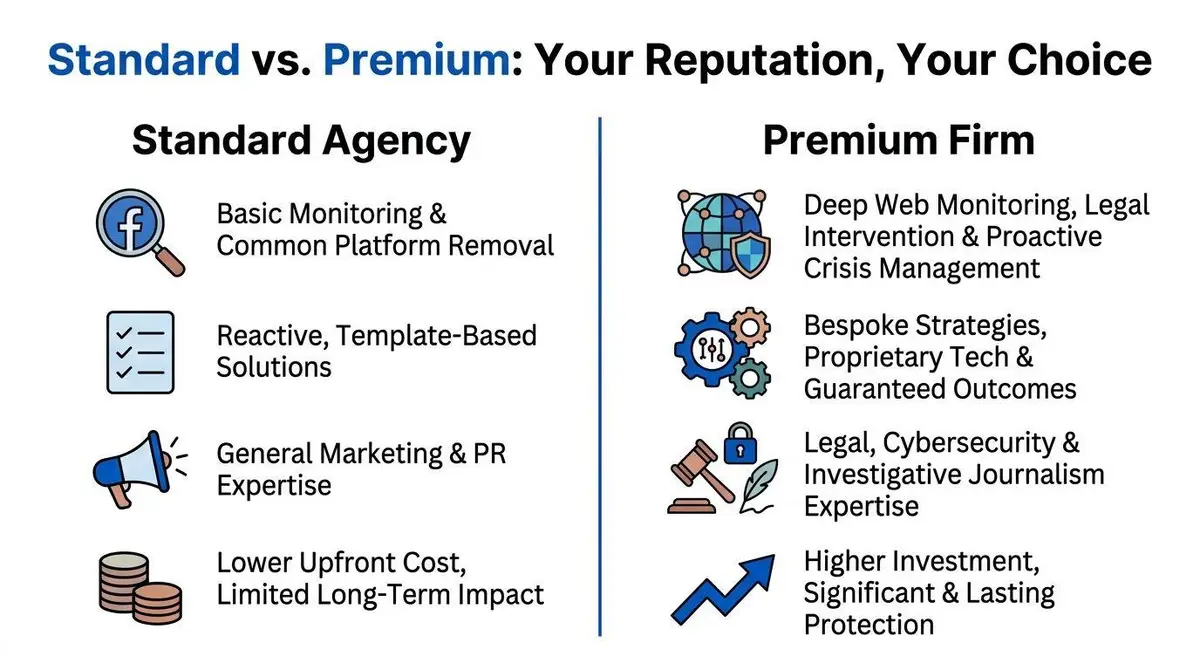
A premium online reputation management firm is built for hostile facts and limited room for error. Its starting point is source removal, de-indexing, account takedowns, host escalation, and control of copied or republished material across the online environment. Search suppression still has a role, but as a support measure, not the main event.
Suppression versus removal
Suppression changes what people see first. Removal changes what exists and what can continue to spread.
That distinction matters more in high-net-worth cases than clients expect. If a false article remains live, it can still be shared privately, cited by another publisher, found through platform search, scraped by data brokers, or reposted from a mirror domain. A lower ranking does not solve any of that. It only reduces casual visibility.
Removal work is narrower, harder, and more valuable. It examines whether the content is defamatory, unlawful, privacy-invasive, non-consensual, infringing, manipulated, or prohibited under platform rules. Then it pursues the right pressure point. Publisher, platform, host, registrar, search engine, or court-backed process. In premium engagements, the question is not how to dilute the result. The question is how to eliminate it at source and stop its return.
What separates the two models
| Issue | Standard agency | Premium firm |
|---|---|---|
| Primary objective | Reduce visibility in search results | Secure removal where possible, then contain any residual exposure |
| Core tactics | SEO content, PR placements, review replies | Legal notices, platform escalation, de-indexing, source takedowns, recurrence control |
| View of the problem | Branding issue | Asset protection and risk event |
| Team structure | Marketers and account managers | Legal strategists, technical operators, investigators, crisis advisors |
| Foreign jurisdiction issues | Deferred, outsourced, or ignored | Assessed at the start and managed as part of the core strategy |
| Measurement | Ranking gains and sentiment improvement | URLs removed, de-indexed, disabled, or prevented from resurfacing |
| Client fit | Local businesses and routine brand work | Executives, family offices, public figures, regulated entities |
The cross-jurisdiction point is where many firms fail. Harmful material is often hosted in one country, published through an entity in another, indexed globally, and copied onto servers with different compliance standards. A premium firm plans for that from the start. It knows which venues cooperate, which require formal process, which platforms respond to policy arguments faster than legal ones, and where a search remedy may be available even when a publisher refuses to engage.
That is what clients are paying for. Judgment under pressure, backed by removal capability.
Premium means outcome discipline
A premium firm speaks plainly. It identifies what can likely be removed, what can likely be de-indexed, what will require litigation support, and where suppression is only a fallback. It does not hide behind vague language such as “reputation enhancement” when the issue is extortion, defamation, impersonation, or exposure of private material.
The market for reputation services keeps expanding, as noted earlier. That growth has created more agencies, more software, and more noise. It has not created more firms capable of securing hard removals across borders.
My advice is simple. If a firm leads with content creation before it has assessed legal grounds, platform rules, host influence, and jurisdiction, it is selling comfort, not control.
My view: If a firm cannot explain, in plain language, how it handles source removal, de-indexing, mirror sites, and foreign-hosted content, do not hire it for a high-stakes matter.
The Arsenal of Advanced Removal Services
When clients hear “reputation management,” they often think of press releases, review responses, and search optimisation. That is entry-level work. Premium engagements involve a different set of tools because the problems are different.

Source removal of harmful content
The first priority is always the source. If a defamatory article, leaked file, false review cluster, or impersonation profile remains live, every downstream fix is weaker.
Premium firms begin by classifying the content. Is it false, private, manipulated, unlawful, non-consensual, infringing, or platform-prohibited? That classification determines the route. Some matters are won through platform policy. Others require formal legal grounds. Others need a hybrid approach that combines evidence preservation, notice drafting, and escalation.
Specialist operators differ from generic agencies here. They do not just file a report and wait. They build the takedown case around the platform, host, search engine, and jurisdiction involved.
Defamation and false content across borders
Cross-border cases are where weak firms fail. Harmful content rarely appears in the one country where your rights are strongest. It appears where the host is difficult, the site operator is anonymous, or the platform has limited incentives to act quickly.
A premium firm works through these variables in sequence:
- Jurisdictional mapping: Identify where the publisher, host, registrar, and target audience sit.
- Cause of action analysis: Determine whether the issue is defamation, privacy invasion, impersonation, copyright misuse, or another category.
- Enforcement route: Choose between direct notice, court-backed process, search engine request, or platform escalation.
- Recurrence control: Track mirrors, clones, and reposts that appear after initial action.
Some providers in this space handle only U.S.-centric suppression and avoid the harder legal questions. That is not enough for a family office with exposure in Europe, the United States, the Gulf, and Asia at the same time.
NCII deepfakes and image-based abuse
Leaked intimate material and synthetic sexual content require urgency and discretion. Delay is costly because replication is easy and the victim often loses control of the image trail within hours.
In these matters, premium service means acting on several fronts at once. Evidence must be preserved without amplifying distribution. Platform notices must be precise. Search visibility must be contained. Repeat uploads must be tracked. If a known actor is involved, legal pressure may need to run in parallel.
The same applies to manipulated media. A deepfake is not only a privacy issue. It can become an extortion issue, an employment issue, or a securities issue if the target is a listed-company executive.
A short industry explainer is useful here:
Impersonation and brand abuse
Impersonation work is often misunderstood. Clients assume the answer is to report the fake account. Sometimes that works. Often it does not, especially when the account has been built to look credible and the platform response queue is slow.
A premium response usually includes identity verification materials, trademark or personality-rights analysis where relevant, account-linkage review, preservation of deceptive messaging, and steps to reduce recurrence after the first takedown. That last point matters. Removing one account is not enough if the operator can recreate it with minor variations.
Dark web monitoring and remediation
This is one of the clearest dividing lines in the online reputation management firm premium category. Many agencies never look beyond search results. Serious operators do.
Dark web exposure may involve leaked credentials, private documents, passport scans, internal communications, extortion threats, or pre-publication sale of damaging material. The strategic value of monitoring is not voyeurism. It is early warning. If you know what is circulating before it reaches mainstream platforms, you retain options.
One factual example in the market is that ContentRemoval.com offers dark web monitoring and remediation as part of its service set for harmful material, leaked content, impersonation, and reputation threats. That belongs in the premium category because it addresses the source ecosystem, not just the public-facing symptom.
Operational advice: In a high-profile matter, ask not only “Can you take this down?” Ask “How will you stop the second and third upload?”
How Premium Firms Execute with Precision
Results do not come from one clever letter or one well-placed article. They come from a disciplined operating model. In strong firms, that model has three parts working together at all times: legal strategy, technical execution, and proactive monitoring.
Legal strategy first
Legal analysis is not a ceremonial prelude. It shapes everything that follows.
A premium team starts by identifying the strongest available basis for intervention. Defamation law may apply. Privacy law may apply. Terms of service may be more useful than either. A claim that is weak in one country may be stronger in another. A host may ignore a moral complaint and act immediately on a well-supported rights notice.
Cross-border judgement is the rare skill here. The firm must know when to pursue source removal, when to seek de-indexing, when to preserve evidence for later use, and when a direct platform escalation is more effective than litigation theatre. This is not glamorous work, but it is where outcomes are won.
Technical execution without theatrics
Once the legal basis is set, operators move. They identify every instance of the harmful material, including mirrors, derivatives, cached traces, reposts, and associated assets. They prepare platform-specific submissions. They manage communications so the client is not exposed to unnecessary back-and-forth. They document each step because repeat appearances are common.
Process maturity also matters here. A premium provider should be able to show you how an engagement runs from intake to action. If you want to understand what that operational sequence looks like, review the ContentRemoval.com process.
The strongest firms also know that not every platform behaves the same way. Search engines, social platforms, review sites, forums, image boards, and foreign publishers each have their own friction points. Treating them with one template is amateur work.
Monitoring that compresses response time
Monitoring is not an add-on. It is what prevents a contained issue from becoming a reputational spiral.
According to Meltwater’s discussion of online reputation management companies and monitoring capabilities, premium ORM firms use AI-powered sentiment analysis and continuous monitoring to achieve up to 95% faster response times than manual methods, allowing near real-time detection of negative content spikes across over a million sources. That matters because the first hours determine whether a threat gets indexed, syndicated, copied, and discussed, or whether it is intercepted early.
The practical consequence is simple. If a system detects a negative spike quickly, counsel can assess, operators can preserve evidence, and takedown efforts can begin before the issue hardens into a permanent search problem.
The three functions must work together
A legal team acting alone often moves too slowly for online propagation. A technical team acting alone often lacks the grounds needed for difficult removals. Monitoring without action merely creates more alerts.
That is why integrated execution outperforms siloed vendors. The legal side frames the argument. The technical side applies it platform by platform. Monitoring catches recurrence and narrows the response window the next time.
Selection shortcut: If one vendor handles “SEO,” another handles “legal,” and a third handles “monitoring,” expect delay, diluted accountability, and gaps at the handoffs.
Selection Criteria for a High-Stakes Engagement
When a client is under pressure, sales language becomes dangerous. Firms know how to sound reassuring. Your task is to test whether they can resolve the problem you have.

Questions that expose competence
Do not ask whether the firm is experienced. Every firm says yes. Ask questions that require substance.
- Removal track record: Ask what categories of content they handle at source. Defamation, fake reviews, impersonation, leaked media, mugshots, forum posts, and search de-indexing are different disciplines.
- Jurisdictional capability: Ask how they handle hostile publishers or foreign platforms. If they avoid the question, they are telling you their limits.
- Legal integration: Ask whether legal analysis is internal, tightly integrated, or outsourced after the fact.
- Recurrence management: Ask what they do after first removal to detect mirrors and reuploads.
- Confidentiality controls: Ask who sees the file, how communications are restricted, and how evidence is stored.
- Escalation logic: Ask what happens if the first route fails. Good firms always have a second and third route.
Cross-border enforcement is the test
Cross-border enforcement is the test. Many polished agencies collapse at this point. As noted in this discussion of premium ORM firms and cross-border enforcement challenges, EU right-to-be-forgotten requests succeed in only 45% of cases, and U.S. platforms often resist de-indexing without a court order. That is not a trivia point. It is a central due diligence question for any executive or principal whose name appears across multiple markets.
If a firm cannot explain how it approaches Europe differently from the United States, and how it handles publishers outside both, it is not ready for a high-stakes engagement.
What to reject immediately
Some red flags are disqualifying.
| Red flag | What it usually means |
|---|---|
| “We commit to every negative result disappears” | They are overselling or using imprecise language |
| Heavy focus on blogs, press releases, and “positive content assets” | They are built for suppression first |
| No clear answer on foreign enforcement | They lack jurisdictional depth |
| Confusion between de-indexing and deletion | They do not understand the remedy stack |
| Loose confidentiality language | They are not used to sensitive matters |
Buy judgement, not activity
High-net-worth clients often receive proposals packed with deliverables. Articles per month. Profile creation. SEO tasks. Reporting dashboards. Most of that is operational noise if the core issue is one damaging URL or one persistent impersonation attack.
You are not buying busyness. You are buying judgement under pressure. The right firm tells you which items matter, which are distractions, and which actions should be delayed to avoid making the problem more visible.
Due diligence rule: Ask each firm to describe, in writing, the first actions they would take in your exact fact pattern. General promises are useless. Specific sequencing is evidence of competence.
Understanding Timelines Pricing and Guarantees
Clients want three answers at the start. How fast can you act? What will it cost? What exactly are you promising?
Those are the right questions. They should be answered directly.
Timelines depend on the remedy
In premium matters, action usually begins fast, but completion depends on the type of target. A platform profile can move on one timetable. A search de-indexing request on another. A foreign publisher on another still.
The sensible way to think about timing is in phases:
- Immediate intake and assessment. Evidence is secured, risks are identified, and the remedy stack is chosen.
- Initial intervention. Notices, reports, escalations, and protective steps begin.
- Follow-through. Responses are tracked, resisted claims are escalated, and mirrors are addressed.
- Monitoring and prevention. The matter stays under watch after the first win.
Do not hire a firm that treats all content as if it moves at the same speed. It does not.
Pricing should reflect the case, not a generic package
Open-ended monthly retainers are common in SEO-heavy ORM. They are often a poor fit for removal-focused work because the client needs a defined outcome, not indefinite content production.
For high-stakes cases, project-based or scoped pricing is usually more rational. It aligns the fee with the actual target set. In some matters, success-based components may also make sense, but only when the definitions are precise. If you want a practical commercial framework, this professional pricing guide for content removal engagements lays out the variables clearly.
A guarantee must be specific
“Guaranteed results” is one of the most abused phrases in this market.
A legitimate guarantee is narrow and concrete. It relates to a defined target, a defined action, or a defined fee consequence if that action is not achieved. A vague promise that your reputation will be “restored” is not a guarantee. It is sales copy.
Use this filter:
- Credible guarantee: removal or de-indexing work tied to identified URLs or accounts, with clear terms.
- Non-credible guarantee: broad promises about search domination, complete clean-up, or universal platform compliance.
Confidentiality is part of the fee for a reason
In sensitive matters, confidentiality is not an extra service. It is part of the operating standard. Restricted communications, narrow contact chains, disciplined evidence handling, and careful outreach all consume time and judgement. They should.
The clients who regret their choice in this market usually chose the cheaper proposal that treated a private crisis like a routine marketing campaign. Price matters. Exposure costs more.
Your Action Plan for Securing Your Digital Legacy
If you are dealing with online harm now, do not spend the next week collecting opinions from people who do not remove content for a living. Move in sequence.
Start with a confidential audit
Look at your exposure as a principal would look at any other risk register. Search results, social platforms, review sites, image indexes, archived pages, impersonation vectors, and known hostile publishers all belong in scope. Do not rely on memory. Capture screenshots, URLs, dates, and any evidence of spread.
Separate noise from legal targets
Not everything offensive is removable. Not everything visible is strategically significant. You need a disciplined classification of what is false, private, manipulated, policy-violating, or unhelpful but lawful. That classification determines where to apply pressure and where to avoid wasted motion.
Engage a specialist before the matter spreads
The right time to bring in a premium firm is not after the issue has propagated across multiple platforms. It is at the point where speed still changes the result. The online reputation management firm premium category exists for that reason. Not to make you feel better, but to narrow the damage window and improve the odds of actual erasure.
Final counsel: Treat your digital footprint as part of your estate, not as a side issue. Names, companies, and families lose influence when they delay.
The strongest response is quiet, deliberate, and coordinated. Assess the exposure. Preserve the evidence. Then hand the matter to people who understand removal, cross-border influence, and recurrence control.
If you need a discreet next step, request a confidential assessment through ContentRemoval.com. A focused review of the harmful content, the jurisdictions involved, and the practical removal pathways will tell you quickly whether you are dealing with a suppressible nuisance or a matter that requires immediate specialist intervention.
Frequently asked questions
What is the difference between a premium reputation firm and a standard ORM agency?
A standard agency manages visibility: positive content, owned profiles, and pushing harmful pages lower. A premium firm secures removal where possible through legal notices, platform escalation, de-indexing, and source takedowns, assesses foreign jurisdictions at the start, and measures success in URLs removed, de-indexed, or prevented from resurfacing.
How do I vet a reputation management firm for a sensitive matter?
Ask which content categories they handle at source, how they approach hostile publishers or foreign platforms, whether legal analysis is integrated or outsourced, what they do after first removal to catch mirrors, who sees the file, and what happens if the first route fails. Then ask them to describe in writing the first actions for your exact fact pattern.
How long does premium content removal take?
It depends on the remedy. A platform profile, a search de-indexing request, and a foreign publisher each move on a different timetable. Expect phases: immediate intake and evidence capture, initial notices and escalations, follow-through on resisted claims and mirrors, then monitoring after the first win.