
An online reputation management agency in the UK should be judged on three pillars: suppression that displaces harmful material with authoritative assets, removal through platform enforcement, de-indexing, and legal process, and proactive defence that monitors for reuploads and AI resurfacing. The biggest gap in the UK market is firms selling suppression without any removal capability.
Key facts
- GDPR erasure rights can support de-indexing but are weighed against public interest, and public figures face a harder path
- UK defamation law requires serious harm, evidence, and an identifiable defendant, and can attract more attention than the post
- The Digital Markets, Competition and Consumers Act gives fake review activity real regulatory exposure
- Ask what the agency will do in the first 48 hours; if the answer is mostly content creation, look elsewhere
Where ContentRemoval.com comes in. ContentRemoval.com covers the removal pillar UK buyers most often find missing: evidence-led platform enforcement, de-indexing submissions framed on privacy or inaccuracy grounds, impersonation and false review takedowns, and monitoring for reuploads. UK executives, founders, and family offices usually make contact through their solicitor or a chief of staff. A free 15-minute Exposure Scan maps what is removable, and the report is yours to keep. Get a Free, Confidential Exposure Scan or read how our reputation management work is done.
You search your name, your company, or your product. A hostile article sits on page one. A fake review cluster has appeared overnight. A leaked image, an impersonation profile, or an old allegation now shows up before your own website. If you’re dealing with this, you don’t have a marketing problem. You have a digital risk problem with legal, commercial, and personal consequences.
Most advisers respond too slowly and with the wrong tools. A general PR firm wants to issue a statement. A conventional solicitor wants to send a letter. An SEO agency wants to publish blog posts and wait. None of that is enough when the material is already indexed, copied, screenshot, syndicated, or circulating on obscure forums.
That’s why choosing the right online reputation management agency uk matters. The question isn’t whether an agency can improve sentiment. It’s whether it can remove, contain, monitor, and defend under pressure.
Navigating a Digital Crisis
The first hours are usually chaotic.
An executive learns that a defamatory article has been republished by aggregators. A founder sees manipulated reviews drag down a launch. A family office discovers personal data on search and mirror sites. By the time internal teams discuss “brand response,” the damage is already public, searchable, and persistent.

Why ordinary responses fail
A press release doesn’t remove a search result.
A solicitor’s letter may be necessary, but it often lands after screenshots, reposts, and search indexing have already compounded the exposure. If the content sits on foreign hosting, anonymous domains, social platforms, review sites, or copied databases, legal rights alone won’t solve the operational problem.
The operational problem is this: harmful content spreads across multiple surfaces at once. Search. Reviews. AI-generated summaries. Forums. News syndication. Cached links. Social reposts. Sometimes the dark web. You need coordinated action, not siloed advice.
Practical rule: If harmful material is visible in search, assume it already exists in more than one place and act on removal, de-indexing, suppression, and monitoring in parallel.
The commercial stakes are obvious. The global online reputation management market is projected at USD 7.75 billion in 2026 and expected to reach USD 14.01 billion by 2031, with a 12.59% CAGR according to Mordor Intelligence’s online reputation management market analysis. The same source states that 97% of consumers read online reviews before making purchasing decisions, 31% require 4.5+ star ratings before engaging, and the UK’s Digital Markets, Competition and Consumers Act allows fines of up to 10% of global turnover for fake reviews. It also notes the FTC’s August 2024 enforcement framework with civil penalties of up to USD 51,744 per violation for fake testimonials and bot-driven manipulation.
This is a specialist brief
That scale tells you something important. Businesses and individuals don’t spend at that level because online criticism is mildly inconvenient. They spend because reputation now affects transactions, financing, hiring, partnerships, investor confidence, and private family security.
If your issue involves defamation, impersonation, false reviews, leaked material, or malicious indexing, instructing a specialist agency is not discretionary. It’s a form of risk containment. If the issue is already public, your first moves matter, and they need to be defensible. This guide on what to do if you are a victim of online defamation is a useful starting point because it treats the problem as a strategic incident, not a branding inconvenience.
A serious online reputation management agency uk should understand one fact from the outset. Your objective is not “more positive content.” Your objective is control.
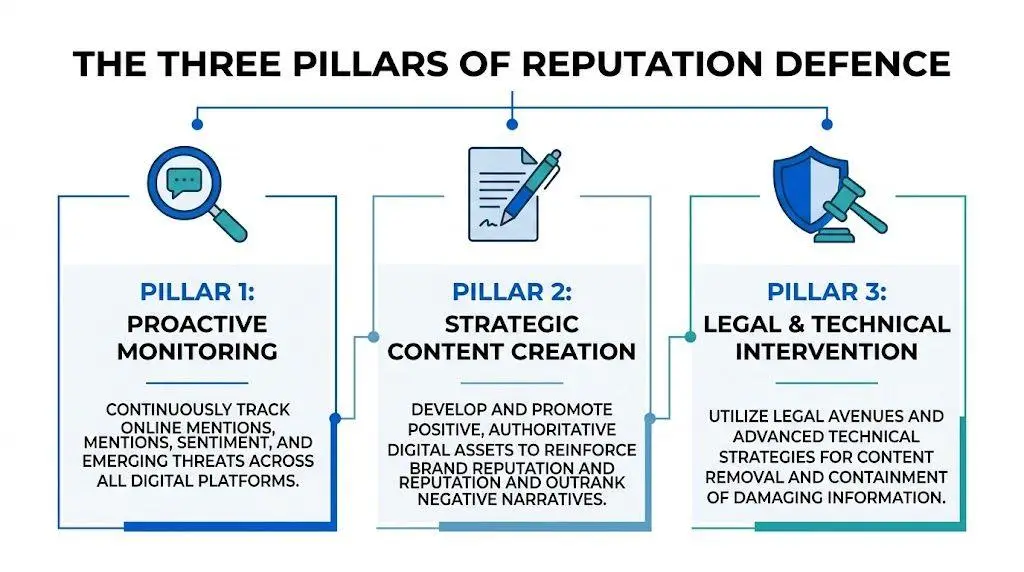
The Three Pillars of Reputation Defence
A proper reputation campaign rests on three pillars. If an agency can only do one of them, it’s incomplete.
Suppression
Suppression is controlled displacement. You build and strengthen assets you can influence so harmful material loses prominence.
That sounds simple. It isn’t. Effective suppression requires search intent mapping, entity alignment, profile consolidation, content architecture, digital PR placement, and often paid amplification of neutral or positive assets. The goal is to occupy the terrain someone else is using against you.
A weak agency publishes generic articles and hopes rankings improve. A competent one identifies which assets can realistically win branded search positions, then pushes them with discipline.
Think of suppression as building new walls around a property under attack. You’re not pretending the threat doesn’t exist. You’re reducing visibility and regaining control over what appears first.
Removal
Removal is the pillar most agencies underplay because it’s hard.
It requires platform-specific reporting, evidential packaging, privacy analysis, intellectual property arguments where available, defamation assessment, terms-of-service enforcement, and cross-border judgment about where to apply pressure first. Legal literacy is also important. So does technical fluency.
For high-stakes matters, removal is superior to mere suppression. If the material is unlawful, false, invasive, impersonating, intimate, stolen, or placed in breach of platform rules, the primary question should be whether it can be taken down or de-indexed at source. Too many agencies skip that and sell a long SEO retainer instead.
Removal is surgical. Suppression is strategic. You often need both, but you should never confuse one for the other.
Proactive defence
The third pillar is what protects you after the first fire is out.
Monitoring isn’t a vanity dashboard. It’s intelligence. It tells you where your name appears, where sentiment is shifting, whether a hostile actor has moved platforms, whether reuploads are happening, and whether an AI system is repeating a harmful narrative. For executives, public figures, and family offices, that intelligence should extend beyond mainstream search.
That includes closed communities, impersonation surfaces, domain abuse, and dark web exposure where relevant. If an agency doesn’t discuss persistent monitoring and reappearance risk, it’s treating your matter as a campaign rather than an ongoing threat environment.
How the pillars work together
You should expect these functions to run together, not in sequence.
- Suppression holds ground by improving what users and counterparties see first.
- Removal cuts out the source where law, privacy rights, platform rules, or technical process permit.
- Proactive defence prevents recurrence by detecting reposts, copies, and escalation early.
Here is the test I use when evaluating any online reputation management agency uk.
| Pillar | What a serious agency should do |
|---|---|
| Suppression | Build authoritative assets, improve prominence, and manage branded search visibility |
| Removal | Pursue direct takedowns, de-indexing, and platform enforcement with evidence-led process |
| Proactive defence | Monitor search, review, social, impersonation, and hidden-risk surfaces for recurrence |
If a firm talks only about “pushing down negatives,” it’s giving you one-third of the answer. That may be enough for a restaurant with scattered reviews. It isn’t enough for a board director, founder, regulated professional, or public figure.
The UK Legal and Regulatory Minefield
The UK gives you tools, but none of them work automatically. The law can help. It can also waste time if used without a digital enforcement strategy.

GDPR and de-indexing
For many clients, the first question is whether Google can be compelled to stop surfacing harmful results. In some cases, yes. GDPR rights, including the right to erasure, can support de-indexing requests where content is inaccurate, excessive, outdated, or unlawfully processed.
But GDPR is not a universal eraser.
Search engines weigh privacy rights against public interest, freedom of expression, and relevance. Public figures face a harder path. So do executives whose conduct may be framed as commercially relevant. A specialist has to know when GDPR is your strongest route and when it will fail.
That’s why a de-indexing request should never be drafted as a generic complaint. It should be framed as a legal and factual submission with evidence, chronology, and platform-specific reasoning. This guide to navigating online content removal laws is useful because it treats law as part of the campaign architecture, not as a detached academic exercise.
Defamation law is powerful but slow
UK defamation law can be effective. It can also be punishingly inefficient in a live reputation crisis.
You need to prove serious harm. You need evidence. You need a defendant you can identify and reach. You need to weigh whether proceedings will attract more attention than the original content. If publication is repeated across multiple domains or accounts, litigation against one actor may leave most of the practical damage untouched.
That doesn’t mean defamation law is irrelevant. It means it must be used selectively.
A good agency or legal team asks harder questions first. Is the publisher identifiable? Is there a clean takedown path under platform rules? Does the content contain personal data? Is there impersonation? Is there a hosting angle? Is there a terms breach? Can search visibility be reduced while legal steps proceed?
DMCC and the Online Safety Act
The UK regulatory climate has become more useful for rapid intervention than many clients realise.
The Digital Markets, Competition and Consumers Act changed the fake review situation. Agencies that still treat false review campaigns as a customer service annoyance are behind the market. Fake review activity now carries real regulatory exposure, which changes how review fraud should be documented and challenged.
The position is similar with harmful online content. As reported by The Independent’s coverage of UK reputation management firms in 2026, 68% of executives surveyed by Deloitte’s 2025 UK Reputation Report prioritise “permanent removal” over suppression, yet only 12% of top UK agencies highlight legal expertise or 24-48 hour action starts. The same report notes that GDPR and Online Safety Act updates effective in 2025 require platforms to remove harmful content within 24 hours.
The legal question is rarely, “Do you have rights?” The real question is, “Which right can be turned into a result fastest, with the least collateral exposure?”
That is the minefield. Rights exist. Procedures exist. Enforcement windows exist. But if your agency can’t convert them into platform action, de-indexing, containment, and recurrence prevention, those rights stay theoretical.
Anatomy of a Reputation Management Campaign
Clients under pressure want two things immediately. They want the problem contained, and they want to know what happens next.
A professional campaign should feel structured from the first call. Not theatrical. Not vague. Structured.
The first assessment
The opening phase is confidential and forensic.
You identify the harmful assets, who controls them, where they rank, whether they’ve been mirrored, what legal rights may apply, and whether the matter is likely to spread. You also separate noise from actual risk. Not every insult matters. A leaked document, false review cluster, or impersonation page does.
The output should be a risk map, not a sales deck.
The action plan
Once the threat is mapped, the agency should set an order of operations.
Some items need immediate platform escalation. Some need search de-indexing requests. Some need legal correspondence. Some need suppression assets built and promoted so the visible content starts changing while removal work is underway.
At this stage, timelines matter. According to Superhub’s review of top UK reputation management agencies in 2026, technical SERM workflows in UK ORM agencies combine digital PR, SEO, and legal takedowns to control 70-90% of page-one results, with negative content demotion associated with a 25-40% uplift in positive sentiment scores within 3-6 months. The same source states that for ContentRemoval.com clients this translates to 24-48 hour initiation of de-indexing and suppression, supported by AI monitoring to prevent reuploads.
That is the right model. Immediate containment first. Longer-cycle search and sentiment work running in parallel.
Execution is never one-track
A serious campaign doesn’t wait for one channel to finish before using another.
You should expect at least three workstreams moving at once:
- Removal workstream involving platform reports, legal notices, privacy submissions, and evidence packets.
- Search control workstream focused on assets that can outrank, absorb, or neutralise branded-query damage.
- Monitoring workstream tracking recurrence, new mentions, reposts, and movement onto secondary platforms.
Many agencies fail here. They serialise a problem that should be handled concurrently. Every week lost allows more indexing, more screenshots, more citations, and more AI summarisation of the same hostile material.
Reporting should be decision-grade
You don’t need vanity PDFs. You need reporting that lets you make decisions.
That means clear status updates on what has been removed, what is pending, what has been refused, what has improved in search, and where recurrence risk remains. The best reporting also distinguishes between visible progress and hidden progress. A successful host escalation may matter more than a new positive article.
Here’s what clients should expect from campaign reporting:
| Stage | What you should receive |
|---|---|
| Initial assessment | Threat inventory, risk priorities, and immediate action recommendations |
| Active campaign | Status by asset, platform action updates, search visibility movement, and next-step decisions |
| Ongoing protection | Monitoring summaries, recurrence alerts, and strategic adjustments |
Ask one blunt question at the start: “What will you do in the first 48 hours?” If the answer is mostly content creation, you’re speaking to the wrong firm.
A proper engagement moves from panic to managed control. Not because the internet becomes fair. It won’t. But because the campaign is run as a pressure-tested operation rather than a branding exercise.
Vetting Your UK Agency Beyond the Sales Pitch
Most agencies are easy to spot once you know what to ask.
If they promise permanent removal of everything, they’re overstating. If they avoid legal process, they’re incomplete. If they recommend aggressive tactics they can’t defend, they’re dangerous. Your objective isn’t to hire confident people. It’s to hire people who can operate lawfully, discreetly, and effectively across hostile platforms.
The industry gap you need to test for
The biggest weakness in the UK market is simple. Too many firms sell suppression without removal capability.
That’s a poor fit for defamation, leaks, impersonation, private images, or material that keeps getting reposted. As noted earlier in reporting on the UK market, executives prefer permanent removal, yet few agencies foreground legal expertise, fast action starts, or reupload prevention. That gap is where serious buyers should focus.
A useful way to frame your approach is to borrow procurement discipline from adjacent digital services. This short guide on how to choose an agency isn’t about reputation work specifically, but its logic is sound: examine process, evidence, communication quality, and fit under pressure. For reputation matters, apply that standard more aggressively.
Questions that expose real capability
Use a checklist. Don’t rely on chemistry.
| Category | Question to Ask |
|---|---|
| Legal removal | What categories of content can you pursue for source removal rather than suppression alone? |
| De-indexing | Who drafts de-indexing submissions, and how do you decide between privacy, inaccuracy, and platform-rule arguments? |
| Review fraud | How do you handle fake reviews when platform reporting fails? |
| Impersonation | What is your process for false profiles, cloned accounts, and domain abuse? |
| Leaks and intimate content | How do you handle urgent removal where privacy and safety are at stake? |
| Dark web exposure | Do you monitor beyond standard search and social surfaces? If so, what triggers escalation? |
| Reuploads | What is your process after a successful takedown to stop the same material resurfacing? |
| Jurisdiction | How do you adapt strategy when the host, publisher, platform, and subject are in different countries? |
| Confidentiality | Who sees my file, how is evidence handled, and what can be kept off ordinary email? |
| Reporting | What will I receive weekly, and what decisions will those reports enable? |
Red flags that should end the conversation
Some warning signs are decisive.
- Guaranteed universal removal means they’re selling certainty they don’t control.
- SEO-only recommendations for obviously unlawful or invasive content mean they lack takedown depth.
- No discussion of dark web or repost risk means they’re solving the first publication, not the continuing threat.
- Opaque methods usually hide weak process or risky tactics.
- No specific jurisdiction analysis is unacceptable for cross-border matters.
If you want a more focused framework for evaluating specialist providers, this guide to evaluating professional content removal services is worth reviewing before any engagement call.
You’re not hiring a cheerleader. You’re hiring a firm to regain control where harm is public, searchable, and potentially compounding. Treat the selection process accordingly.
Measuring Success and Ensuring Long-Term Resilience
A reputation campaign succeeds when the visible risk drops, the source risk is reduced, and recurrence becomes manageable.
That means measurement has to go beyond “we published some positive content” or “we sent notices.” Process isn’t the same as outcome.
What success actually looks like
Success usually shows up in a small set of indicators.
Search results become less hostile. Harmful assets are removed or de-indexed where possible. Review integrity improves. Branded-query visibility becomes more controlled. Internal stakeholders stop firefighting because the issue is contained.
The most useful measurements are practical:
- Quality of search results across your branded results
- Sentiment direction across visible high-impact surfaces
- Removal progress by asset type and platform
- Recurrence risk after takedown or de-indexing
- Commercial impact signals such as whether key counterparties keep encountering harmful material
AI has changed the standard
Reputation is no longer limited to ten blue links.
According to Whitehat SEO’s analysis of AI-driven online reputation repair, consumer adoption of AI tools for business recommendations rose from 6% in 2025 to 45% in 2026, and only 30% of brands maintain consistent visibility across consecutive AI responses. That volatility matters because users increasingly ask platforms such as ChatGPT, Gemini, and Perplexity what they should think about a company, executive, or provider.
That changes the resilience standard.
A brand may look stable in traditional search but still be vulnerable if AI systems keep surfacing stale allegations, poor review themes, or fragmented identity signals. Monitoring now has to include what AI systems infer and repeat, not just what Google indexes on a given day.
The future-proofed brief is simple. Remove what you can. Suppress what you must. Monitor everything that can reappear or be reinterpreted by AI.
Long-term resilience is a standing function
For high-value clients, resilience should be treated like cyber hygiene or legal risk management.
The campaign may begin with a crisis, but the long-term posture should include persistent monitoring, periodic audit, profile consolidation, review integrity controls, impersonation checks, and readiness to act when harmful material resurfaces. The threat environment changes too quickly for one-off fixes to hold indefinitely.
That’s the difference between recovery and control. Recovery gets you through this incident. Control reduces the odds that the next one gets traction.
Frequently Asked Questions
How quickly should an agency act after I report a problem
Immediately. High-risk matters degrade fast because content gets indexed, copied, quoted, and reposted. The right agency should triage the issue at once and set first actions without waiting for a full branding workshop.
Can an online reputation management agency uk remove anything from the internet
No. Any firm claiming that is overstating its power. What a serious agency can do is assess whether removal, de-indexing, suppression, or a combined strategy is realistic for the specific content, platform, and jurisdiction involved.
Is suppression enough on its own
Sometimes, for low-grade criticism or dated but lawful material. Not for leaks, impersonation, false allegations, intimate content, or repeat abuse. In those matters, suppression without removal leaves the core threat intact.
Do I need a law firm or an agency
Often you need both capabilities in one coordinated strategy. Legal rights matter, but rights without digital execution are slow. Pure marketing support is also inadequate where privacy, defamation, impersonation, or platform enforcement are central.
Should I worry about confidentiality
Yes. You should ask exactly how evidence is handled, who has access to your matter, and how communications are secured. Discretion isn’t a courtesy in this field. It’s part of risk control.
What if the content comes back after it’s removed
That risk is real. Reuploads, mirror posts, screenshots, and copied text are common. You need monitoring and repeat-response procedures, not just a one-time takedown request.
Are UK agencies always UK-based
No, and that matters if you want rapid access to people who understand UK law, platforms, and media context. If supplier geography is relevant to your diligence process, even simple checks can help. For example, this FAQ on Is Kogifi a UK company? shows the kind of basic jurisdictional verification buyers often overlook when hiring digital service providers.
How do I know whether my issue needs urgent intervention
Treat it as urgent if the material involves allegations of misconduct, private information, fake reviews, impersonation, leaked images or video, or anything that could affect banking, transactions, employment, regulation, or personal safety. Delay helps the publisher, not you.
If you need legal-grade help with online content removal, de-indexing, false review takedowns, impersonation, leaks, or reputation monitoring, speak to ContentRemoval.com for a confidential assessment and a clear action plan.