
An online reputation fix starts with one decision for each harmful asset: can it be removed, or must it be suppressed. Removal fits content that breaks law, platform policy, or ownership rights. Suppression fits lawful but damaging material such as old press or public records. Audit quietly in the first 72 hours, remove the removable, and outrank the rest.
Key facts
- Removal candidates: impersonation, stolen media, doxxing, intimate imagery, fake reviews, and provable defamation
- Escalation ladder: preserve evidence, platform submission, publisher outreach only if useful, counsel demand, court action
- Suppression stack: owned pages, LinkedIn, third-party bios and interviews, current commentary, and directory profiles
- AI search summaries pull from the whole source pool, so entity consistency and source diversity now matter
Where ContentRemoval.com comes in. ContentRemoval.com runs both tracks in parallel: evidence capture, platform submissions, de-indexing requests, and legal-basis removals for content that should not exist, alongside suppression architecture for what will stay online. Executives, brands, and public figures typically make contact through a chief of staff or general counsel once a board member or investor has seen the result. A free 15-minute Exposure Scan maps what is removable, and the report is yours to keep. Get a Free, Confidential Exposure Scan or read how our reputation management work is done.
You usually learn there’s a reputation problem the wrong way. A board member forwards a search result. A prospective investor goes quiet. A journalist emails with a link you hadn’t seen. By the time the issue becomes visible to you, it has often already been visible to everyone else who matters.
That’s why a serious online reputation fix starts with one decision, not ten. You need to determine whether the harmful material can be removed or whether it must be suppressed. Most advice online skips that distinction and jumps straight to “post more positive content.” That’s amateur work. If a page is removable, suppression wastes time. If it isn’t removable, legal threats often make the problem worse.
The right response is clinical. Audit first. Classify each asset. Remove what can be removed. Outrank what can’t. Then build a defensive layer that prevents the next incident from becoming another emergency.
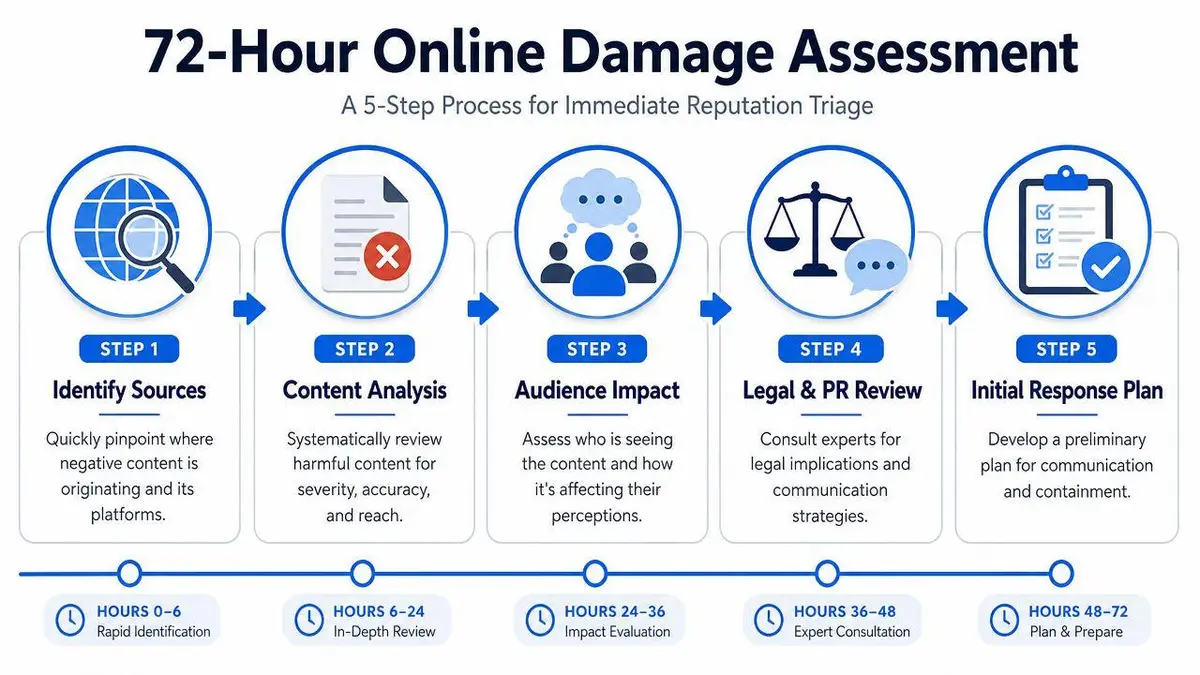
The Initial 72-Hour Damage Assessment
The first three days matter because panic produces bad decisions. Executives call the publisher too early, argue in public, or trigger fresh coverage by trying to swat at a story before they understand its reach. The correct move is to build a private map of the problem.
Consumer behavior explains why speed matters. Independent industry reporting cited by Nadernejad Media’s online reputation management statistics roundup says 84% of people trust online reviews as much as personal recommendations, 90% of customers read reviews before visiting a business, and only 5% of internet users look past the first page of search results. If the damaging material is visible, it is already influencing decisions.
Build the threat matrix
Start with a disciplined audit, not a casual search. The practical baseline is straightforward: search the brand in incognito mode across Google, Bing, major review sites, and social platforms, then document each asset by URL, sentiment, domain authority, and current ranking, as described by Curogram’s reputation strategy guidance. That becomes your measurement system.
Use a spreadsheet or case log and create columns that matter:
- Asset type: review, news article, social post, forum thread, leaked file, court record, video, profile, data broker listing.
- Visibility: direct rank for your name, rank for your company, image search presence, autocomplete association.
- Control status: owned by you, owned by a platform, owned by a publisher, anonymous source, syndication network.
- Risk profile: reputational, legal, commercial, privacy, security.
Don’t stop at your exact name. Search common misspellings, executive names, old company names, product names, and combinations with words like “lawsuit,” “scam,” “arrest,” “fraud,” or “complaint.” Search images and videos separately. Search social platforms directly, because platform search often reveals material Google hasn’t surfaced yet.
Audit quietly
Run the audit from incognito mode. For high-stakes matters, check from more than one location and device so you can see if results vary. Search exposure is often inconsistent across regions and user histories, and bad actors know that.
Practical rule: Never contact a hostile publisher, poster, or platform before you’ve captured screenshots, URLs, timestamps, and ranking positions.
A competent triage file also records whether the content is static or spreading. One negative article is one problem. A negative article copied into aggregator sites, Reddit threads, YouTube commentary, and AI-generated summaries is a different problem entirely.
For ongoing visibility, use a dedicated reputation monitoring system, not just inbox alerts. You need alerts tied to names, brands, executives, and recurring threat terms, plus a review cadence that someone is responsible for.
What to decide in the first 72 hours
You’re not trying to solve the whole crisis immediately. You’re deciding three things:
- What is causing actual damage right now
- What is likely to spread next
- Which items qualify for removal instead of suppression
That last point determines everything that follows.
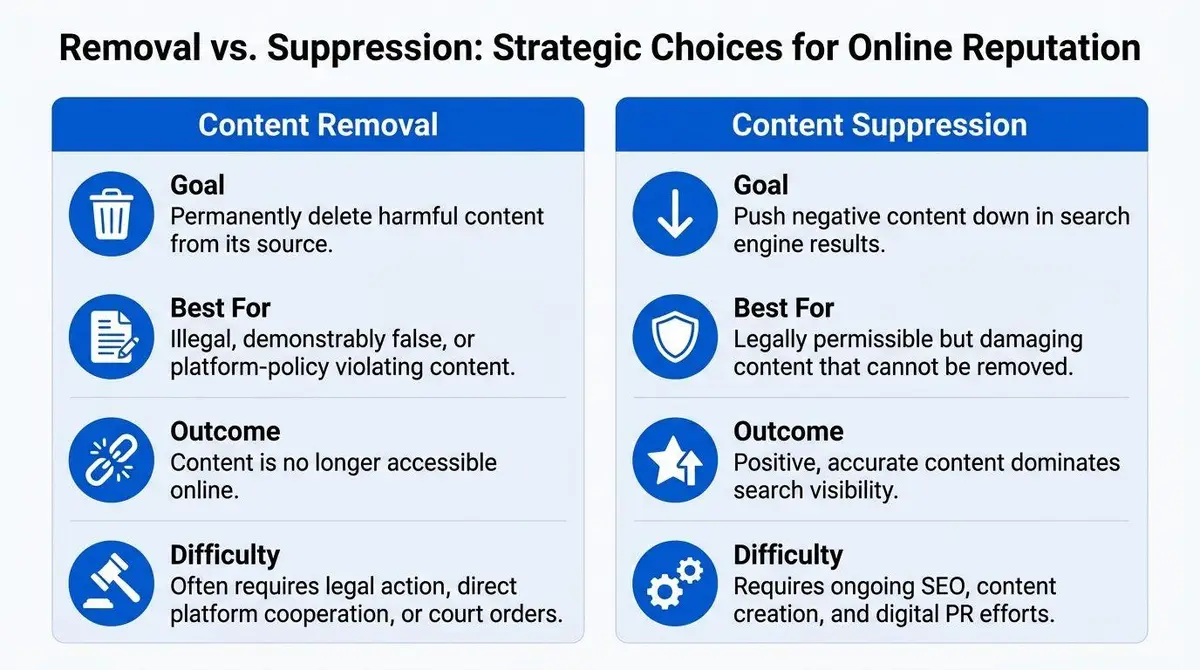
The Critical Decision Removal Versus Suppression
This is the fork in the road. Most failed reputation campaigns fail here because they treat every negative result as an SEO problem. It isn’t. Some content belongs in a takedown workflow. Other content belongs in a search displacement campaign. Confuse the two and you lose time, money, and your advantage.
Guidance on this issue is still weak. THM2G’s discussion of damaged online reputation repair correctly identifies a neglected issue: public advice often focuses on positive content, review responses, and SEO, but doesn’t answer the harder question of when negative material is genuinely removable. That distinction is the core of professional decision-making.
When removal is the right move
Removal is appropriate when the content violates law, policy, or ownership rights. Typical examples include impersonation, stolen copyrighted material, doxxing, non-consensual intimate imagery, fabricated reviews that violate platform rules, and defamatory claims where the legal standard can be met.
Here is the practical test:
| Question | If yes | If no |
|---|---|---|
| Does the content violate a platform policy? | Pursue platform removal | Move to next question |
| Does it infringe copyright or misuse owned media? | Use a rights-based takedown path | Move to next question |
| Is there a legal basis strong enough to support court-backed action? | Treat as removal case | Move to next question |
| Is the content lawful, accurate, or protected opinion? | Suppression is likely the durable path | Keep analyzing context |
Removal is attractive because it targets the source. If successful, it prevents the content from continuing to rank, spread, or feed secondary mentions. But removal also demands evidence, precision, and patience. Empty threats rarely work.
When suppression is the right move
Suppression is for material that is damaging but legally durable. That includes old press coverage, outdated controversies, critical commentary, lawful reviews, and public records that can’t realistically be erased. In those cases, trying to “get it taken down” is often futile.
If the content is legal and the publisher has every right to keep it live, your job is to control visibility, not argue about fairness.
A suppression campaign accepts that the page may stay online. The objective is to make it harder to find, less central in search, and less influential in AI summaries. That means replacing a vacuum with better assets: official sites, executive profiles, interviews, third-party coverage, social profiles, and highly relevant pages that search engines trust more for branded queries.
The decision framework professionals use
Use this sequence with every harmful asset:
- Legal status. Illegal, infringing, defamatory, privacy-invasive, or policy-violating.
- Publisher posture. Cooperative, indifferent, anonymous, adversarial, or extortionary.
- Search footprint. Isolated page, entrenched ranking page, or syndicated across multiple domains.
- Narrative durability. One-off issue, recurring allegation, or identity-defining search association.
The goal isn’t to pick one strategy for the whole crisis. It’s to assign the right strategy to each asset. In serious matters, you’ll often run both tracks at once. Remove the removable. Suppress the rest.
Executing Legal and Platform-Based Removals
A takedown succeeds or fails long before anyone clicks “submit.” The difference is usually the quality of the record. Filings often consist of emotional complaints. Platforms and hosts respond to structured evidence tied to a specific rule, a specific right, and a specific remedy.
Build the file before you make contact
For each target URL, assemble a package that includes archived captures, screenshots, publication dates, author details if available, account handles, and a concise explanation of the violation. If there are duplicates, map them. If the same material has been reposted, document the chain. If the content impersonates you or misuses your image, gather proof of identity and original ownership.
Then isolate the removal basis. Don’t mix arguments unless they apply. A rights claim should read like a rights claim. A harassment report should read like a harassment report. A defamation matter should be built with legal counsel around provable falsity, not anger.
Match the demand to the platform
Platforms enforce their own categories. If you report impersonation, show the impersonation. If you claim harassment, show repeated targeted conduct. If you allege copyright infringement, identify the original work and the unauthorized use precisely. Vague complaints are easy to close.
A professional removal demand differs from a user-level report in three ways:
- It anchors the complaint to the exact policy or legal basis
- It includes evidence in the format the decision-maker can verify quickly
- It asks for a specific action, such as source removal, account suspension, or de-indexing
For search visibility issues, there’s a separate layer to consider. Even if a source page remains live, search engines may have processes for de-indexing in narrow circumstances. That is a strategic lane of its own, and this guide to removing a Google search result for executives outlines that distinction well.
Don’t escalate clumsily
Many clients worsen their own cases by sending aggressive emails to publishers, threatening lawsuits they won’t file, or publicizing the dispute. That approach gives adversarial parties material to publish and turns a contained issue into a live conflict.
Use a narrower escalation ladder:
- Quiet evidence preservation
- Platform or host submission under the correct policy
- Direct publisher outreach only if it serves a purpose
- Counsel-led demand if the legal basis is real
- Court-backed enforcement if the facts justify it
Bad takedown requests don’t just fail. They educate the other side and give them time to harden their position.
Know what a win looks like
A source removal is ideal. A de-indexed URL may still be useful. An account suspension can cut off future reposting. In some cases, the victory is partial but still decisive because it removes the asset from branded search, limits indexing, and interrupts syndication.
That’s why legal and platform removals should be handled as targeted operations, not customer service tickets.
Mastering Digital Suppression and SERP Control
A damaging page can stay live and still lose practical influence. That is the point of suppression. You are competing for what appears first, what looks credible, and what both search engines and AI systems choose to summarize.
The priority is branded search. Reputation X’s online reputation management statistics cite the concentration of clicks at the top of Google and Google’s dominant share of search usage. For reputation repair, that means one thing. If negative content ranks high for your name, title, or company, it controls discovery until you displace it.
Build the controlled asset stack
Start with assets you control completely. For an executive, that usually means a personal website, a strong executive bio on the company site, a fully built LinkedIn profile, selected social profiles, and a publishing hub for articles, statements, or commentary that can rank under branded queries.
Then add independent validation. Search engines rarely reward self-authored praise on its own. They rank corroboration. You want conference bios, association profiles, podcast appearances, interviews, contributed articles, speaking pages, and reputable third-party profiles that repeat the same identity signals.
Use each asset for a specific job.
| Asset class | Role in suppression |
|---|---|
| Owned website pages | Hold branded relevance and capture name-based searches |
| LinkedIn and core profiles | Rank for entity queries and reinforce identity |
| Third-party bios and interviews | Add credibility from independent domains |
| Newsworthy commentary and articles | Replace stale narratives with current material |
| Review and directory profiles | Occupy commercial-intent branded searches |
Publishing volume is not the goal. Rank pressure is. Build assets on domains that already carry authority, optimize them for the exact branded terms under attack, and support them with internal links, external links, and consistent entity information.
Treat suppression like search warfare
Public relations alone usually fails here. A flattering feature that never reaches page one does not help. Suppression works when technical SEO, digital PR, content structure, and link acquisition are managed as one campaign.
Set target queries first. Then assign a target page to each query, strengthen on-page signals, and push links toward the pages most likely to outrank the problem result. Track movement weekly. If an asset stalls, revise it, expand it, or replace it.
If you want a practical reference for how authority compounds through structured search work, Pait Digital on SaaS SEO is useful even outside the SaaS context. For a reputation-specific analysis, this guide on methods to suppress negative content and restore digital authority explains how to push entrenched results lower with intent.
AI summaries changed the target
Page-one control is no longer enough. AI-generated search summaries can pull from multiple sources and restate an old accusation, dispute, or controversy even after the original article drops lower in the results.
That changes the standard. You are no longer managing only ten blue links. You are managing the source pool that trains the summary layer users see before they click.
Your suppression plan needs three additions:
- Source diversity. One polished bio will not carry this. AI systems look for repeated signals across multiple trusted sources.
- Entity consistency. Titles, company descriptions, achievements, and core biographical facts need to match across your website, LinkedIn, company pages, media profiles, and third-party bios.
- Narrative replacement. If outdated allegations still exist online, publish stronger current materials that give search engines and answer engines fresher, more authoritative context to cite.
A weak suppression campaign lowers one bad result. A strong one changes the dominant narrative across search results, knowledge panels, and AI-generated summaries.
That is how SERP control protects reputation.
DIY Repair vs Specialist Engagement
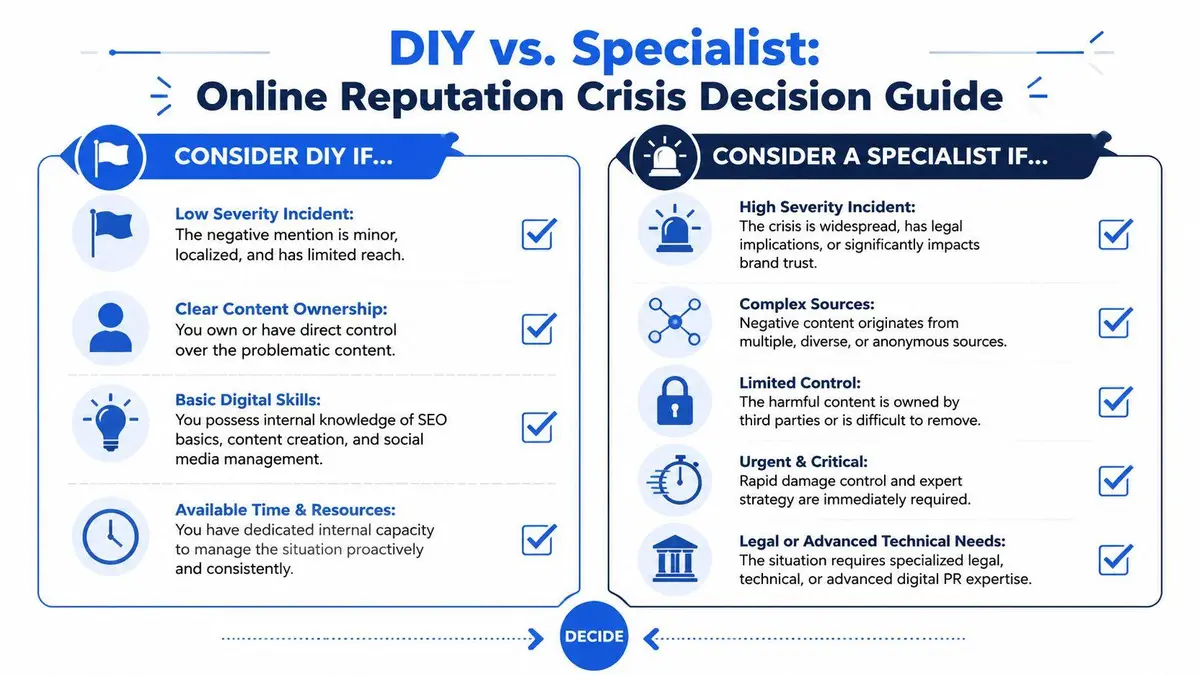
Some reputation issues can be handled internally. Most executive-grade crises should not be. The deciding factor isn’t confidence. It’s exposure.
If you’re dealing with one inaccurate review on a platform you know well, a measured response and a standard policy report may be enough. If the issue involves multiple domains, anonymous operators, legal ambiguity, mainstream media, impersonation, leaks, or repeat reuploads, internal teams usually lack the right mix of legal analysis, platform fluency, investigative discipline, and search control.
When internal handling is reasonable
An in-house team can often manage a contained issue when the facts are simple and the stakes are limited.
- Single-platform problem. One review cluster, one mistaken listing, one outdated profile.
- Clear ownership path. You control the account, the page, or the directory profile.
- No legal edge. There’s no allegation of defamation, extortion, privacy invasion, or rights misuse.
- Low search visibility. The material isn’t dominating branded queries.
In those cases, discipline matters more than outside firepower. Respond carefully. Document everything. Don’t improvise.
Red flags that justify specialist involvement
The situation changes fast when the problem becomes adversarial or technically layered.
- Multiple hostile sources. A coordinated attack across forums, social, reviews, and cloned sites.
- Identity abuse. Impersonation, fake profiles, fabricated statements, or manipulated media.
- Legal complexity. Defamation claims, stolen content, privacy violations, threats, or extortion.
- Search entrenchment. Negative material ranking prominently for your name or company.
- AI resurfacing. Harmful narratives appearing in generated answers despite lower page visibility.
Specialist support ceases to be discretionary. It becomes risk containment. A firm that works in removal and digital threat response can run parallel tracks across evidence capture, legal analysis, platform submissions, de-indexing requests, and suppression architecture. For example, ContentRemoval.com handles content removal and reputation protection workflows that include source removal, de-indexing, and ongoing monitoring. In a complex matter, that kind of integrated response is operationally useful.
The hidden cost of getting it wrong
A failed DIY effort can make the issue larger. This is the inherent danger. If you contact a publisher badly, they may update the article. If you threaten litigation without substance, they may publish your threat. If you report an issue under the wrong policy category repeatedly, platforms may ignore later submissions that are better grounded.
The harsh reality is simple. The higher your profile, the less room you have for trial and error.
Building a Long-Term Reputational Firewall
Six months after a cleanup, a board member searches your name before a vote. The old article is gone from page one, but an AI summary still compresses your story into a distorted accusation and a dated controversy. That is what weak reputation repair looks like. It solves the last incident and leaves you exposed to the next synthesis of it.

A long-term firewall has one job: make future attacks harder to publish, harder to rank, and harder for search engines and answer engines to summarize as truth. That requires structure, not occasional cleanup.
What a real firewall includes
Build three layers.
First, monitor the full exposure surface: branded search results, social platforms, review sites, forums, data leaks, impersonation channels, and AI-generated search summaries. If you only watch traditional rankings, you will miss the version of the story that users now see first.
Second, keep publishing controlled and credible third-party material even during quiet periods. In this context, the removal versus suppression framework becomes permanent policy. Removal handles content that should not exist. Suppression protects against content that will remain visible somewhere and must be outranked, diluted, or displaced before it hardens into the dominant narrative.
Third, lock in an escalation plan before the next hit lands. Define decision rights early so the response starts in minutes, not days.
That plan should answer five questions:
- Who reviews alerts first
- Who owns legal review
- Who approves public statements
- Which outside providers are activated
- Which assets are protected first
Without those answers, every incident burns time at the exact moment time matters most.
Monitor for the next version of the problem
Search has changed. Monitoring now has to cover not just what ranks, but what gets quoted, summarized, and repeated by AI systems. A clean page one can still produce a dirty answer box if the underlying web contains enough stale, hostile, or ambiguous material.
Treat AI summaries as a separate risk category.
Review prompts tied to your name, your company, your executives, and any disputed event. Track whether answer engines pull from old press coverage, complaint sites, low-quality blogs, or forum threads that no longer rank well but still remain crawlable. If a false or unfair narrative keeps resurfacing in summaries, your fix is not finished. You need stronger source control, better entity signals, and fresher high-authority content that gives machines better material to synthesize.
The strategic question is no longer only what ranks. It is what search engines and AI systems feel confident repeating.
Keep the narrative current
Strong reputation defense depends on recency. If your digital footprint goes quiet, old criticism gains relative weight. Keep executive bios current. Update leadership pages after major transactions, appointments, awards, speaking appearances, litigation outcomes, or philanthropic work. Maintain verified profiles. Secure legitimate coverage and references that reinforce the facts you want associated with your name.
Do not publish filler. Publish assets that hold ranking power and carry credibility.
The goal is larger than a cleaner search result. You are building an identity layer that can absorb pressure, feed accurate signals into search and AI systems, and reduce the odds that the next attack defines you before you can respond.
If a harmful result, article, leak, review cluster, or AI-generated summary is already affecting how investors, clients, or counterparties see you, waiting is a strategic mistake. ContentRemoval.com works on confidential assessments for executives, brands, and public figures who need a removal-first or suppression-first action plan grounded in the actual facts of the case.
Frequently asked questions
How do I know if negative content can be removed or only pushed down?
Run the test in order: does it violate a platform policy, does it infringe copyright or misuse owned media, is there a legal basis strong enough for court-backed action. If all three are no and the content is lawful, accurate, or protected opinion, suppression is the durable path and removal demands will likely fail.
What is the first thing to do when I find damaging search results about me?
Audit quietly from incognito mode across Google, Bing, review sites, and social platforms, logging each asset by type, visibility, control status, and risk. Search misspellings, old company names, and combinations with words like lawsuit or scam. Capture screenshots, URLs, and rankings before contacting any publisher or platform.
Why does an old accusation still appear in AI search summaries after the article dropped?
AI summaries draw from multiple sources and can restate a dispute even when the original page ranks lower. The fix is source diversity, consistent titles and biographical facts across your website, LinkedIn, and third-party profiles, and fresher authoritative content that gives answer engines better material to cite.