
An online content removal lawyer combines legal analysis, technical execution, and negotiation to remove, de-index, or constrain harmful content without amplifying it. Because the United States has no single removal statute, the work draws on defamation, privacy torts, copyright, injunctions, and platform policy, sequenced from the shortest path to reduced visibility toward stronger enforcement if needed.
Key facts
- Preserve screenshots, URLs, timestamps, and ranking context before any outreach to a publisher or platform
- Copyright notices move fastest when the rights are real; a weak or dishonest DMCA notice destroys credibility
- Cross-border cases involve three layers: victim location, publisher location, and hosting or registrar location
- The 2014 CJEU right to be forgotten ruling turned search de-indexing into a formal legal remedy
Where ContentRemoval.com comes in. ContentRemoval.com runs the de-indexing, source removal, and monitoring workflows that sit alongside legal counsel when a matter needs both enforcement and visibility control. Outside counsel often brings the firm in directly, or the executive’s chief of staff makes contact after a first notice has stalled. A free 15-minute Exposure Scan maps what is removable, and the report is yours to keep. Get a Free, Confidential Exposure Scan or read how our reputation management work is done.
The call usually comes after midnight, or just before a board meeting. An executive searches his own name and finds a false accusation, an old arrest report that no longer reflects reality, a leaked file, or a post designed to humiliate him at the exact moment investors, lenders, clients, or family members are looking. He has already made a common initial error. He clicked, panicked, and considered emailing the publisher himself.
That’s when matters either get contained or get worse.
An online content removal lawyer isn’t a cosmetic fix. In a serious matter, this lawyer is the person who stops impulsive moves, preserves evidence, chooses the pressure point that actually matters, and turns a chaotic online attack into a controlled enforcement strategy. If your name, company, or family is exposed online, the issue isn’t whether the content is upsetting. The issue is whether it can be removed, deindexed, constrained, or neutralized without amplifying it.
Your First Move When Harmful Content Surfaces
A managing partner at a private investment firm opens a search result and sees an article accusing him of financial misconduct. The story is inaccurate, but that’s not what matters in the first ten minutes. What matters is that the article ranks for his name, screenshots can spread, and every direct outreach he makes could become part of the next post.

The right first move is simple. Stop reacting publicly. Start preserving privately. Do not contact the publisher in anger. Do not threaten litigation on social media. Do not ask a junior staff member to “get it taken down.” Those moves create discoverable records, invite retaliation, and tell the other side that you’re emotional.
What to do in the first hour
You need a controlled intake. That means capturing the content as it appears, identifying where it lives, and deciding whether the fastest route for removal sits with the publisher, the host, the platform, the search engine, or the court.
A disciplined first-hour response looks like this:
- Lock down evidence: Save the URL, visible text, images, usernames, and any search result showing your name next to the content.
- Map exposure: Determine whether the harm is limited to one page, one platform, or a broader search footprint.
- Contain internal chatter: Tell only the people who need to know. Reputational crises often spread inside organizations before they spread outside.
- Escalate to specialists: Use a focused team that handles takedowns, deindexing, and platform complaints, not just traditional disputes. A practical starting point is professional online content removal support.
Practical rule: The first response should create leverage, not noise.
Why general advice fails here
When under pressure, individuals ask the wrong question. They ask, “Can this be deleted?” The better question is, “What is the fastest defensible route to reducing visibility and increasing pressure?”
Sometimes deletion is realistic. Sometimes deindexing is the immediate win. Sometimes the correct move is silence while evidence is preserved and a notice goes out through counsel. Strategy comes first. Outrage comes last, if at all.
If your reputation has real monetary, legal, or family consequences attached to it, treat the matter like a cross between litigation and incident response. Because that’s what it is.
Defining the Modern Content Removal Specialist
A modern online content removal lawyer is not just a defamation lawyer with a new label. The role grew out of a broader legal shift toward digital privacy, search deindexing, and platform takedown work. In the United States, the legal foundation for privacy-based removal efforts was strengthened by the 2014 recognition of a “right to be forgotten” framework in Europe after the Court of Justice of the European Union ruled that search engines can be required to remove certain links from name-based searches under qualifying circumstances, a milestone that helped turn search-engine deindexing into a formal legal remedy and influenced removal strategy well beyond the EU (Chambers on what a content removal lawyer does).
That history matters because it changed the job. Removal work is no longer only about sending angry letters. It now sits at the intersection of privacy law, search visibility, platform enforcement, and litigation advantage.
What this lawyer does that others don’t
A traditional litigator may know defamation doctrine but still miss the tactical opening inside a platform complaint, a copyright notice, a registrar escalation, or a search deindexing request. A public relations firm may know how to message around a problem but can’t compel removal and shouldn’t be your first call when the content is unlawful, false, invasive, or copied.
The specialist does three things at once:
| Function | What it looks like in practice | Why it matters |
|---|---|---|
| Legal analysis | Defamation, privacy torts, copyright, injunction strategy, contract issues | Identifies the strongest claim and avoids weak threats |
| Technical execution | Deindexing, no-index coordination, host and platform workflows, monitoring | Reduces visibility even when source removal is contested |
| Negotiation and enforcement | Targeted notices, escalation to legal departments, settlement framing | Gets action without unnecessary publicity |
Why the U.S. approach is more fragmented
Europe developed a recognizable privacy-removal framework. The United States did not. According to the same Chambers analysis, U.S. lawyers often rely on defamation law, privacy torts, copyright law, injunctions, and platform policies rather than a single broad removal statute, which is why the work often combines litigation, notice-and-takedown practice, and suppression of search results.
That fragmentation is exactly why specialists outperform generalists. There is no single switch to flip. There is only the correct combination of rights, pressure, sequence, and forum.
The best online content removal lawyers don’t start with a template. They start by deciding which gatekeeper has both the ability and the incentive to act.
What this lawyer is not
This lawyer is not a crisis publicist in legal clothing. He is not an SEO vendor selling “burial” as a substitute for removal, and he is not a courtroom purist who believes every problem requires a lawsuit.
For high-stakes clients, the right specialist behaves more like lead counsel in a sensitive investigation. He controls facts, preserves optionality, protects confidentiality, and chooses the route that gives you the strongest outcome with the least collateral damage.
The Strategic Toolkit of Removal Services
The public tends to think content removal is one service. It isn’t. It’s a toolkit. The mistake is hiring someone who only knows how to swing one instrument.
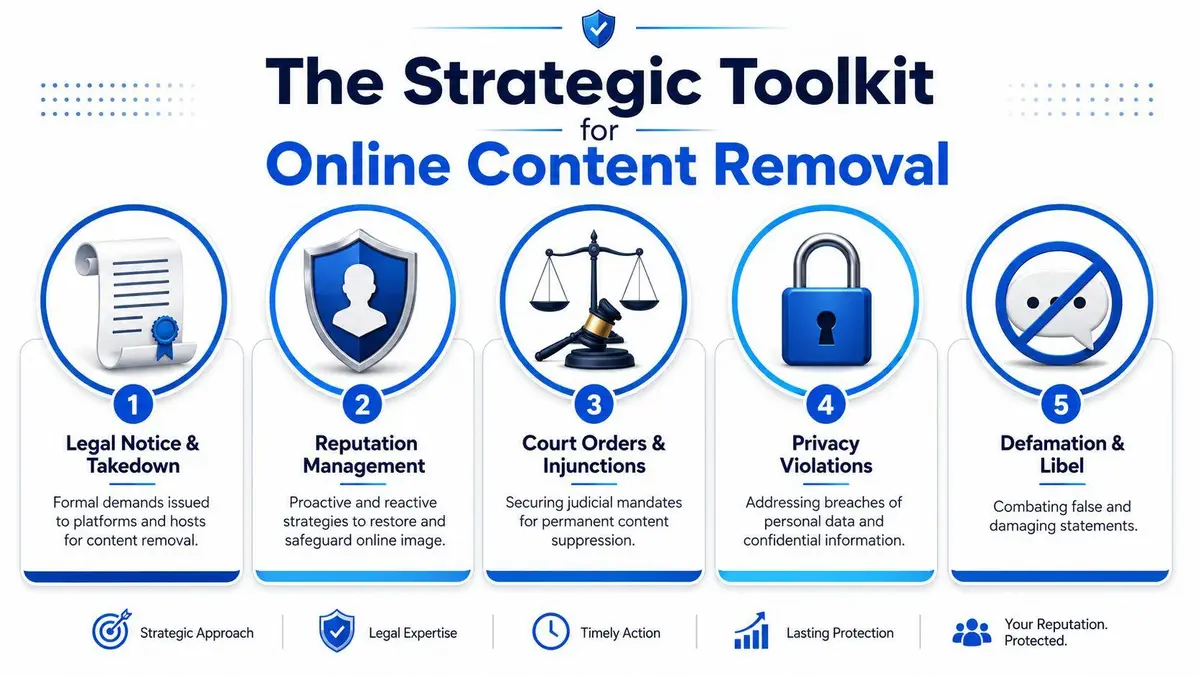
A serious online content removal lawyer matches the tool to the vulnerability in the content itself. If the post is false, the legal ground may be defamation. If it uses your image or writing without permission, copyright may be faster. If the material reveals private information, privacy and policy channels may outperform court threats. If the target is search visibility rather than source deletion, deindexing may matter more than argument.
The main levers and when they work
Here’s how the toolkit usually breaks down:
| Tool | Typical target | Best use case | Main limitation |
|---|---|---|---|
| Defamation demand or claim | Publisher, author, sometimes platform | False statements of fact causing reputational harm | Slower, fact-intensive, and sometimes public |
| Copyright takedown | Host, platform, search engine | Unauthorized use of protected photos, videos, text, documents | Only works if copyright exists and is enforceable |
| Privacy complaint | Platform, publisher, search engine | Doxing, exposed personal data, intimate or confidential material | Depends heavily on policy language and facts |
| Impersonation or trademark action | Platform, marketplace, website operator | Fake accounts, false endorsements, misuse of brand identity | Scope may be narrow if the misuse is subtle |
| Injunction and court order | Court first, then publisher/platform/host | Repeat misconduct, refusal to comply, stronger coercive remedy | Cost, time, and visibility |
Why speed and strength often conflict
Clients want one thing. Fast, invisible, permanent removal. That combination exists in some cases, not all.
A copyright notice can move quickly when the factual basis is clean. A defamation action can be powerful, but it takes more preparation and may create a public docket. A platform privacy complaint may be discreet, but platform reviewers are inconsistent and often need persistent escalation. A no-index request can cut discoverability without winning an argument on the merits.
That’s why sequencing matters. In many cases, counsel starts with the shortest path to reduced visibility, then builds toward stronger enforcement if needed. If a copied image drives the page, copyright may be the opening move. If a false accusation is the core problem, legal notice may frame the next step. If the publisher resists deletion but fears exposure to a host or search engine review, pressure shifts there.
DMCA is useful, but only when it’s real
Many people misuse copyright takedowns. That is reckless. A weak or dishonest notice can undermine your credibility immediately.
Use copyright only when the material is yours or your rights can be properly asserted. When it fits, it’s efficient. When it doesn’t, it’s a distraction. If that route may apply, a more detailed overview of strategic DMCA takedown planning helps frame the analysis.
Decision standard: Pick the tool that creates lawful pressure at the lowest reputational cost. Not the tool that sounds the toughest.
The role of non-legal tactics
Not every useful tactic is a lawsuit. Search suppression, no-index implementation, host escalation, and ongoing monitoring all belong in the same strategic conversation. ContentRemoval.com, for example, offers deindexing, source removal, and monitoring workflows that can sit alongside legal counsel when a matter requires both enforcement and ongoing visibility control.
That’s the key point. High-stakes removals aren’t won by ideology. They’re won by coordination.
The Anatomy of a Takedown Campaign
A proper takedown campaign is procedural. It isn’t improvised. Effective online content removal depends on preserving screenshots, URLs, timestamps, and ranking context before any action is taken, because those materials support cease-and-desist letters, platform complaints, DMCA notices, and injunction requests. In practice, lawyers also combine legal takedowns with no-index requests and ongoing monitoring to prevent re-uploads and preserve suppression results over time (eLawFirm on online reputation workflow).
That single principle explains why amateur outreach fails so often. People contact the platform first, lose the original version, and then discover they’ve destroyed the record they needed.
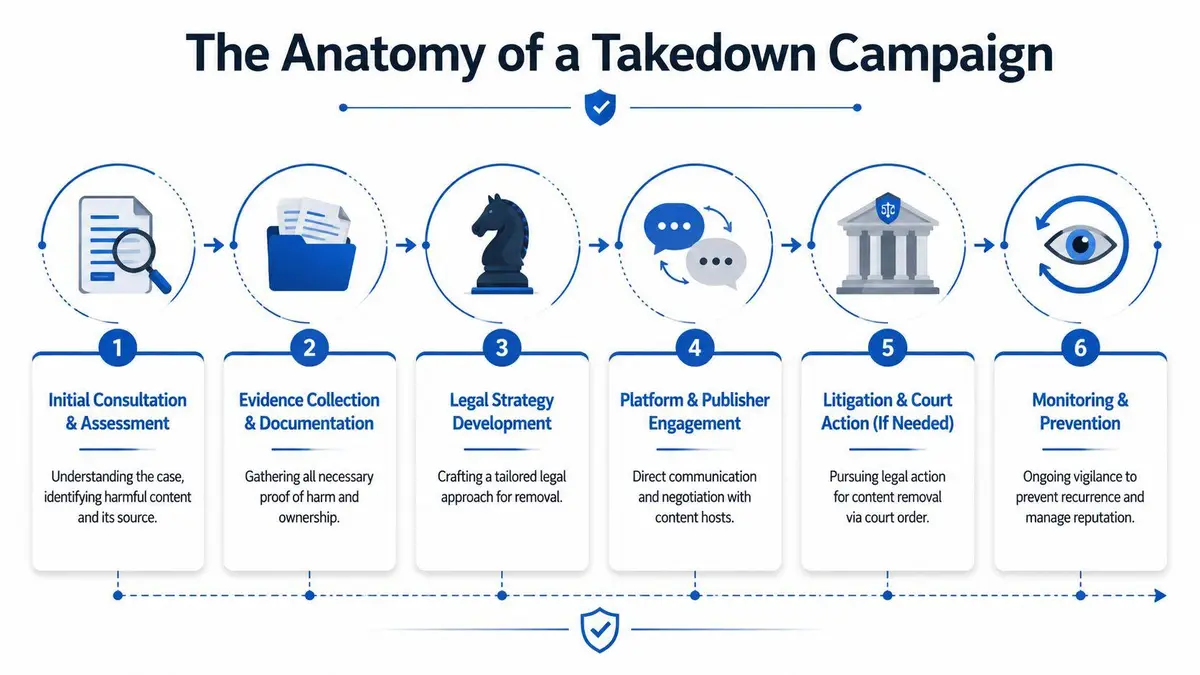
Stage one through three
The first half of the campaign is about control.
- Assessment
Counsel identifies exactly what is harmful, who published it, where it is hosted, how it ranks, and whether the content has been copied elsewhere. - Evidence preservation
The content is captured in a way that supports legal and technical action. That includes the page itself, search-result appearance, date and time markers, and account details where available. - Strategy selection
Experienced counsel earns their fee at this stage. One case belongs in a platform queue. Another belongs in a lawyer-to-lawyer exchange. Another requires immediate court preparation because the poster is escalating.
Before the campaign moves outward, the internal record has to be complete.
A visual overview helps make the workflow concrete:
Stage four through six
The second half is execution and maintenance.
- Platform and publisher engagement: Notices are sent to the right entity, in the right order, with the right legal and factual framing.
- Escalation: If first-line support refuses or stalls, counsel moves to legal departments, hosts, registrars, or court proceedings where justified.
- Verification and monitoring: Removal is checked, search results are reviewed, and re-upload risk is managed.
Why monitoring is not optional
Clients often think the job ends when a page disappears. It doesn’t. Harmful content gets reposted, scraped, quoted, or mirrored. Search engines can retain traces. Third parties can republish screenshots long after the original page is gone.
After removal, you need confirmation, surveillance, and a plan for recurrence. Otherwise you’ve paid for a pause, not a solution.
A professional campaign closes the loop. It verifies that the content is down or deindexed, checks whether the search result still appears, and watches for reposts. If the issue involves an organized attacker, monitoring may matter as much as the initial takedown.
Navigating Jurisdictional and Enforcement Complexities
Clients with public profiles rarely face a neat domestic dispute. The publisher may sit in one country, the server in another, the domain registrar in a third, and the victim in a fourth. That changes everything.

A U.S. court order may carry real force against a domestic publisher and much less practical force against an anonymous operator using offshore infrastructure. A platform with global operations may still review content under one centralized policy framework, while a local host may ignore polished legal correspondence unless it sees a direct risk to its own business.
The three-jurisdiction problem
Most difficult cases involve at least three layers of law and influence:
| Layer | Core question | Strategic consequence |
|---|---|---|
| Victim location | Where is the harm occurring? | Affects forum choice and available claims |
| Publisher or operator location | Who controls the content? | Determines service, pressure, and negotiation dynamics |
| Infrastructure location | Who hosts or registers the asset? | Shapes practical enforcement options |
A common scenario looks like this: a fake-profile operator targets a family office principal from abroad, hosts the content through an intermediary service, and routes publication through a platform that refuses direct disclosure without formal process. If you hire counsel who only knows your home-state law, you won’t get far.
Being right is not enough
Clients waste time with lawyers who can analyze liability but can’t convert liability into compliance. In cross-border matters, the operative question is not only whether the content is wrongful. It’s whether there is a viable enforcement path.
That path may involve platform policy rather than a court. It may involve copyright rather than privacy. It may involve targeting payment processors, ad relationships, or hosts rather than arguing with the site owner, and sometimes the correct move is to accept that source removal will be slow and instead cut off discoverability while a stronger record is built.
The most expensive mistake in a global takedown is pursuing a legal theory that has no enforcement tail.
For executives, public figures, and high-net-worth families, global experience is not a luxury. It is the difference between sending impressive letters and getting actual results.
How to Vet and Select Your Legal Counsel
If you’re hiring for a high-stakes removal, assume most providers are not built for your problem. Some are ordinary litigators with little platform experience. Some are reputation shops with no legal authority. Some are aggressive enough to make the problem worse.
You need counsel who can explain not just what they’ll do, but why that sequence makes sense for your case.
Questions that expose real capability
Ask direct questions. If the answers are vague, move on.
- Ask about pathway, not promises: What is your first-line strategy for this exact content, and what is your escalation path if the first notice fails?
- Ask about forum choice: Who is the primary decision-maker here. The publisher, the platform, the host, the registrar, or the search engine?
- Ask about evidence protocol: What do you preserve before outreach, and how do you document ranking context and copies?
- Ask about confidentiality: Who inside your team will see this matter, how do you communicate, and what steps protect privilege and discretion?
- Ask about recurrence: What happens if the content reappears, is mirrored, or remains visible in search after source removal?
A capable specialist should answer crisply. They should not hide behind “we use proprietary methods” as a substitute for substance.
Red flags you should take seriously
The biggest red flag is a guarantee. No serious online content removal lawyer can guarantee removal because too many variables sit outside counsel’s control. Another red flag is a one-size-fits-all answer. If someone says every problem needs a defamation claim, or every issue is solved by SEO, you’re not speaking with a strategist.
You should also be wary of counsel who dismisses technical workflows as “not legal work.” In this field, that division is artificial. Legal and technical tactics are inseparable.
For executives evaluating professional service providers, a structured procurement lens helps. The same discipline used in vendor review applies here. Beyond Surplus due diligence resources offer a practical checklist mindset for testing process maturity, confidentiality standards, and operational credibility.
DIY is usually the costly option
Clients often think self-help saves money. In reputational matters, DIY often creates the evidence the attacker wanted. Direct outreach can trigger reposting, mockery, extortionate responses, or a public “we were threatened” narrative.
If you need a framework for evaluating counsel specifically in a reputational dispute, this guide on an internet defamation attorney consultation for executives is a useful benchmark.
The right lawyer should make the situation quieter, narrower, and more controllable within days of engagement. If their approach increases public friction immediately, they may be solving the wrong problem.
Critical Questions for High-Stakes Removals
Can a lawyer guarantee removal
No. Guarantees are a red flag. What experienced counsel can do is maximize the probability of removal or deindexing by choosing the right target, preserving evidence correctly, and escalating with discipline.
What if the attacker is anonymous or the content is on the dark web
Anonymous attacks require a different track. The strategy may involve platform process, subpoena planning, digital tracing, host escalation, or containment rather than immediate confrontation. Dark web matters often shift from pure removal to monitoring, attribution, and downstream damage control. Anyone who treats those issues like an ordinary website complaint is out of their depth.
How is confidentiality protected
Start with attorney-client privilege and then test the actual workflow. Ask who handles intake, where records are stored, how communications are secured, and whether outside vendors are involved. High-value clients should expect need-to-know handling, controlled written communications, and a plan for avoiding unnecessary disclosures from the outset.
If harmful content is affecting your reputation, business, or family, act before the next search, screenshot, or repost compounds the problem. ContentRemoval.com provides confidential assessments for high-stakes online content removal matters, including source removal, deindexing, and ongoing monitoring where the facts support action.
Frequently asked questions
What does a content removal lawyer do that a regular defamation lawyer does not?
A traditional litigator may know defamation doctrine but miss the tactical opening inside a platform complaint, a copyright notice, a registrar escalation, or a search de-indexing request. The specialist runs legal analysis, technical execution, and negotiation at once, and starts by deciding which gatekeeper has both the ability and the incentive to act.
Should I contact the website myself before hiring a lawyer to remove content?
No. Direct outreach in anger creates discoverable records, invites retaliation, and can trigger reposting or a public we-were-threatened narrative. Lock down evidence, map how far the content has spread, keep internal chatter contained, and let counsel choose the pressure point.
How long does it take a lawyer to get content removed from the internet?
It depends on the tool. A copyright notice can move quickly when the factual basis is clean, a platform privacy complaint may need persistent escalation, and a defamation action takes more preparation and may create a public docket. Counsel usually starts with the shortest path to reduced visibility, then builds toward stronger enforcement.