

Getting your name on top of search results means putting verifiable, high-authority material above everything else and keeping it there. The playbook runs in phases: a 72-hour triage that freezes reactive communication and captures evidence, a controlled personal site plus supporting profiles built around one consistent name format, a removal-or-suppression decision for each hostile URL, and a monthly maintenance cadence.
Key facts
- Removal fits platform violations, legal grounds, or a responsive publisher; suppression fits lawful dated content
- A personal site or executive profile hub under your control serves as the canonical identity record
- Escalate when posts are mirrored across domains, republished after takedowns, or pushed by anonymous account networks
- Maintenance runs monthly search reviews, quarterly audits of owned properties, and an issue log by severity
Where ContentRemoval.com comes in. When hostile or stale pages have already taken the first page for a name, ContentRemoval.com assesses each URL for de-indexing, source removal, or suppression and runs the platform process, documentation, and follow-up at the pace the situation requires. Executives usually make contact through a chief of staff or general counsel. A free 15-minute Exposure Scan maps what is removable, and the report is yours to keep. Get a Free, Confidential Exposure Scan or read how our reputation management work is done.
You search your name. A hostile article sits above your company bio. A forum thread with half-truths outranks your LinkedIn profile. A cached page exposes information you never agreed to make public. That moment feels personal, but the implications are commercial. Investors search. Journalists search. Board members search. So do counterparties, litigants, competitors, and future employers.
This isn’t a Google quirk. It’s a control problem.
When clients ask how to get their name on top, they usually mean one thing. They want the first page of search results to reflect authority, legitimacy, and facts they can stand behind. That requires discipline, not panic. The right response is closer to crisis counsel than marketing. You identify the threat, lock down unnecessary exposure, build assets you control, and decide which items can be removed, which must be buried, and which justify immediate specialist intervention.
Defining the Digital Battlefield
A high-stakes reputation problem rarely begins with a dramatic headline. More often, it starts with a quiet discovery. A colleague flags an odd result. A client forwards a screenshot. Your assistant notices that a search for your name now surfaces an old dispute, a malicious post, or a misleading profile before your official biography.
That’s the moment many executives make their first mistake. They treat visibility as vanity. It isn’t. Search results for your personal name are a live due diligence file assembled by third parties.
Your name is an asset class
Your personal search results influence how others price risk around you. If the top results are confused, stale, or contaminated by hostile content, people fill in the gaps against you. They assume there’s more smoke than they can see. They delay, avoid, or demand concessions.
A serious response starts with a hard distinction. You do not control what others publish. You do control how much authoritative material exists under your name, how clearly your official identity is structured online, and how quickly you act when harmful content appears.
Practical rule: If a negative result is ranking for your name, assume key stakeholders have already seen it or will see it soon.
That’s why executives should monitor their own search footprint with the same regularity they monitor financial exposure. If you haven’t built that habit, start with a disciplined review process such as searching and Googling your name. It sounds basic. It isn’t. Individuals under pressure often discover too late that they’ve delegated visibility without managing it.
Getting your name on top is a systems problem
You won’t fix a polluted search presence with one email, one legal threat, or one polished profile. You need a campaign architecture. I advise clients to think like operators building an acquisition plan. Define the objective. Inventory available assets. Prioritize interventions. Measure movement. That logic isn’t far from how companies are now using AI agents to drive revenue. The toolset differs, but the discipline is the same. Structured systems outperform reactive effort.
There’s another reason to take this seriously. Search behavior compounds first impressions. In the United States, the Social Security Administration’s baby-name records go back to 1879, based on actual birth registrations rather than surveys, giving analysts a century-plus view of how names rise, fall, and cluster in public use through the SSA baby names dataset. The naming context matters because common names, uncommon names, and name variations create different search conditions. If your name is shared widely, ambiguity becomes part of the battlefield. If it’s distinctive, a single hostile result can define the environment faster.
Your assignment is simple to state and demanding to execute. Put verifiable, high-authority material above everything else. Then keep it there.
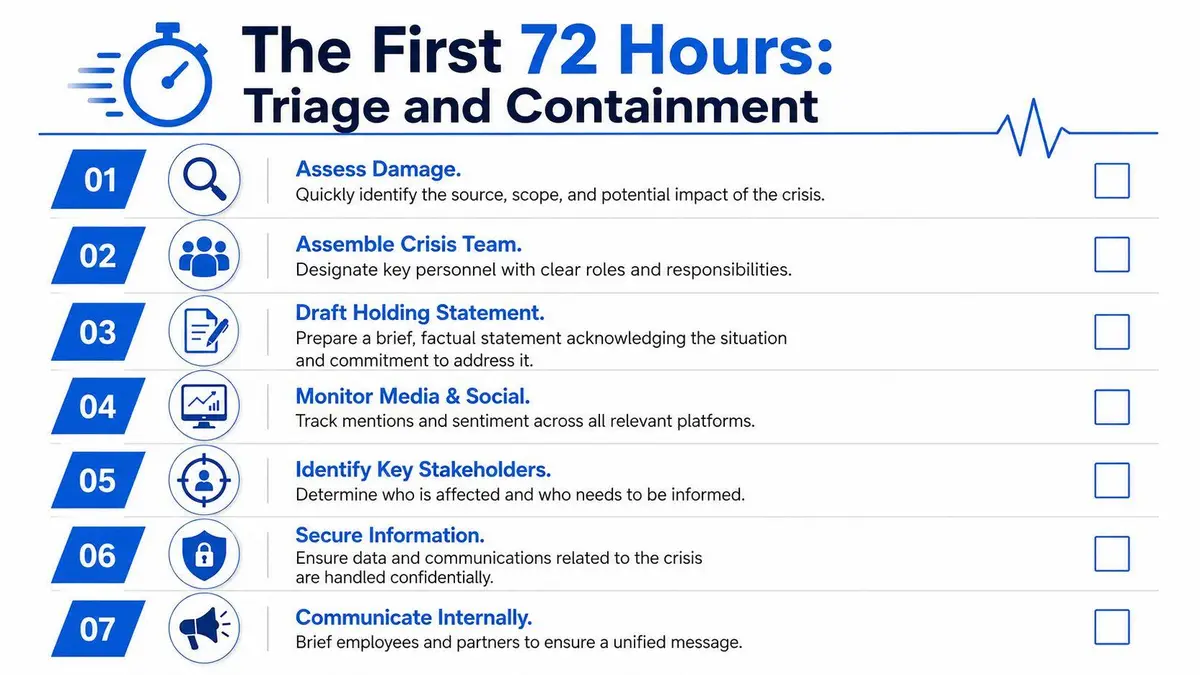
The First 72 Hours Triage and Containment
The first three days decide whether a reputation incident stays containable or turns into a search-term war you didn’t need. Don’t improvise. Treat the situation like a critical operational event.
Start with a visual command checklist.
What you must not do
The instinct to reply publicly, confront the publisher, or post a defensive statement is usually wrong. If the content is malicious, you may amplify it. If the facts are mixed, you may lock yourself into a bad position. If legal action is possible, careless language can narrow your options.
Do these instead:
- Freeze reactive communications. No staff member should comment publicly, even informally, until one person owns message control.
- Capture evidence immediately. Save screenshots, page titles, timestamps, snippets, cached appearances, and visible usernames.
- Separate fact from accusation. You need to know what is false, what is private, what is embarrassing but accurate, and what violates platform rules.
That last point matters because the remedy depends on the content category. Defamation, privacy invasion, impersonation, copyright misuse, and doxxing each require different paths.
Build a search landscape map
Your next job is intelligence gathering. Search your full name, common variants, company name, title, and combinations that an adversary or journalist would try. Check web, news, images, video, social platforms, and forum discussions. Look beyond the first result. Patterns matter more than single pages.
Gather domain information and existing requirements first, state the problem in detail, brainstorm solution options, select the most reasonable approach, and then document the plan.
That approach comes from expert guidance on complex project planning, and it applies directly here. Reputation control fails when people skip definition and jump to action.
Use a simple triage model:
| Threat type | What to check | Immediate posture |
|---|---|---|
| False or misleading content | Specific inaccuracies, missing context, identity confusion | Preserve evidence, assess legal and platform remedies |
| Private information exposure | Home address, family details, personal contacts, leaked documents | Prioritize safety and takedown pathways |
| Old but accurate negative content | Publication authority, ranking strength, recirculation risk | Prepare suppression strategy |
| Coordinated attacks | Multiple posts, repeated language, account networks | Escalate containment and monitoring |
A practical reference point for exposure involving personal information is this guide on what to do when you are doxxed, a strategic response checklist. Use it if any result includes location details, family identifiers, or contact channels that create physical or security risk.
After you’ve documented the terrain, brief only the people who need to know. Keep the circle tight. Internal chatter creates leaks, and leaks create fresh content.
Later in the triage window, review this briefing video with your team to align on response discipline before anyone goes off-script.
Building Your Digital Fortress
A CEO searches their own name after a difficult quarter and finds a scattered identity. An old conference bio ranks above the current company profile. A stale board listing shows the wrong title. A third-party article frames the story before your official channels do. That is not a content problem. It is a control problem.
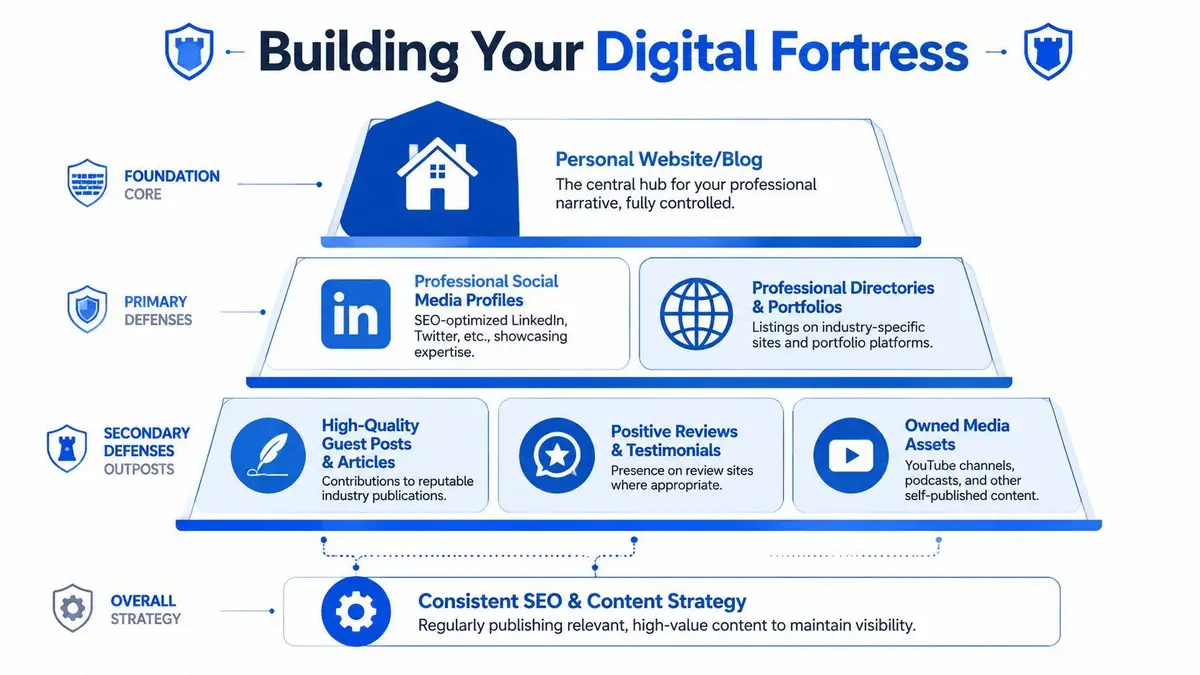
Your job in this phase is to build assets you control, strengthen assets you can influence, and identify the gaps that require specialist support. Suppression only works when search engines can find a clear, authoritative version of who you are and trust it.
The core asset you actually own
If your name affects capital, hiring, partnerships, or board confidence, you need a personal site or executive profile hub under your control. That property must be search-optimized, current, and explicit about who you are, what you lead, which entities are tied to you, and which media appearances are legitimate.
Treat this as your canonical identity record.
Use your full professional name consistently across the site. State current and prior titles clearly. Publish a concise biography, current affiliations, selected press, speaking history, and a contact path for media or business inquiries. If your name overlaps with other people, solve that with specificity. Add company context, sector, geography, and role history so search engines and human readers have no room for confusion.
A weak executive page creates ambiguity. Ambiguity gives hostile or outdated third-party pages room to rank.
Build the supporting wall
Your owned site is the command center. It cannot carry the full burden alone. You also need supporting properties that rank well for personal-name queries and reinforce the same identity signals.
Prioritize these assets:
- LinkedIn and executive bios: Your LinkedIn profile and official corporate biography should match on name format, title, summary, and current positioning.
- Authoritative bylines: Publish articles or commentary on respected industry platforms under your exact professional name.
- Media assets: Video interviews, podcasts, event pages, and transcript pages often perform well in name searches because the domains already have authority.
- Professional directories and profiles: Maintain credible industry listings that confirm your role, expertise, and affiliations.
Fragmentation is expensive. One version of your name on the company site, another on social platforms, initials in a directory, and a middle name in media coverage will dilute the record you are trying to establish. High-stakes individuals do not need more content. They need tighter entity consistency.
This is also the point where executives need to decide what they can control directly. You can update your site, your LinkedIn profile, your corporate bio, and your approved bylines. You usually cannot quickly fix old conference pages, unmanaged directories, scraper sites, or legacy press coverage. Mark those for escalation instead of wasting internal time on low-yield outreach.
Run this like an operating plan
Reputation recovery fails when it is treated as vague branding work. Run it like a controlled production schedule with clear ownership, deadlines, approval rules, and publication standards.
Create a simple build sheet for every asset:
- the exact name format to use
- the approved title and company description
- the target keywords tied to your name
- the pages, profiles, and media assets to update
- the evidence or credentials each asset should reinforce
- the review cadence for keeping each property current
That discipline matters because search results reward consistency over improvisation. A scattered build-out signals uncertainty. A coordinated build-out gives Google a stable identity map to index.
If negative or outdated results already have traction, pair this foundation work with an executive-focused suppression plan. This strategic guide to suppressing negative search results for executives lays out how to sequence owned assets, supporting profiles, and higher-authority placements without wasting effort on pages that will never move the rankings.
The objective is to control the first page with assets that accurately define you, support your commercial position, and narrow the space available for harmful or irrelevant third-party narratives.
Strategic Suppression and Removal
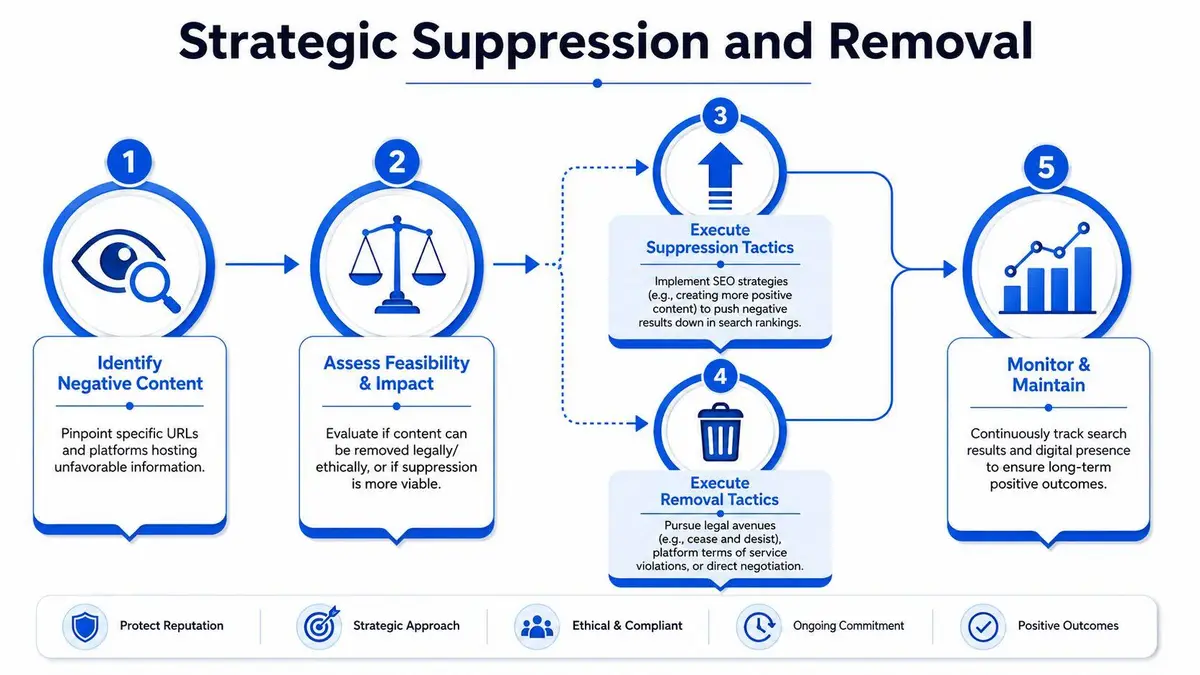
At this stage, the question is simple. Do you have a realistic path to make the result disappear, or do you need to crowd it out with stronger assets that you control?
Executives lose time when they treat every harmful result as a matter of principle. Treat it as a decision tree instead. Removal is a legal, platform, and publisher problem. Suppression is a search visibility problem. Pick the lane that matches the facts.
When removal is realistic
Pursue removal when you can attack the source, the search listing, or both. Source removal means the host deletes or edits the page. De-indexing means the page remains live but loses visibility for name-based searches.
That route makes sense when the content falls into one of these categories:
- Platform violation: Impersonation, harassment, non-consensual intimate material, or exposed personal data.
- Legal grounds: Defamation, copyright infringement, breach of confidentiality, or claims supported by court records and counsel.
- Publisher discretion: The site owner is reachable, responsive, and willing to correct, update, or remove the material.
Speed matters. If a page can be removed, act before it is copied, archived, or syndicated across other domains.
ContentRemoval.com handles de-indexing and source removal across search engines, websites, and social platforms, including privacy-related and defamatory content. Use a specialist when the issue has already spread beyond a single URL and internal teams cannot manage platform process, documentation, and follow-up at the required pace.
When suppression is the right answer
Use suppression when the content is unlikely to come down. That usually means dated but lawful reporting, complaint-site pages, forum threads, old litigation references, and commentary that remains online because no platform rule or legal claim will force action.
The practical objective is to reduce visibility and click share. You replace weak or harmful search results with stronger, relevant assets that reinforce your current authority, your operating role, and your verified record.
Here’s the decision frame:
| Question | Removal path | Suppression path |
|---|---|---|
| Can the source page realistically be changed or deleted? | Sometimes | No |
| Can search visibility be reduced? | Sometimes | Yes |
| Does legal merit drive the strategy? | Usually | Only indirectly |
| Can your team control execution speed? | Limited | Much more |
A suppression campaign needs tight planning and executive discipline. Define which negative URLs can be displaced, which owned properties will carry the load, which third-party assets deserve investment, and how progress will be measured each month. If those answers are vague, the campaign will drift and spend will rise without changing page one.
For the operating model, use this strategic guide on how to suppress negative search results for executives. Review it with one standard. Separate URLs your team can push down through structured publishing from URLs so authoritative that they justify specialist involvement and a longer campaign.
Stop debating fairness. Classify each result by removability, suppressibility, and business impact, then allocate resources accordingly.
Escalation Pathways for Specialist Intervention
There’s a point where self-direction stops being prudent and starts being expensive. High-stakes clients often escalate too late because they assume a strong legal team, a generalist PR firm, or an internal marketing department can absorb the problem. Usually they can’t.
The trigger points that justify escalation
Escalate immediately if the attack shows coordination. That means mirrored posts across domains, anonymous accounts pushing the same allegations, manipulated review activity, or repeated republication after takedowns. You’re no longer dealing with one page. You’re dealing with an adversarial campaign.
Escalate if the content sits on major media sites, entrenched complaint platforms, or jurisdictions that complicate service, notice, and enforcement. A local lawyer may be excellent in court and useless in search. A PR agency may draft polished statements and have no idea how to influence indexing, snippet behavior, or replication risk.
You should also escalate when private information is circulating in places that don’t respond like mainstream platforms. Dark web references, leak forums, data broker spillover, and archive propagation demand a different toolset and a narrower chain of custody.
Why generalist fixes fail
Generalists tend to optimize for narrative. Specialists optimize for outcome. That difference matters. The wrong public response can refresh a dormant story. The wrong legal letter can provoke reposting. The wrong SEO campaign can create thin, low-trust assets that never rank.
Use this standard:
- Bring in legal counsel when rights, liability, injunctions, or pre-action communications are central.
- Bring in specialist reputation operators when the problem is cross-platform persistence, search visibility, de-indexing, anonymity, or coordinated malicious publication.
- Use PR carefully when stakeholder reassurance is needed, but only after legal and digital-risk considerations are aligned.
Hiring a specialist firm is not surrender. It’s the same judgment call you’d make in high-value litigation. You retain the people built for the terrain you’re on.
If your name is tied to enterprise value, political exposure, family security, or ongoing litigation, delay is not conservative. Delay is risk acceptance.
Securing Your Digital Legacy Through Maintenance
Once you’ve pushed your name on top, the job changes. It doesn’t end. Search results drift. New pages get indexed. Old material resurfaces. AI-generated summaries and answer engines create fresh visibility layers you don’t fully control.
Maintenance has to be light enough to sustain and serious enough to catch problems early.
The executive maintenance protocol
Set ownership first. One person, either internal or external, should own name monitoring across web, social, news, image, and AI surfaces. Diffuse responsibility guarantees missed signals.
Then keep to a recurring cadence:
- Monthly review: Check branded search results, image results, autocomplete patterns, and major profile pages for changes.
- Quarterly audit: Review whether your owned properties still dominate the most visible search positions for your name and key variants.
- Content upkeep: Refresh bios, executive profiles, publication pages, and media references so stale assets don’t lose relevance.
- Issue log: Track new threats, remedial actions taken, and unresolved items by severity, not by emotion.
The monitoring layer now has to include answer engines and AI interfaces, not just classic search. For teams adapting to that shift, SearchMention on monitoring brands in Perplexity is a useful operational reference because it reflects how discovery is changing.
What disciplined maintenance looks like
Most clients don’t need constant public posting. They need consistency. A low-volume program of accurate updates, occasional authoritative commentary, and routine profile maintenance will usually outperform bursts of activity followed by neglect.
Use a standing checklist:
- Verify identity consistency. Your name, title, affiliations, and current company references should match across high-authority properties.
- Retain evidence habits. When a new issue appears, preserve it before anyone contacts the platform or publisher.
- Review for ambiguity. Shared names, family members with similar names, and old corporate affiliations can create confusion if left unattended.
- Refresh what ranks. The assets already ranking for your name deserve maintenance first. They are your frontline positions.
A neglected reputation isn’t neutral. It decays into whatever others publish about you. That’s why maintenance belongs on the same executive dashboard as legal exposure and communications risk.
If your search results are exposing private information, elevating false claims, or letting hostile third parties define your identity, ContentRemoval.com can assess the issue confidentially and outline whether your best path is de-indexing, source removal, suppression, monitoring, or a combined strategy.
Frequently asked questions
How do I get my own website to rank first for my name?
Treat it as your canonical identity record: use your full professional name consistently, state current and prior titles, and publish a concise biography, affiliations, selected press, and a media contact path. Then reinforce it with a matching LinkedIn profile, corporate bio, authoritative bylines, and media assets so search engines see one stable identity.
Should I respond publicly to a negative article ranking for my name?
Usually not in the first 72 hours. A public reply can amplify malicious content, lock you into a bad position if the facts are mixed, and narrow legal options. Freeze reactive communications, capture evidence, and separate what is false, private, embarrassing but accurate, or a platform violation before anyone speaks.
When is it worth hiring a specialist to fix my search results?
When the attack shows coordination, when the content sits on major media sites or entrenched complaint platforms, or when private information is circulating on leak forums and data brokers. A litigator may be excellent in court and useless in search, and a PR agency rarely knows how to influence indexing or replication risk.