
A damaging name in Google search calls for triage, evidence preservation, and a coordinated response rather than an angry email to the publisher. Capture the query, ranking, snippet, and page first, classify the result by severity, then pursue source removal, de-indexing, or legal escalation depending on who controls the page, with suppression for results that will not come down.
Key facts
- Tier 1 covers doxxing, leaks, impersonation, intimate-image abuse, and severe defamation; Tier 3 is stale nuisance content
- If the source page stays live, Google’s result often persists or returns, so the publisher or host comes first
- Match the legal tool to the wrong: copyright notice, defamation demand, privacy claim, or impersonation report
- Google Trends reports relative interest on a 0 to 100 scale, not how many times a name was searched
Where ContentRemoval.com comes in. ContentRemoval.com handles source removal, de-indexing, defamation takedowns, and leak response for people whose name search has become a business, legal, or family risk. Founders, physicians, and family office principals often reach out directly, or through their counsel, once a first round of requests has failed. A free 15-minute Exposure Scan maps what is removable, and the report is yours to keep. Get a Free, Confidential Exposure Scan or read how our search result removal work is done.
You search your name. A damaging result is sitting near the top of Google. It might be false, private, malicious, or old enough to be misleading. What matters is that clients, journalists, investors, counterparties, and family members can see it before they ever speak to you.
Individuals often respond badly in the first few hours. They email the publisher in anger, threaten legal action without a plan, or start random SEO activity that has no chance of changing the outcome. That usually makes the problem harder. A serious name in google search issue needs triage, evidence preservation, and a coordinated response across technical, legal, and search channels.
Initial Assessment The First 72 Hours
The first mistake is treating discovery as the crisis itself. It isn’t. The core crisis starts when harmful content spreads, gets copied, or becomes harder to remove because you failed to preserve evidence.
Google’s own removal ecosystem creates a practical problem here. Removal is often limited to specific policies, and persistent results may survive through cached, mirrored, or third-party indexed copies, which means de-indexing and source removal are often separate tasks, not the same task, as reflected in Google’s own documented removal constraints discussed in this Google removal process overview. That is why the first 72 hours must be disciplined.
Preserve evidence before anyone edits anything
Start with capture, not confrontation. Save the exact search query used, the ranking position, the visible snippet, the cached text if available, and the target page itself. Take date-stamped screenshots of desktop and mobile results. Save PDFs. Archive the page content if lawful in your jurisdiction and appropriate for counsel review.
If the content is likely to change, preserve the surrounding context as well. That includes related pages, author profile pages, category pages, comment threads, and any social posts driving attention to the result.
For clients who need a defensible record, I want evidence gathered the way auditors gather proof: complete, traceable, and contemporaneous. AuditReady’s audit evidence insights are useful here because they reinforce the core principle that evidence has to be reliable, organized, and fit for later review. Sloppy screenshots are not enough when you’re trying to persuade a platform, a host, or a court.
Practical rule: Never send a takedown demand before you’ve captured the exact state of the result and the source page.
Ask the right questions immediately
Not every harmful result deserves the same response. You need four answers fast:
- What is the content type: News article, forum post, review, mugshot page, leak, social post, court record mirror, or impersonation profile.
- Who controls it: A mainstream publisher, anonymous site owner, platform, data broker, forum moderator, or a host that can be identified.
- What is the legal character: False statement, privacy invasion, copyright misuse, harassment, leaked confidential material, or lawful but damaging commentary.
- What is the spread risk: Is it isolated, being reposted, or likely to trigger further search interest.
If you haven’t audited your own search footprint recently, read why regular name searches matter. Not because self-Googling is novel, but because delayed discovery turns manageable incidents into entrenched search problems.
Separate emotional shock from operational severity
Some results feel catastrophic but have limited reach. Others look minor and are operationally dangerous because they can be replicated across domains, scraped into data sets, or cited by journalists. A private leak, a false fraud allegation, or a doxxing page belongs in a different category from an unflattering but lawful opinion piece.
Your task in the first 72 hours is simple. Establish facts, lock down evidence, identify the controlling party, and stop guessing.
The Triage Framework Classifying Harmful Results
A damaging result should never be handled as a generic “bad press” matter. That is amateur thinking. The right question is how much harm the result can cause, how quickly, and through which channels.
Use a triage model. It prevents overreaction to nuisance content and underreaction to material that threatens safety, deal flow, licensing, employment, or family privacy.
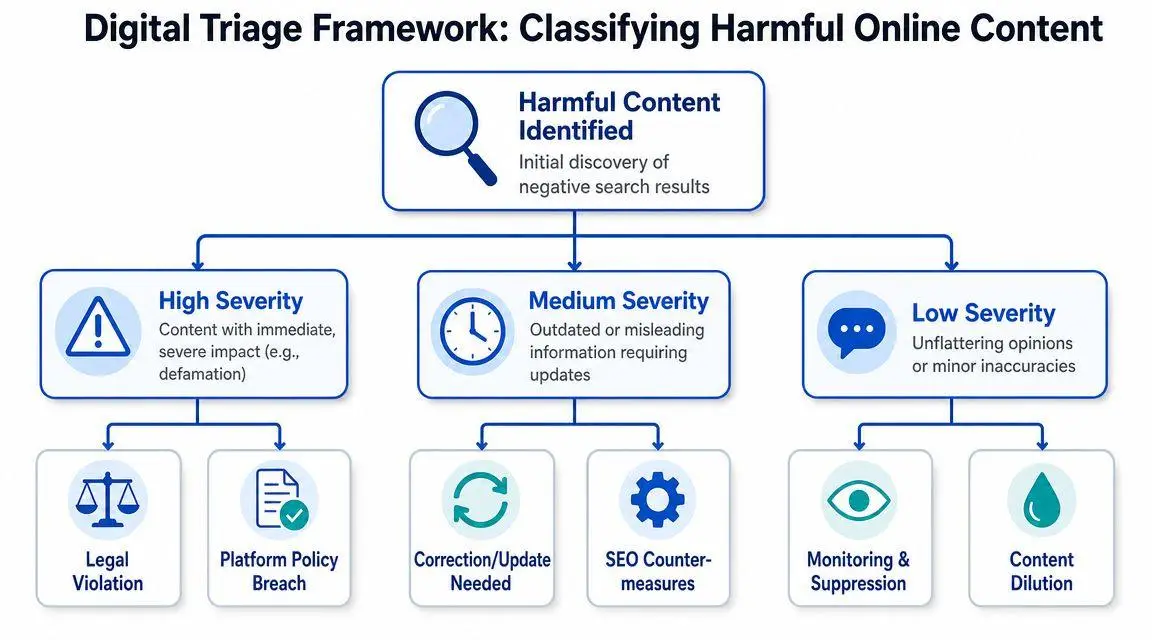
Tier 1 severe and immediate harm
Tier 1 is where delay is expensive. This includes doxxing, explicit threats, non-consensual intimate imagery, hacked or leaked materials, impersonation tied to fraud, and defamatory allegations that can trigger instant professional or personal fallout.
An executive with leaked board materials is a Tier 1 matter. So is a physician falsely accused of criminal conduct on a public forum. So is a family office principal whose home address appears in search.
For Tier 1 matters, your working assumption should be that one pathway won’t be enough. You may need platform escalation, host contact, legal notice, search de-indexing, and active monitoring for reposts at the same time.
If content creates immediate safety risk or invites unlawful contact, treat speed as part of the remedy.
Tier 2 significant reputational or financial harm
Tier 2 matters don’t always require same-day legal escalation, but they can still affect revenue, hiring, partnerships, and media exposure. Think false reviews posted in volume, mugshot publications, inaccurate articles, manipulated forum threads, or outdated allegations that continue to rank for your name.
This is the category where many executives lose time. They assume a negative result is “just bad optics” when it’s poisoning due diligence. Investors don’t announce that search results changed their view. Recruiters don’t explain why they dropped you. General counsel at counterparties won’t send a courtesy note.
A leaked internal memo can sit between Tier 1 and Tier 2 depending on whether it contains confidential data, trade secrets, or material likely to be recirculated.
Tier 3 nuisance or stale content
Tier 3 covers old forum comments, irrelevant mentions, duplicate profiles, and stray commentary that is annoying but not outcome-determinative. These still matter because clusters of low-grade negative content can shape first impressions and reinforce more serious results nearby.
Tier 3 doesn’t justify maximal legal aggression. It usually calls for measured cleanup, corrections where possible, and suppression.
A simple classification table
| Tier | Typical examples | Primary response |
|---|---|---|
| Tier 1 | Doxxing, leaks, impersonation, severe defamation, intimate-image abuse | Immediate preservation, urgent reporting, legal escalation, monitoring for replication |
| Tier 2 | False reviews, mugshots, damaging inaccuracies, misleading articles | Removal requests, correction demands, de-indexing strategy, selective legal pressure |
| Tier 3 | Old posts, minor inaccuracies, irrelevant mentions | Monitoring, cleanup, suppression, asset building |
The point of triage is allocation. If you spend your energy fighting Tier 3 clutter while a Tier 1 privacy breach is spreading, you’ve already lost control of the situation.
Direct Removal Pathways Technical and Platform Processes
Removal work fails when people confuse moral outrage with process. Google and platforms respond to categories, evidence, and technical states. They don’t respond to the fact that you’re upset.
The first operational principle comes from Google’s own search pipeline. Search works through crawling, indexing, and serving, and a page blocked by robots.txt or noindex cannot be indexed and therefore can’t influence search results for your name, which is why technical barriers must be resolved before expecting search outcomes, as Google explains in its overview of how Google Search works.
Start with the source, not just Google
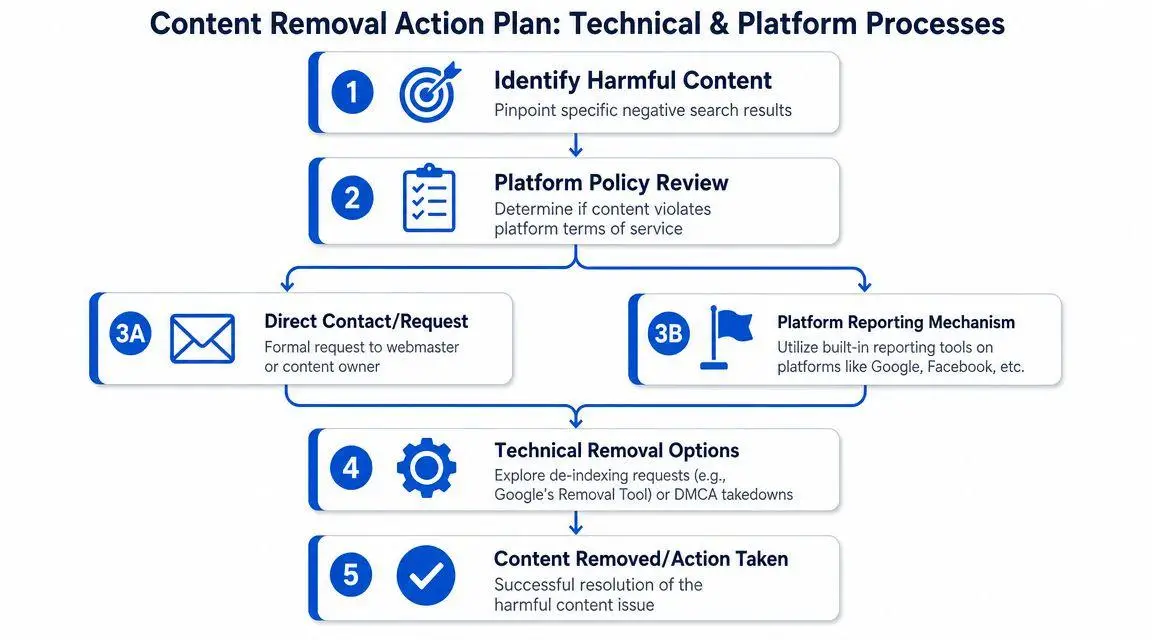
If the page remains live at the source, Google’s result often persists or returns. That means your first line of attack is usually the publisher, webmaster, moderator, host, or platform trust-and-safety team.
Your request should include:
- Exact URLs: Every offending page, image URL, profile URL, and search result where relevant.
- Clear violation theory: Defamation, privacy breach, impersonation, copyright infringement, policy violation, or outdated removed content still appearing in search.
- Evidence packet: Screenshots, identification of false statements, proof of ownership or identity where appropriate, and prior correspondence.
- Specific remedy sought: Removal, correction, de-indexing, anonymization, account suspension, or access restriction.
Don’t write essays. Write a precise demand. A weak email gets ignored. A concise, documented request gets routed properly.
Use the right tool for the right problem
Google has multiple pathways, and each has limits. Search Console removal tools apply to properties you control. Public removal pathways and legal requests apply only in narrower circumstances. Regional privacy routes may apply depending on jurisdiction and the nature of the content.
If you’re preparing a formal submission, this guide on how to submit a Google legal request is a useful procedural reference because it forces the right discipline around URLs, grounds, and evidence.
A few distinctions matter:
- Source removal deletes or changes the page at origin.
- De-indexing targets search visibility, not necessarily the source page.
- Temporary removals may buy time, but they don’t solve the underlying issue if the content remains live.
- Owned-property removal tools are irrelevant if you don’t control the underlying domain.
Know where technical failure blocks your remedy
A surprising number of cleanup efforts fail because the “good” pages meant to replace or outrank the harmful result aren’t indexable, while the harmful page remains fully accessible. That is backwards.
If you’re trying to publish a correction, statement, or controlled profile asset, confirm that Google can crawl and index it. If you’re asking a publisher to remove content, confirm whether they will delete the page, add noindex, restrict access, or leave the page live with cosmetic edits only. Those are materially different outcomes.
The remedy isn’t “we updated the page.” The remedy is whether Google can still serve the result for your name.
Keep a paper trail from day one
Every removal attempt should be logged: who you contacted, when, what evidence you supplied, what they said, and what changed. This matters for escalation. It also matters if the publisher later claims they were never notified, or if a court needs evidence of repeated refusal.
For some matters, specialist providers can assist across source removal and de-indexing workflows. That includes firms such as ContentRemoval.com, as well as outside counsel, digital forensics teams, or platform-specific consultants depending on the facts. What matters is not branding. What matters is whether the operator understands search mechanics, evidence requirements, and legal escalation thresholds.
Legal Levers and Formal Escalation
When direct requests fail, people often assume the next move is louder complaining. It isn’t. The next move is legal precision.
A properly structured legal escalation changes the character of the dispute. You are no longer asking for a favor. You are creating consequences for continued publication, continued indexing, or continued refusal to act after notice.

Cease and desist is useful when it is credible
A cease-and-desist letter is effective when it is drafted by someone who understands the underlying claim and the target’s pressure points. A vague threat letter sent to a generic inbox is performative. A focused legal notice that identifies the false statements, the privacy violations, the infringing content, or the unlawful processing issue can move the matter quickly.
It also establishes notice. That matters if the publisher keeps the content live. Continuing after notice can affect how a court views conduct, intent, and remedy.
Some matters are obvious candidates for formal legal action. Defamatory allegations presented as fact. Leaked confidential material. Impersonation used for fraud. Stolen copyrighted images or videos. False accusations tied to crime, professional misconduct, or dishonesty.
Match the legal tool to the underlying wrong
Different wrongs require different instruments. A copyright claim is not a defamation claim. A privacy breach is not a trademark dispute. If you use the wrong weapon, you waste time and hand the target an easy reason to refuse.
Use a simple mapping:
| Problem | Likely legal pathway |
|---|---|
| Stolen article, photo, or video | Copyright notice or related rights enforcement |
| False factual allegation | Defamation demand and, if needed, court action |
| Private data or intimate material | Privacy, harassment, platform policy, and urgent injunctive relief where available |
| Fake account or impersonation | Identity misuse, platform impersonation report, fraud-related escalation |
For executives dealing with false allegations, this resource on removing defamatory content strategically is a practical reference point because it treats defamation as a coordinated legal and search problem, not a PR inconvenience.
Court orders change the temperature
A court order that identifies content as unlawful can enable action by intermediaries who won’t adjudicate factual disputes on their own. Platforms and search engines often resist acting as judges. A court order removes that excuse.
That becomes even more urgent when attention around a name begins to spike. Google Trends is useful for monitoring those surges because it reports relative interest over time on a 0 to 100 scale, not exact counts, and Google publicly highlights how names such as Katt Williams and Kieran Culkin appeared among trending people in its coverage of search behavior, illustrating how quickly attention can concentrate around a person’s name in Google Trends training and examples.
A legal win that arrives after search interest has peaked can still matter, but a legal win obtained early is usually worth more.
The Suppression Strategy Building a Digital Firewall
Some results won’t come down. They may be lawful, stubborn, or tied to publishers who refuse to engage. In those cases, your job is to build a stronger first page for your name than the one you currently have.
That is what a digital firewall does. It places controlled, credible, indexable assets between your name and the material you want pushed down.

Start with assets you control completely
The centerpiece is usually a personal or company site on a domain you control. If Google is going to associate a preferred name with that site, the homepage has to be engineered correctly. Google says the preferred site name should be declared with WebSite structured data on the homepage, and it corroborates that preference through og:site_name, the <title>, headings, and other homepage text, as set out in Google’s site name documentation.
That means your homepage branding can’t be sloppy. If the legal name, trading name, personal brand, and visible heading all conflict, Google may choose its own label.
Build a suppression stack that can rank for your name
For individuals, the usual stack looks like this:
- Primary website: A clean homepage, biography page, media page, and contact page built around the exact name people search.
- LinkedIn profile: Usually one of the strongest controllable assets for personal-name queries.
- Professional directory listings: Chambers, associations, speaker profiles, faculty pages, or verified company leadership pages.
- Authored content: Articles, interviews, podcast guest pages, and commentary on reputable domains.
- Secondary social profiles: Only if they can be maintained professionally and indexed cleanly.
Not all assets carry equal weight. A neglected profile can rank, but it won’t persuade. A strong personal site supported by corroborating profiles often gives Google a clearer identity map.
Technical consistency matters more than people think
Suppression is not just publishing more content. It is alignment. The same name format should appear across titles, headings, profile names, author bios, and homepage schema. The same headshot, employer description, and professional summary should appear in a controlled and credible way.
A short operational checklist helps:
- Use one canonical name format: Don’t alternate between initials, nicknames, and legal variants unless there is a strategic reason.
- Align homepage signals: Schema, visible branding, metadata, and headings should tell the same story.
- Publish on crawlable pages: If the asset can’t be indexed, it can’t help you.
- Prefer authority over volume: One respected profile often beats ten weak microsites.
For teams building this at scale, some operators review essential AI SEO tools for 2025 to streamline content workflows and monitoring. Use those tools cautiously. Automation can support production, but it won’t fix inconsistent identity signals or weak editorial placement.
Suppression works when Google sees a coherent, authoritative identity layer around your name. It fails when you publish a pile of thin pages and hope for mercy.
Proactive Monitoring and Engaging Professionals
A repaired search result is not the end of the problem. Search reputation is maintenance work. The people who manage it well assume recurrence, replication, and drift.
Start with routine monitoring. Set up Google Alerts for your exact name, common misspellings, company-name combinations, and any high-risk terms that tend to appear with your name. Use quotation marks where appropriate. Monitor image search, news search, and major social platforms separately because harmful material often surfaces there before it stabilizes in standard web search.
What monitoring can and cannot tell you
You cannot know the exact number of times your name has been searched on Google through public Google data. Google doesn’t disclose individual search counts, and services claiming exact numbers are not relying on public Google Search data. Google Trends only reports relative interest over time rather than absolute query counts, which is why the practical use of search monitoring is directional, not precise, as explained in this analysis of how often a name has been Googled.
That limitation matters. High-stakes clients often ask, “How many people saw this?” The honest answer is that you’ll usually estimate impact qualitatively unless you have first-party analytics, direct referral evidence, or litigation discovery tools. Don’t let anyone sell you false precision.
The triggers for immediate escalation
You should stop handling this yourself and bring in professionals when any of the following is true:
- The content threatens safety or privacy: Doxxing, leaks, intimate material, extortion, impersonation, or threats.
- The publisher is anonymous or offshore: Identity, jurisdiction, and enforcement get complicated quickly.
- The content has legal complexity: Defamation, confidential information, employment issues, regulated professions, or cross-border privacy law.
- The result has begun to replicate: Mirrors, reposts, syndication, or scrape sites.
- Your own requests have failed: A failed first round is often a sign the case needs better evidence, better legal framing, or both.
What a serious consultation should look like
A competent advisor won’t give you slogans. They should ask for search queries, URLs, screenshots, jurisdictional facts, identity evidence, chronology, prior contact history, and your risk priorities. They should tell you what can likely be removed, what may only be de-indexed, what must be litigated, and what should be suppressed instead.
They should also discuss confidentiality. For executives, founders, public figures, and family offices, discretion is not a luxury feature. It is part of the remedy.
The practical value of a specialist is not just speed. It is coordination. Technical changes without legal backing often stall. Legal demands without search strategy leave damaging remnants behind. SEO without source removal can look busy while the underlying problem spreads.
If your name in google search has become a business, legal, or family risk, treat it like one. Discreetly. Methodically. Early.
If you need a confidential assessment, ContentRemoval.com handles source removal, de-indexing, defamation takedowns, leak response, and long-term search suppression for high-risk reputation matters. Bring the URLs, screenshots, and timeline. You’ll get a clear action plan, not generic advice.
Frequently asked questions
What should I do first when I find something damaging about me on Google?
Preserve evidence before contacting anyone: save the exact query, ranking position, snippet, and page, with date-stamped screenshots on desktop and mobile. Then identify the content type, who controls it, its legal character, and how likely it is to spread. Sending a takedown demand before capturing the result is the most common early mistake.
Can I get Google to remove a search result about me if the page is still online?
Sometimes, but Google’s public removal pathways apply only in narrow circumstances, and a result often persists or returns while the source page stays live. That is why the first line of attack is usually the publisher, host, or platform, with a Google legal request or de-indexing submission as a parallel or follow-up step.
How do I push a bad result down if it cannot be removed?
Build a stronger first page: a personal site on a domain you control with WebSite structured data, a consistent LinkedIn profile, professional directory listings, and authored content on reputable domains. Use one canonical name format across every asset and make sure each page is crawlable, because authority and consistency beat volume.