
Misdemeanor removal requires two separate operations. The first clears the legal record through expungement, sealing, set-aside, or correction in the originating court and state repository. The second clears the digital record: background-check aggregators, mugshot sites, data-broker profiles, and search results that copied the entry before relief took effect, none of which update automatically on a court order.
Key facts
- Expungement, sealing, and correction produce different results; sealed records stay visible to licensing boards and law enforcement
- Waiting periods vary: three years in Michigan and New York, more than five years in Louisiana
- North Carolina cut the wait for one nonviolent misdemeanor to three years from July 9, 2025
- Send operators a URL-specific notice with the certified order, then request search de-indexing and monitor for copies
Where ContentRemoval.com comes in. Once the court order is granted, ContentRemoval.com coordinates the digital side: background-check disputes, mugshot-site requests, source removal, search de-indexing, and monitoring for reappearance. The person’s defense attorney, an executive search consultant, or the individual themselves usually makes contact when a record is affecting a pending appointment or transaction. A free 15-minute Exposure Scan maps what is removable, and the report is yours to keep. Get a Free, Confidential Exposure Scan or read how our court record removal work is done.
A decade-old misdemeanor can resurface at the worst possible moment. A recruiter may finish interviews, an investment committee may approve a proposal, or a licensing review may appear routine, until a background-check aggregator displays a record that the court considers resolved. The legal matter may be closed, but the public-facing problem remains.
That’s why effective misdemeanor removal requires two separate operations. The first addresses court files and state repositories through expungement, sealing, set-aside procedures, or correction. The second addresses commercial databases, mugshot websites, cached pages, and search results that copied the record before legal relief took effect. Completing only the first operation often leaves the reputational damage intact.
Why a Cleared Misdemeanor Still Follows You Online
A court order changes the legal status of a record. It doesn’t automatically force every private website, screening company, or search engine to update its copy. Background-check aggregators may have collected information from court dockets, state repositories, or other databases, then republished it under your name. Mugshot pages can preserve arrest-related material even when the underlying case was dismissed, sealed, or expunged.
The result is a frustrating mismatch. A court clerk may confirm that public access has been restricted, while an employer, lender, journalist, or business partner still finds the old entry through a commercial search. In high-stakes settings, that mismatch can affect how decision-makers evaluate judgment, trust, and risk before you have an opportunity to explain the underlying history.
The two records you must treat separately
The legal record is controlled by courts, clerks, prosecutors, state police repositories, and other government systems. Relief may remove information from public access, destroy it under the applicable state definition, or restrict access while retaining it for authorized users. The available result depends on the state, the offense, the case disposition, and the statutory pathway.
The digital record is distributed. It may appear on a background-check provider, a data-broker profile, a mugshot website, a county-record mirror, or a search result that points to an outdated page. Each location has its own correction or removal process. None is automatically bound by the court’s order unless the operator receives the relevant documentation and acts on it.
Practical rule: Treat the court order as the foundation of the cleanup, not the finish line.
The sequence should be deliberate. First, obtain the final disposition and any expungement, sealing, or set-aside order. Next, verify the result through the originating court and relevant state repository. Then identify every public or commercial copy, submit documented disputes and removal requests, and monitor for reappearance. A strategic guide to removing public court records from Google explains why search remediation must follow the legal record rather than substitute for it.
Some records can be permanently removed under the state’s legal definition of expungement. Others remain available to law enforcement, licensing authorities, courts, or specified agencies. Online remediation can reduce public exposure even where government retention continues, but it can’t rewrite an agency’s lawful internal record or guarantee that every private copy will disappear permanently without monitoring.
Expungement, Sealing, and Record Correction Are Not the Same Thing
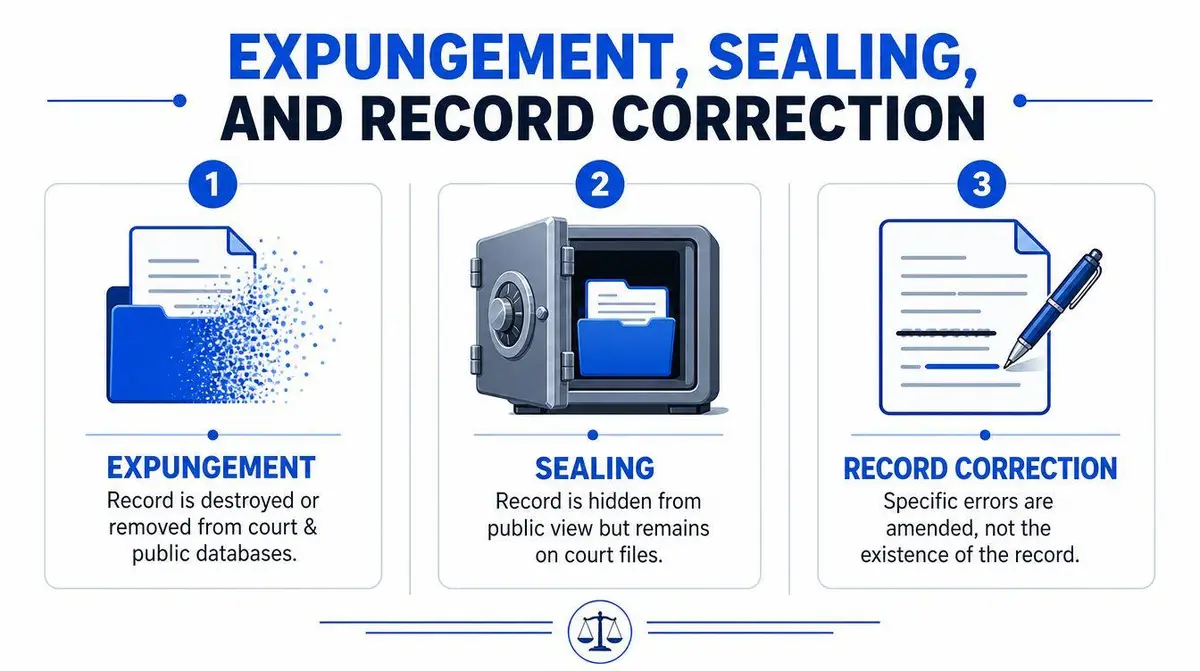
“Removed” has no uniform legal meaning. Expungement, sealing, and record correction produce different results, and using the wrong term can lead to unrealistic expectations about employment screening, licensing reviews, or law-enforcement access.
Expungement can mean destruction, removal, or restricted public access
In Pennsylvania, court materials state that expungement is the only mechanism to permanently and completely remove criminal history record information. That definition is not universal. Other states use “expungement” for a process that limits public access while retaining the record in some form, as reflected in Pennsylvania court guidance on clean slate expungement and limited access.
Sealing generally restricts public visibility but preserves the record for authorized access. A licensing board, law-enforcement agency, court, or another legally designated entity may still see information that an ordinary employer or member of the public can’t access. Virginia’s automatic sealing rules, for example, still leave some records accessible under specific conditions.
Correction addresses a different problem. If the record contains the wrong disposition, identifies the wrong person, omits a dismissal, or merges two individuals with similar names, the remedy is to amend inaccurate information. Correction doesn’t necessarily eliminate the existence of a valid case. It makes the record accurately reflect what happened.
The correct question is who can still see it
For each matter, ask four questions:
- Public access: Can an ordinary person find the record through the court system?
- Commercial screening: Can a background-check company report it to an employer or client?
- Regulated access: Can a licensing board or financial institution obtain it?
- Law-enforcement access: Can authorized agencies retrieve the underlying information?
A court order may answer the first question without resolving the second. That’s why a legal filing and a digital remediation campaign should be coordinated. Readers who need a plain-language explanation of the sealing concept can also consult this practical resource from the Law Office of Bryan Fagan on sealing. For the broader distinction between public access and online discoverability, see the legal realities of the right to be forgotten in the United States.
Qualifying Rules Differ by State and Changed in 2025
Eligibility depends on the state, offense classification, disposition, waiting period, later convictions, pending charges, and effective date of the governing rule. A guide written before a statutory change can give a confident answer that is no longer correct.
Michigan illustrates the need for careful screening. State guidance sets a three-year waiting period for most misdemeanors, while certain serious misdemeanors have a longer period. A new conviction during the waiting period resets eligibility until the new waiting period ends. That rule can delay relief even when the original misdemeanor is low-level. Michigan’s automatic system also became a benchmark because lower-level offenses can qualify for automatic relief under defined conditions.
Louisiana uses a different structure. A misdemeanor conviction generally requires more than five years after completion of the sentence, deferred adjudication, probation, or parole, with no felony conviction and no pending felony charge during that period. Domestic abuse battery and stalking are explicit misdemeanor exclusions, while some first-offense marijuana convictions can be filed after 90 days, subject to the applicable statute. The controlling provision is summarized in Louisiana’s misdemeanor expungement statute.
South Carolina ties eligibility to offense severity. Convictions carrying a maximum sentence of 30 days and/or a $1,000 fine may qualify, but the applicant must wait three years and avoid other convictions during that period. Domestic violence misdemeanor expungement requires a five-year wait, and pending charges can make an applicant ineligible. The state’s eligibility framework is outlined in this South Carolina expungement reference guide.
| State | Waiting Period | Pathway | Notes |
|---|---|---|---|
| Michigan | Three years for most misdemeanors | Petition-based and automatic pathways may apply | A new conviction resets the waiting period. |
| Louisiana | More than five years after sentence completion | Petition | Domestic abuse battery and stalking are excluded. Certain first-offense marijuana matters may qualify after 90 days. |
| South Carolina | Three years for qualifying offenses | Petition | Severity limits apply. Domestic violence misdemeanors require five years. Pending charges may block eligibility. |
| New York | Three years for eligible misdemeanors | Automatic or near-automatic sealing | The Clean Slate Act was signed on November 16, 2023. |
| North Carolina | Three years for one qualifying nonviolent misdemeanor | Petition | The change applies to petitions filed on or after July 9, 2025. |
North Carolina shortened one waiting period from five years to three years for a single nonviolent misdemeanor when the petition was filed on or after July 9, 2025. Maryland’s 2025 reform added more common nonviolent misdemeanors. Virginia created automatic sealing for some dismissed or acquitted misdemeanor arrest records beginning October 1, 2025. New York’s Clean Slate Act made New York the 12th state to enact a clean slate law, with misdemeanor records sealed after three years and more than 2 million records estimated to be affected, as discussed in this 2026 expunction update. Before filing, confirm whether your specific offense qualifies under the current rule. A jurisdiction-specific resource can help you find out if your misdemeanor qualifies, but a serious or complex matter still warrants individualized legal review.
Filing Your Petition Without Losing Momentum
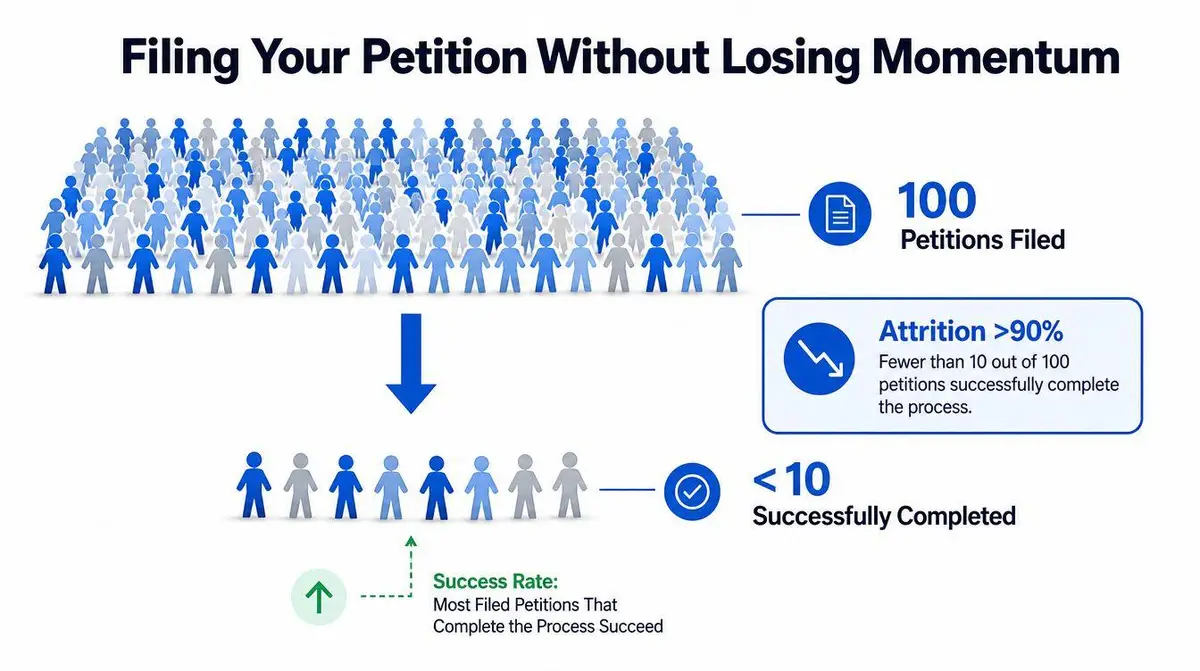
Petition-based systems often fail before a judge evaluates the merits. One empirical study found that only 6.5% of legally eligible people obtained expungement within five years, while recent applications were granted about 75% of the time, implying that more than 90% of eligible individuals never filed. The operational lesson is direct: the largest opportunity usually lies in screening, document assembly, and getting a complete petition into the correct court, not in persuading a judge who has already received a proper application. See the underlying analysis in The Power of Clean Slate.
Start with the authoritative record
Commercial searches are useful for discovering online exposure, but they’re not a reliable substitute for the originating court file or state criminal-history record. Pull the docket, charging document, final disposition, sentencing information, and any proof that financial obligations or supervision were completed. If the state database is incomplete, the court file may supply the missing disposition, but the discrepancy should be resolved before filing.
Then test eligibility against the current statute. Check the offense, case outcome, waiting period, later convictions, pending matters, and any offense-specific exclusion. Don’t assume that a clean commercial report means the legal record is eligible, and don’t assume that an absent state entry means no court record exists.
Build the filing packet around the venue
The petition must go to the court and district authorized by the state’s rules. Forms, service requirements, proposed orders, notices, filing fees, and hearing procedures vary. New Mexico, for example, requires filing in the originating district after applicable waiting periods, and its administrative requirements include a $132 filing fee. Hawaii charges $35 for a first-time expungement. Those fixed requirements make venue confirmation and fee planning part of eligibility work, not clerical cleanup.
Use a filing calendar that records every deadline, response period, hearing date, and follow-up obligation. If a fee waiver may be available, prepare the supporting documentation at the same time. A petition that is legally sound but filed in the wrong venue, built on an incomplete disposition, or missing required notices can lose months.
Decide whether the case needs counsel
Kansas legal-representation research reported 70%+ success within six to seven months for people with full-scope counsel, compared with about 13% in self-help. The same research reported that about 90% of people who cleared some record eventually achieved complete relief, while the self-help comparison remained materially lower. Those figures don’t promise an outcome in any individual state, but they show why procedural completeness and hearing readiness matter. A lawyer who handles the full scope can identify disqualifying history, correct the packet, manage service, and prepare for objections.
The fastest filing is the one that doesn’t have to be repaired after submission.
If a hearing is scheduled, bring the final disposition, proof of completion, identification documents, and any evidence needed to address the statutory criteria. Don’t treat the hearing as a formality. Treat it as the final quality-control stage before the order becomes the document used for digital remediation.
Erasing the Digital Shadow After the Court Says Yes
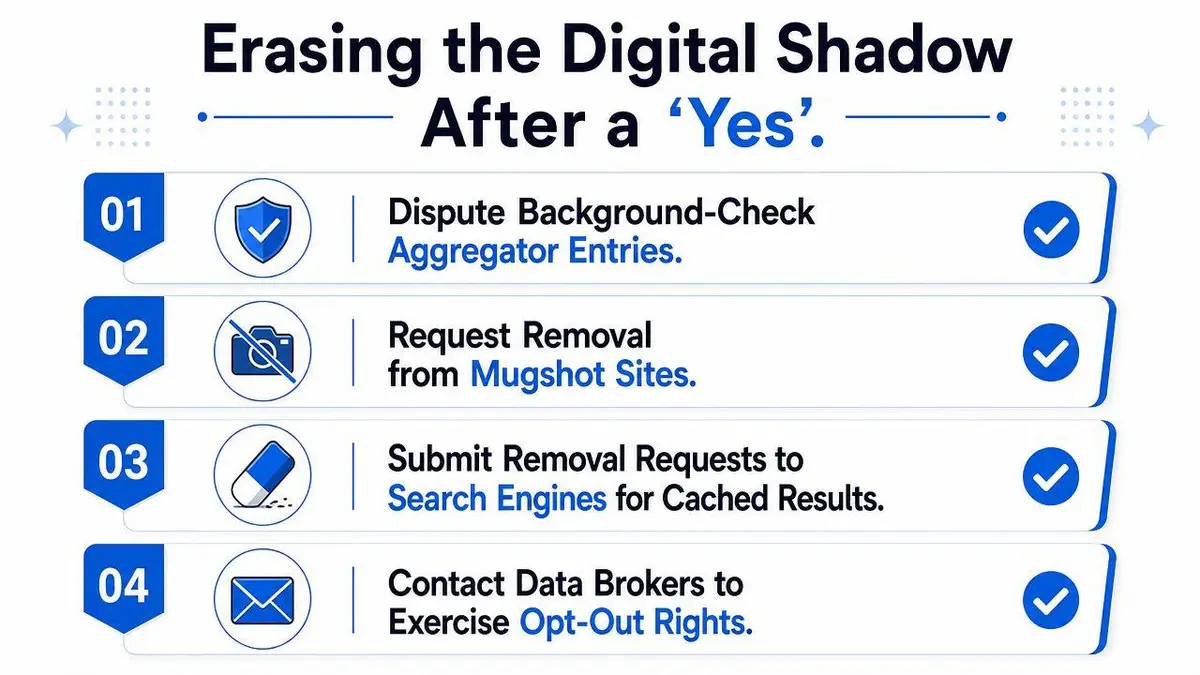
A granted order doesn’t automatically update background-check aggregators, mugshot sites, or search indexes. Those systems may have copied the record years earlier, and some may continue displaying it because their data refresh process never received the disposition. The cleanup should begin with a documented inventory, not a few casual Google searches.
Build evidence before contacting operators
Create a private file containing the certified order, final disposition, case number, court information, identity-verification documents where appropriate, and screenshots of each URL displaying the record. Record the date you found each result and the exact name, date of birth, case number, or other identifier shown. This prevents a provider from claiming it can’t match the dispute to the correct person.
Pull reports from the screening providers most likely to be used in your employment, housing, lending, or licensing context. Compare each report with the court order. If a provider reports a sealed, expunged, dismissed, or corrected matter, submit a formal dispute with the order and a precise explanation of what information is inaccurate or no longer publicly reportable.
Use targeted requests, not vague complaints
Website operators respond more effectively to specific requests tied to a particular URL and legal disposition. A concise notice can state:
Subject: Request to remove or correct record at [URL]
The record identified at this URL concerns [name and case identifier]. The originating court entered an order dated [date] granting [expungement, sealing, dismissal, or correction]. The page now presents information that is legally restricted or inaccurate. Please remove the page and associated images, or update the record to reflect the final disposition. Attached are the court order and supporting identification documents. Please confirm the action taken and identify any additional URLs under your control.
For search engines, request removal or de-indexing where the result exposes information that has been legally restricted, is inaccurate, or violates the platform’s applicable policies. Search removal may suppress a result without deleting the source page, so source-site remediation remains necessary. The executive guide to removing public records from the internet addresses that distinction.
Monitor for copies and re-uploads
A page can disappear from one search result while another URL remains live. Aggregators can also refresh from a source that still contains the old entry, and mugshot operators may publish duplicate pages. Re-search your name, case identifiers, and distinctive record language after each removal request, then maintain monitoring so a new copy is identified before it becomes the first result for your name.
When to Handle It Yourself and When to Bring In Specialists
Self-filing can make sense when there’s a single conviction, the disposition is clear, the state offers an automatic or near-automatic pathway, and no hearing or complicated service requirement is involved. Michigan demonstrates how automatic systems can operate at scale. State reporting showed that more than 1.3 million convictions were automatically expunged by March 21, 2024, including 912,416 people receiving full automatic expungements and 283,428 receiving partial ones. The same report recorded five-year re-arrest and reconviction rates of 6.4% and 3.8%, respectively, among recipients with expunged misdemeanor convictions. These figures show the reach of automatic relief, not a guarantee for every applicant. The underlying report is available from Safe and Just Michigan.
An attorney is the better choice when the record involves multiple jurisdictions, uncertain dispositions, later convictions, pending charges, exclusions, disputed identity, or a hearing. A reputation-management specialist becomes necessary when the legal relief is already complete but the commercial and search layers continue to expose the matter. Those are different professional functions, and treating them as interchangeable wastes time.
For an executive with a decade-old misdemeanor, the practical workflow is parallel. Counsel verifies and obtains the order, while the digital team inventories aggregator entries, mugshot pages, cached results, and data-broker profiles. After requests are submitted, verify the court order, re-pull relevant background reports, search your name and case identifiers, and establish monitoring for reappearance.
ContentRemoval.com handles digital remediation involving arrest records, mugshot-site listings, aggregator entries, expungement or sealing documentation, and search de-indexing requests. If the record is affecting a pending transaction, appointment, employment decision, or public profile, seek a confidential assessment rather than relying on an untracked DIY timeline.
ContentRemoval.com can coordinate the digital side of misdemeanor removal, including background-check disputes, mugshot-site requests, source removal, de-indexing, and monitoring after legal relief. Visit ContentRemoval.com to request a confidential assessment and receive a specific action plan for the records affecting your name.
Frequently asked questions
Why does my expunged misdemeanor still show up on Google?
A court order changes the legal status of the record but does not force private websites, screening companies, or search engines to update their copies. Aggregators and mugshot sites may have collected the entry years earlier and never received the disposition, so each location needs its own documented removal or correction request.
What is the difference between expungement and sealing a misdemeanor?
Expungement can mean destruction, removal, or restricted public access depending on the state; Pennsylvania describes it as the only way to permanently remove criminal history information. Sealing generally hides the record from the public while preserving it for licensing boards, courts, and law enforcement. Correction fixes a wrong disposition or identity without eliminating a valid case.
Do I need a lawyer to expunge a misdemeanor?
Self-filing can work for a single conviction with a clear disposition and an automatic or near-automatic state pathway. Counsel is the better choice for multiple jurisdictions, uncertain dispositions, later convictions, pending charges, or a hearing. Kansas research cited in the article reported far higher success with full-scope counsel than in self-help.