
Managing online reputation after a scandal means containing the first 48 hours, auditing every harmful URL, removing what can be removed, de-indexing what qualifies, and suppressing what must stay public. A statement alone does nothing while copied allegations, impersonation accounts, and leaked material remain indexed, so legal and technical takedown work sits ahead of messaging.
Key facts
- Source removal deletes content at the publisher; de-indexing leaves it live but limits search visibility
- Fastest removals come from rule-based routes: copyright, NCII, impersonation, and terms of service breaches
- Truthful reporting, court records, and regulatory filings usually stay up and need suppression instead
- One cited suppression methodology reports 65 to 80% of negative results leaving page one within 3 to 6 months
Where ContentRemoval.com comes in. ContentRemoval.com handles the infrastructure of a scandal: mapping each URL to a remedy, filing copyright, impersonation, and de-indexing requests, tracking reuploads, and suppressing what cannot come down. The first call usually comes from the principal, their chief of staff, or their lawyer while the story is still moving. A free 15-minute Exposure Scan maps what is removable, and the report is yours to keep. Get a Free, Confidential Exposure Scan or read how our reputation management work is done.
Your phone is lit up. Counsel wants a draft statement. Your assistant is forwarding screenshots. Reporters are calling. Search results for your name or company are already changing, and not in your favor.
That first wave is where many individuals lose control.
They over-explain. They threaten everyone. They let a panicked staff member post something reckless. They hire a generalist PR team that talks about “narrative” while hostile search results harden into the public record. That approach is inadequate. If you need to manage online reputation after scandal, you are not dealing with a messaging problem alone. You are dealing with a visibility problem, a search problem, a platform problem, and often a legal problem.
Most advice in this area is shallow. It tells you to apologize, post an update, and “focus on transparency.” Fine. But that does almost nothing if negative articles, copied allegations, impersonation accounts, leaked material, or manipulated clips stay indexed. An underserved angle in scandal response is legal removal and de-indexing, even though 72% of consumers trust search results over brand statements, and 68% of executives report scandals persisting in top search results for over 6 months post-crisis, according to research on online reputation repair and de-indexing gaps.
That is the core problem. Public perception now forms through what appears first, what remains searchable, and what can be screenshotted forever.
Introduction The Anatomy of a Modern Scandal
A modern scandal doesn’t unfold in a single place. It fractures across search engines, social platforms, review pages, news archives, YouTube clips, Reddit threads, AI summaries, and private messaging channels. By the time your team has agreed on language, the internet has already produced its own version of events.
The mistake is to treat this like an old-fashioned press issue. It isn’t. The public doesn’t read one statement and move on. They search your name. They search your company. They check social accounts, old articles, comment threads, and cached fragments. If the first page is hostile, your formal statement is secondary.
What clients usually get wrong
In the first hours, high-profile clients tend to make one of three errors:
- They confuse speech with control. A fast statement can help, but it doesn’t remove a defamatory post, de-index a copied article, or stop reuploads.
- They over-delegate to PR. Traditional PR can manage reporters. It usually cannot handle impersonation reports, copyright claims, search de-indexing requests, or coordinated suppression.
- They go to war in public. Angry replies, legal threats posted online, and moral grandstanding often give the story a second life.
Practical rule: Your first job is not to sound eloquent. Your first job is to stop the spread, preserve evidence, and identify what can actually be removed.
What matters in the first two days
The first forty-eight hours are about containment and classification. You need to know what is false, what is lawful but damaging, what violates platform rules, what infringes your rights, and what cannot be removed at source but can be pushed down in search.
That distinction determines the strategy.
A stolen private image is handled differently from a legitimate newspaper article. A fake LinkedIn profile is handled differently from a bad review. A forum thread with false allegations is handled differently from a regulator’s public filing. Serious reputation work starts when someone separates these categories and acts on each one with discipline.
If you remember one thing, remember this. The scandal itself is one event. The indexed record of that scandal is another. The second one often lasts longer and causes more durable harm.
The First 48 Hours Immediate Containment Protocol
The clock starts before you feel ready. In many cases, the market, your customers, and your stakeholders will form a judgment before you’ve finished your internal meeting. According to Social Czars’ crisis reputation data, share prices can drop by double digits within hours after a scandal breaks. The same source states that a holding statement within 60 minutes can help retain up to 72% of consumers who value transparency, while churn can otherwise reach 81%.
That is why the first response must be controlled, not elaborate.

Lock down communications
Do this immediately:
- Name one decision-maker. Not a committee. One person approves outbound communication.
- Freeze unsanctioned posting. Executives, assistants, social teams, brand managers, and regional staff should post nothing without approval.
- Preserve everything. Take screenshots of articles, posts, comments, accounts, timestamps, and URLs before anything disappears or changes.
- Separate internal from external facts. What you suspect internally may not be what you can safely say publicly.
A holding statement is not a confession, a defense brief, or an emotional reaction. It is a narrow acknowledgment that you’re aware of the matter, reviewing it, and will communicate further when verified facts are clear. The goal is to reduce speculation without creating new liability.
Run an intelligence operation, not a brainstorming session
Your team needs a digital map. Start with branded searches on Google and Bing, then move to platform search inside X, LinkedIn, Reddit, Instagram, Facebook, TikTok, YouTube, and major review sites. Search executive names, common misspellings, product names, old company names, and the allegation itself paired with your brand.
Build a working grid like this:
| Area | What to capture | Why it matters |
|---|---|---|
| Search results | First-page results, autocomplete, news tab, image tab | This is where public judgment forms |
| Social platforms | Viral posts, impersonation accounts, hashtags, replies | Social content drives screenshots and amplification |
| News and blogs | Original article, syndicated copies, commentary pieces | Source authority affects removal and suppression options |
| Review sites and forums | Coordinated review attacks, recurring allegations | These influence buyers and investors differently |
| Leaks and private channels | Reuploads, file-sharing references, mirror sites | These often revive an issue after initial cleanup |
What not to do
The fastest way to make a bad situation worse is to react as if every hostile item deserves a public answer.
- Don’t argue in comment threads. That rarely changes minds and often creates fresh screenshots.
- Don’t send broad legal threats blindly. Poorly aimed takedown demands can trigger reposts and mockery.
- Don’t edit your website impulsively. Panic edits can remove valuable owned assets and weaken your search position.
- Don’t let staff freelance explanations. One well-meaning executive on LinkedIn can undermine the legal strategy.
Preserve first. Publish second. Remove third. Suppress what remains.
The client who stays calm in this window usually recovers faster. The client who tries to “win the internet” on day one usually gives the internet more material.
Assessing the Digital Battlefield A Comprehensive Audit
Once containment is in place, you need a complete audit. Not a vague scan. A proper inventory. Most reputational damage persists because decision-makers only see the visible layer. They focus on the headline article and miss the copies, the forum discussion, the image search results, the impersonation profiles, and the leak trail that keeps feeding the story.
Build the asset map
A professional audit should classify every harmful item by source, authority, removability, and risk. Start with the surface web, then move into platform-specific search, then review environments, and finally closed or semi-hidden channels where reposts tend to resurface.
Use categories that support action:
- False or defamatory content that may support legal challenge
- Copyright-infringing material such as stolen images, clips, documents, or paywalled content reposted without permission
- Platform-rule violations including impersonation, harassment, doxxing, manipulated media, and coordinated abuse
- Lawful but damaging content such as legitimate news coverage that likely won’t disappear at source
- High-risk recirculation points including mirror blogs, scraper sites, gossip forums, and dark web references
Ongoing reputation monitoring systems matter. Without continuous tracking, clients often remove one item and miss five copies.
Judge each item by remedy, not emotion
Not every ugly result deserves the same response. A disciplined team asks four questions.
| Question | Why it matters | Typical direction |
|---|---|---|
| Is it false? | False factual claims may support defamation action | Legal review and evidence file |
| Is it unauthorized use of your content? | Ownership can support a direct takedown route | Copyright claim or platform notice |
| Does it violate platform rules? | Terms of service often move faster than court process | In-platform reporting and escalation |
| Is it true but harmful? | Truthful reporting is often not removable at source | Search suppression and counter-assets |
Don’t ignore the hidden layers
Clients under pressure often ask only one question: “Can you remove this article?” That’s too narrow. You also need to ask who copied it, which accounts are amplifying it, whether image search is surfacing damaging visuals, whether AI-generated summaries are repeating the allegation, and whether leaked files are circulating outside public view.
If you only audit Google’s first page, you are looking at the symptom, not the system.
A complete audit provides a strategic advantage. It tells you where legal pressure is realistic, where platform escalation is efficient, and where suppression is the only sensible route. Without that map, people waste time fighting the wrong targets while actual drivers of reputational harm remain untouched.
Deploying Legal and Technical Takedown Actions
A scandal breaks on Monday. By Tuesday, the original post has been copied to scraper sites, clipped into short-form video, attached to image search, and quoted out of context on forums. If you respond with a generic statement and no takedown plan, the search results harden against you.
This phase is about mechanics. You need to remove what can be removed, de-index what qualifies for search relief, and stop wasting time on targets that will never come down.

Source removal versus de-indexing
These are different remedies with different standards.
Source removal deletes the material from the publisher, host, or platform. De-indexing leaves the page live but removes or limits its visibility in search results for relevant queries. Source removal is stronger because it cuts off the content at origin. De-indexing still matters because hostile search results shape public judgment long before anyone reads the underlying page.
Use the right tool for the right target:
| Remedy | What it does | Best used when |
|---|---|---|
| Source removal | Eliminates content from the publisher or platform | Copyright infringement, NCII, impersonation, clear ToS breaches |
| Search de-indexing | Reduces discoverability in search results | Harmful URLs that remain live but are eligible for search-level relief |
| Suppression | Pushes negative results down with stronger positive assets | Legitimate news or commentary that will not be removed |
The main takedown routes
The fastest wins usually come from rule-based enforcement, not broad moral arguments.
- Copyright claims apply when someone reposted your photo, video, written material, or other protected work without permission. This is often the cleanest route for stolen images, leaked media, copied site content, and mirrored proprietary files. A documented copyright infringement removal process usually gets better results than arguing reputational harm in the abstract.
- Defamation action applies to false statements of fact that cause harm. You need the exact language, proof of falsity, proof of damage, and a clear reason the publisher or platform should act.
- NCII and intimate content removal requires immediate escalation. File platform reports at once, preserve evidence, and monitor for mirrors, cropped reposts, and renamed files.
- Impersonation and harassment reports are often handled inside the platform. Fake executive profiles, deceptive parody accounts, fraudulent support pages, and doxxing campaigns fit here.
- Terms of service violations are often ignored when they should be your first move. Harmful content may stay up as opinion, then come down for privacy violations, manipulated media, threats, coordinated abuse, or disclosure of personal data.
What usually stays up
Truthful reporting from established outlets is difficult to remove. So are court records, regulatory filings, and commentary that stays within legal boundaries. Sending aggressive letters against lawful content often creates a second problem. It gives critics fresh material and can trigger wider coverage.
Call it correctly. If the content is lawful and the platform has no rule basis to remove it, your job shifts from takedown to search control.
Ask a harder question: which URLs can be deleted at source, which can be de-indexed, and which require a suppression campaign because they are going to remain public?
Operational capability matters
Many legal teams can draft demands. Many PR teams can draft statements. Very few can run a coordinated removal program across hosts, social platforms, search engines, mirror sites, and repeat uploaders.
That gap matters in a live crisis. A weak team files one complaint and waits. A capable team builds a rights file, maps each URL to a remedy, escalates through platform channels, tracks reuploads, and closes the loop when search caches and image results continue surfacing old material.
Evidence quality determines speed
Reviewers act on clean submissions. They ignore emotional ones.
Build every harmful URL into a case file with ownership records, identity documents where required, timestamps, screenshots, archived copies, direct links, and a short legal or policy basis. Write for the person reviewing hundreds of tickets a day. Make the violation obvious. Make the requested action precise.
That is how you reduce visibility in the online environment. Not with outrage, and not with vague requests, but with targeted filings that match the platform, the rule, and the evidence.
Executing a Controlled Communications Strategy
Public communication still matters. It just needs to be subordinate to the legal and technical plan, not the other way around. If your messaging creates new admissions, contradicts your evidence, or inflames critics, it becomes an obstacle.
The benchmark is disciplined trust rebuilding, not public performance. According to Thrive Agency’s crisis recovery framework, a structured 4-phase trust rebuilding protocol should include responding to 95% of reviews within 24 hours and aiming for a 0.5-1 point improvement in average ratings within 90 days. The same source warns that defensive responses increase negativity 2.5x.
The four phases that actually work
The sequence matters.
- Internal post-mortem first
Get facts, identify operational failure if one exists, and decide what you can acknowledge without speculating. - External acknowledgment second
Speak briefly, directly, and with corrective action. Empty regret language is weak. A concise admission of concern plus a corrective measure is stronger. - Positive signal amplification third
Strengthen credible, verifiable material that reflects competence, ethics, and normal business performance. - Continuous review response and monitoring fourth
Continuous review response and monitoring rebuilds trust in practice, not in press copy.
What to say and what to avoid
A controlled statement should do three things. It should acknowledge the issue, identify the immediate response, and indicate next steps. It should not litigate facts in public unless counsel specifically approves that route.
Bad responses share the same flaws:
- They sound injured. The company or executive spends more time describing unfairness than addressing the issue.
- They attack critics. That often validates the perception of evasion.
- They promise broad reform with no operational detail. Audiences read that as staging.
A better approach is narrow and specific. If customer harm is alleged, address service remediation. If internal conduct is at issue, address review procedure and oversight. If private material leaked, confirm action is underway to remove and contain it without repeating or amplifying the content.
Speak once with purpose. Then let operations, removals, and documented corrections do the heavy lifting.
Handle reviews and stakeholder contact differently
Review platforms are not the place for legal briefs. Investor calls are not the place for vague brand language. Media inquiries are not the place for unvetted improvisation.
Use a split-channel model:
| Audience | Response style | Objective |
|---|---|---|
| Customers and reviewers | Short, empathetic, problem-solving | Reduce visible hostility and show accountability |
| Investors and partners | Controlled, factual, forward-looking | Preserve confidence and operational credibility |
| Media | Brief, consistent, non-speculative | Avoid feeding a longer cycle |
| Internal staff | Clear instructions and escalation paths | Prevent mixed messaging |
Communication is part of the cure. It is not the cure itself. If negative search results remain dominant, words alone won’t rehabilitate the reputation you need people to trust.
Reclaiming Search Dominance Through Suppression
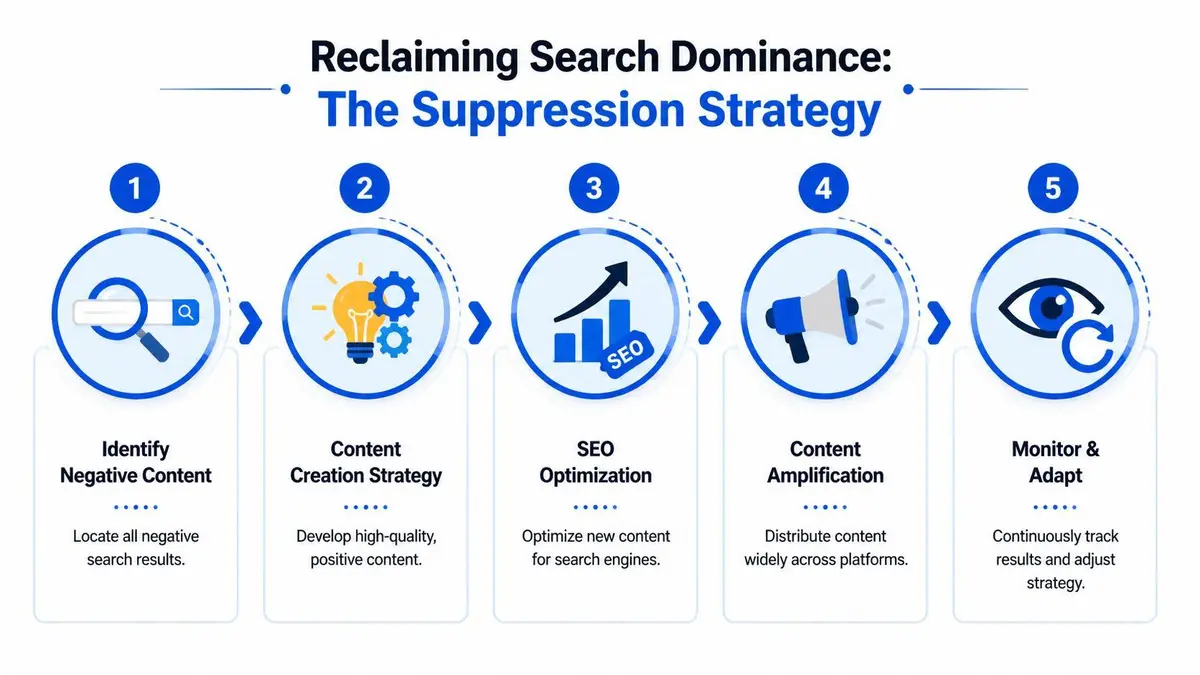
Some content won’t come down. That is the uncomfortable truth many advisers avoid saying. If a major outlet published a lawful article, if a blog post stays within legal boundaries, or if a commentary thread remains technically permissible, removal may not be available. You still need a result. That result is search suppression.
According to ALM Corp’s search suppression methodology, a targeted campaign can move 65-80% of negative results off page one within 3-6 months, using a content playbook, technical SEO work that can improve click-through rate by 20-30%, and consistent KPI monitoring.
Treat suppression as an engineering problem
Search suppression is not “post more positive content.” That advice is amateur. You need an asset portfolio built to rank.
The core process usually includes:
- SERP analysis to identify which negative URLs are stable, which are volatile, and which query variations trigger them
- Owned asset creation such as executive bios, press releases, interviews, microsites, knowledge-panel-supporting pages, and controlled media properties
- On-page optimization using targeted titles, structured metadata, internal linking, and schema where appropriate
- Authority building through legitimate backlinks, citations, and distribution across respected domains
- Measurement against branded search visibility, sentiment, and first-page control
If you need the tactical version of that process, strategic methods to suppress negative content and restore digital authority outlines the operating logic.
Build assets with ranking intent
Not every positive page deserves to exist. Create assets because they can rank, not because they sound nice in a meeting.
High-value suppression assets often include:
| Asset type | Why it works |
|---|---|
| Executive profile pages | Strong relevance for name-based searches |
| Third-party interviews and commentary | External domains often carry more trust and authority |
| Updated company leadership pages | Useful for branded and executive queries |
| Press releases on real developments | Freshness helps when properly distributed |
| Controlled social profiles | These often secure first-page positions for name searches |
Common mistakes that waste months
The most common suppression failures are predictable.
- Thin content. Search engines won’t reward a bland page created purely for optics.
- No authority plan. A new page without links is just a page.
- Ignoring image and video search. Visual results can keep the scandal alive even when web results improve.
- Relying on paid ads. Ads don’t replace organic ranking control.
- Stopping too early. Suppression gains need maintenance or negative URLs can rebound.
Clients require patience. Mild issues can resolve faster. Severe scandals take longer. What matters is that the first page stops functioning as a permanent indictment. Once you control more branded results, stakeholder behavior changes. Recruiters, investors, journalists, and customers all see a different digital profile.
Search suppression is not cosmetic. It is the practical method for reclaiming discoverability when the source content survives.
Establishing Long-Term Reputation Defense
Once the fire is contained, the job changes. You are no longer trying to survive the scandal. You are trying to make sure the next attack, leak, rumor, or hostile article has less room to take hold.
Most firms never get there. According to reputation management data on proactive leaders, only 17% of firms proactively manage their reputation. The same source notes that proactive leaders use sentiment tracking at 43% and publicizing positive ratings at 46%, far more than peers.

Build a reputational moat
A strong defense has three layers.
First, keep monitoring active across search, social, review sites, and leak-prone channels. You want alerts before a hostile item becomes the dominant result.
Second, keep publishing durable positive assets. Not fluff. Material with ranking power, credibility, and relevance to your name or brand.
Third, create an internal escalation protocol so nobody improvises under pressure again.
A practical long-term setup looks like this:
- Monitoring layer for mentions, impersonation, copied media, and reuploads
- Asset layer for executive pages, verified profiles, authoritative articles, and structured company content
- Response layer for legal review, platform reporting, and approved communications templates
The questions clients ask after the crisis
They usually ask whether this level of defense is excessive. It isn’t. It is cheaper than repeated crisis response.
They ask whether monitoring should continue once search results improve. Yes. The most damaging recurrences come from old material resurfacing when no one is watching.
They ask whether good content alone is enough. No. Good content without detection and response capability leaves blind spots.
Long-term defense isn’t paranoia. It’s the discipline of making yourself harder to damage.
What resilience actually looks like
A resilient digital reputation does not mean nobody can criticize you. It means one hostile item doesn’t immediately become your defining search result. It means your brand has enough authoritative, current, and favorable digital real estate to absorb a hit. It means your team knows who acts, who approves, and which remedy applies.
That’s how serious operators manage online reputation after scandal. They don’t wait for the next incident to learn the same lesson twice.
Conclusion From Crisis Response to Reputational Fortitude
A scandal becomes durable damage when it settles into search results, copied pages, platform archives, and visual media that stay visible long after the initial story breaks. That is why recovery requires more than apology language and media handling.
The correct sequence is straightforward. Contain the first forty-eight hours. Audit every harmful asset. Remove what can be removed. De-index what qualifies. Suppress what must remain. Then build a monitoring and asset system strong enough to prevent repeat exposure.
This work is technical. It is legal. It is operational. It is also highly personal when the subject is your name, your family, your board position, or your company’s valuation.
Some initial steps can be handled internally if your team is disciplined. Full-scale recovery usually cannot. The stakes are too high, the channels are too fragmented, and the consequences of poor execution are too permanent.
If you are facing a live reputational event, act before the search record hardens. Quiet, competent intervention in the early stage is worth far more than loud reassurance after the damage is entrenched.
Frequently Asked Questions for High-Stakes Reputation Crises
Can legitimate news articles be removed
Start with the hard truth. A lawful, fact-based article from a credible outlet usually stays up.
Your options are still meaningful. Push for corrections where the record is wrong. Review whether search engines may de-index specific URLs under applicable policies or legal standards. If neither route applies, reduce visibility through disciplined search suppression so one article does not define your name indefinitely.
What is usually removable fastest
Clear rule violations move first. Stolen images, unauthorized video reposts, impersonation profiles, certain harassment posts, fake reviews tied to platform abuse, and copyright infringement usually offer the cleanest removal path.
False statements can also be challenged, but they demand evidence, precision, and the right legal theory. Broad claims that content feels unfair go nowhere. Specific violations get action.
Should I respond publicly right away
Respond fast. Keep it tight.
A short holding statement often makes sense. A long explanation usually creates more problems than it solves, especially before counsel has assessed facts, exposure, and discoverable risk. Every public sentence can become evidence, a headline, or a fresh search result.
How confidential is this process
Confidentiality has to be controlled, not assumed. Limit circulation. Preserve evidence. Route approvals through one decision maker. Keep family details, employment issues, board matters, and internal allegations out of shared inboxes and casual Slack threads.
High-stakes cases break open when too many people touch them.
How long does reputation recovery take
Recovery runs on two clocks. Removal can be quick when the violation is clear and the platform process is straightforward. Search suppression takes longer because search rankings change through sustained publishing, indexing, authority signals, and repeated optimization.
Expect a phased result. First, reduce immediate exposure. Then weaken harmful visibility. Then build enough controlled assets to keep the problem from resurfacing every time someone searches your name.
What is the difference between a PR agency and a reputation removal specialist
PR firms manage narrative, press relationships, and public positioning. Removal specialists handle the infrastructure of the crisis. Takedown requests, de-indexing review, copyright claims, impersonation reporting, duplicate URL mapping, reupload monitoring, and suppression strategy.
If the damage lives in search results, scraped copies, image tabs, and autocomplete suggestions, messaging alone is inadequate.
Will trying to remove content make the situation worse
Yes, if you do it badly.
Angry emails to editors, weak legal threats, and obvious attempts to bury criticism can trigger reposting, mock coverage, and wider indexing. Proper handling depends on sequence. Identify the claim type, choose the right channel, preserve evidence, then escalate only when the facts and jurisdiction support it.
What should I prepare before speaking with a specialist
Bring the exact URLs, screenshots, timestamps, platform names, known copies, and any prior legal correspondence. Include a short timeline with what was published, when it spread, and who amplified it.
Then define the business risk in plain terms. Investor concern, customer loss, board pressure, hiring damage, family privacy, or personal safety. The strategy should match the risk, not the loudest headline.
If you need a discreet assessment, ContentRemoval.com can review the harmful assets, determine which ones are candidates for removal or de-indexing, and outline a confidential plan for suppression, monitoring, and longer-term protection.