

The malice legal definition in defamation law has nothing to do with spite or ill will. Under New York Times v. Sullivan, a public figure must prove actual malice: that the publisher knew the statement was false or published it with reckless disregard for the truth, meaning serious doubts about its accuracy. Negligent reporting does not meet that standard.
Key facts
- Actual malice from Sullivan applies to public figures; private figures need only prove negligence.
- Reckless disregard is subjective: the publisher must have entertained serious doubts, per St. Amant v. Thompson.
- Cited data puts public figure success in US defamation suits under 10 percent.
- Express and implied malice are criminal law concepts about intent to kill, unrelated to defamation.
Where ContentRemoval.com comes in. ContentRemoval.com exists for the situations the actual malice standard leaves unresolved: false articles, smear posts and fabricated criminal allegations that will not meet the litigation bar but still sit on page one. We remove or de-index the content through publisher negotiation, platform policy and search engine channels, without proving a publisher’s state of mind. The client’s attorney or chief of staff usually makes contact. A free 15-minute Exposure Scan maps what is removable, and the report is yours to keep. Get a Free, Confidential Exposure Scan or read how our content removal work is done.
When you are in the public eye, scrutiny is expected. When that scrutiny crosses into outright falsehoods, the word malice seems to capture the intent behind a damaging story.
In a legal context, however, malice is not about emotion. It has no bearing on personal spite, ill will, or a desire to cause harm. The malice legal definition establishes a specific and exceptionally high bar for proving a speaker’s state of mind, a standard that is critical for any public figure to understand.
What Legal Malice Means for Your Reputation
For leaders facing a reputational attack, the legal requirements for proving malice are often a source of immense frustration. You may be facing a storm of false articles, venomous social media posts, and harmful rumors, yet your legal counsel advises that proving “malice” is extraordinarily difficult.
The disconnect arises from the chasm between the everyday meaning of malice and its strict legal definition. U.S. law, in particular, places a heavy thumb on the scale in favor of free speech. To protect this freedom, it sets a demanding standard for what it takes to sue for defamation, especially when the subject is a public figure. Understanding this distinction is the first step toward building a realistic and effective strategy to protect your name.
Two Different Worlds of Malice
The word “malice” does not have a single legal definition; its meaning varies dramatically across different legal domains. The standards for malice in a defamation lawsuit are entirely separate from those in a criminal case. The strategy required to combat a defamatory news story is worlds apart from what is necessary if you are falsely accused of a crime.
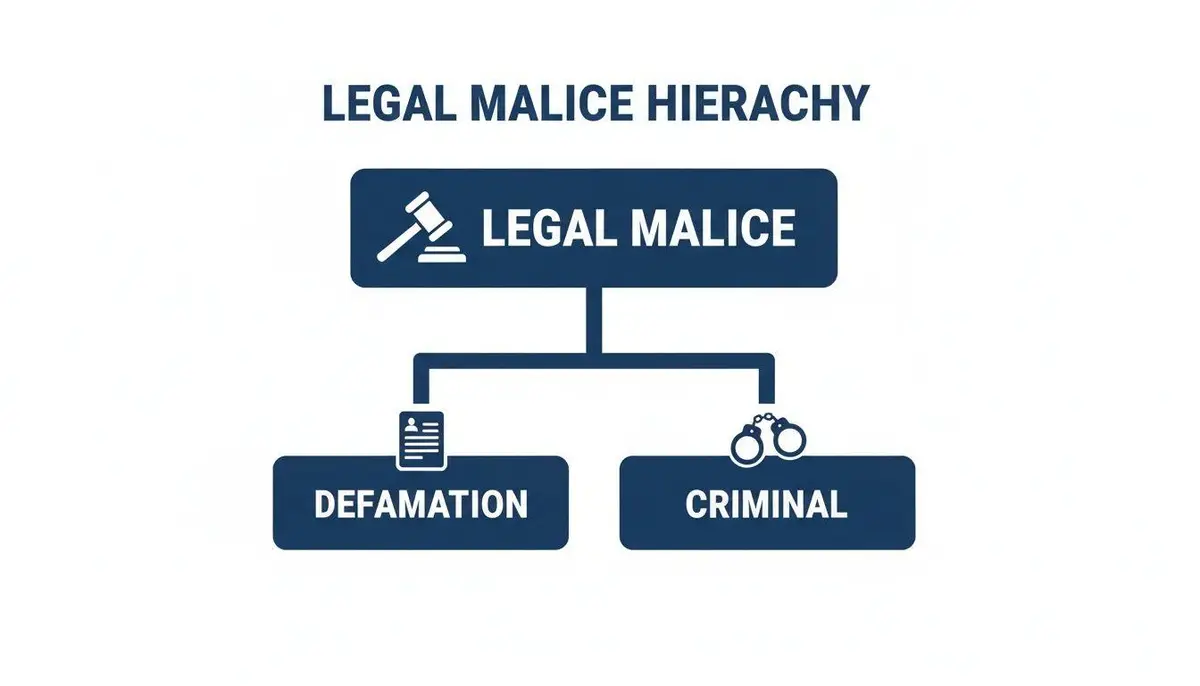
The path to proving malice splits depending on the context. An online outlet accusing a CEO of a poor business decision falls under defamation law. A false blog post accusing that same CEO of embezzlement could trigger criminal law implications. Each requires a distinct strategic response.
Key Insight: A court will not ask if the publisher disliked you. It will ask: Did the publisher know the statement was false, or did they publish it with a reckless disregard for whether it was true or not?
This is why so much damaging and seemingly malicious content remains online. Sloppy reporting, personal bias, or even outright animosity are often insufficient to clear this high legal hurdle.
Legal Malice at a Glance
A side-by-side comparison of the standards illuminates these critical differences. This table breaks down the primary types of legal malice, showing how context dictates the standard of proof and the ultimate consequences.
| Type of Malice | Legal Context | Core Standard | Primary Consequence |
|---|---|---|---|
| Actual Malice | Defamation (Public Figures) | Knew the statement was false or showed reckless disregard for the truth. | Allows a public figure to win a defamation lawsuit and claim damages. |
| Express Malice | Criminal Law (e.g., Murder) | The deliberate, unlawful intention to take a human life. | Can elevate a homicide charge to first-degree murder. |
| Implied Malice | Criminal Law (e.g., Murder) | An act whose natural consequences are dangerous to human life, performed with conscious disregard. | Can be sufficient for a second-degree murder conviction. |
Understanding these distinctions is crucial for developing a sound reputation defense. It allows you to determine whether litigation is a viable path or if other strategies, such as direct content removal, are a more efficient use of resources.
Grasping the nuances between these terms is the foundation for moving from a defensive posture to one of strategic control. The definitions that matter most in the digital realm are:
- Actual Malice: The formidable standard from New York Times v. Sullivan that governs defamation cases for public figures.
- Express and Implied Malice: Criminal law concepts that define intent for serious crimes but are often confused with the defamation standard.
Mastering these concepts is essential before taking any action.
How the Sullivan Ruling Redefined Defamation for Public Figures

Before 1964, defamation law in the United States was a far simpler landscape. If a newspaper published a false and damaging statement about a public official, a lawsuit was often a direct path to victory. The burden of proof was low, and newsrooms operated under the constant threat that a minor factual error could trigger a financially ruinous judgment.
A single, seismic Supreme Court decision changed everything. The landmark case was New York Times Co. v. Sullivan, a 1964 ruling that completely reshaped defamation law by creating the actual malice standard. The case arose after the New York Times published a full-page advertisement criticizing the conduct of Montgomery, Alabama’s police commissioner, L.B. Sullivan, during the Civil Rights Movement. The ad contained several minor inaccuracies, and an Alabama court awarded Sullivan $500,000 in damages.
The Supreme Court unanimously overturned this decision. Its reasoning was that a free press required protection to foster robust, and at times sharp, public debate. You can delve into the details of the actual malice test and its origins to see the depth of its legal foundations.
In one stroke, the Court established a much higher bar for public officials (and later, all public figures) to win a defamation suit. It was no longer sufficient to show that a statement was false and damaging. A public figure now had to prove the publisher acted with what the Court termed “actual malice.”
The Actual Malice Standard
The Court was precise in its definition of “actual malice,” and it is not what most people assume. It is unrelated to personal hatred, spite, or ill will. It pertains exclusively to the publisher’s state of mind regarding the truth of the published statement.
To prevail, a public figure must prove the publisher released a false statement with one of two elements:
- Knowledge of Falsity: The publisher knew the information was a lie but published it anyway.
- Reckless Disregard for the Truth: The publisher entertained serious doubts about the information’s veracity but proceeded with publication regardless.
This standard was designed to give the press “breathing space.” The Court understood that if honest mistakes or negligent reporting could lead to crippling lawsuits, journalists would be deterred from criticizing public officials. This high bar intentionally shields publishers from being punished for simple negligence.
What Is Reckless Disregard in Practice?
The second part of the test, reckless disregard, is where most modern defamation battles are fought and lost. It is a subjective standard, meaning the court must assess the publisher’s state of mind at the time of publication. The key question is not whether a responsible journalist would have verified sources, but whether this specific journalist actually entertained serious doubts about the story’s accuracy.
Key Takeaway: Proving reckless disregard requires hard evidence that the publisher knew their story was probably false and chose to publish it anyway. It is about a conscious decision to ignore red flags, not merely a failure to adhere to journalistic best practices.
This is the central challenge for any executive or public figure facing a modern smear campaign. A blogger who publishes a tip from an unverified anonymous source might be acting irresponsibly, but that alone is likely not reckless disregard. A news outlet that misinterprets a complex financial report may be negligent, but they have likely not acted with actual malice.
The shadow of the Sullivan decision looms large, explaining why so many factually incorrect and reputation-shattering posts, articles, and videos remain online. Unless you possess clear and convincing evidence that the publisher knew they were disseminating a lie, or had a high degree of awareness that it was probably false, the statement is protected. This reality makes proactive content removal and reputation management strategies far more effective than a long, expensive court battle.
The Modern Challenge of Proving Actual Malice
While the Sullivan case established the “actual malice” standard, subsequent court decisions have reinforced its high threshold. For any public figure attempting to combat a false and damaging story, this is where the battle is almost always lost. The issue is not proving the story was untrue. It is about proving what was in the publisher’s mind at the moment of publication.
Securing an admission of knowledge of falsity is extraordinarily rare. It would require a “smoking gun”, a leaked email or a whistleblower, proving the publisher knowingly ran a false story. Consequently, most cases hinge on the second, more elusive component of the standard: proving reckless disregard for the truth. This is not an objective test. The question is whether the publisher themselves had serious doubts about the story’s truthfulness. Two landmark Supreme Court cases defined what this means in practice, and understanding them is essential.
The High Bar for Reckless Disregard
First, in Curtis Publishing Co. v. Butts (1967), the Supreme Court extended the actual malice standard from public officials to public figures, such as prominent executives or celebrities. In that case, the Saturday Evening Post published a story accusing a famous football coach of fixing a game. Its sole source was a man with a criminal record, and the publication failed to corroborate the story. The Court found this to be a clear example of reckless disregard, the magazine’s complete failure to conduct basic fact-checking demonstrated a purposeful avoidance of the truth.
However, just a year later, the Court tightened this standard in St. Amant v. Thompson (1968). It clarified that simply relying on an unreliable source is not automatically reckless. To prevail, the plaintiff must show the publisher had “obvious reasons to doubt the veracity of the informant or the accuracy of his reports.”
The court in St. Amant drew a sharp line: “Reckless conduct is not measured by whether a reasonably prudent man would have published, or would have investigated before publishing. There must be sufficient evidence to permit the conclusion that the defendant in fact entertained serious doubts as to the truth of his publication.”
This distinction is what dooms so many defamation cases. Being a sloppy or even negligent journalist is insufficient to prove malice. You must prove the publisher made a conscious decision to print something they had a strong subjective belief was false.
The Stark Reality of Litigation
The data confirm the difficulty. The actual malice standard has pushed the success rate for public figures in U.S. defamation lawsuits to under 10%. Even when a case reaches the discovery phase, where internal communications can be examined, the chance of finding definitive proof of malice is only about 14%. The Freedom Forum’s comprehensive analysis of over 500 cases corroborates this trend.
For an executive, entrepreneur, or public figure, the message is clear: litigation is a long, expensive, and public gamble with a low probability of success. Before pursuing that path, it is critical to perform a strategic evaluation of online defamation lawsuits. This is precisely why a proactive strategy focused on content removal, rather than litigation, is often the most intelligent first move. It sidesteps the near-impossible task of proving malice and aims for the only outcome that truly matters: getting the harmful content removed quickly and discreetly.
The most dangerous attacks on a public figure’s reputation often involve accusations of criminal behavior. A misleading mugshot from a dismissed charge, a fabricated arrest record, or a blog post alleging fraud can be devastating. This is where we leave the world of defamation and enter the realm of criminal law, with its distinct definition of malice.
Malice in Criminal Law and Its Reputational Impact

While “actual malice” governs libel law for public figures, the criminal law concept of malice aforethought is entirely different. It has no connection to a journalist’s state of mind. Instead, it refers to the mental state required to commit some of the most serious crimes, particularly murder. Understanding this distinction is vital, as it fundamentally alters the strategy for removing such toxic online content.
Express vs. Implied Criminal Malice
In a criminal court, malice aforethought is not a single concept. It is broken down into two types of intent that prosecutors use to build a case for a major crime. These have nothing in common with the standards used in a defamation lawsuit.
- Express Malice: This is the deliberate intention to kill another person. It is a calculated, conscious decision.
- Implied Malice: This concept applies when an individual acts with such an extreme and conscious disregard for human life that their actions are almost certain to cause death. They might not have specifically intended to kill, but their behavior was so reckless that intent is implied. This is often described as having a “depraved heart.”
To illustrate: aiming a loaded firearm at someone and pulling the trigger constitutes express malice. In contrast, engaging in a game of Russian roulette, even with the hope that no one dies, demonstrates the profound recklessness that qualifies as implied malice.
The Reputational Fallout of Implied Criminality
The danger for an executive or public figure arises when online content falsely attributes this type of criminal intent to you. A viral post that twists a complex business decision into a scheme to defraud investors does not just defame. It implies the malicious intent that forms the basis of criminal charges. The same is true for a deceptively edited video that portrays a heated argument as a physical assault. It creates a powerful, false narrative of criminal malice that is incredibly difficult to dispel.
Across the United States, malice aforethought is the cornerstone of first-degree murder charges, whether based on direct intent or extreme recklessness. When you are fighting an online smear that falsely paints you as a criminal, litigation is rarely the best initial action. The goal is not to prove malice in a courtroom. It is to sever the connection between your name and the accusation. This requires a swift, technical approach focused on removing the content at its source and de-indexing it from search engines.
Specialized services focusing on these technical takedowns have demonstrated a 92% success rate in getting such content de-indexed from Google, often within 48 hours. This is a different battlefield than a public legal fight, and it demands a completely different strategy.
Strategic Content Removal Beyond Litigation
The difficulty of winning a defamation lawsuit is clear. The formidable standard of actual malice, the slow pace of the courts, and the poor success rate for public figures all lead to one conclusion: for an executive under attack, litigation is rarely the correct first step. It is an expensive, unpredictable, and public ordeal for a problem that demands speed, discretion, and a definitive resolution.
A superior alternative exists, one that bypasses the courtroom and the need to prove the malice legal definition entirely. This approach is not about legal theory; it is about tactical action. It involves using proven, targeted methods to remove damaging content directly at the source, effectively neutralizing the threat before it can proliferate.
Shifting from Legal Theory to Tactical Execution
Attempting to solve a fast-moving digital crisis with a lawsuit is like performing microsurgery with a sledgehammer. The tools are mismatched for the task. A malicious article can circle the globe in hours, causing devastating harm long before a lawyer files an initial complaint.
The modern, effective solution operates on a simple truth: online platforms, search engines, and web hosts all have their own terms of service. These internal policies offer a much faster and more direct path for content removal than the legal system. A post might not meet the legal standard for defamation, but it can still be a blatant violation of a platform’s rules against harassment, misinformation, or impersonation.
A tactical content removal expert is not focused on winning a legal debate over malice. Our sole objective is to get the damaging material offline. We achieve this by identifying the path of least resistance, whether through a platform’s reporting system, direct negotiation with a site owner, or by removing the content from search engine results.
This is a fundamentally different approach. It is about getting ahead of the problem and controlling the narrative, not merely reacting to the damage after it has been done.
A Multi-Pronged Approach to Neutralize Threats
A successful removal strategy is never a single action. It is a coordinated campaign that addresses the problem from multiple angles simultaneously, using specific tactics for different types of attacks. Each situation is unique and demands a tailored response.
The correct approach depends entirely on the nature of the threat:
- False News Articles: The first step is often a direct, factual appeal to the publisher, pointing out clear errors and violations of their own journalistic standards. If they are uncooperative, the focus pivots to de-indexing, ensuring the article is removed from search results so it cannot be found by the public.
- Defamatory Social Media Campaigns: These attacks require speed. The key is to leverage the platforms’ own reporting tools for harassment, hate speech, or coordinated attacks to secure immediate removal. The campaign must be dismantled before it goes viral. We have honed our ability to remove defamation from online platforms by mastering these complex and constantly evolving systems.
- Leaked Private Information or NCII: When private photos or documents are leaked, every second counts. The strategy involves immediate takedown notices to platforms and web hosts, citing policies like the Digital Millennium Copyright Act (DMCA) or rules against non-consensual intimate imagery. The only acceptable outcome is complete removal.
- Impersonation Accounts: Combating fake profiles requires a swift verification and takedown process directly with the platform. This is critical to prevent someone from using your name and likeness to destroy your reputation or defraud others.
This technical, layered strategy delivers the speed and confidentiality that litigation cannot. It achieves a concrete result, the removal of the content, without the immense risk, cost, and public exposure of a court battle.
Protecting Your Reputation Before Malice Strikes
The most effective way to win a fight over your reputation is to avoid it entirely. Once you are in a courtroom attempting to prove the malice legal definition, you are already reacting from a disadvantaged position. True reputation management is not about crisis response; it is about constructing a fortress around your name so that attacks cannot land in the first place.

This change in mindset shifts you from defense to fortification. It is built on establishing a strong positive online presence, monitoring for threats continuously, and having a clear action plan. Chasing down every negative comment is an exhausting and unwinnable game. The smarter play is to know what a genuine threat looks like and have a precise, rapid response protocol ready.
Building a Resilient Digital Footprint
Waiting for a damaging article or social media firestorm to hit your desk means you have already lost control of the narrative. The key is to identify these threats the moment they appear, long before they gather momentum and escalate into a full-blown crisis.
This is where modern monitoring is indispensable. It acts as your digital radar, constantly scanning the surface web, dark web, and social media platforms for any mention of your name or company. These tools serve as an early-warning system, flagging potential risks as they emerge.
A proactive strategy recognizes that the best defense is a strong offense. By the time you are forced to argue about malice, the damage to your reputation is already done. The goal is to make your digital presence so resilient that most attacks never gain the oxygen they need to survive.
With this intelligence, you can separate harmless background noise from a credible, developing threat. This gives you the power to act from a position of strength, not panic. Once you understand the landscape, you can make an informed decision on when to intervene and when to let an issue resolve itself. You can learn more about protecting the personal information of public figures and begin constructing that digital shield.
From Vulnerability to Fortification
The conclusion is simple: do not wait for a major crisis to identify your vulnerabilities. The time to act is now, during periods of calm, not when your reputation is under siege. When you build a protective barrier around your name, you stop playing defense and start exercising strategic control.
A confidential assessment is the crucial first step. It is a deep analysis that identifies your specific risks and provides a blueprint to strengthen your digital presence. It ensures that when a threat does surface, you have the plan and the tools ready to neutralize it quickly and discreetly, long before a lawsuit becomes part of the conversation.
Frequently Asked Questions About Malice and Defamation
When your reputation is on the line, clear answers are non-negotiable. This section addresses the most pressing questions we receive from executives and public figures navigating the complexities of online defamation. Our objective is to cut through the legal jargon and provide the clarity needed to make strategic decisions under pressure.
What Is the Difference Between a Public and Private Figure?
In a defamation case, this distinction is paramount. A public figure is precisely who one would expect: a celebrity, a high-profile CEO, a politician, or an individual who voluntarily enters a public debate. Because they command public attention, courts have set an exceptionally high bar for them to win a defamation suit: they must prove actual malice.
A private figure, an individual who has not sought public attention, has a much lower burden of proof. They typically only need to show the publisher was negligent, meaning they failed to exercise reasonable care. This is a far lower hurdle to clear.
Is an Opinion Actionable if It Implies a False Fact?
Generally, pure opinion is protected by the First Amendment and is not actionable. A statement like, “I believe his business strategy is a failure,” is a subjective assessment.
However, that protection vanishes if an “opinion” implies a false statement of fact. For instance, stating, “In my opinion, John Doe is a thief,” is not merely an opinion if it suggests the speaker has undisclosed factual knowledge to support the claim. The line between protected opinion and actionable defamatory implication is highly context-dependent, making litigation over it a significant gamble.
Strategic Consideration: The ambiguity between opinion and fact is a prime example of why direct content removal is often the superior strategy. It bypasses the messy legal debate and achieves a faster, more predictable result without the risks of public litigation.
How Does Online Anonymity Affect Proving Malice?
Anonymity introduces a formidable obstacle. Before you can even begin to prove malice, you must first identify the anonymous attacker. This requires obtaining a court order to compel an internet service provider or a social media platform to disclose the user’s identity.
This legal process, often known as a “John Doe” lawsuit, is a protracted and expensive endeavor that frequently leads to a dead end, particularly if the individual used sophisticated methods to cover their digital tracks. Even if you succeed in unmasking the poster, you still face the challenge of proving they acted with actual malice. This is precisely why we advocate for strategies that target the harmful content itself. It can be removed regardless of whether the perpetrator is ever identified.
When your reputation is under fire, you cannot afford slow, uncertain legal battles. At ContentRemoval.com, we specialize in direct takedown strategies that neutralize threats quickly and discreetly. We get the harmful content offline before it has a chance to spread. Start with a confidential assessment to protect your reputation.