
A legal professional’s online reputation is a live exposure surface that shapes intake, referrals and negotiations, and lawyers cannot freely rebut attacks without risking client confidentiality. The playbook is to build owned assets before a crisis, monitor name variants in incognito search weekly, triage incidents into four categories, and pursue source removal, de-indexing or legal pressure in that order.
Key facts
- Incognito searches for your name, firm and words like complaint, sanction or scam reveal what clients see.
- Public replies must not debate facts, imply representation details or reveal confidential information.
- Platform reports work best when they quote the specific rule breached and attach exact URLs and screenshots.
- Cited figures put EU right-to-be-forgotten compliance far above US First Amendment takedown success.
Where ContentRemoval.com comes in. ContentRemoval.com works with lawyers and their firms when a non-client review, forum accusation, impersonation profile or recycled news item is indexed for their name and a public reply would breach confidentiality. The managing partner or the lawyer’s own counsel usually gets in touch once a platform report has gone nowhere. A free 15-minute Exposure Scan maps what can be removed, de-indexed or suppressed across platforms and jurisdictions, and the report is yours to keep. Get a Free, Confidential Exposure Scan or read how our reputation management work is done.
You’re in your office before court. A colleague forwards you a link with no explanation. It’s a review, a forum post, or a recycled news item, and it attaches your name to misconduct, incompetence, or some invented conflict. By the time you open it, a prospective client has already seen it. So has a referral source. Maybe opposing counsel has too.
That’s the reality of legal professional online reputation. It isn’t a branding exercise. It’s a live exposure surface that affects intake, referrals, negotiations, and your standing with the people who decide whether to trust your judgment. Lawyers often underestimate this because they assume credentials and results will outweigh noise. Online, that assumption fails fast.
The Digital Courtroom Where Reputations Are Won and Lost
A lawyer’s first mistake is treating online attacks as background chatter. They’re not. They’re public allegations, indexed, screenshot, recirculated, and stripped of context. A bar complaint rumor on a review site. A one-star post from someone who was never your client. A headline about a former matter that resurfaces when your name is searched. Each one forces you into a defensive posture before you’ve spoken a word.

The internet acts like an uncontrolled courtroom. There’s accusation, inference, and public reaction, but rarely procedure. No evidentiary filter. No neutral fact finder. No meaningful penalty for a bad-faith poster unless you push the issue into a forum that has rules.
That matters because prospective clients now vet you there first. 80% of potential clients seek out and consider an attorney’s online reviews before hiring them, and 64% conduct their first research step online for legal problems, according to legal marketing data summarized by Attorneysluice. The same source notes that businesses actively monitoring their online reputation achieve a 510% increase in review volume and maintain an 88% positive review share.
What one bad result actually does
A damaging result doesn’t just offend you. It changes behavior.
- Prospective clients hesitate: They may never call, and you’ll never know why.
- Referral sources grow cautious: Nobody wants to send a valuable relationship into uncertainty.
- Opponents find an advantage: Even weak claims can be exploited if they support a narrative.
- Your staff absorbs the fallout: Intake teams, associates, and assistants field the confusion.
Practical rule: If a negative result appears on page one for your name, treat it as a business and professional risk issue on day one, not a communications issue on day thirty.
Lawyers also face a constraint that most other professionals don’t. You can’t freely “set the record straight” if doing so risks client confidentiality, prejudices a matter, or creates a misleading public statement. That makes unmanaged attacks more dangerous. The poster can say too much. You often can’t.
The wrong instinct
The common impulse is to fire back publicly. That usually creates more exposure, not less. A defensive response can confirm the post to people who never would have noticed it, invite copycat attacks, or trigger ethics problems if you reveal facts tied to representation.
Your reputation online is now part of your risk profile. Treat it with the same seriousness you’d apply to privilege, cybersecurity, or trust-account controls. Delay is expensive. Silence without strategy is worse.
Proactive Defense Building Your Reputational Firewall
If your search results are empty, stale, or controlled by third parties, you’re exposed. A reputational firewall starts with owned and semi-owned assets that you control before a crisis hits. The point isn’t vanity. The point is to give search engines, referral sources, and prospective clients strong, accurate material to rank ahead of gossip, low-quality directories, and malicious posts.
A thin digital footprint invites distortion. A developed one resists it.
Build assets that can hold page one
Most lawyers already have raw material. They just haven’t structured it into defensible assets. Start with the fundamentals and do them properly.
- A complete firm profile and attorney profile
Your biography should be more than a résumé pasted into a web page. It needs clear practice focus, jurisdiction, representative experience stated carefully, publications, speaking engagements, and media-ready credentials. If you want a useful model for structure and clarity, review a well-built professional attorney bio and note how it organizes authority without resorting to hype. - Platform profiles that reinforce identity
Claim and complete your profiles on the platforms that matter in legal search and vetting, including LinkedIn, Google Business Profile, Avvo, and relevant directories for your jurisdiction and practice area. Consistency matters. Name format, headshot, firm description, and practice-area language should align. - Thought leadership tied to actual client concerns
Publish under your own name on subjects clients search when they’re anxious and evaluating counsel. Not generic legal commentary. Write the article a general counsel, founder, or individual client hopes exists when a problem lands on their desk.
What to publish
A firewall works when it answers the questions that would otherwise send people into uncontrolled corners of the internet.
Use a mix such as:
- Issue analysis: Short pieces on new rulings, enforcement shifts, or procedural pitfalls in your practice.
- Client guidance: Plain-English explainers on what to do in the first day, week, or month after a triggering event.
- Professional appearances: Webinars, podcast interviews, panel clips, and conference recaps under your name.
- Institutional credibility: Bar activity, teaching, publications, and carefully framed case-related experience.
A strong online reputation for a lawyer is built before it’s tested.
The numbers support a proactive buildout. Firms with 50+ positive reviews across platforms report 28% higher client acquisition, proactive content creation can drown out negative search results in 80% of cases within 90 days, and top legal professionals build at least 10+ high-authority digital assets before a crisis to ensure 65% resilience against attacks, according to Titletap’s review of lawyer reputation management benchmarks.
Reviews matter, but ethics matter more
You should ask satisfied clients for reviews. You should not manipulate the process, script facts, pressure vulnerable clients, or invite selective dishonesty. Lawyers get into trouble when they treat review acquisition like consumer retail.
Use a compliant review process:
| Focus area | Sound approach | Risky approach |
|---|---|---|
| Timing | Ask after a matter reaches a natural closing point | Ask during active pressure points in representation |
| Language | Request honest feedback in the client’s own words | Provide talking points that overstate results |
| Selection | Apply a neutral process | Cherry-pick only clients likely to bury criticism |
| Follow-up | One or two professional reminders | Repeated pressure that feels coercive |
Control the narrative with specificity
Vague websites don’t rank well and don’t persuade serious clients. Specificity does. If you defend physicians in licensing matters, say so. If you represent founders in internal investigations, say so. If you handle cross-border disputes, say so. Generality leaves room for third parties to define you.
The reputational firewall is simple in concept. Publish enough accurate, authoritative material under your name that a hostile result has to fight for oxygen. If you don’t occupy your own search domain, someone else will.
Vigilant Monitoring The Early Warning System
Most lawyers find harmful content too late. They see it after a client mentions it, after a colleague forwards it, or after intake slows for reasons nobody can explain. That’s operational failure. Monitoring isn’t optional if your name generates business.
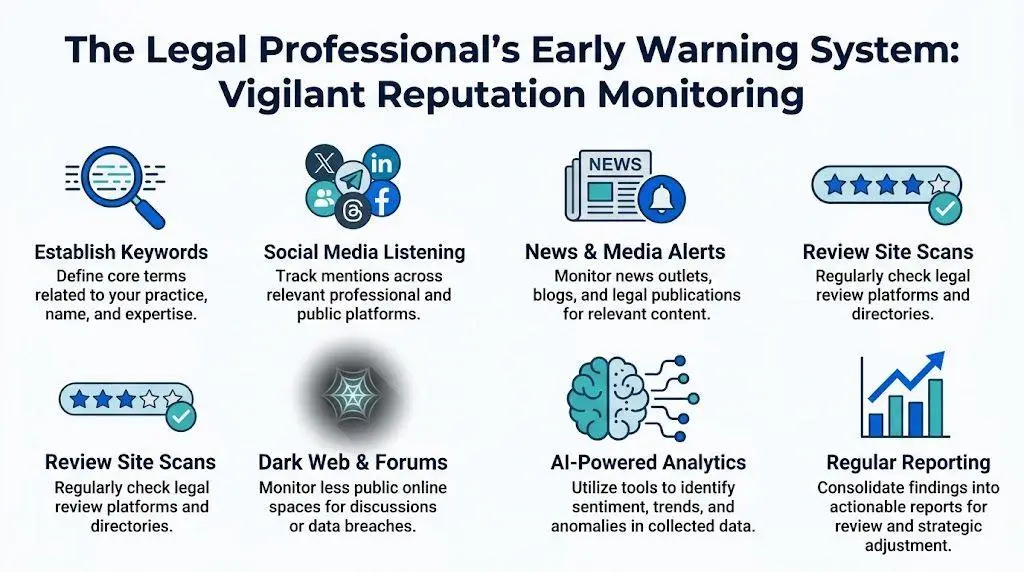
The baseline is not difficult, but it does require discipline. Start with incognito searches for your full name, common name variations, firm name, and practice-specific combinations. Search the way a worried client searches, not the way you search when you already know the facts. Then layer in alerts and platform checks.
Start with visibility, not assumptions
The most common error is assuming your own search results reflect what the public sees. They often don’t. Personal browsing history, device behavior, and logged-in accounts distort the picture. Incognito checks reduce that distortion and expose what prospective clients are encountering.
The monitoring methodology matters. A rigorous monitoring process begins with incognito searches to map visibility. Firms that establish automated tracking with tools like Google Alerts or Mention achieve 95% coverage of top review platforms and see 30% faster issue detection. Critically, 62% of firms neglect incognito auditing, missing an estimated 40% of negative content visible to potential clients, according to Clio’s discussion of lawyer reputation management practices.
What to monitor every week
Don’t monitor everything equally. Monitor the places where legal reputations are shaped.
- Search results for name variants: Your name, your firm, and combinations with words like review, complaint, lawsuit, sanction, ethics, fraud, and scam.
- Review and directory platforms: Google, Avvo, Yelp, and jurisdiction-specific legal directories.
- Professional platforms: LinkedIn posts, comments, and mentions.
- News and blog mentions: Local media, niche legal publications, and industry blogs.
- Forums and discussion sites: Reddit, Quora, and any practice-area communities where lawyers are named.
- Dark-web and breach chatter: Especially if you handle prominent clients, sensitive matters, or politically exposed parties.
A manual process catches some of this. A proper system catches more, earlier. If your firm doesn’t have an established protocol, a dedicated reputation monitoring process is the right place to start.
Grade alerts before you react
Not every mention deserves the same response. A disciplined monitoring system sorts alerts by legal risk, visibility, and velocity.
| Alert type | What it usually means | Immediate action |
|---|---|---|
| New negative review | Potential client-facing reputational harm | Preserve screenshots, assess authenticity, review platform rules |
| Forum accusation | Narrative risk with possible amplification | Archive, identify poster pattern, avoid public argument |
| News pickup | Broader credibility issue | Review for factual error, authorship, syndication, and legal options |
| Impersonation or fake profile | Identity misuse with client confusion risk | Report quickly, preserve evidence, warn internal stakeholders |
Operational advice: Route alerts to one decision-maker and one backup. Group inboxes create delay, and delay lets bad content spread.
Monitoring has to include people, not just software
Assign responsibility. Someone must own the dashboard, preserve evidence, and escalate by severity. If that function is split across marketing, intake, and a partner who checks email at midnight, your response will be inconsistent.
Your early warning system should answer four questions immediately: What appeared, where did it appear, who has seen it, and what happens if we do nothing for seventy-two hours? If you can’t answer those four, you aren’t monitoring. You’re hoping.
Incident Response Triage and Strategic Engagement
Once harmful content appears, speed matters. So does restraint. Lawyers damage themselves when they confuse visibility with priority and emotion with strategy. The first task is triage. You need to know what you’re dealing with before you touch it publicly.

Four threat categories
Most incidents fall into one of four buckets, and each demands a different response.
Genuine client dissatisfaction
This is the only category where a limited public response is often useful. Even then, your reply must be restrained. Don’t debate facts. Don’t imply representation details. Don’t sound wounded.
A sound response acknowledges concern, invites offline contact, and avoids admitting fault or revealing confidential information. The audience is not the reviewer. It’s everyone else reading.
Non-client false review
This category is common and mishandled constantly. If the poster was never a client, don’t engage on the facts in a way that suggests a confidential relationship might exist. Preserve the review, document why it appears false, and use the platform’s reporting process with precision.
Publicly, less is more. A broad denial can inflame the poster or encourage additional attacks.
Competitor, activist, or bad-faith campaign
This usually appears as clusters. Similar wording across platforms. Newly created accounts. Repeated accusations that sound coordinated. Here, a public back-and-forth is a mistake. The objective is evidence preservation, pattern identification, and quiet escalation.
Defamatory publication or viral shaming event
This is the highest-risk category. It may involve articles, social posts, edited clips, old allegations recirculated without context, or accusations attached to your firm name. Here, an unplanned response often worsens discoverability. You need a litigation-aware communications position, not a spontaneous rebuttal.
If a response would require you to mention client facts, litigation strategy, sealed material, or internal firm details, don’t post it.
The response test
Before publishing anything, run it through three filters:
- Ethics: Does this reveal or imply confidential information?
- Escalation risk: Will this draw more attention to a low-visibility item?
- Evidence value: Have you preserved screenshots, URLs, timestamps, and account details first?
Lawyers often skip the third point because they assume the platform will preserve the record. Don’t rely on that. Preserve your own evidence immediately.
When public engagement helps and when it hurts
A short comparison is useful here.
| Situation | Public reply | Better move |
|---|---|---|
| Real client complaint with measured language | Sometimes | Brief acknowledgment and offline invitation |
| False review from unknown identity | Rarely | Preserve, report, investigate authenticity |
| Coordinated attack | No | Quiet evidence collection and escalation |
| Defamatory article or viral post | Usually no | Removal assessment, legal review, de-indexing strategy |
Later in the process, a more formal strategy often makes sense. If you need a framework for handling public humiliation, targeted abuse, or a viral pile-on, this strategic response guide to being publicly shamed online gives a useful decision lens.
A short briefing on public-response discipline is worth watching before anyone on your team starts typing.
Red lines that require escalation
Some events should move out of routine review management immediately:
- The content alleges criminal, unethical, or fraudulent conduct
- The attacker appears anonymous and persistent
- The post is indexed for your name and firm
- The allegation crosses borders or platforms
- The issue touches active litigation, regulatory exposure, or client confidentiality
- Staff, family members, or clients are being contacted
Counsel’s rule: The moment the issue stops being a comment and starts becoming a dossier, you need a formal response plan.
Triage is about choosing the least harmful effective move. Not every attack deserves a reply. Some deserve silence, evidence collection, and removal pressure. Others justify immediate legal escalation. The worst option is improvised engagement by a lawyer who is personally angry and ethically constrained.
Pursuing Removal De-Indexing and Legal Action
Some content won’t be solved by better reviews, cleaner profiles, or polite responses. If the material is false, abusive, impersonating, privacy-invasive, or unlawfully published, you move to removal. During removal, many lawyers waste time because they pursue the wrong mechanism in the wrong order.
There are three distinct paths. Source removal. Search de-indexing. Legal pressure. They overlap, but they’re not interchangeable.
Source removal first
If a platform’s own rules prohibit the content, start there. Fake reviews, impersonation, privacy violations, non-consensual intimate material, copyright misuse, and certain forms of harassment often fit platform enforcement categories more cleanly than broad accusations of “defamation.”
The mistake is filing emotional, vague complaints. Platforms respond better to documented rule violations tied to their specific terms. Quote the category that applies. Attach screenshots. Provide the exact URL. Explain why the content violates policy without turning the report into a legal brief.
De-indexing is different from deletion
Many lawyers fixate on deleting the source and ignore search visibility. That’s a mistake. In some matters, the practical objective is to stop the content from appearing when your name is searched, even if the original page remains live somewhere obscure.
De-indexing requests can be effective when the content is outdated, privacy-invasive, or legally unsupported in the relevant jurisdiction. But de-indexing is not a universal remedy. Search engines apply different standards than publishers, and many requests fail because the submission doesn’t match the legal pathway available.
Legal pressure works when the facts are aligned
Cease-and-desist letters have a role. So do defamation claims, privacy claims, and demands tied to impersonation, copyright, or contractual breach. But sending an aggressive letter without a credible enforcement path is often counterproductive. It alerts the poster, encourages republication, or triggers a “lawyer tries to silence criticism” narrative.
Use legal pressure when you can answer yes to these questions:
- Is the statement factual and false, not merely insulting or opinionated?
- Can you identify the publisher, poster, host, or an intermediary with obligations?
- Do you have admissible evidence of falsity or unlawful publication?
- Will escalation improve your position rather than publicize the dispute?
Removal strategy fails when lawyers treat every ugly statement as actionable defamation. The law doesn’t work that way, and neither do platforms.
Cross-border problems change everything
Legal professional online reputation becomes more complicated than standard review management. Jurisdiction controls options. The same content may be removable in one region and effectively protected in another.
The cross-border gap is stark. EU platforms comply with GDPR right-to-be-forgotten requests around 85% of the time, while takedown success rates for US-hosted sites on First Amendment grounds are often below 20%. Reactive responses in cross-border cases fail an estimated 70% of the time due to platform non-cooperation, according to MileMark Media’s discussion of attorney reputation management and takedown complexity.
That means a lawyer licensed in one jurisdiction, practicing in another, and reviewed on a US-hosted platform by a foreign poster may face conflicting legal standards at every stage. Privacy law, speech law, platform location, hosting provider location, and search-engine policies all matter.
A practical escalation model
When the issue is serious, use this sequence:
- Preserve evidence immediately: Screenshots, source code capture if needed, timestamps, user identifiers, and search-result placement.
- Map the ecosystem: Source URL, mirrors, syndication, reposts, cached copies, and search indexing.
- Choose the removal path: Platform report, de-indexing request, legal notice, or combined approach.
- Control republication risk: Don’t tip off the attacker without a plan for copies and reuploads.
- Review jurisdiction before filing: Especially if the content or parties cross borders.
In certain matters, lawyers also need support beyond a traditional law firm or PR consultant. A service provider such as ContentRemoval.com can handle takedowns, de-indexing, false review removal, and monitoring across platforms where standard legal correspondence alone often stalls.
DIY removal works for simple, low-visibility issues. It breaks down when the content is syndicated, anonymous, hostile, or spread across jurisdictions. At that point, precision matters more than indignation.
Engaging Professional Services for Certainty and Speed
Most lawyers can handle routine criticism internally. They can’t always handle persistent attacks, anonymous campaigns, cross-platform impersonation, breach-related exposure, or multi-jurisdictional removal battles without wasting time and creating risk. The question isn’t whether you’re smart enough to understand the problem. You are. The question is whether the matter justifies specialist execution.
Often it does.
When internal handling is no longer enough
Bring in specialist support when any of the following is true:
- The attacker is unknown or coordinated
- The content has migrated across multiple sites
- Search results are already affected
- The issue crosses borders or legal regimes
- Your response is constrained by confidentiality or litigation posture
- Speed and discretion matter more than experimentation
This is now a front-end business issue as much as a reputational one. In 2026, 75% of individuals seeking attorneys use online resources, and 70% are willing to travel further for those with superior online reputations. The same projection reports AI adoption for monitoring surged to 79% among legal professionals, and firms that actively manage their reputation see a 3-year marketing ROI of 526%, according to Broadly’s analysis of online reviews for lawyers.
That combination should change how you think about outside help. Attacks move faster, search surfaces are broader, and the cost of delay is higher. A specialist doesn’t replace legal judgment. A specialist shortens the path from discovery to containment.
What competent outside help should provide
You shouldn’t hire vague “online reputation” help. You should expect a defined process.
| Capability | Why it matters |
|---|---|
| Evidence preservation | You need a clean record before content changes or disappears |
| Platform-specific removal knowledge | Each platform enforces different rules and evidentiary thresholds |
| De-indexing strategy | Search visibility often matters as much as source deletion |
| Cross-border handling | Jurisdictional mistakes waste time and reduce leverage |
| Ongoing monitoring | Removal without watchfulness invites reappearance |
If you’re evaluating whether to escalate, this guide to evaluating professional content removal services is a useful screening tool.
The right time to engage specialist help is before your internal team starts improvising.
The legal profession runs on trust, discretion, and perceived judgment. Online attacks strike all three. If the matter is small, handle it carefully. If it’s persistent, indexed, anonymous, or cross-border, treat it like a high-stakes exposure event and bring in people who do this work every day.
If your name, firm, or practice is under attack online, don’t guess your way through it. ContentRemoval.com provides confidential assessments for lawyers facing false reviews, defamatory posts, impersonation, invasive search results, and complex takedown scenarios across platforms and jurisdictions.
Frequently asked questions
Should a lawyer respond publicly to a negative review?
Only for genuine client dissatisfaction, and even then briefly: acknowledge the concern, invite offline contact, and avoid admitting fault or revealing confidential information. For non-client false reviews, coordinated campaigns or defamatory publications, a public reply usually inflames the poster or draws attention, so preserve evidence and use the platform’s reporting process instead.
How should a law firm monitor its online reputation?
Run weekly incognito searches for your name, name variants, firm name and combinations with words like review, complaint, lawsuit or scam, then check Google, Avvo, Yelp, LinkedIn, local media, Reddit and any practice-area forums. Route alerts to one decision-maker and one backup, and grade each by legal risk, visibility and velocity before acting.
When should a lawyer escalate an online attack beyond routine review management?
When the content alleges criminal, unethical or fraudulent conduct, the attacker is anonymous and persistent, the post is indexed for your name and firm, the allegation crosses borders or platforms, the issue touches active litigation or client confidentiality, or staff, family or clients are being contacted.