
Hiring a lawyer for defamation should come after evidence preservation and a decision about which path ends the damage fastest. A viable claim needs a false statement framed as fact, published to others and harmful, with public figures also proving actual malice. Good counsel handles anonymous publishers, platform enforcement, search indexing and reuploads, and knows when litigation becomes the story.
Key facts
- Preserve screenshots, URLs, timestamps, metadata and witness context before contacting the publisher.
- Public figures must meet the actual malice standard from New York Times Co. v. Sullivan.
- Defamation filing deadlines are short and vary by state; missing one bars the claim.
- Discovery exposes your own communications about the allegation and its business impact.
Where ContentRemoval.com comes in. ContentRemoval.com is the execution layer that sits alongside defamation counsel: source removal, de-indexing, impersonation takedowns and reupload monitoring while the legal track proceeds. Executives, founders and their attorneys bring us in when a false allegation has spread across several domains and a lawsuit alone will not clear the search results. A free 15-minute Exposure Scan maps which copies are removable and how, and the report is yours to keep. Get a Free, Confidential Exposure Scan or read how our defamation removal work is done.
You search for a lawyer for defamation when something false is already costing you. A post names you. A review accuses your company of fraud. A burner account republishes the allegation with screenshots, and then search results start doing the rest of the work. By the time your assistant flags it, clients have seen it, investors have questions, and silence starts to look like confirmation.
That’s the wrong moment to think only in terms of a lawsuit.
The right question is control. You need to know what to preserve, what can be removed quickly, what should be escalated, and whether litigation will fix the problem or turn a private mess into a public file. If you’re an executive, founder, investor, or public figure, speed and discretion usually matter as much as legal merit.
Your Reputation Is Under Attack What Now
Many individuals make the same mistake in the first hour. They either fire off an angry response or they call a general litigator who immediately starts talking about defamation in the abstract. Neither move solves the immediate problem.
A reputational attack rarely stays confined to the original post. It gets screenshotted, indexed, reposted, and discussed by people who never saw the source. That’s why your first job isn’t to “win.” It’s to stop further spread while preserving every piece of evidence you may need later.
A lawyer for defamation can be necessary, but not every crisis should begin with a complaint in court. Some attacks are better handled through source removal, platform reporting, search de-indexing requests, and carefully timed legal notices. Others require immediate legal escalation because the publisher is persistent, anonymous, or clearly targeting business relationships.
Practical rule: Treat this as reputation damage control first, litigation second.
If you’re dealing with active online smears, start with a structured response, not improvisation. A strong overview of that response appears in this strategic guide for victims of online defamation. The key is simple. Don’t let panic dictate the sequence.
The clients who recover fastest usually do three things well. They preserve evidence before it disappears. They choose the removal path that matches the platform, and they retain counsel only after they understand whether legal pressure will speed up resolution or slow it down.
Your First 24 Hours A Triage and Evidence Plan
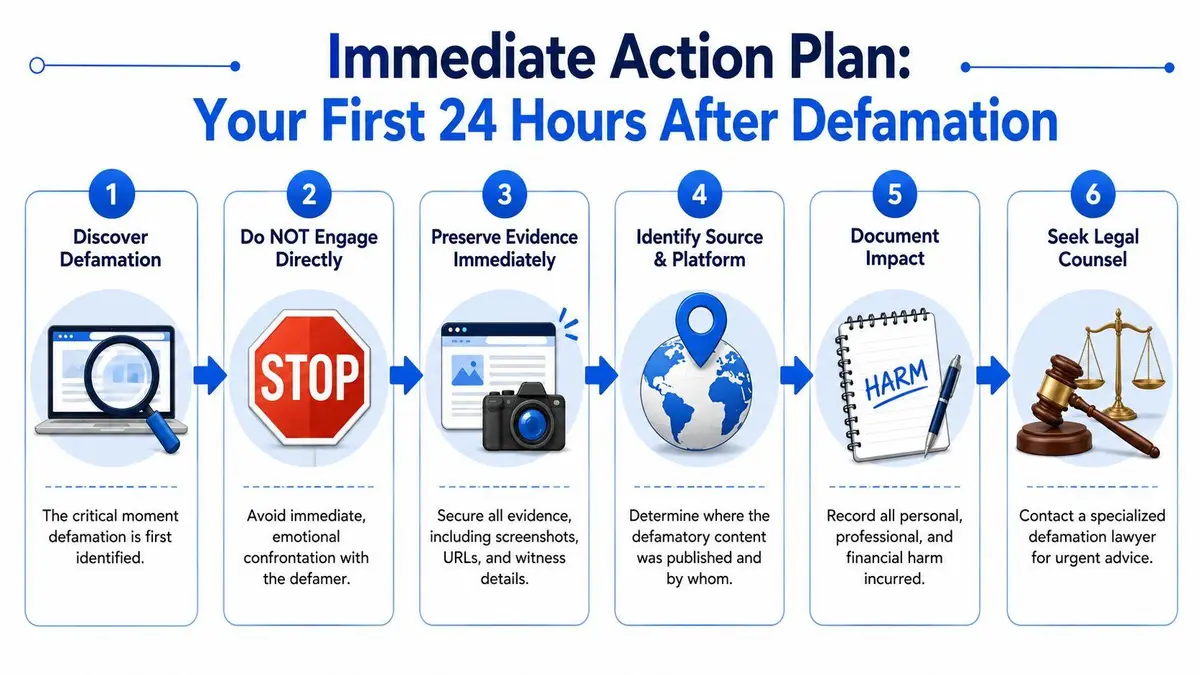
Your first day matters more than is often realized. A post can be deleted, edited, mirrored, or buried while still continuing to circulate in private messages and search snippets. Once the original context is gone, proving what was published and when becomes harder.
For high-stakes matters, practitioners note that defamation work is front-loaded into evidence preservation first, including screenshots, URLs, timestamps, metadata, and witness context before any other action is taken, as discussed in Best Lawyers’ guide on suing for defamation.
Preserve before you protest
Don’t contact the publisher first. Don’t threaten them in writing. Don’t post a rebuttal while the evidence is still loose.
Start here:
- Capture the statement exactly as published. Take screenshots that show the full statement, username, platform, date, URL, and any visible engagement.
- Save the location data. Copy direct links, archive the page if possible, and record where the content appears in search results.
- Preserve surrounding context. Comments, captions, reposts, profile pages, and linked media often matter as much as the main accusation.
- Identify witnesses. If colleagues, customers, or family members saw the statement, note who they are and when they saw it.
- Document impact immediately. Save emails, canceled meetings, lost opportunities, and messages asking whether the allegation is true.
A strategic response often starts with a targeted reporting path. If the content violates platform rules, impersonates you, uses stolen media, or contains other removable features, removal may happen faster through the platform than through a courtroom. This guide to reporting a defamatory website is useful when the publisher sits behind a site owner, host, or third-party platform.
Choose between fast removal and formal escalation
People need judgment, not slogans, in these circumstances. A lawyer for defamation is one tool. Sometimes it’s the right tool. Sometimes it’s too slow.
Here’s the practical decision frame:
| Situation | Likely first move |
|---|---|
| Fake profile, impersonation, or clear platform-rule violation | Platform complaint and identity-based removal request |
| Anonymous blog post repeating factual allegations | Evidence preservation, tracing strategy, legal review |
| False accusation on a review platform | Assess whether it’s opinion, factual assertion, or policy violation |
| Private extortion or smear threat | Immediate counsel, evidence lock, controlled response |
| Search-result crisis involving reposts and screenshots | Blended removal and search-suppression strategy |
A cease-and-desist or demand letter can work, but only if it’s timed correctly. Sent too early, it can trigger deletion of evidence, a retaliation post, or a louder campaign. Sent well, it can force the publisher, host, or counsel on the other side to reassess their exposure without turning the dispute into a spectacle.
Preserve first. Then decide whether your fastest path is platform enforcement, private legal pressure, or a complaint.
One more point. Don’t confuse emotional satisfaction with strategic value. Public rebuttals feel decisive. They also often give the allegation a second life.
Assessing the Viability of Your Defamation Claim
At 6:30 a.m., a false accusation about you or your company appears on page one of Google. By noon, investors, board members, or reporters may have seen it. The first legal question is not whether the post is offensive. It is whether you have a claim strong enough to support the outcome you want, and whether a lawsuit helps or slows that outcome.
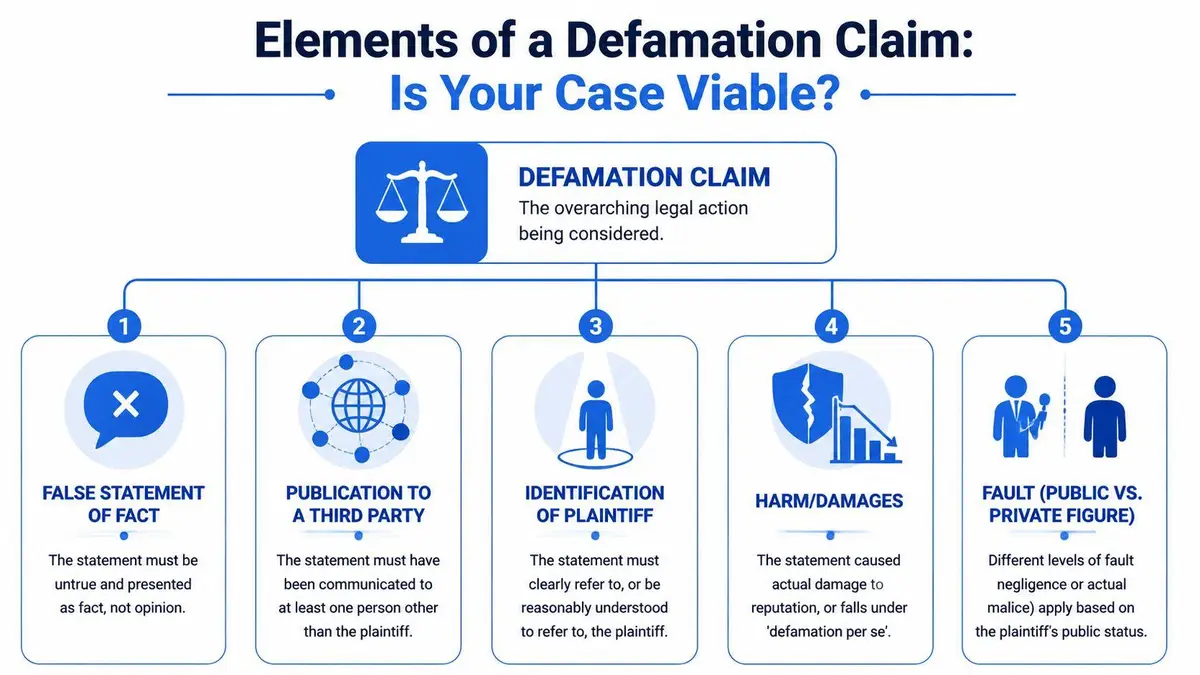
A viable defamation claim usually starts with four points. The statement must be false, framed as fact rather than opinion, published to someone else, and harmful to reputation. If you are a public official or public figure, you also need to deal with the higher actual malice standard from New York Times Co. v. Sullivan, meaning knowledge of falsity or reckless disregard for the truth, as explained in Carter-Ruck’s guide to defamation and privacy law in the United States.
Actionable claims turn on proof, not outrage
The opinion versus fact line decides more cases than clients expect.
“I think this CEO is incompetent” is usually treated as opinion, even if it is malicious and damaging. “This CEO falsified financial records” is different. That is a factual allegation. It can be tested against evidence. The same rule applies to companies. “Terrible service” is usually protected opinion. “They stole my money” may be a false factual accusation with real legal exposure.
That distinction matters because executives and public-facing founders often want speed, privacy, and control more than a courtroom fight. A weak legal claim still may justify a removal effort under platform rules, impersonation policies, privacy grounds, or terms-of-service violations. A strong legal claim gives you more pressure points. It does not automatically mean filing suit is the smartest first move.
Timing also matters. Defamation deadlines are often short, and the filing window varies by state. The Digital Media Law Project’s state law guide on defamation and related claims is a better starting point than generic firm marketing pages because it tracks how these rules differ by jurisdiction. If counsel misses the deadline, your claim may be barred. If counsel rushes into court without a damage-control plan, you may preserve the claim and still lose the broader reputation battle.
Use a stricter screening standard before you authorize litigation:
- Can you prove the statement is false with documents, records, or witnesses?
- Does the wording read like a factual allegation, not rhetorical abuse or opinion?
- Can you identify the publisher, or at least map a realistic path to identification?
- Is there measurable harm such as lost business, investor concern, media pickup, or search visibility damage?
- Will legal action remove the content faster, or will it amplify the allegation?
If you want a sharper explanation of the line between insult and actionable falsehood, review this guide on what constitutes online defamation for executives and founders before your first strategy call.
The right conclusion is sometimes “file now.” Often it is “preserve the claim, pressure the right intermediaries, contain distribution, and litigate only if that gets results you cannot otherwise achieve.” That is how experienced reputation counsel protects both the case and the client.
The Playbook for Selecting the Right Counsel
Most lawyers can describe defamation law. Fewer can manage a modern defamation crisis.
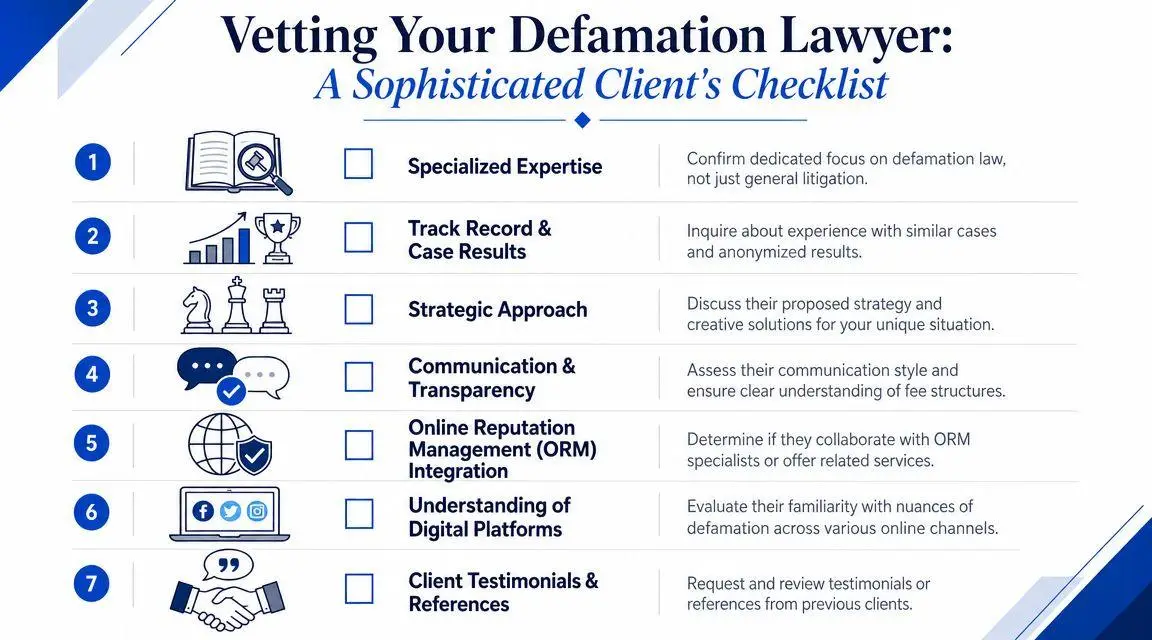
That distinction matters. You are not hiring someone to recite legal elements. You are hiring someone to decide whether to remove, pressure, trace, file, negotiate, or stay quiet. If a lawyer for defamation doesn’t understand online distribution, anonymous publishing, search indexing, and re-upload cycles, they may be technically competent and still strategically wrong for your problem.
What to ask in the first call
Start with this: “How do you handle the problem if the content keeps resurfacing after the original post is removed?”
If the answer is only about filing suit, keep looking.
Clients should ask potential counsel how they handle anonymous accounts, reposts, search engine indexing, and synthetic content, because traditional legal pages rarely address the workflow required to trace publication and prevent re-uploads, according to Cole Law Group’s discussion of modern defamation and privacy issues.
Ask direct questions:
- Anonymous publisher strategy. Can they explain how they would identify the poster if the account is fake or hidden?
- Platform fluency. Do they understand how content moderation, impersonation policies, and account-level enforcement work?
- Search-result thinking. If the page remains indexed or copied elsewhere, what’s the plan beyond the original host?
- AI and synthetic media competence. Can they deal with altered voice, image, or text-based fabrications?
- Discretion. Do they appreciate when litigation itself becomes the story?
A strong lawyer won’t promise a guaranteed outcome. They’ll explain decision paths and tradeoffs.
Red flags that should end the conversation
Some warning signs are obvious. Others are expensive.
| Red flag | Why it matters |
|---|---|
| They push a lawsuit before reviewing the exact publication | That usually means they’re selling process, not judgment |
| They don’t ask where the content lives | Platform and publisher identity shape the remedy |
| They can’t discuss non-litigation options | They may turn a manageable problem into a public dispute |
| They guarantee removal or victory | Serious counsel doesn’t talk that way |
| They ignore reuploads and screenshots | They don’t understand distribution risk |
Here’s a useful way to think about it. Traditional defamation counsel focuses on proving a wrong. Modern reputation counsel focuses on ending a threat.
This short video gives a useful baseline on the topic before you interview firms:
You may need a coordinated team, not a solo legal answer
Some matters require a lawyer, a digital investigator, and a removal specialist working in parallel. That isn’t overkill. It’s often the only rational response when a false allegation appears on multiple domains, social accounts, and search results at once.
A service like ContentRemoval.com can fit into that structure when the problem includes source removal, de-indexing, impersonation takedowns, or repeat re-uploads across platforms. That’s not a substitute for legal advice. It’s part of a broader execution layer when the problem is distribution, not just liability.
The right counsel doesn’t ask only, “Can we sue?” They ask, “What ends this fastest with the least collateral damage?”
What the Litigation Process Actually Involves
You file to stop a lie. Weeks later, the post is still ranking, reporters are calling, and your own emails are headed for review. That is the reality of defamation litigation. It can punish a wrongdoer and establish a strong position, but it is rarely the fastest way to contain reputational harm.
The work starts before anyone files a complaint. Counsel has to pin down the exact statements, preserve the publication record, identify every viable defendant, and test the obvious defenses before the other side raises them first. Then comes drafting. A weak or vague complaint invites an early motion to dismiss and hands the defendant momentum.
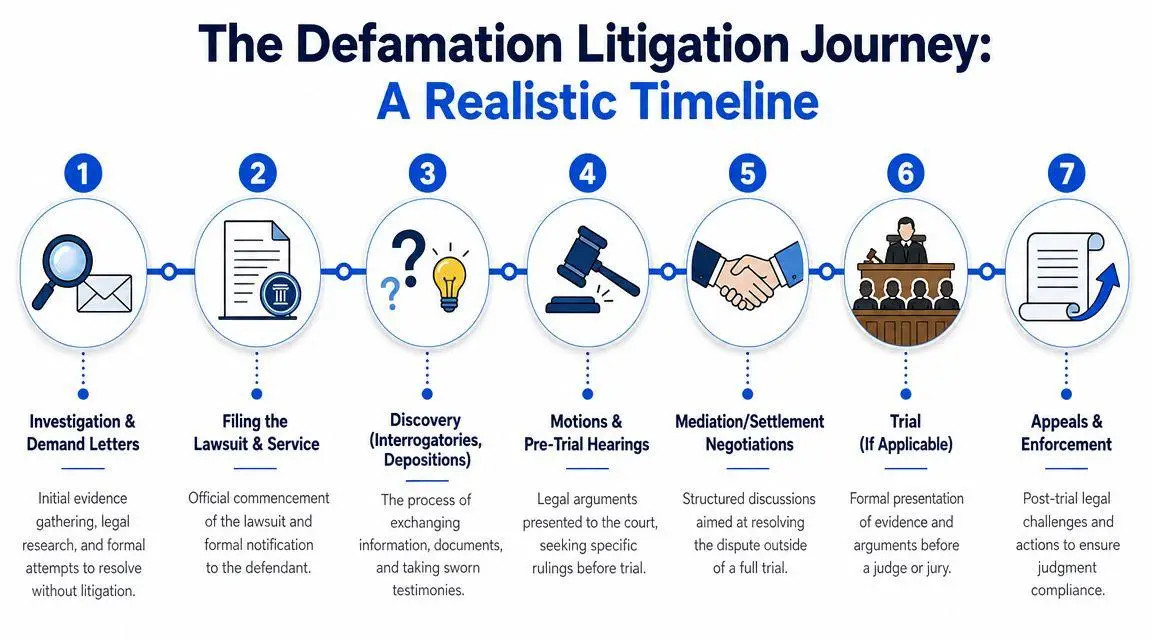
What the phases feel like in practice
The formal steps look clean on paper. Living through them is different.
- Investigation and pleading. Your legal team builds the record, identifies who published what, and pleads the claim tightly enough to survive early attack.
- Service and response. The defendant appears and often goes on offense at once, challenging the complaint, jurisdiction, or both.
- Discovery. Private communications, business records, and sworn testimony enter play.
- Motions practice. Judges may decide key issues well before trial, including whether the case narrows or ends.
- Settlement efforts. Serious cases often resolve here, once each side sees the evidentiary risk.
- Trial and appeal. These stages are expensive, public, and slow.
Discovery is the phase clients underestimate most. If you are an executive, founder, or public figure, expect demands for communications about the accusation, internal discussions of reputational impact, lost business opportunities, and steps you took after publication. Your records do not sit on the sidelines. They become evidence.
The remedy may not match your expectation
A court can award damages. It can create pressure for a retraction or negotiated removal. It can also leave the practical problem partly intact if copies, commentary, screenshots, and search-result traces keep circulating.
That is why I treat litigation as one track, not the whole plan. If the false statement is hurting you now, you need a parallel response aimed at distribution control. That can include platform reporting, publisher outreach, negotiated corrections, search suppression, and broader digital reputation strategies while the case proceeds.
Court delivers legal remedy. It does not control how fast harmful content spreads online.
Timing still matters, and any competent lawyer will address filing deadlines early, as noted earlier. But the smarter question is not only whether you can sue. It is whether a lawsuit solves the problem you have.
When litigation makes strategic sense
File suit when the case gives you a real path to relief, not just a chance to express outrage.
Litigation makes sense when these conditions line up:
- The statement is specific and false. Vague insults and loose opinions are poor vehicles for a serious claim.
- The speaker can be identified. Anonymous or judgment-proof defendants often make bad targets unless you need subpoena power to trace the source.
- The harm can be shown. Lost deals, canceled appearances, investor concern, and documented business disruption change the economics of the case.
- The publication is ongoing. Repetition, republication, or coordinated amplification strengthens the need for formal action.
- You need discovery. Sometimes only subpoenas and court supervision will expose the source network or preserve evidence.
If those factors are missing, filing can make the situation worse. A public complaint may give the allegation a longer life, create a searchable court record, and push the other side to repeat the accusation more aggressively.
Use litigation with discipline. The goal is not to look aggressive. The goal is to stop the damage fast, preserve optionality, and avoid turning a reputational attack into a longer public spectacle.
Beyond the Verdict A Long-Term Reputation Shield
A successful lawsuit is an event. Reputation protection is a system.
That’s the piece most legal articles miss. Even if counsel obtains a strong result, the underlying problem may survive in screenshots, reposts, commentary, cached links, and low-quality sites that feed on controversy. For high-profile individuals, a blended approach that addresses source removal, search visibility, and re-upload prevention is often more effective than a defamation complaint alone, as noted in Ben Crump’s discussion of whether a defamation lawyer is always the right first move.
The practical answer is ongoing monitoring and controlled reinforcement of accurate, favorable information. That means watching for new copies, flagging impersonation quickly, tightening your public-facing assets, and building enough credible digital real estate that an attack has less room to dominate. Broader digital reputation strategies can help frame that long game, especially if your issue touches both personal and corporate visibility.
You don’t need a lawsuit every time someone lies about you online. You need a plan that matches the threat, the platform, and the speed at which damage is spreading. Sometimes that plan starts with a lawyer for defamation. Sometimes it starts somewhere else. Astute clients know the difference.
If you need a confidential assessment, ContentRemoval.com can help evaluate whether your situation calls for legal escalation, platform-based removal, search de-indexing, or a combined response built for speed and discretion.
Frequently asked questions
Do I need a lawyer to get defamatory content removed?
Not always. Fake profiles, impersonation, stolen media and clear platform-rule violations are often removed faster through the platform than through a courtroom. Counsel becomes necessary when the publisher is persistent, anonymous or targeting business relationships, or when subpoena power is needed to trace the source.
What questions should I ask a defamation lawyer before hiring them?
Ask how they handle content that resurfaces after the original post is removed, how they would identify an anonymous poster, whether they understand platform moderation and impersonation policies, what the plan is if the page stays indexed or copied elsewhere, and whether they can deal with altered voice, image or text. A lawyer who pushes a lawsuit before reviewing the publication is a red flag.
When does suing for defamation make the situation worse?
When the statement is vague opinion rather than a specific false fact, the speaker is anonymous or judgment-proof, harm cannot be shown, or the publication has stopped. A public complaint can give the allegation a longer life, create a searchable court record and prompt the other side to repeat the accusation more aggressively.